“Mopy, Dopey, and about twelve other melancholy dwarves “

LANE: I love you, but you’ve been Mopey, Dopey, and about twelve other melancholy dwarves for the past five weeks, and I miss the old Rory.

Lane is referring to Snow White and the Seven Dwarfs, a 1937 animated musical film made by Walt Disney, and based on the German fairy tale told by the Brothers Grimm. It was the first full-length animated feature film, and the earliest feature film made by Walt Disney.

There is a dwarf named Dopey in the film, but the other dwarfs are named Grumpy, Sleepy, Happy, Bashful, Sneezy, and Doc.

Snow White and the Seven Dwarfs was the #1 film of 1937, and audiences loved it so much that many gave the film a standing ovation, while critics hailed it as a piece of art. It received an Honorary Academy Award as a “significant screen innovation”, with Disney receiving one normal-sized Oscar statuette and seven small ones. The film gave Disney the green light to produce further animated features, and inspired MGM to produce its own fantasy movie, The Wizard of Oz.

Snow White was re-released in cinemas in 1993, when Lane and Rory were nine, and came out on video the following year; either year may have been when they first saw it.

It is actually almost six weeks since Rory and Dean broke up, but at five weeks and six days, this is one of the more accurate pieces of timing given in the first season of Gilmore Girls.
“Full Matrix”

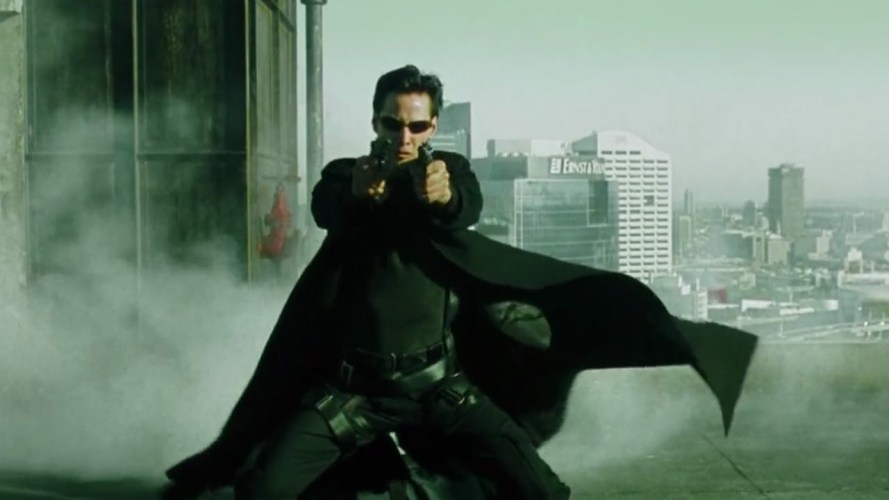
LANE: And then she [Janie Fertman] goes, “You’re cheerleader material.” Cheerleader material! Just like that. I couldn’t believe it! I almost went full Matrix on her.

The Matrix is a 1999 science-fiction action film, written and directed by The Wachowskis and starring Keanu Reeves in the lead role.

Set in a dystopian future, it shows that what most humans accept as reality is actually a simulation known as “the Matrix”, created by sentient machines. Some of the freed humans mount a rebellion against the machines, and the film is notable for its highly choreographed fight scenes, influenced by martial arts movies – this is probably what Lane means by “going full Matrix” on Janie.

The Matrix was the #4 film of 1999, received critical acclaim, and won four Academy Awards in technical categories. It is widely regarded as one of the best science-fiction films of all time.

In a later season, Lane takes up Janie’s offer, and does become a cheerleader. In this episode, the lady is probably protesting a little too much about it.

Stretch Cunningham and Dick Tracy

LORELAI: Hey, who was the guy who used to run the auto body shop?
(We pan up to see Luke lying on the roof with a hammer.)
LUKE: The Stretch Cunningham guy?
LORELAI: No, the Dick Tracy guy.

Jerome “Stretch” Cunningham was a recurring character on the 1970s sitcom All in the Family, played by James Cromwell. Stretch was a friend and co-worker of main character Archie Bunker. (Both Sally Struthers, who played Babette, and Liz Torres, who played Miss Patty, were also in All in the Family; possibly why it was referenced several times on Gilmore Girls).

Dick Tracy is a fictional police detective who first appeared in the Dick Tracy comic strips created by Chester Gould in 1931. The Dick Tracy stories have been adapted into radio serials, comic books, novels, and films – most recently in 1990, with Warren Beatty in the title role.

There is a real mystery as to what the barely-remembered auto mechanic actually looked like. Lorelai first says he is tall and skinny, then corrects herself to say he was short and fat, and that the tall, skinny guy was actually his employee. Then she decides that he looked like Dick Tracy, who isn’t short and fat. Did the auto mechanic (who we learn was named Jim Dunning) look like a short, stocky version of Dick Tracy?

Margot Kidder

RORY: I was sleeping through it [Luke working on their house]!
LORELAI: It had to have woken you up.
RORY: No, my insane mother Margot Kidder Gilmore woke me up.

Margot Kidder (born 1948) is a Canadian-born American actress who has had roles in a number of horror and science-fiction films and television series, including The Amityville Horror, previously discussed.

Kidder was diagnosed with bipolar disorder. After an extremely stressful event where she lost three years work due to a computer virus, she had a widely publicised manic episode in 1996, in which she disappeared for four days, was found in a distressed state in someone’s backyard, and placed in psychiatric care. Her career slowed down after this episode, but during the 2000s it picked up again, and no other manic episodes have ever been reported.

UPDATE: Margot Kidder passed away on May 13 2018.

The Amityville Horror

MAX: She’s safe.
LORELAI: She’s with my mother. No one is safe with my mother.
MAX: She needed some space.
LORELAI: No, that house is not safe. It’s like The Amityville Horror without all the good times.

The Amityville Horror is a 1979 horror film directed by Stuart Rosenberg, and based on the sensational book of the same name by Jay Anson. The book purported to be a true story about a demon-possessed house in Amityville on Long Island, New York, but investigation proved that the book was a hoax cooked up to make money (at which it succeeded spectacularly).

The Amityville Horror was a massive box office success, and the #2 film of 1979; it is one of the highest-grossing independent films of all time. Despite getting mostly negative reviews, it has had a number of sequels and remakes, and is regarded as a horror classic.

“Turban and a little booth”

RICHARD: The girl [Rory] obviously needs some peace.
EMILY: How do you know that?
RICHARD: I can tell.
EMILY: Oh, you’re a mind reader now, how nice. We’ll get you a turban and a little booth by the train station.

Emily may be referring to coin-operated fortune telling machines, which display an animatronic figure in a glass booth which dispenses fortunes, either on a little card, or in a recorded voice. Her description of a turbaned figure sounds rather like the Zoltar fortune teller which appears in the 1988 film Big, starring Tom Hanks. Although created for the film (and based on the real-life Zoltan fortune telling machines), since then there have been Zoltar machines made to resemble the one in the movie.

Fortune teller machines are usually in amusement arcades or at fairgrounds, but in times past there were sometimes machines designed to tell your fortune at railway stations (often combined with weighing you at the same time). No doubt the idea was that people hanging around waiting for trains had time to kill, and spare change. These kind of fortune teller machines are still widely available at train stations throughout Asia.

Seven Brides for Seven Brothers

LUKE: I’m not trying anything on.
LORELAI: Hey, its not like the lumberjack look will ever go out; it won’t. But just once, wouldn’t it be nice not to be dressed like an extra from Seven Brides for Seven Brothers?

Seven Brides for Seven Brothers is a 1954 musical film, directed by Stanley Donen with music by Saul Chaplin and Gene De Paul, lyrics by Johnny Mercer, and choreography by Michael Kidd. The screenplay is inspired by the short story The Sobbin’ Women by Stephen Vincent Benét, a parody of the Rape of the Sabine Women from Roman mythology.

The film is set in the backwoods of Oregon in the 1850s, and is about seven brothers who are tough mountain men, seeking a bride for each of them in spite of a whole town’s opposition. After reading the story by Benét, the brothers kidnap six women (one brother already has a wife) to marry them, and hi-jinks ensue: luckily the women aren’t averse to the kidnapping. Notably, the film is about how these rough men must change their attitudes and appearance in order to attract women and make them happy, just as Lorelai is trying to change Luke’s image.

Seven Brides for Seven Brothers was a commercial success, and did especially well in the UK. It won the Academy Award for Best Music, and is regarded as one of the best musical films, although still more popular with British audiences.

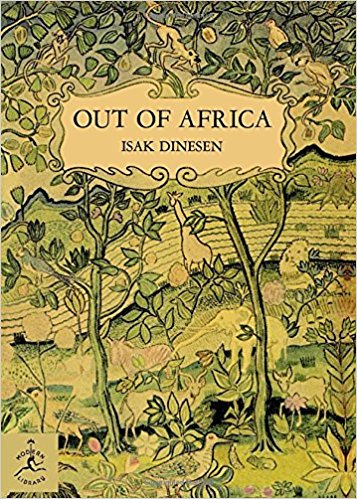
Out of Africa

LORELAI: Okay, last week we were talking about Meryl Streep and the whole accent thing, and Rachel said that she loved Out of Africa, but she’d never read the book, remember?
LUKE: Nope.
LORELAI: Okay, so I was like, “Are you crazy? Isak Dinesen is amazing, I love her.” Which is kind of crap because I’d never read the book either, but Rory told me it was amazing, so I felt pretty confident in my recommendation of Out of Africa.

Out of Africa is a 1937 memoir by Isak Dinesen, the pen name of Danish author Karen Blixen. It describes the seventeen years that Blixen spent in Kenya, then called British East Africa. It is a meditation on her life on her coffee plantation, and some of the people she encountered there.

The book is non-chronological in structure, and is notable for its melancholic, poetic style that is above all a tribute to the Africa she knew, and a world that had changed irretrievably. That she helped change it did not seem to make a strong impression on her, although her notes on the African people are understanding and accepting, and they admired her as wise and trustworthy.

It seems appropriate that Rory would enjoy Out of Africa. We know that she admires women writers, books on travel, memoir and autobiography, and works with a certain lyrical sadness to them – she likes things that make her feel “gloomy”.

Out of Africa was adapted into film in 1985, directed by Sydney Pollack, and starring Meryl Streep and Robert Redford in the lead roles. The film has several differences from the book, and focuses on Karen Blixen’s love affair with a hunter named Denys Finch Hatton (an Englishman, although Robert Redford plays him with an American accent). Meryl Streep spent a lot of time listening to tapes of Karen Blixen speaking, and chose an old-fashioned, aristocratic accent for her character, which Sydney Pollack thought excessive; Streep is well known for her mastery of different accents.

Out of Africa was the #5 film of 1985 and won seven Academy Awards, including Best Picture, and Best Director. Despite this, it received mixed reviews from critics.

The fact that Luke can’t remember a word of a conversation with Rachel doesn’t seem very promising for their relationship. As Out of Africa is in part about a doomed love affair, it is possible that Rachel may read something into the gift that Luke has “chosen” for her.

Patton

DEAN: So that’s your mom?
LANE: That’s my mom.
DEAN: Has she seen Patton?

Patton is a 1970 biographical film about US General George S. Patton during World War II; it was directed by Franklin J. Schaffner, and starred George C. Scott in the title role. The film shows one of General Patton’s first tasks as head of operations in North Africa was to enforce discipline among the American troops, so Dean is suggesting that Mrs. Kim may have modelled herself on the strict general.

Patton was the #4 film of 1970, and received enthusiastic acclaim from critics; it was also Richard Nixon’s favourite film. The film won seven Academy Awards, including Best Picture and Best Director: George C. Scott won Best Actor, but famously declined the honour, the first person to turn down an Oscar.

Saving Private Ryan

LORELAI: It [talking to Emily] would be like the first fifteen minutes of Saving Private Ryan but at least those guys got to be in France.

Saving Private Ryan is a 1998 war film directed by Steven Spielberg. Tom Hanks stars as the movie’s hero, while Matt Damon is in the title role. It is notable for its early scenes of the Normandy landing on Omaha Beach on D-Day, which were critically acclaimed for their violently realistic portrayal of World War II battles. In fact, they were so realistic that they triggered PTSD in some returned veterans, and a helpline had to be set up to counsel them.

Saving Private Ryan was the #2 film of 1998, and the top-grossing US film of the year world wide. Receiving widespread critical acclaim, it won five Academy Awards, including a Best Director for Spielberg. It is regarded as one of the best war films of all time, and helped bring about a resurgence of interest in World War II.