JESS: Yeah, or we can wear Three Stooges masks all the time, that way no one will know who we are.
RORY: I can be Curly.
JESS: I’ll be Moe.
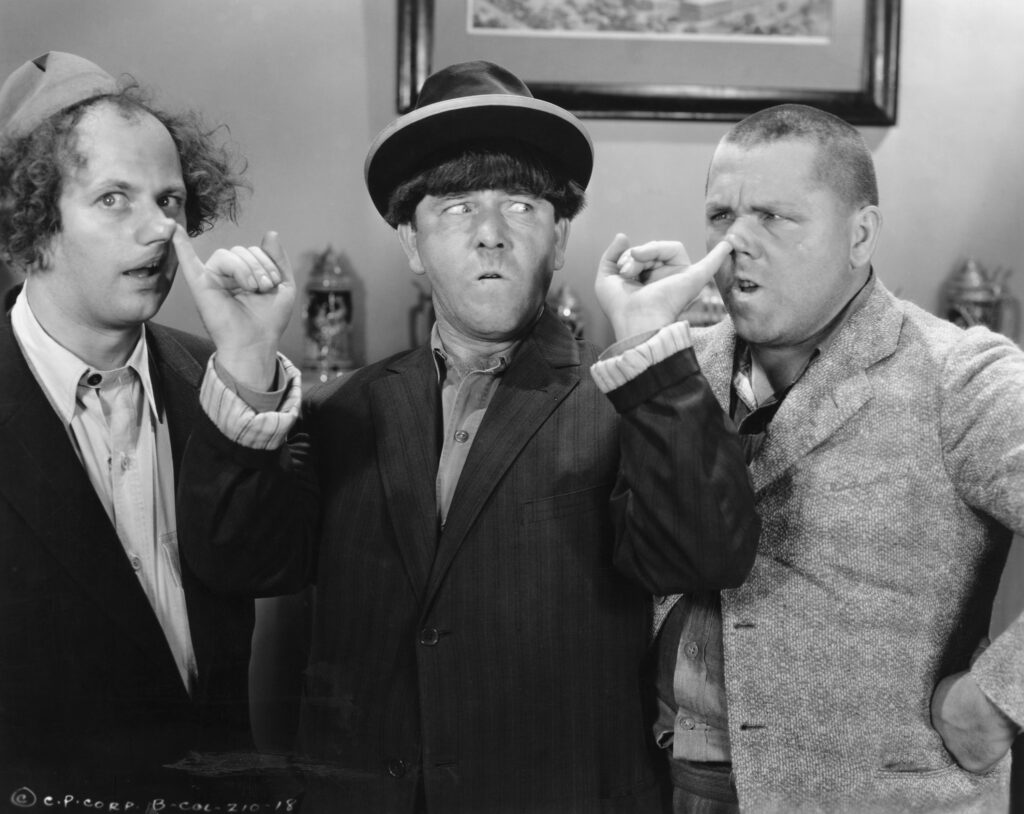
The Three Stooges was an American vaudeville comedy team active from 1922 until 1970, best remembered for their 190 short films. Their hallmark styles were physical farce and slapstick. Although six actors played the Three Stooges, the classic line up was Moe Howard (played by Moses Horwitz), Larry Fine (played by Louis Feinberg), and Curly Howard (played by Jerome Horwitz). Their peak popularity was from 1934 to 1946, but television syndication made them one of the most popular comedy acts of the early 1960s.
Rory was proud to be seen with Dean, and kiss him in public. Now her relationship with Jess begins with her hiding their relationship away as if it is something shameful. It doesn’t feel as if the relationship is getting off to a very healthy start.
RORY: He actually likes it when we come for Thanksgiving. All these years and we never knew.
LORELAI: Hm, he’s the Grinch and we’re Cindy Lou Who.
Another reference to the 2000 Christmas filmHow the Grinch Stole Christmas. Cindy Lou Who (played by Taylor Momsen) is a little girl from the Christmas-loving town of Whoville while the Grinch is a grumpy Christmas-hater who learns to love the holiday with the help of Cindy Lou (showing that he was really good-hearted all along).
PARIS: My Thanksgiving is turning into a Wes Craven movie.
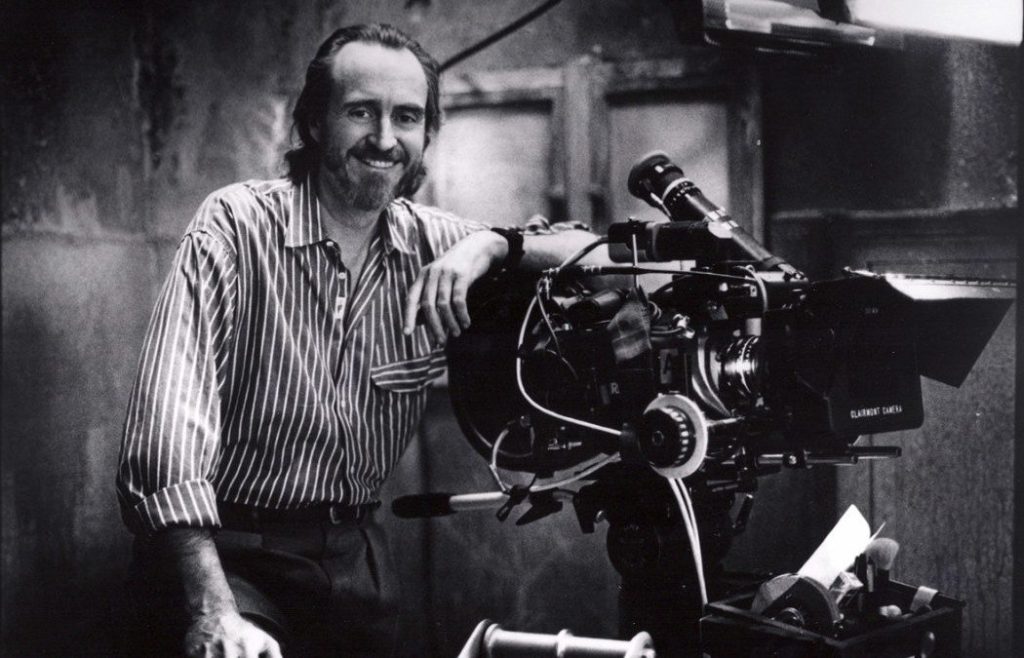
Wesley “Wes” Craven (1939-2015) film director, screenwriter, producer, actor, and editor. Craven is recognised as a master of the horror genre due to the influence of his work. He is best known for his pioneering work in the genre, particularly slasher films, where he mixed horror cliches with humour and satire.
He was the the creator of the A Nightmare on Elm Street franchise (1984–2010), and the director of the first four films in the Scream franchise (1996–2011). He directed cult classics such as The LastHouse on the Left (1972) and The Hills Have Eyes (1977), the horror comedy The People Under theStairs (1991), and psychological thriller Red Eye (2005).
Craven received a Scream Award, a Sitges Film Festival Award, and a Fangoria Chainsaw Award. In 1995, he was honoured by the Academy of Science Fiction, Fantasy and Horror Films with the Life Career Award. In 2012, the New York City Horror Film Festival awarded Craven the Lifetime Achievement Award.
LOUISE: Plus, the Golgi body. I mean, is it me or is that majorly pornographic?
PARIS: My life with the Banger sisters.
The Banger Sisters, a 2002 comedy film directed by Bob Dolman , starring Goldie Hawn and Susan Sarandon as two middle-aged women who used to be friends and groupies when they were young. During the film, they have one night together of remembering their youthful hijinks. The film was commercially successful and received average reviews. The performance of the two leads was praised, but the plot was judged to be thin and predictable. The film came out in September.
Paris seems to be already imagining Madeline and Louise in their middle age. Compare with Paris calling Madeline and Louise the Pigeon Sisters.
PARIS: Oh. Well, by all means, Madeline, you should point out to the faculty that their annoying custom of teaching is distracting you from more important things like nail filing and daydreaming about marrying Ryan Phillippe.
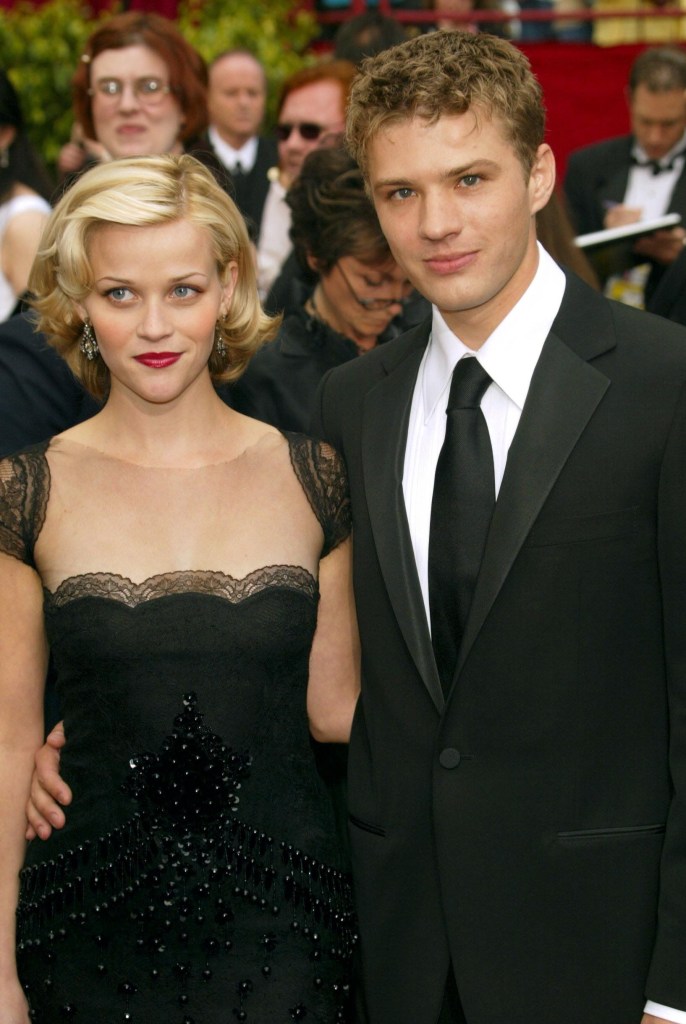
Matthew Ryan Phillippe (1974), actor. After appearing in the soap opera One Life to Live, he came to fame in the late 1990s with starring roles in films including I Know What You Did LastSummer, Cruel Intentions, and 54. In the 2000s, he appeared in several films, including Gosford Park (2001), Crash (2004), and Flags of Our Fathers (2006). In 2002, his latest film was Igby Goes Down, which came out in September.
Madeline points out that Ryan Phillipe is already married – he married actress Reese Witherspoon in 1999 [pictured together]. They separated in 2006 and divorced in 2008.
LORELAI: I can’t believe [the Beales] were related to Jackie.
RORY: Well, the Kennedys kind of hid them in the background for many years.
LORELAI: Well, when you’re a Kennedy, how do you even choose who in the family to hide?
I’m not sure that there’s much evidence that the Kennedy family “hid” Jackie’s relatives away. Jackie and her sister Lee Radziwill certainly didn’t seem to pay them much attention until they began to be featured in the tabloid press as eccentric upper-class hoarders.
However, it’s said Jackie and Lee paid for Grey Gardens to be cleaned up to some extent – the house in the documentary is actually much less of a hovel than it had been previously. And it was Jackie and Lee who approached the filmmakers about the documentary, hoping it could be a way for the Beales to make some money, so they actually helped give them publicity, rather than hid them away.
Lorelai’s snarky comment reflects the number of scandals the Kennedy family have had over the years. She may be specifically thinking of Rose Marie “Rosemary” Kennedy (1918-2005) [pictured], the sister of President John F. Kennedy. Due to a difficult birth, she was developmentally delayed, although it is unknown to what extent, as the Kennedy family kept her life private.
When Rosemary was in the early twenties, she became increasingly irritable, and went into convulsions, as well as attacks of rage in which she would hit other people. At the age of 23, her father, Joseph Kennedy, agreed to her being lobotomised to help control her violent mood swings – he did not tell his wife until the procedure had taken place.
The lobotomy had a devastating effect on Rosemary, whose mental capacity became that of a two year old. She couldn’t walk or speak intelligibly, and was incontinent. She was immediately institutionalised, and separated from her family for over 20 years – her siblings did not know where she was, and the press was told she was “reclusive”. After her father’s death in 1969, she gradually became part of the family again. By that time, she had learned to walk, although with a limp.
Some say that Rosemary was one of the inspirations for Eunice Kennedy Shriver to later found the Special Olympics, although Eunice said that the Games were never about one individual.
[Lorelai and Rory are on the couch watching television]
RORY: I like these women.
LORELAI: I love these women.
During the cold open, Lorelai and Rory watch Grey Gardens, a 1975 documentary by Albert and David Maysles. The film depicts the everyday lives of two reclusive, upper-class women, a mother and daughter both named Edith Beale, who lived in poverty at Grey Gardens, a derelict mansion in the wealthy Georgica Pond neighbourhood of East Hampton, New York.
Edith Ewing Bouvier Beale (1895–1977), known as “Big Edie”, and her daughter Edith Bouvier Beale (1917–2002), known as “Little Edie”, were the aunt and the first cousin, respectively, of former US First Lady Jacqueline Kennedy Onassis. The two women lived together at the Grey Gardens estate for more than fifty years with limited funds in increasing squalor and isolation.
Throughout the fall of 1971 and into 1972, their living conditions—their house was infested by fleas, inhabited by numerous cats and raccoons, deprived of running water, and filled with garbage and decay—were exposed as the result of an article in the National Enquirer and a cover story in New York Magazine after a series of inspections by the Health Department.
With the Beale women facing eviction and the razing of their house, in the summer of 1972 Jacqueline Onassis and her sister Lee Radziwill provided the necessary funds to stabilize and repair the dilapidated house so that it would meet village codes.
Albert and David Maysles became interested in their story and received permission to film a documentary about the women, which was released in 1976 to wide critical acclaim. Their direct cinema technique left the women to tell their own stories.
The film was controversial from the start, with some feeling that the Beales were being exploited, and that because they were paid for taking part, the documentary was ethically compromised.
“Big Edie” died in 1977 and “Little Edie” sold the house in 1979, dying in Florida in 2002. The fashion designer Liz Lange now owns the house, which has been extensively remodelled and landscaped.
Lorelai and Rory both enjoy eccentric biographies, and stories about mother-daughter relationships, so this film is a natural fit for them. It’s clear they can see a little of themselves in “Big Edie” and “Little Edie” – like the Beales, the Gilmores share the same name. Other similarities are that their home is similarly described as needing work (“The Crapshack”), and they live a life of of genteel squalor, doing exactly as they please. Most importantly, like the Beales, the Gilmore girls are intensely codependent.
It’s hard not to think that Gilmore Girls was influenced to some extent by Grey Gardens – their names even have the same initials!
LORELAI: Don’t study so much that you get brilliant, go mad, grow a big bald egghead and try to take over the world, okay, ’cause I wanna go shoe shopping this weekend.
Lorelai sounds as if she is referring to the fictional character Ernst Stavro Blofeld from the James Bond novels and films, created by British author Ian Fleming. He is a criminal mastermind and the chief antagonist of the series, instantly recognisable from his bald head. He has been played by several actors, but his portrayal by Donald Pleasance is often thought of as “the classic Blofeld”.
Ernest Blofeld gained degrees political history and economics, and also engineering and radionics, but used his formidable intellect for nefarious purposes. He becomes completely insane by the end of the book series, and is obsessed with gaining world domination.
Ernst Blofeld has been often parodied in film and television, including the character of Dr Evil in the Austin Powers movies.
[The four of them are walking through the administration building]
RORY: Wow.
LORELAI: Lions and tigers and bears . . .
RORY: Oh my.
Lorelai and Rory are referencing the film, The Wizard of Oz, previously discussed, and a touchstone for the show.
In the film, Dorothy is walking through a dark forest with the Tin Man and the Scarecrow, and they become frightened by noises in the foliage. The Scarecrow wonders if there might be animals in the forest, and the Tin Man suggests there are lions and tigers and bears, which the others nervously repeat.
Dorothy gasps, “Lions and tigers and bears! Oh, my”. Pretty soon the three of them are skipping through the forest chanting, “Lions and tigers and bears, oh my”.
In fact, the very next creature they meet is a lion – the Cowardly Lion, who soon becomes their companion on the quest to see the Wizard of Oz.
Lorelai is suggesting that the administration building is intimidating, like the dark, scary forest, and that they need to keep their spirits up, like Dorothy did in the film. Like Dorothy, Rory will soon be confronted by a “scary” unexpected interview, although like the Lion, it won’t really hurt her.
EMILY: Richard Gilmore, you are going to give these girls the wrong impression.
RORY: What impression is that, Grandma?
LORELAI: That you were the Helena Bonham Carter of the society set?
Helena Bonham Carter (born 1966), English actress. She rose to fame in 1985 film A Room With a View, and became a favourite choice for playing a virginal “English rose” in period dramas – something she was uncomfortable with. Bonham Carter gained worldwide recognition in the 2000s, and has had many major roles, including awards for biographical film and TV The King’s Speech, Enid, and The Crown.
Lorelai is referring to the fact that in 1994, Helena Bonham Carter began an affair with fellow actor Kenneth Branagh while they were filming Mary Shelley’s Frankenstein, even though Branagh was married to actress Emma Thompson at the time (they married in 1989).
Branagh and Thompson divorced in 1995, and Bonham Carter and Branagh broke up in 1999. They have all made peace with one another now, and the three of them had major roles in the Harry Potter film series. Helena Bonham Carter married director Tim Burton in 2001, the year before this episode aired. They divorced in 2014.
Amy Sherman-Palladino seems to have modelled her image very heavily on Helena Bonham Carter, who is known for her eccentric fashion and dark aesthetic, and for playing quirky female roles. I’d imagine she would be one of Sherman-Palladino’s favourite actresses, as well as her style icon.




 The Annotated Gilmore Girls