Rory and Emily

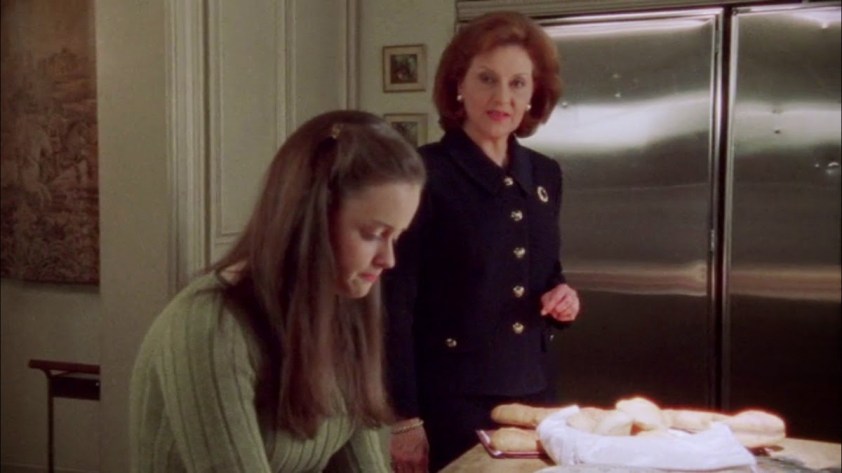
While Lorelai is talking with her father, Emily at first tries to defend Straub as a good man, highly intelligent, who was one of the top lawyers in an obscure field of international law, and a great contributor to the community through his charity work. She then drops the charade, and says he’s always been a big ass. Most importantly, she lets Rory know that never, for even one second, has Rory herself ever been a disappointment to them. It’s something Rory needs to hear.

Emily then gives Rory some cold leftovers, which look like a roast potato and a couple of asparagus spears; it doesn’t seem like an adequate meal. What about the leftover roast meat? At least make her a sandwich, Emily!

Paraguay

CHRISTOPHER: What kind of international cuisine [is served at Al’s Pancake World]?
RORY: He kind of hops around. Last month it was his salute to Paraguay.

Paraguay is a land-locked country in central South America, bordered by Argentina, Brazil, and Bolivia. Its traditional cuisine tends to be simple, hearty, and based on meat and cornmeal.

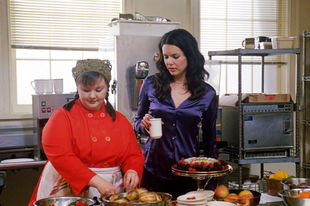
Some of the traditional dishes Al might have served during his salute to Paraguay: milanesa, (fried crumbed meat cutlets), chipa guazu (a savoury cake made from cornmeal, eggs, onions, and cheese), parillada (a meat dish cooked over banana leaves and hot coals), or vori vori (a thick yellow soup filled with little dumplings made from cornmeal) [pictured].

Al’s Pancake World

Rory explains to her dad that the never-seen but often-referenced local restaurant Al’s Pancake World doesn’t actually serve pancakes any more, although it once did. A few years previously AlĀ  switched to international cuisine, but as he had just had new napkins printed out he had to keep the name. Presumably when the napkins run out he will change the name, but he must have a lot of napkins as that never happened. The name of the business suggests it was always international cuisine, just with a pancake theme that was abandoned for some no doubt quirky reason.

Al keeping the name of the restaurant is not dissimilar to the situation with Arnold’s Restaurant in the sitcom Happy Days. Mitsumo Takahashi (Pat Morita), the restaurant’s owner, explains that he goes by the name “Arnold” because he bought the business as Arnold’s Restaurant, and it was too expensive to buy enough sign letters to rename it “Takahashi’s”. Patrons assumed the restaurant was named after him instead of the other way around.

Biscotti

When Sookie offers Lorelai a treat and instructs her to dunk it in her coffee, she gives her a biscotto, without identifying it.

Biscotti are Italian almond biscuits (cookies) that are twice-baked, and very crisp and crunchy. Although biscotti’s origins go back to ancient Rome, they were revived in the Tuscan city of Prato in the 19th century, now seen as the home of modern biscotti. In Italy they are usually dunked in a dessert wine at the end of a meal, but outside Italy dunking them in coffee or tea is more usual.

Pop-Tarts

SOOKIE: You – get in here and tell me the happenings at home.
LORELAI: I’m assuming you mean “did we get our toaster fixed” and no, it’s been cold Pop-Tarts for a week, it’s like a damn Dickens novel.

Pop-Tarts are convenience food pastries, introduced by the Kellogg Company in 1964. Pop-Tarts are thin, retangular pieces of pastry sealed with a sugary, flavoured filling, often with frosting (icing) on the outside.

They are already cooked, so you can eat them cold, as Lorelai and Rory have been doing, without ill-effect, but are designed to be warmed in a toaster or a microwave. Why the Gilmores haven’t been heating theirs in the microwave is a mystery. Presumably they prefer to eat them cold rather than microwaved.

Pop-Tarts are Lorelai and Rory’s go-to breakfast when they eat at home, so of course they are a nutritional nightmare – high in calories (at least 200 per Pop-Tart), low in nutrients, and loaded with sugar. Just two Pop-Tarts (a standard serve) contain all of the recommended daily sugar allowance.

Lorelai and Rory are hardly unusual though: Pop-Tarts are Kellogg’s most popular brand in the United States, and sales have continued to rise every year for more than thirty years.

“I can’t eat like that and look like her”

MICHEL: But I can’t eat like that and look like her. [gestures to Lorelai eating a rich omelette]

Michel surely speaks for most of the audience at this point: it drives many fans up the wall that Lorelai lives on sugary, fatty food and still looks amazing – thanks to the magic of television. In reality, Lauren Graham has reportedly been on a diet to stay slim since she was eleven years old (so if you want to look like Lorelai, start dieting at the beginning of puberty).

Sure it’s fiction, but sometimes people ask how Lorelai could eat such an unhealthy diet and remain slender in real life. The average person definitely wouldn’t, but here are some ways it might be possible, in any combination of factors:

1.Ā Genes. Around 5% of the population are lucky enough to be genetically predisposed to remain slim no matter what they eat. Lorelai could be one of those fortunate few. These people tend to remain around the same size as adults as they did in high school, and Lorelai still wears clothes from when she was 17, so it seems possible.

2.Ā Coffee. Lorelai drinks massive amounts of very strong coffee every day, and coffee is known to speed up the metabolism and suppress the appetite, leading to overall weight loss. Furthermore, it is a diuretic, so that coffee drinkers can keep off the “water weight” that doesn’t actually weigh much, but gives a bloated, puffy appearance.

3.Ā She burns up all the excess calories. Although Lorelai rarely does any formal exercise, she walks a lot around Stars Hollow, and she is later said to have an extremely brisk natural walking pace. She is also a very busy, animated person who may be burning up excess calories through everyday physical movement without even thinking about it. This would also give her a reasonable level of very basic physical fitness – Lorelai seems to accomplish all her daily tasks with ease, and rarely seems tired.

4.Ā Binge eating. Lorelai may binge on huge quantities of unhealthy food once or twice a month, but in between eat very little. To outsiders, it would look as as if she was eating 5000+ calories a day, but it could average out to as little as 1200 calories a day, and some days she might eat only eat 400-800 calories. Her fridge often seems to be empty, suggesting there’s a lack of food constantly at hand to tempt her. Those snacks that Sookie makes her at the inn, such as muffins and omelettes, could be all she eats on some days thanks to her appetite-suppressing coffee.

5.Ā It’s all talk, no action. We constantly hear about Lorelai’s huge appetite, but we never actually see her eat anything much. She’ll sit down in front of a burger and fries, but be suddenly called away or storm off before she takes a bite. Or she and Rory will have a table filled with sugary snacks, then in the next scene the table will be cleared and the snacks are gone. Did they eat them all? Or just take a handful and put the rest away? Lorelai and Rory always have tons of leftovers from their junk food binges, suggesting they don’t really eat that much in one sitting. People with big appetites don’t usually have leftovers – they eat everything at once.

6.Ā She’s “skinny obese”. Even if Lorelai is eating far less calories than it looks like, there’s no denying her diet is generally unhealthy (luckily she gets more nutritious food at Friday Night Dinners and from Sookie). People who eat poorly but maintain a normal weight by whatever means can have what is called “skinny obesity” – they look perfectly fine, but their internal organs are surrounded by toxic fat. Michel does warn Lorelai that her diet could kill her, but she isn’t concerned. On the other hand, there’s no evidence that Lorelai’s poor diet is making her unwell: she’s energetic, vibrant, looks healthy, and never seems to have any illness more serious than a headache or allergies.

(See here for more on the purpose of junk food in the themes of Gilmore Girls).
Rory’s Dinner for Dean

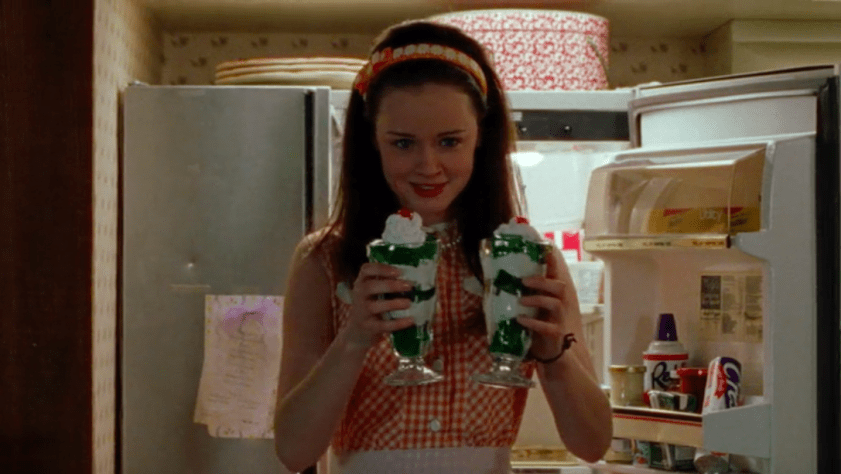
Appetisers (premade pastry shells filled with what looks like some sort of processed cheese-like product, such as Velveeta or Cheez Whiz)

Steak

Mashed potatoes (instant, made from a boxed mixture)

Green beans (from a can)

Dinner rolls (ready-made dough, just needs to be placed in oven)

Lime Jello-O (from a box) with Cool Whip imitation cream (from a can) – quick setting due to being made in individual glasses rather than a bowl

Rory’s dinner is clever because most of the ingredients are processed, with each of the food items being available during The Donna Reed Show era of 1958 to 1966. From a practical point of view, it means that Rory, who can’t cook, didn’t have to do a lot of actual food preparation – frying the steak was the only part that required any real kitchen skill, and is pretty basic.

On a deeper level, it is showing the artificiality of the era, and the “fakeness” of being a perfect 1950s/1960s housewife. Obviously any woman who, like Donna Stone, has to provide extraordinary amounts of food, as well as keeping the house spotless, doing the laundry, child-raising, volunteering, and looking immaculate at the same time has to rely on processed and convenience food to save time. It’s unlikely Dean picks up on this sly comment, however.

Unlike the dress, the ingredients for the dinner are easily explained – Babette told Rory there was tons of food in the house, and implied that she could help herself.

Paris

While suggesting that Richard and Emily go to Paris instead of Martha’s Vineyard, Lorelai and Rory mention some of the things associated with this city.

Impressionism: A 19th century art movement associated with small, thin brushstrokes; an emphasis on light and movement; unusual angles; and ordinary subject matters. The movement arose in Paris during the 1870s and 1880s with a number of independent art exhibitions. Famous impressionist artists include Claude Monet, Pierre-Auguste Renoir, and Camille Pissarro.

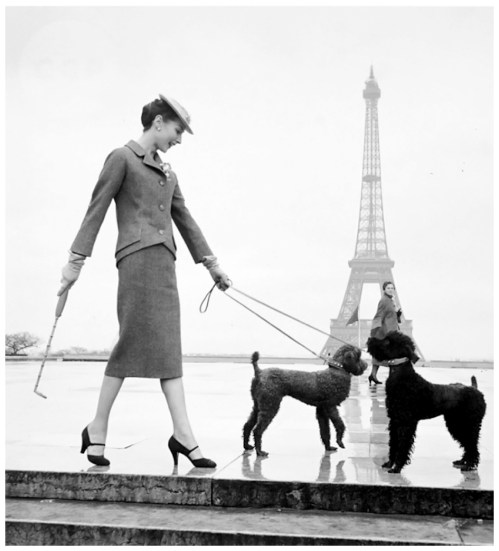
Poodles: A stereotypical image of Paris is an elegant middle-class woman taking her poodle for a walk. Although poodles were very fashionable in France some decades ago, they have fallen out of favour and are no longer chic. (The photo used was taken by American photographer Louise Dahl-Wolfe, and first published in 1940).

CrĆØme brĆ»lĆ©e: A rich, creamy custard dessert with a hard caramel topping. It originated in Spain, and was first given its French name (which means “burnt cream”) in the 17th century. It wasn’t common until the 1980s, and was popularised by Italian chef Sirio Maccioni at his New York restaurant Le Cirque. It isn’t particularly Parisian, although you can certainly eat it while in Paris.

It’s in keeping with their lack of travel experience that Lorelai’s and Rory’s visions of Paris are distinctly dated and second-hand.