MADELINE: So there’s only gonna be one seventy-fourth anniversary issue ever and we didn’t do anything special for it.
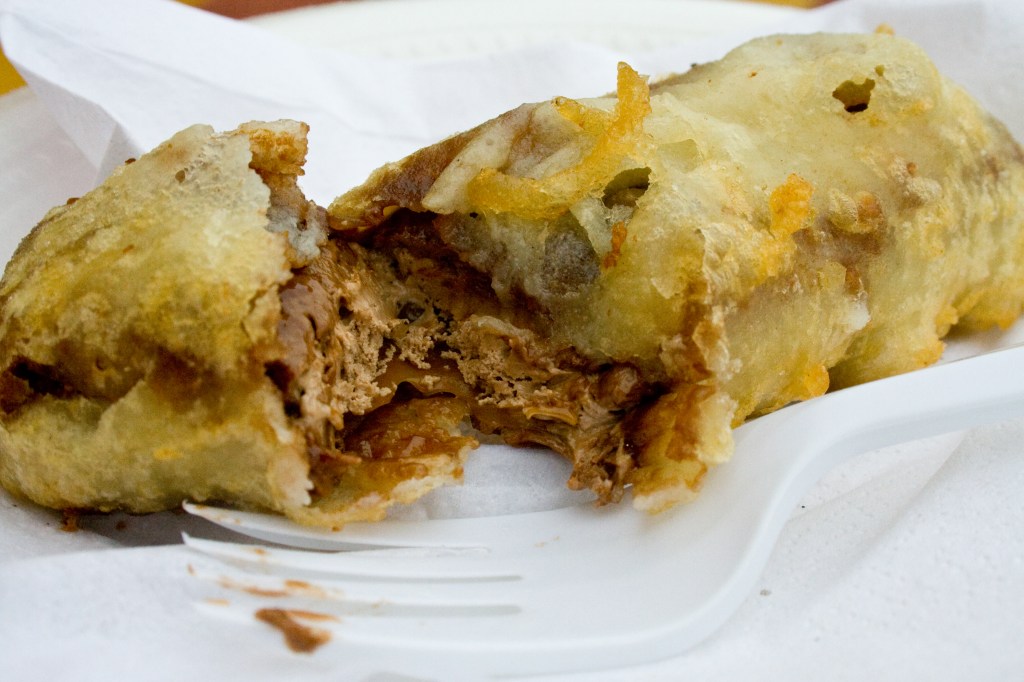
LOUISE: I think the cover was of a deep-fried Mars bar.
A deep-fried Mars Bar is one which has been battered then deep-fried in oil. The dish has been claimed as originating at a chip shop in Stonehaven, Scotland in 1992, although this has been disputed, with others saying it had been sold elsewhere in Scotland in the 1980s. It became a media sensation in the mid-1990s and through the early 2000s as a symbol of unhealthy eating.
The dish isn’t common in the US, and the American Mars Bar is not the same as the one sold in the UK. The Mars Bar sold everywhere else in the world is caramel and nougat coated with milk chocolate. The US version is nougat and almonds covered in milk chocolate. At some point which nobody seems able to identify, caramel got added in there, but the bar was discontinued in 2002. When it was brought back in 2016, it was the “original” recipe without caramel.
Presumably the Franklin was covering the deep-fried Mars Bar as part of the media interest in it.
EMILY: And if you’d like, later on, you can make my asparagus talk.
LORELAI: Well, maybe next week.
Asparagus (Asparagus officinalis), a plant cultivated as a green vegetable since ancient times, and was introduced to North America by the Dutch in the 17th century. It is native to maritime areas of Europe and western Asia, and will grow in soil too saline for anything else. The young shoots of the plant are usually prepared as an appetiser or side dish
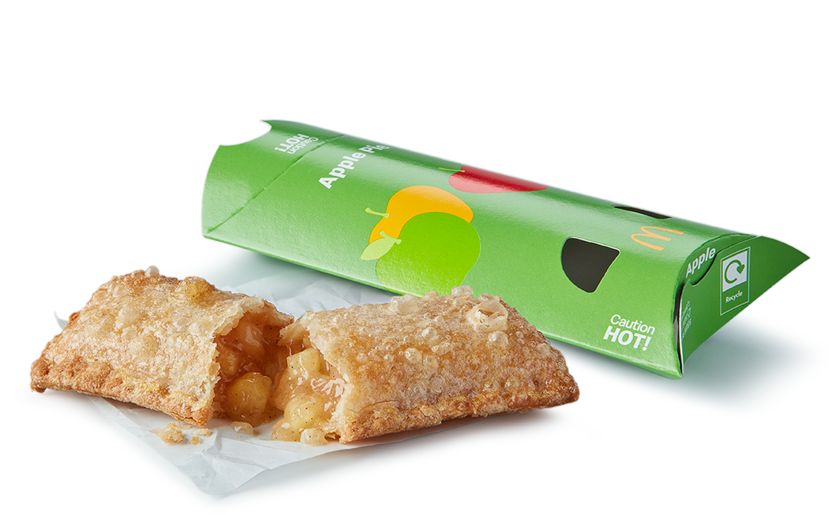
LORELAI: And out of nowhere, Kirk comes dancing by, waving a McDonald’s hot apple pie in the air and of course Ho-Ho lunges for the pie and drops my hand and that was it. Kirk wins, I’m out. I’m gonna get that Ho-Ho someday.
McDonald’s fast food restaurants, previously discussed. They have had hot apple pie on their dessert menu since 1968. Until 1992, the apple pies were deep fried, but are now baked.
Lorelai’s story reveals that Kirk is not above fighting dirty in order to win the dance marathon. He had great foresight to bring a McDonald’s apple pie with him to the marathon, and kept it hot (?) by some arcane means.
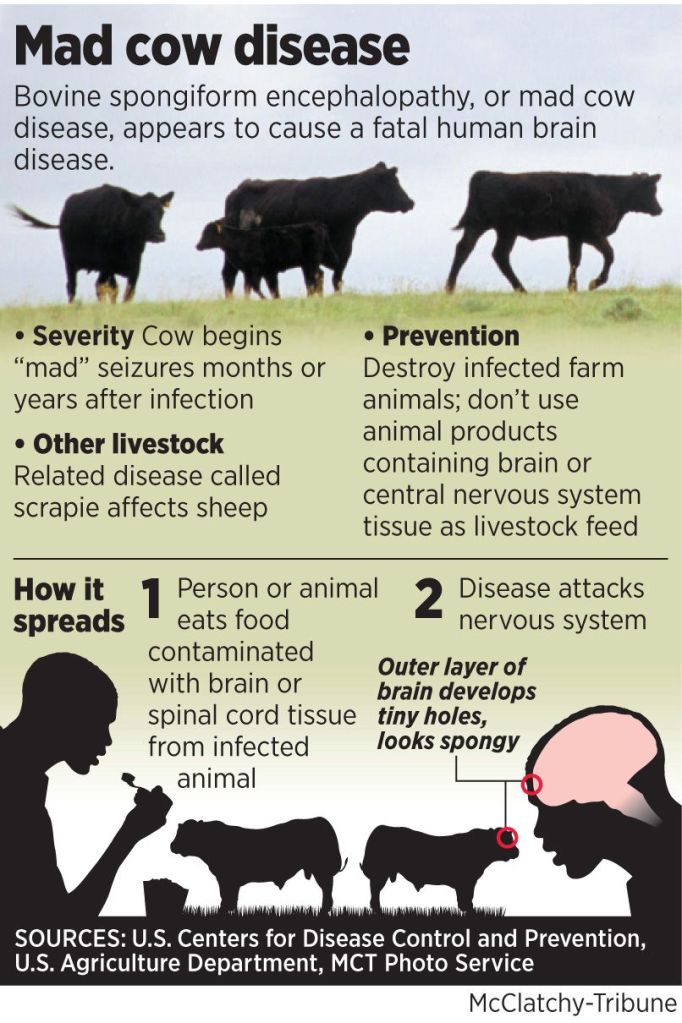
Bovine spongiform encephalopathy (BSE), commonly known as mad cow disease, is an incurable and inevitably fatal neurodegenerative disease of cattle. It can be spread to humans if they eat meat from infected cows.
In humans, infection can result in Creutzfeldt–Jakob disease (CJD), also known as subacute spongiform encephalopathy or neurocognitive disorder due to prion disease, an invariably fatal degenerative brain disorder. Early symptoms include memory problems, behavioral changes, poor coordination, and visual disturbances. Later symptoms include dementia, involuntary movements, blindness, weakness, and coma. About 70% of people die within a year of diagnosis. Pale skin isn’t one of the symptoms.
There was an outbreak of mad cow disease in the UK which lasted from 1986 to 2015, reaching a peak in 1993. There were a few cases in North America from 1993 to 2012, which had an impact on the US beef industry.
Taylor says that if birds land on the street lights, he will put sharp metal spikes on top and turn them into shish kabobs.
Shish kabobs is the North American term for shish kebabs, skewered and grilled cubes of meat, traditionally lamb, found in Mediterranean cuisine and originating in the Middle East. In North America, the word kebab nearly always refers to a shish kebab. The word kebab comes from Arabic, and means “frying, burning”, while the shish part means “skewer, pointed stick”.
Quiche
Rory predicts that quiche will be served at Sherry’s baby shower.
Quiche is a French tart which is a pastry crust filled with savoury custard and pieces of cheese, meat, seafood, or vegetables. The word goes back to the 17th century in the Lorrain patois (quiche Lorraine, anyone?), but only to 1805 in French. It’s probably related to the German word for “cake, tart”. The basic premise of putting savoury custard into a pastry shell goes back to the 14th century in England, and the 13th century in Italy, so they are not uniquely French.
Mojito [pictured]
Maureen offers Lorelai a mojito at the baby shower, which she gratefully accepts.
Mojito is a traditional Cuban punch, made from white rum, sugar (or sugar cane juice), lime juice, soda water, and mint. It originated in Havana, but it’s origins are debatable – local South American Indians, Sir Francis Drake, and African slaves have all been given the credit for it. The name may come from mojo, meaning a spice made from mint, or from mojadito, the Spanish for “lightly wet”. It’s a popular drink for summer, but because it’s green, Sherry has it at her “green is the new pink” autumn baby shower.
Club Soda
Gail offers Rory a club soda at the baby shower.
Club soda is a manufactured carbonated water used as a drink mixer. English chemist Joseph Priestly discovered the method for making carbonated water in 1772, but commercial production was begun by Johann Jacob Schweppe, a Swiss jeweller and amateur chemist in 1783. It was first made commercially in the US by Benjamin Silliman, a Yale chemistry professor, who sold in New Haven, Connecticut. The original trademarked club soda was made by Cantrell and Cochrane in Ireland in 1877 – the “club” in the name refers to the Kildare Street Club in Dublin.
Horseradish
Susan guesses that horseradish is the smell in her diaper during a game at the baby shower.
Horseradish (Armoracia rusticana) is a root vegetable in the radish and mustard family, cultivated since antiquity for use as a spice and condiment. You may remember that Emily enjoys horseradish on her steak.
Jell-O
Babette thinks that the Town Loner mentioned the word “Jello-O” in his protest.
LORELAI: “Take the deviled eggs!” How many times did the woman say it? And then her drunken friends hear it and they’re all shouting, “Take the deviled eggs!”
Devilled eggs (also known as stuffed eggs, Russian eggs, salad eggs, or dressed eggs)are hard-boiled eggs that have been shelled, cut in half, and filled with a mixture of the egg yolks, mayonnaise and mustard. They are generally served cold as a side dish, appetiser or a main course at parties. The dish’s origin go as far back as ancient Rome, but the modern version can be found in a 1896 cookery book by Fannie Farmer.
The instruction to “Take the devilled eggs” is where this episode’s title comes from. Lorelai and Rory have a two hour drive to get home, and the eggs have already been out on the table (we see them when Sherry and Lorelai are talking by the cake). Every episode of this show is a salmonella outbreak waiting to happen! Luckily nobody eats these disgusting old eggs – they were only thrown on a car.
RABBI BARANS: Is the whole shellfish thing really serious? Because, I gotta tell you, some of these Red Lobster commercials . . .
Red Lobster is a chain of casual dining restaurants headquartered in Orlando, Florida. They have more than 700 locations worldwide. It first opened in Lakelands, Florida in 1968, and specialises in seafood, including lobster, crab, fish, molluscs, and shrimp.
The rabbi jokingly refers to the fact that shellfish are not kosher, and therefore forbidden in Judaism.
RABBI BARANS: Ugh, I can’t even look at this mayonnaise.
A joke based on the stereotype that Jewish people hate mayonnaise, preferring mustard as their condiment of choice. It has nothing to do with mayonnaise not being kosher – there’s no religious stipulation against it.
Jewish comedian Milton Berle once cracked, “Anytime somebody orders a corned beef sandwich on white bread with mayonnaise, somewhere in the world, a Jew dies” – I guess, dies in horror? Although Milton Berle himself ate mayonnaise on his corned beef sandwiches, making fun of people eating mayonnaise became a staple of Jewish comedy.
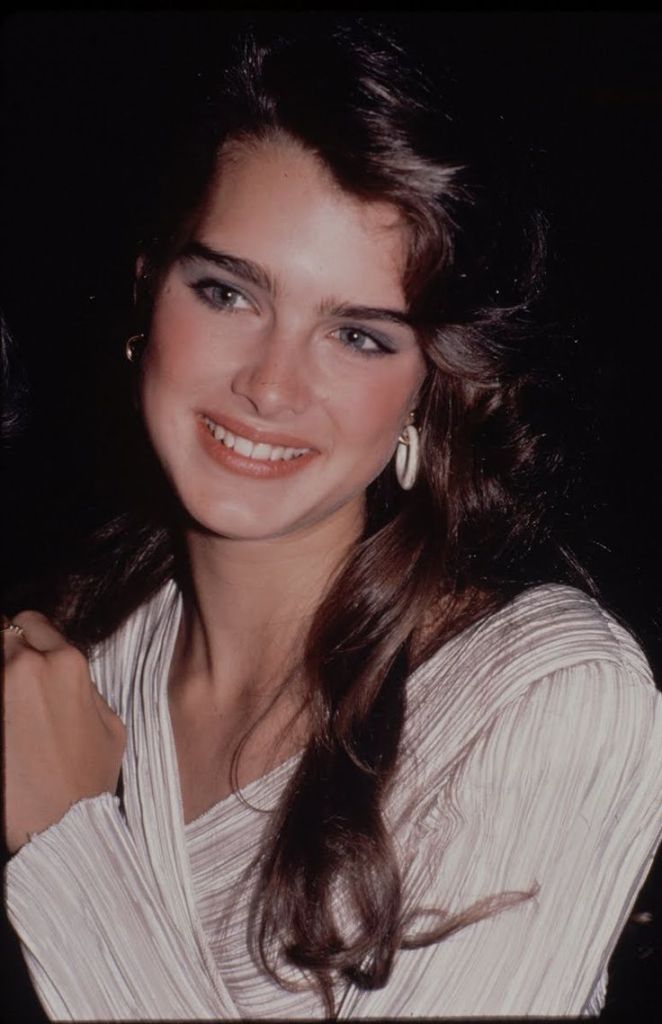
LORELAI: I once told a store my name was Squeegy Beckinheim just to see how many catalogs they would sell my name to, and apparently my name is to catalog companies what Brooke Shields’ picture is to Chinese restaurants.
Brooke Shields (born 1965), actress and model. She began her career as a child model and gained critical acclaim at age 12 for her leading role as an underage prostitute in the film Pretty Baby (1978). She continued to model into her late teenage years and starred in several dramas in the 1980s, including The Blue Lagoon (1980), andEndless Love (1981).
She returned to acting in the 1990s and appeared in several films, as well as starring in the TV shows Suddenly Susan and Lipstick Jungle. She is currently a voice actor on animated TV show Mr Pickles, and its spinoff, Momma Named Me Sheriff.
Lorelai refers to the practice of restaurants putting up photos of their famous customers, and sometimes, famous people they wish were customers. Brooke Shields may have eaten at a lot of Chinese restaurants when she was young – she was brought up by a “bohemian” single mother, and like Lorelai and Rory, they often had Chinese food for dinner. Brooke Shields does have a regular Chinese restaurant – Mr Chow, which opened in Manhattan in 1979, and became an upscale hotspot in the 1980s. Her favourite Chinese food is chicken sticks and fried seaweed.
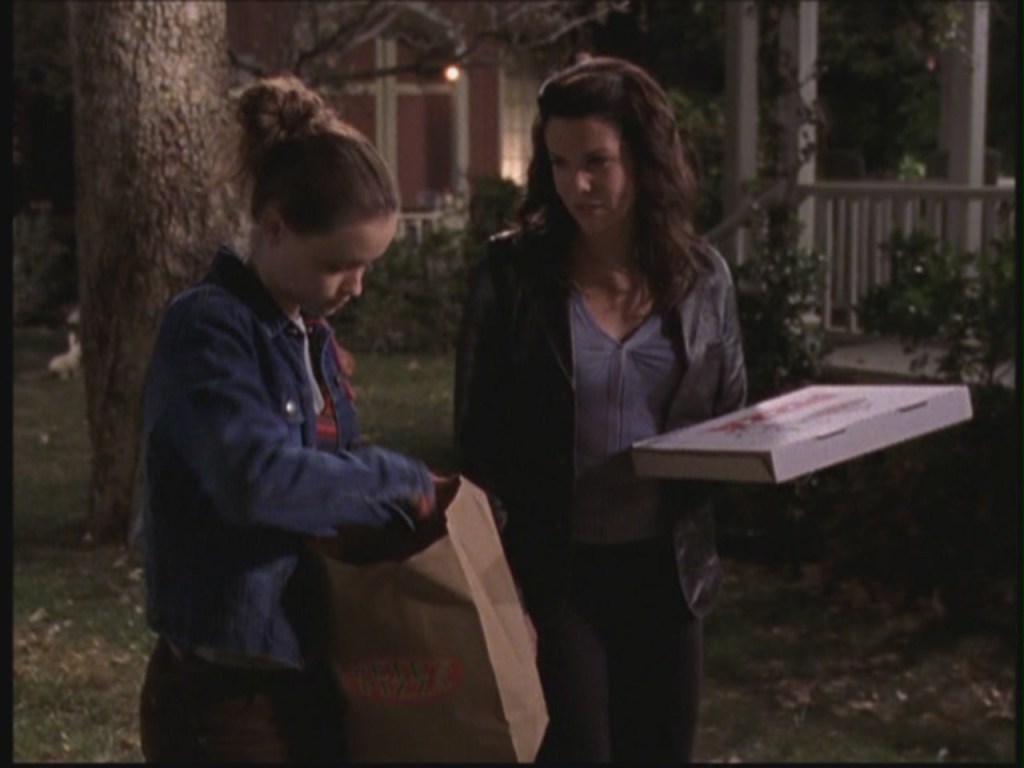
RORY: I can’t believe you got into a fight with Pete.
LORELAI: Hey, you do not suddenly decide that garlic is an extra topping, not after five years, not after all we’ve been through.
The first mention of Pete as the owner/manager of the pizza store which Lorelai and Rory frequent, they have apparently been customers there since 1997, ever since Lorelai bought her own house. We met Joe delivering their pizza in “Kiss and Tell”, and Lorelai ordered a pizza from Joe in “The Break Up Part 2” – perhaps Joe is Pete’s son, and it’s a family business?
The bag Rory is carrying seems to have Bell Pizza written on it, but later the pizza store is called Antonioli’s Restaurant and Pizzeria. There is a Bell Pizza in the Los Angeles suburb of Bell, however.



 The Annotated Gilmore Girls