The Copacabana

[Miss Patty’s standing in front of big drums.]
MISS PATTY: I danced on these drums at the Copacabana in 1969.
LORELAI: Wow.
MISS PATTY: Yeah, it was a great act. I wore bananas.

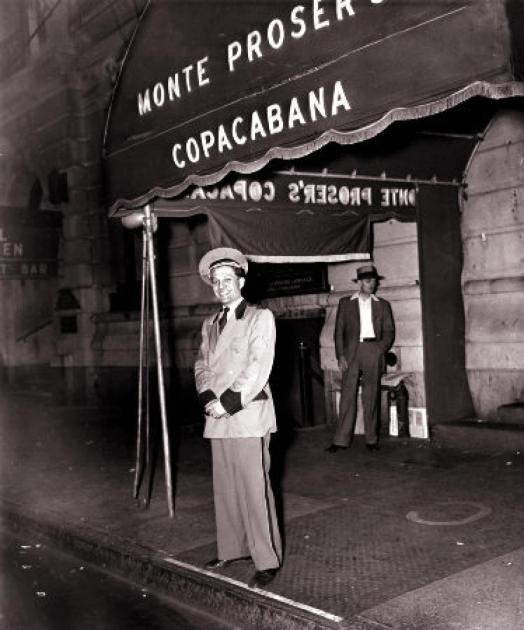
The Copacabana is a famous nightclub in New York City, first opening in 1940 at 10 East 60th Street; many top entertainers have performed there. The club had a Brazilian decor and Latin-themed orchestra, and their showgirls wore bananas on their heads in the style of Carmen Miranda (who appeared in the 1947 film Copacabana). It seems Miss Patty was one of the famed “Copa Girls”.

Annie Oakley

[Lorelai has entered wearing a leopard print cowboy hat]
RORY: What are you wearing?
LORELAI: Hey, we have already argued about the sweatshirt.
RORY: Yes but we have not argued about the hat.
LORELAI: What hat?
RORY: The one on your head, Annie Oakley.

Annie Oakley (1860-1926) was an American sharpshooter and exhibition shooter who won a shooting match while still a teenager. She later joined Buffalo Bill’s Wild West Show, and became an international star who performed before royalty and heads of state. While performing, she generally wore a Western-style outfit, including a cowboy hat.

Queen Anne

Lane looks for an opportunity to find her mother in a good mood, and approaches her after she made a sale of a reputed Queen Anne chair to a customer.

Anne (1665-1714) was Queen of England, Scotland, and Ireland from 1702, and Queen of Great Britain and Ireland from 1707 until her death.

The term Queen Anne when applied to furniture usually describes styles from the mid 1720s to the mid 1760s, even though this is after the reign of Queen Anne. Queen Anne furniture is characterised as being smaller, lighter and more comfortable than its predecessors, and Queen Anne chairs have elegant curved legs and cushioned seats.

Naturally the chair shown in the episode looks nothing like a Queen Anne. The customer even begins by questioning its authenticity and saying that it looks wrong, suggesting that the Kims are selling their antiques under very loose labels. When the customer asks for evidence that the chair is Queen Anne, Mrs. Kim says she will write a letter to that effect, which isn’t any proof of provenance at all.

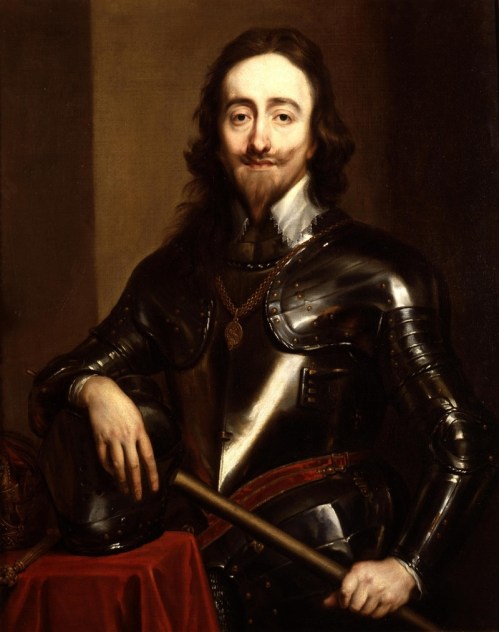
Charles I

Rory’s teacher Ms. Caldecott tells the class they will be debating “Did Charles I receive a fair trial?”. It’s not clear which class this is – it may be History, and Ms. Caldecott has replaced Mrs. Ness as the teacher for the subject this semester, or it may be Government.

Charles I (1600-1649) was the king of England, Scotland, and Ireland from 1625 until his death. Charles was in conflict with the Parliament of England, which tried to place limits on his royal prerogative – the authority and privileges which belong to the monarch alone. Charles believed in the divine right of kings, and that he was subject to no earthly authority, but could rule as he pleased through the will of God.

From 1642, Charles fought the armies of the English and Scottish parliaments in the English Civil War, was defeated in 1645 but still refused to accept demands for a constitutional monarchy. He was tried, convicted, and executed on charges of high treason in January 1649. The monarchy was abolished before being restored in 1660.

At his trial, Charles was held responsible for all the damage done to his country during the Civil War, including the deaths of 6% of the population. He refused to plead, claiming that no court held authority over a monarch, and that his authority to rule came from God and from the laws of England. He said that the trial was illegal, and its power only came from the force of arms.

The court challenged the idea that a monarch was immune from prosecution by the state, proposing that the “king” was not a person, but an office whose occupant had to govern by the laws of the land. They went ahead with the trial without the king’s royal assent. Charles was not present to hear the evidence against him, and had no opportunity to question witnesses, so there would be material for both sides of the debate.
Anvil

LORELAI: Hey, four menus, a coffee and an anvil please.
LUKE: What’s the anvil for?
LORELAI: For Rune.

Lorelai is referring to a common trope in cartoons where an anvil is dropped on a character’s head with hilarious results. It seems to have first been used in Disney animated films, and was perfected by Warner Bros. in their Looney Toons cartoons. (Possibly not a coincidence that Lorelai sees Rune off with a “Bye, Loon”.

The comedy anvil drop may have its origins in real life. A traditional celebration on the Fourth of July in America was launching an anvil into the air with gunpowder from atop another anvil, then watching it fall onto the other anvil with a thud. Presumably everyone stood well back during this exciting spectacle and hopefully nobody got an anvil on the head.

Tall Lorelai

RUNE: That’s Lorelai?
JACKSON: Yes.
RUNE: Did you see how tall she is?

Lauren Graham (Lorelai) is 1.75 m tall (just under 5 foot 7 and a half inches), while Max Perlich (Rune) is 1.62 m tall (around 5 foot 3). There’s a height difference in Lorelai’s favour – somewhat increased by heels – but Rune ridiculously compares her to a basketball player, an East German maid, and a freak of “bearded lady” proportions.

(The East German comment refers to the decades-long systematic doping of East German athletes with steroids and testosterone for the purposes of cheating, leading to some impressively large and strong athletes. The program ended in 1989 with the fall of communism, but unfortunately the men and women involved – some of whom were only eight years old at the time – are still experiencing physical and mental health disorders because of the doping. Lorelai is in the right age bracket to be an East German maid who was doped as an athlete in the 1980s:  picture shows 1980s East German athlete Marita Koch, who holds the world record for the 400 m, partly due to steroid use).

Lorelai rarely has any trouble attracting men, so having a date openly and constantly insult her physical appearance must be a bizarre experience for her.

“You run directly for president”

LANE: We’ll tell her [Lorelai] that we’re meeting Dean for a movie, and then we go to the movie, and then somebody who just happens to be a friend of Dean’s just happens to be there for the same movie, and so we figure that it would be completely rude for us to not ask said person to come sit with us.
RORY: I say to hell with governor, you run directly for president.
LANE: It’s not that bad.

Many US Presidents have been Governor of their state before making the run for the White House, including George W. Bush, former Governor of Texas, who had only recently (from Rory’s perspective) been sworn in as President, on January 20 2001.

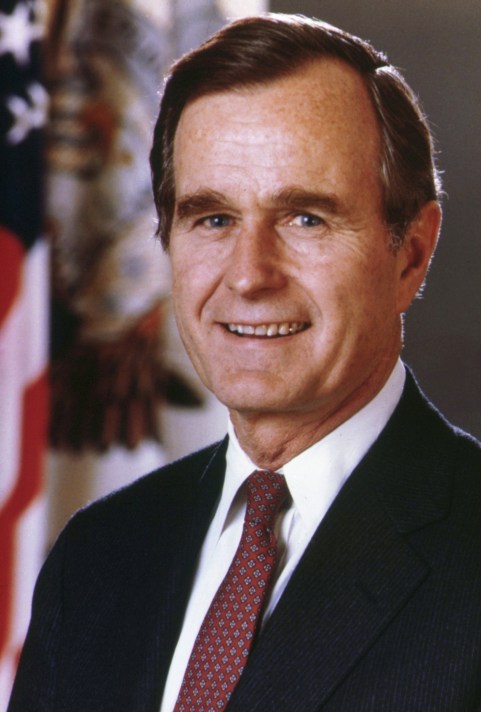
In 2001, the last US President to run for President without standing as a state Governor was George Bush Sr. [pictured], who was a Congressman, Ambassador to the UN, Ambassador to China, then Director of Central Intelligence before his successful presidential campaign in 1988 (sworn in 1989).

Rory is saying that Lane’s lying is on a scale that only a politician at the highest level could come up with. Lane understandably tries to downplay that one.

Alaska and Hawaii

LORELAI: Maybe you could do them [the Baked Alaskas] in the actual shape of Alaska.
SOOKIE: Interesting.
LORELAI: Or you could do little baked Alaskas and Hawaiis.
SOOKIE: Because they joined the union last.

It would be very difficult to make Baked Alaska in the shape of Alaska and Hawaii as Alaska has a multitude of islands around its coastline, and Hawaii is a group of islands. I’m sure it can be done, with some artistic licence. Lorelai is joking though.

Alaska was purchased by America from Russia in 1867, and became a US territory in 1912. It was admitted as the 49th state of the US in January 1959.

The Kingdom of Hawaii was overthrown during a coup d’état in 1893, and the country was annexed by the US in 1898, becoming one of its territories. In August 1959 Hawaii was admitted to the union, becoming the 50th state of the US.

Hawaii is the state where Lauren Graham (who plays Lorelai Gilmore) was born, which might be why it is mentioned here. It also happens to be where Keiko Agena (Lane Kim) was born.

Baked Alaska

LORELAI: Oh! Meringue.
SOOKIE: Yeah, I thought I’d do a variation on a baked Alaska for dessert tonight.

Baked Alaska is a classic American dessert consisting of ice cream in a dish or baking tray which is lined with cake, then the whole thing covered in meringue and quickly browned in the oven. The ice cream won’t melt as the meringue protects it, and the oven is very hot so that cooking time is brief.

According to legend President Thomas Jefferson, earlier mentioned, was the first person to serve Baked Alaska, in 1802. He served a dessert which was warm ice cream in a pastry shell, so not really the same, but shows that the idea of baking ice cream had been around a fair while – and a presidential connection is always a cool thing to have.

The famous Delmenico’s Restaurant in New York City claimed that their chef Charles Ranhofer named the dessert to mark America’s purchase of Alaska from Russia in 1867. The actual dish was probably created some time after the purchase, and Ranhofer called his dessert “Alaska, Florida” to indicate the extremes of heat and cold in the dessert. He published the recipe in 1893.

The first known published recipe for something resembling Baked Alaska is in Mary J.B. Lincoln’s Frozen Dainties in 1888. It seems to be much the same as the modern dish and she calls the dessert Ice-cream en Deguiser (“ice cream dressed up”). Lincoln was the first principal of the Boston Cooking School, so the dish has a distinguished pedigree.

Jefferson Suite

LORELAI: OK, put them [the Ruckers] in the Jefferson suite tonight, move them back to their previously booked room tomorrow, and offer them dinner on the house for the inconvenience.

The suite is named after American statesman Thomas Jefferson (1743-1826), one of the Founding Fathers of the United States, and principal author of The Declaration of Independence. He served as the third President of the United States (1801-1809), and was the second Vice-President under John Adams (1797-1801). It is an appropriate name for a suite at the Independence Inn.