Spittoon

LORELAI: Well where did the Ruckers come from?
MICHEL: Well judging from their clothing, a town where high rubber fishing boots and spittoons would be considered formal wear.

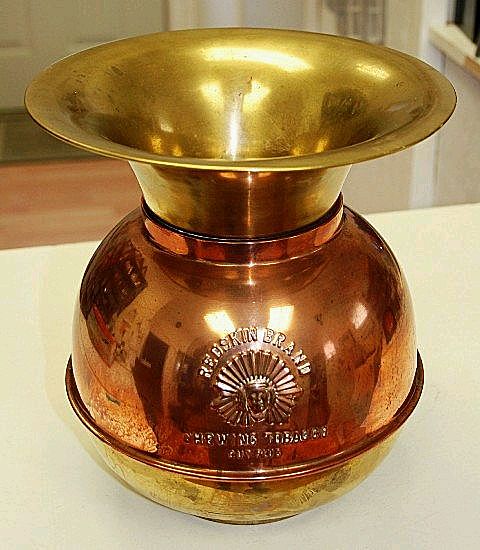
A spittoon is a receptacle made for spitting into, especially used by those using chewing tobacco. They were very common and displayed for public use in the US during the late 19th century, but use declined after the 1918 flu epidemic as they were considered unsanitary (before this, spittoons were actually considered hygienic, as previously people would spit on the ground or the floor). Chewing tobacco also went out of fashion, rendering spittoons less useful.

Spittoons were available in public buildings in the Southern states of the US into the 1970s. The United Sates Senate still has traditional spittoons in their public rooms, but these are just used as rubbish bins. Spittoons are still made, and used for smokeless tobacco, and for wine, coffee, and tea tastings. It is rare to see one in public though.
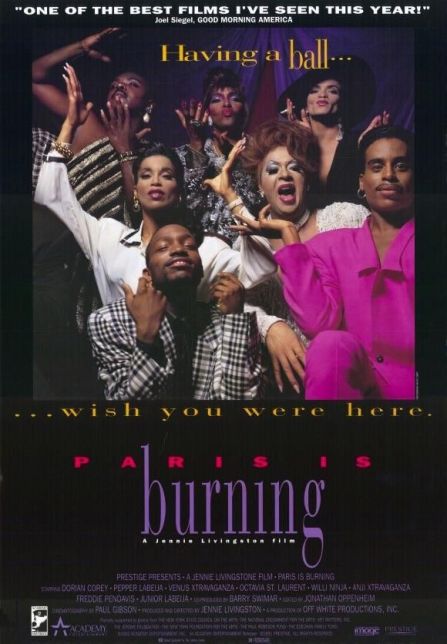
Paris is Burning

The episode title may be a reference to the 1990 documentary film Paris is Burning, directed by Jennie Livingston. The documentary is about the drag ball culture in New York City, and the drag competitions which take place at the balls. The documentary film received rave reviews and several awards at film festivals; it remains relevant in discussions on LGBT, youth, class, and racial issues.

The film’s title comes from drag performer Paris Dupree (1950-2011), who gave a drag ball with the name. It may have been partially inspired by Adolf Hitler’s reported question during World War II, “Is Paris burning?”, when he wished the city to be completely destroyed rather than re-taken by the Allies.

This episode centres on Paris Geller, who we learn more about in this episode, and who does indeed “burn down” or destroy the relationship between Lorelai and Max. She does so to deflect public attention from her own problems, thus playing a role like the drag performers in the film.

Václav Havel

RORY: Did you know the cell that Václav Havel was held in is now a hostel? You can stay there for like $50 a night.

Václav Havel (1936-2011) was a Czech statesman, author, and former dissident. He was the last president of Czechoslavakia from 1989 to 1992, then the first president of the Czech Republic from 1993 to 2003.

Havel was a playwright in Prague who rose to prominence with anti-communist works such as The Garden Party. After participating in the Prague Spring, he became more politically active, and played a major role in the Velvet Revolution that ended communism in Czechoslavakia in 1989. A popular president and major intellectual figure of the twentieth century, he was awarded multiple international awards for peace and freedom.

During his period of political activism against communism, Havel was under the surveillance of the secret police, and sent to prison several times, the longest period being from from 1979 to 1983. Havel was held in a prison opposite the police station in Prague; it was a basement cell in a building that had once been a convent run by the Franciscan Grey Sisters (religion was banned under communism, and all church property siezed by the state).

Once communism had ended and the nuns were allowed to have their convent back, they turned part of it into a hostel for budget travellers and called it Pension Unitas; it generated enough funds to rebuild the convent, the church, and other buildings owned by the Grey Sisters.

Pension Unitas closed in 2006 after hosting 150 000 guests, and was relaunched as the Unitas Hotel. You can stay at the hotel for about $180 a night, and it receives excellent reviews.

Bellevue

MAX: So possibly I’m crazier than you are.
LORELAI: Again, very possible.
MAX: A match made in heaven.
LORELAI: Or in Bellevue.

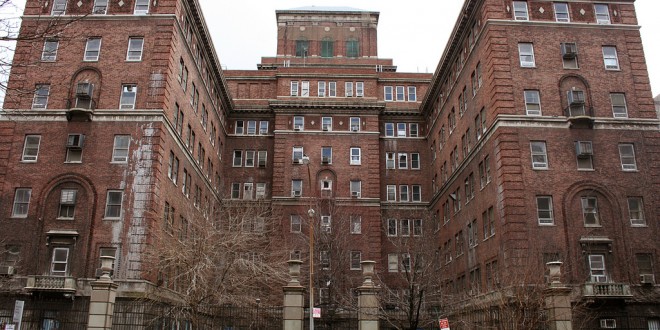
Bellevue Hospital in Manhattan was founded in 1736 and is the oldest public hospital in the US. Its psychiatric hospital opened in 1931, and became a byword for medical neglect and maltreatment of recovering alcoholics and the mentally ill. The name “Bellevue” soon became applied to any psychiatric facility.

The old psychiatric hospital closed in 1984, and part of it is used as a homeless shelter. The new psychiatric unit at Bellevue Hospital is now regarded as one of the best in the country.

Musket

TAYLOR: Who’s stepping on my musket?
KIRK: That’d be me.

A musket is a long gun with a flintlock mechanism, fired over the shoulder, and with musket balls as the ammunition rather than bullets. They were in use from the 17th century, and were the weapon of choice in the American Revolutionary War.

They weren’t very accurate as they didn’t have a sight on them, and took ages to reload. Nonetheless if they did hit their mark they could be deadly, and leave a larger and more complex wound than a modern gun (not to mention the lower standard of medical care victims would have received in the 18th century). Muskets were superseded by the rifle in the 19th century.

USSR

MAYOR: If you don’t like it here in America, why don’t you go stand in line for toilet paper in the USSR!
LUKE: There is no more USSR, Harry.

The Union of Soviet Socialist Republics, abbreviated to USSR, and also known as Soviet Russia, existed from 1922 to 1991. It came into being shortly after the Russian Revolution, and collapsed at the end of the Cold War. The picture shows the present day countries which were once part of the USSR.

Soviet Russia was notorious for its long queues because of the shortages caused by the Communist system, which prioritised industry over consumer goods. People would line up for hours in order to buy any commodity that was in short supply

Battle of Stars Hollow

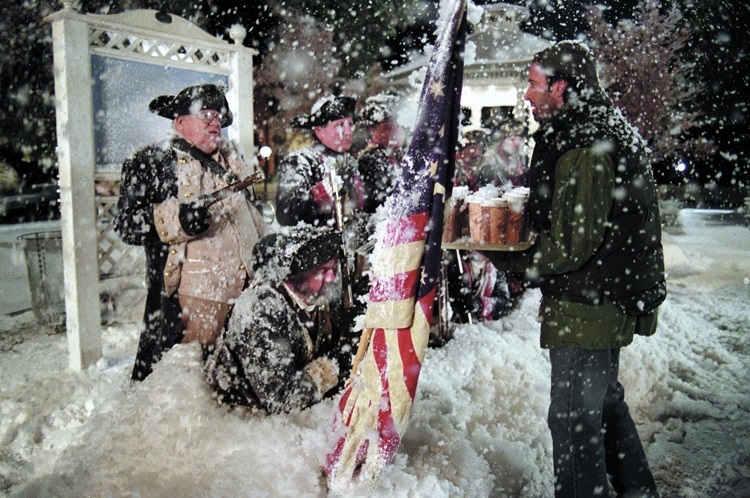
We learn in this episode that every year the town re-enacts The Battle of Stars Hollow, which took place during the Revolutionary War on either November 10 or November 17 in 1776 (depending on whether this episode is one or two weeks after the previous one). This contradicts the sign in town, which says that Stars Hollow was founded in 1779.

In the “battle” a dozen militia men from Stars Hollow waited for the redcoats in the cold, however the British never showed up. Despite this lack of anything happening, Stars Hollow is very proud of its role in the American Revolutionary War.

We also learn that Luke’s father William Danes was an enthusiastic battle re-enactor, and even owned his own musket, which he had buried with him. Although Luke doesn’t follow in his father’s footsteps, he does serve free hot drinks to the re-enactors who have to have to spend all night freezing in the cold.

In real life, there were only three battles sites in Connecticut in the American Revolutionary War, and they were all British victories. Nonetheless, Revolutionary War history is a big deal in New England. Many Connecticut towns have annual commemorations of the American Revolutionary War, just like Stars Hollow.

The Crucible

LUKE: I’m not gonna say you look concerned.
LORELAI: I’m not gonna talk about how good you’d look dressed like one of the guys from The Crucible.

The Crucible is a 1953 play by American playwright Arthur Miller. It is a a dramatised version of the Salem witch trials which took place in Massachusetts in 1692-93, the play serving as an allegory of the McCarthy era, when the US government accused people of subversion or treason based on a suspicion of communist sympathies. It won the Tony Award for Best Play in 1953, and has gone on to become a classic of American drama.

The Crucible was adapted into a film in 1996, with Arthur Miller writing the screenplay. Lorelai could easily have seen the film when it came out, if she had never seen it on stage. The Puritan clothing worn by characters in The Crucible remind Lorelai of Thanksgiving Pilgrim costumes.