“All great empires have fallen”

PARIS: In the past, all great empires have fallen. The feeling seems to be that it’s inevitable – that something like what the Romans built could not last.

Paris refers to the Roman Empire, previously mentioned.

The Roman Empire was the post-Republican era of Roman civilisation, lasting from the accession of the first Roman Emperor, Augustus, in 27 BC to 395 AD, when it disintegrated under onslaughts from Germanic tribes such as the Goths and the Huns after the death of Theodosius the Great, the last Roman Emperor.

The fall of the Roman Empire is often invoked whenever a particular long-standing institution is threatened, or is perceived to be threatened, by destructive outside forces.

[Painting shown is The Course of Empire, Destruction by Thomas Cole, 1836].
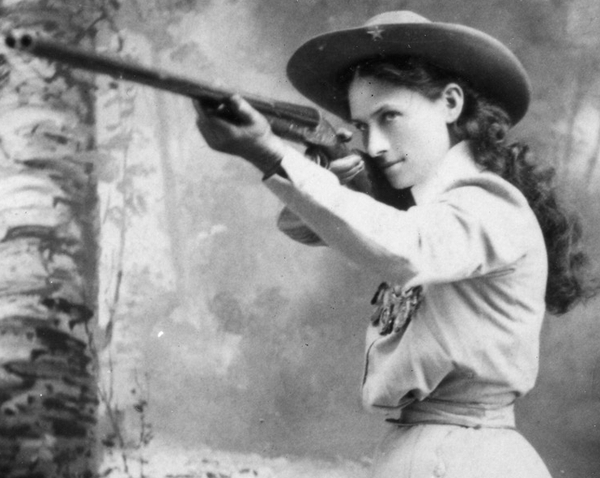
Annie Oakley

LORELAI: Well, apparently this lovely girl came home to find her husband giving the nanny a nice little bonus package … The man was shot thirty-five times. He looks like a sprinkler system.

EMILY: I can’t believe this. Shauna was always such a nice girl. She was bright, cultured, well-spoken.

LORELAI: And apparently, a big Annie Oakley fan.

Annie Oakley, sharpshooter, previously discussed.

Emily manages to get in a nice little dig at Lorelai by remarking of Shauna, “At least she had a husband to kill”.

Manhattan Garbage Union

LUKE: Yup, it’s tough when the universe is against you. That’s like taking on the Manhattan Garbage Union.

Luke refers to the Uniformed Sanitationmen’s Association, called “New York’s Strongest”. Workers at New York City’s Sanitation Department are responsible for collecting trash, and for clearing the streets of snow during winter.

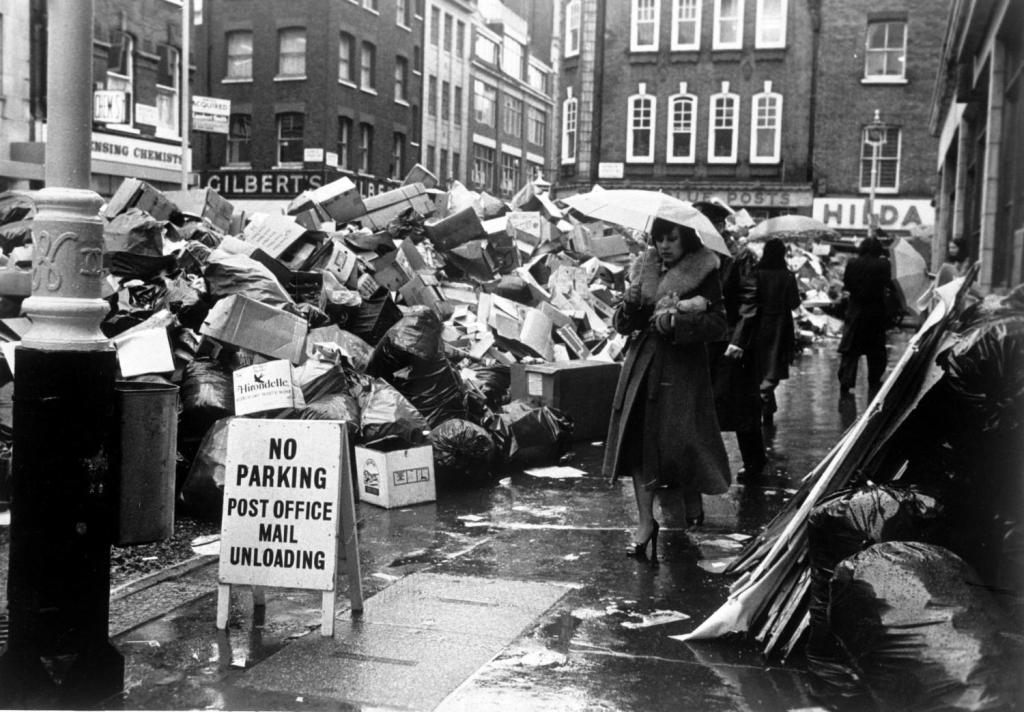
The strength of their union became apparent in February 1968 when they went on strike for nine days demanding higher wages, leading to 100 000 tons of trash on the streets, with piles of garbage everywhere [pictured]. The strike was ended when state governor Nelson Rockefeller agreed to the sanitation workers receiving a slightly higher wage than they otherwise would have, and further arbitration.

Martin Luther King’s “I’ve Been to the Mountaintop” speech in Memphis that year was in support of the sanitation workers, and it inspired the sanitation workers in Memphis to launch their own strike, just days after the one in New York ended. The Uniformed Sanitationmen’s Association claim Martin Luther King Day (16th January) as a holiday each year, in recognition of Dr King’s support for their cause.

There were other strikes by the sanitation workers during the 1970s, 1980s, and 1990s, but they were usually resolved within a day or two, the city having learned its lesson that you have to take care of the people who collect your trash.

Ottoman and Napoleon Complex

RORY: Hello living room.

LORELAI: Hello Rory, we missed you. Not the ottoman, of course, but everyone knows he’s a snob. Napoleon complex, he only really likes the magazine rack.

An ottoman is a small padded seat without a back or arms that can be used as a table, stool, or footstool. They are also known as tuffets, hassocks, or pouffes. The name comes from the Ottoman Empire from where it originated, the seat introduced to Europe in the 18th century.

A Napoleon complex is an imaginary syndrome attributed to people of short stature, where the short person (usually a man), overcompensates for their size by being too aggressive or domineering. In psychology, it is regarded as a derogatory social stereotype and a piece of mysandry. It comes from the idea put about by the British in the 19th century that Napoleon Bonaparte’s short temper was caused by him being of short size. In fact, Napoleon was 5 foot 7, average height for his era.

Presumably the ottoman only likes the magazine rack because it’s the one thing smaller than it is!

General Sherman

MRS. KIM: This was Sherman’s shaving table … General Sherman, famous man, burned Atlanta, liked a close shave.

General William Tecumseh Sherman, previously mentioned. A general in the Union Army during the Civil War, he invaded Georgia with three armies in the spring of 1864. His campaign against Atlanta ended successfully in September of that year with the capturing of the city, and he gave orders that all civilians were to evacuate the city before giving instructions that all military and government buildings were to be burned, although many private homes and businesses were too. This victory made him a household name, and ensured the re-election of President Abraham Lincoln in November that year.

In fact General Sherman had a slightly scruffy beard, rather than being close-shaven. This seems to be another hint that Mrs Kim is not always honest about her antiques.

Archie Bunker’s Chair at the Smithsonian Museum

JAMIE: So, in your opinion, how was our nation’s capital?

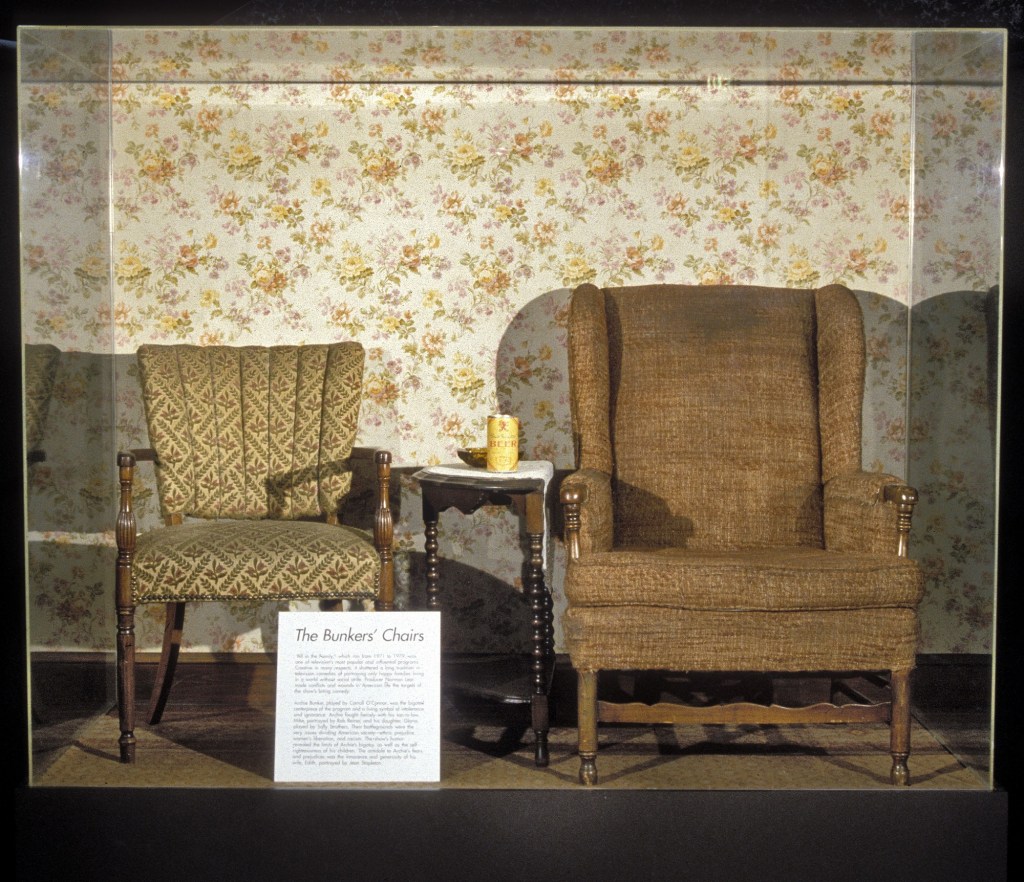
RORY: Well, I got to see Archie Bunker’s chair at the Smithsonian Museum, so it was a big thumbs up for me.

Archie Bunker, played by Carroll O’Connor, from the popular sitcom All in the Family, previously discussed.

The Smithsonian Institution, a group of museums and education and research centres, the largest such complex in the world. It was founded in 1846 by the US government, named after its founding donor, British scientist James Smithson. Known as “the nation’s attic”, it has 19 museums, 21 libraries, nine research centers, and a zoo, mostly located in the Washington DC area. It receives 30 million visitors each year, and entry is free.

Archie Bunker’s chair really is on display at the Smithsonian National Museum of American History in Washington DC, donated by the makers of the television show in 1978. It was originally bought by the show from a Goodwill thrift store in southern California for $8.

“I have lost. Mr Nixon has won”

PARIS: How’s this sound for a template? I have done my best. I have lost. Mr. Nixon has won. The democratic process has worked its will, so now let’s get on with the urgent task of uniting this country … Hubert Humphrey’s concession speech. Now, other than the part about Nixon, parts of it really seem to apply here.

Paris refers to Hubert Humphrey’s concession speech on 6 November 1968, acknowledging that Richard Nixon had been successful in his bid to become President of the United States by a narrow margin. It ended: “I have done my best. I have lost. Mr. Nixon has won. The democratic process has worked its will. Now let us get on with the urgent task of uniting this country”.

Paris says that Hubert Humphrey probably wasn’t considered very fun either, but this is one of a myriad of things that Paris gets completely wrong. Hubert Humphrey was known for his positive outlook and zest for life, a free spirit who loved every minute of being alive and wanted to make the world a happier place. Even when conceding defeat, he spoke about how much fun the campaign had been. It’s probably one of America’s tragedies that they failed to elect him as President.

John F. Kennedy

PARIS: John F. Kennedy once said, ask not what your country can do for you, ask what you can do for your country. Those eloquent words are just as relevant here in this hall today. What can you, the future of Chilton, of America, of the world, what can you do for your school?

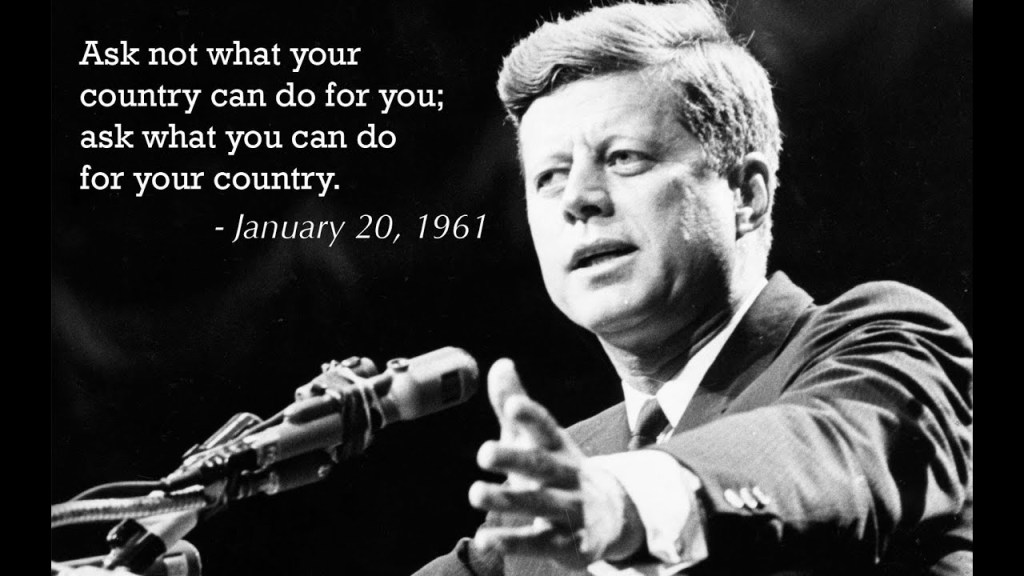
John F. Kennedy, US president, previously discussed. The quote comes from John F. Kennedy’s inaugural address on January 20 1961, inspiring the nation to greater civic participation. The finely-crafted address was one of the shortest ever made, and afterwards, 75% of Americans polled approved of the new president.

Government Cheese

EMILY: But after twenty years, where is the woman’s sense of loyalty?

LORELAI: Oh, gee, I don’t know . . . maybe with the company that’s keeping her from having to stand in line for government cheese.

Government cheese is a processed commodity cheese controlled by the US federal government from World War II until the early 1980s, provided to welfare recipients and the elderly on Social Security, to maintain the price of dairy products. It was particularly associated with the Reagan administration. The cheese itself had a noticeable orange colour and melted easily.

Government cheese was removed in the 1990s when the dairy industry stabilised, so Margie wouldn’t be lining up for it in 2002, even if she lost her job completely. Either Lorelai or the writer doesn’t seem to be aware of that.

The Marshall Plan

RORY: Explain to me the political ramifications of the Marshall Plan.

The Marshall Plan, officially the European Recovery Program or ERP, was an American initiative enacted in 1948 to provide foreign aid to Western Europe. The US transferred over $13 billion (equivalent to around $115 billion today) in economic recovery programs to Western European economies after the end of World War II.

The initiative was named after the US Secretary of State, George C. Marshall, and one of its main ramifications was to ensure greater geopolitical influence for the US in Western Europe. It has been argued that it marked the beginning of the Cold War, with the USSR refusing assistance, and determined to bolster its own influence in Europe. This was seen by the US as an act of hostility.

Jess’ History class is obviously studying the Post-War era.