Star-Crossed Lovers and Other Strangers

The title references two different works. One is William Shakespeare’s Romeo and Juliet, previously and frequently mentioned. In the play, Shakespeare refers to the main characters as “star cross’d lovers”, meaning that their relationship is destined to fail no matter how hard they try. The phrase comes from astrology, meaning that the stars are working against them (in the same sense that we say “don’t cross me”, to mean “don’t interferere with my plans”).

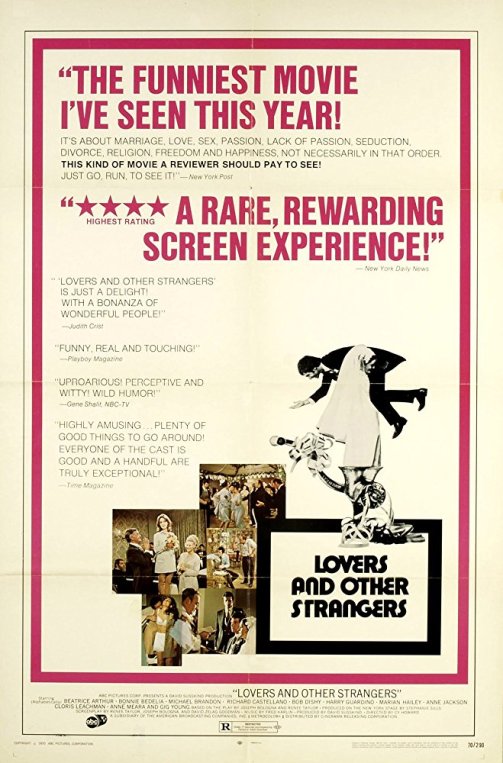
The other reference is to the 1970 comedy film Lovers and Other Strangers, directed by Cy Howard and based on the play of the same name by Renée Taylor and Joseph Bologna, who also co-wrote the screenplay for the film.

The movie revolves around the upcoming wedding of Mike (Michael Brandon) and Susan (Bonnie Bedelia), and the spotlight it shines upon the marriages of their family members. The film is notable for being the screen debut of actress Diane Keaton, who plays Mike’s sister-in-law. Lovers and Other Strangers was well-reviewed and successful at the box office; it won the Academy Award for Best Original Song (For All We Know).
Fiddler on the Roof

LORELAI: We can’t get married Christopher. We don’t know each other as adults.
CHRISTOPHER: So let’s get married and get to know each other as adults.
LORELAI: Well, that’s very Fiddler on the Roof of you.

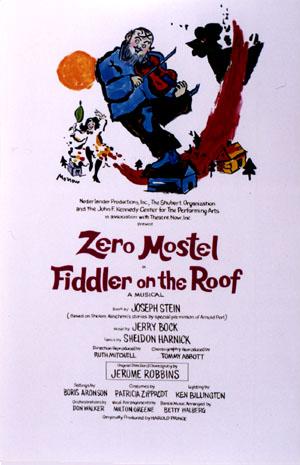
Fiddler on the Roof is a 1964 musical with music by Jerry Bock, lyrics by Sheldon Harnick, and book by Joseph Stein. Set in a Jewish community in Russia in 1905, the play is based on Tevye and His Daughters, a series of short stories written in Yiddish by Russian author Sholom Alecheim.

Tevye (played by Zero Mostel in the original Broadway production), a poor man, wants to arrange the marriages of his daughters, with the idea that although the couple may not know each other very well before marriage, they will learn to know each other after marriage. This was the case in his own happy marriage to his wife Golde, but his daughters have other ideas.

Fiddler on the Roof was a massive hit with both critics and audiences, and won nine Tony Awards, including Best Musical. For many years it was the longest-running musical on Broadway, and has had numerous revivals. Successfully adapted to film in 1971, it remains popular around the world.

Whoville

CHRISTOPHER: Well, I know you well enough to know that when you say no to coffee, especially in the morning, all is not right in Whoville.

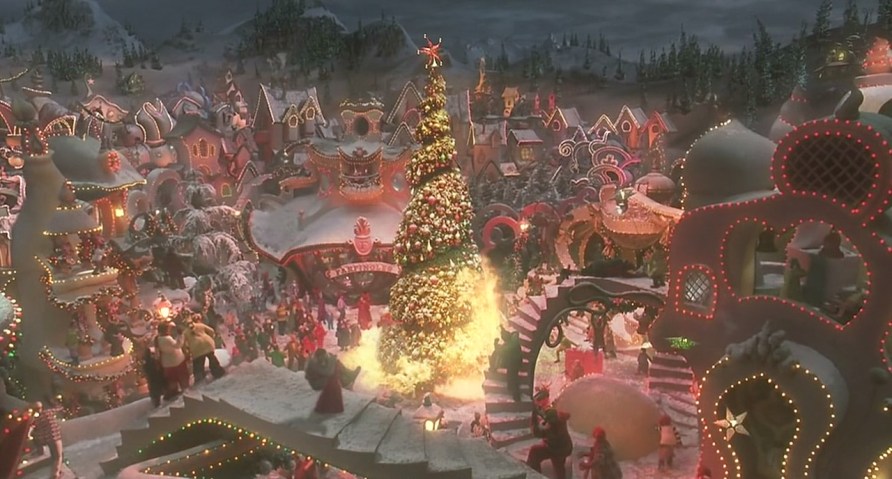
Whoville is the setting for the 2000 Christmas film How the Grinch Stole Christmas, earlier discussed – a charming little place where the denizens all really love Christmas.

It’s interesting that Lorelai referenced it to Rory at the start of Concert Interupptus, and now about a month later, Christopher is referencing it to Lorelai as if it is something they shared together. It suggests the possibility that when Christopher came to Hartford for Christmas in 2000, he and Lorelai took Rory to the movies to see The Grinch. If so, it’s rather touching that they went on a family outing together, and chose a movie to which you’d generally take a younger child than Rory.

(There is a Who-ville in the Dr. Seuss book Horton Hears a Who, but you can see from the books they are two quite different places with different characters, just similar names. The Horton Who-ville exists within a speck of dust on a clover flower, and the Grinch movie pays tribute to that by having their Whoville contained within a single snowflake).

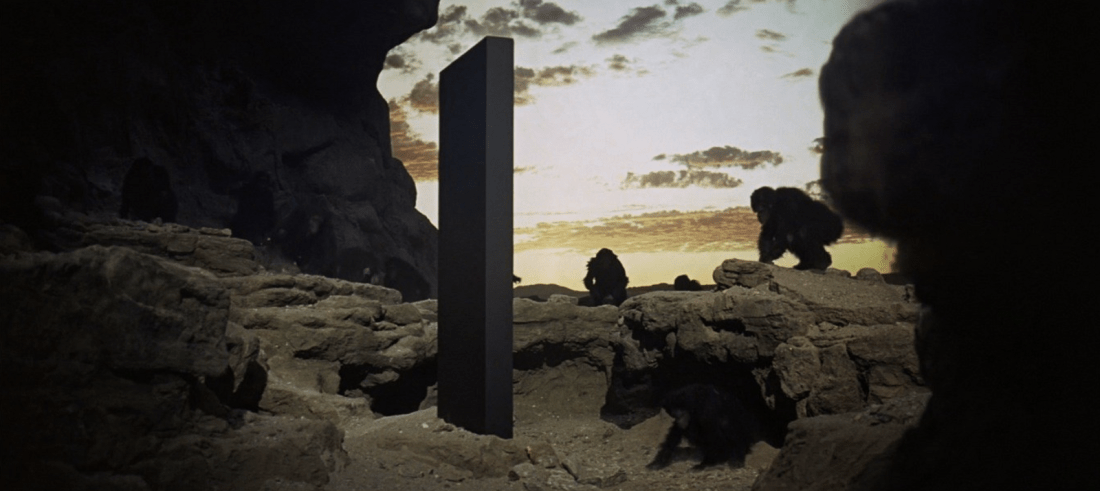
“The monolith from 2001”

ANDREW: [bringing a very large and heavy book] Here you go.
CHRISTOPHER: Holy mother. This is the monolith from 2001.

Christopher is referring to the 1968 science-fiction film 2001: A Space Odyssey, directed by Stanley Kubrick, and partially inspired by a short story called “The Sentinel” by British sci-fi author Arthur C. Clark, who co-wrote the screenplay.

The film features a mysterious flat black monolith which seems to have affected human evolution from prehistoric times by somehow artificially speeding up intellectual development. The Compact Oxford English Dictionary is nowhere near as as large as the monolith in the film, but has similar intellect-stimulating properties. The writer may have referenced the film as it was now 2001.

On release, 2001: A Space Odyssey received mixed, or even polarised, reviews from critics, but gained a cult following. It went on to become the #1 film of 1968, and won the Academy Award for Best Visual Effects. It is now regarded as one of the greatest and most influential films of all time.

Compact Oxford English Dictionary

CHRISTOPHER: Come on, what’s the book of your dreams right now?
RORY: Well, that would definitely be the Compact Oxford English Dictionary, but Dad –

Rory is referring to the Compact Edition of the Oxford English Dictionary, which reduces the print size of the Oxford English Dictionary so that the entire dictionary can fit into a single volume instead of multiple volumes. The print size is so small that a magnifying glass comes with it so you can read it, and it is necessarily a very large and heavy book, with its own slipcase.

It costs about $400 today, which is why it is just a dream to Rory (and why Christopher can’t afford it). As Christopher’s credit card is rejected, Rory must realise that his boasts of financial success are all empty.

Dickens novel

SOOKIE: You – get in here and tell me the happenings at home.
LORELAI: I’m assuming you mean “did we get our toaster fixed” and no, it’s been cold Pop-Tarts for a week, it’s like a damn Dickens novel.

A reference to the classic 19th century novelist Charles Dickens, earlier discussed. Several of his novels focus on characters who suffer in Victorian-era poverty, such as Oliver Twist, The Old Curiosity Shop, Little Dorrit, and Hard Times. Indeed, to say a situation is “Dickensian” means that it is squalid, grim, and impoverished.

Madrid and Cervantes

RICHARD [of his upcoming trip to Madrid]: I think there’s a nice edition of Cervantes in it for you.
RORY: Gracias.

Miguel de Cervantes (1547-1616) was a Spanish writer regarded as the greatest writer in the Spanish language and one of the world’s greatest novelists. His best known work is Don Quixote, earlier discussed – it is sometimes thought of as the first novel, and is a literary classic.

Richard’s comment suggests that whenever he has to travel to a foreign city on business, he tries to buy Rory a book there by an author associated with that city – Cervantes lived and worked in Madrid for most of his life. We know Richard has already bought her something from Prague, quite possibly a book.

Rory simply replies, “Thank you” in Spanish.

(Richard’s trip to Madrid will be on the 12th of March, suggesting it is now Friday 2nd March. It could be Friday the 9th, but in that case it seems more likely that Richard would have simply said he left on Monday).

Michael Douglas

LORELAI: Okay, so now the fact that I suggested painting Luke’s diner also means that I wanted to get him in bed. All of a sudden I’m trying to get any poor, unsuspecting person in bed with me. I’m like – I’m Michael Douglas!

Michael Douglas (born 1944) is a multi award-winning American actor and producer, with a long career in theatre, film, and television. He is married to Catherine Zeta-Jones, earlier discussed as one of the “pretty women” that Lorelai wonders if Luke’s ex-girlfriend Rachel resembles.

In 1993 it was widely reported that Michael Douglas was a sex addict and had entered rehab to be treated for his addiction (leading to much mockery). He refuted these claims, saying that he had gone into rehab to be treated for alcohol addiction, but the rumours persist – they were even published again in his 2012 biography by Marc Eliot, Michael Douglas: A Biography.

Diagnosed with cancer in 2010, Douglas told the public he had throat cancer caused by giving cunnilingus to many women, which did nothing to calm down the sex addiction rumours. In 2013 Douglas revealed he had actually had tongue cancer, and denied that there was any link with performing oral sex.

In January 2018, journalist Susan Braudy went public with claims that she had been sexually harassed by Michael Douglas in 1989 while working for him, including that he used inappropriate sexual language, and masturbated to orgasm in front of her. Douglas denies the allegations, although Braudy has shared corroborating evidence with the press. This has reignited the “sex addiction” rumours all over again.

Lorelai seems to have the common belief that people with “sex addiction” must be constantly trying to get random people to have intercourse with them, although such behaviour is probably rarer in real life than people think.

(Note: “Sex addiction” has not been accepted as a diagnosis by any mainstream psychological or psychiatric body, but there are support groups and treatment programs for it).

Stanley and Stella

LORELAI: Alright, I’ll name him. [to chick] Hi! Your name is Stanley. Hi, Stanley.
RORY: It’s a girl.
LORELAI: Oh. [to chick] Sorry about the Stanley thing. Your name is Stella. [to Rory] Stella’s nice, and Stella was married to Stanley.

A reference to the 1947 play A Streetcar Named Desire by Tennessee Williams, earlier discussed. In the play, Blanche DuBois’ younger sister Stella is married to Stanley Kowalski, a factory parts salesman.

A Streetcar Named Desire was highly successful on Broadway and in London’s West End, and won the 1948 Pulitzer Prize for Drama. It is regarded as one of the greatest plays of the twentieth century, and is Williams’ best known work. The roles of Stanley and Stella were played by Marlon Brando and Kim Hunter in both the original Broadway production, and the 1951 film version.

I think Lorelai is saying the name Stella is nice, rather than the character, but can’t be quite sure.