Mencken’s Memoirs

RICHARD: Rory, I have a surprise. Not only did I find that copy of Mencken’s Chrestomathy we discussed, I also found a first edition of his memoirs as well.

H.L. Mencken wrote three volumes of memoirs. They were Happy Days, 1880-1892 (1940); Newspaper Days, 1899-1906 (1941); and Heathen Days, 1890-1936 (1943). They were published together in a single volume called The Days of H.L. Mencken in 1947; a good quality first edition might go for around $70 today.

The episode ends with Lorelai in the situation she feared: left alone while Rory spends time with her grandparents and gets “spoiled” with a first edition of a book she has wanted. Of course, Lorelai has had Rory all to herself for many years before this.

Chrestomathy

The book which Richard calls Rory to talk about is A Mencken Chrestomathy by American author and journalist H.L. Mencken (1880-1956), first published in 1948. A chrestomathy is a selection of literary passages, usually by a single author; in this case it is a selection of Mencken’s own out-of-print writings chosen by himself.

With the phone call from Richard, the audience (and Lorelai) can see that Rory and her grandfather are bonding over books and reading. Rory must have told Richard about her journalistic ambitions when she told him she was looking for the book, and he almost immediately found a copy for her.

It can’t help but put Lorelai’s nose out of joint. In all her years at the inn, her father has never once phoned her at work. Yet after just one morning with Rory, Richard calls his granddaughter to talk about a book while she is working at the Independence.

Peyton Place

RORY: It’s a conspiracy.
RICHARD: It’s Peyton Place.

Peyton Place is a 1956 novel by American author Grace Metalious. Set in a small, conservative, gossipy New England town, it deals with hypocrisy and class privilege and has a salacious plot which encompasses incest, abortion, adultery, suicide, and murder. It became an immediate best-seller when it was released.

It was adapted as a film in 1957, becoming the #2 film of 1958. In 1964 it was made into a highly successful television series which ran until 1969, which was when the term “Peyton Place” became used for any scandalous situation. The follow up novel Return to Peyton Place also became a film, and then a soap opera.

Plato

RICHARD: Physical fitness is as important as intellectual fitness. So says Plato and so say I.

Plato (c428-c348 BC) was a philosopher of Classical Greece, and founder of the Academy in Athens, the first institute of higher education in the Western world. He is widely considered a key figure in the history of philopshy and science, one of those who laid the foundations of Western thought and culture.

Richard may be thinking of Plato’s philosophical and political dialogue The Republic, written around 380 BC, and his best known work. It depicts the philospopher Socrates speaking with a group of students about the perfect city-state, and how it might be achieved.

In Book 4, Socrates tells his students that education requires both the training of the body, and the training of the mind through what we would call the liberal arts. The type of exercise that Socrates has in mind is dancing, hunting, athletics, and horse racing.

The Shining

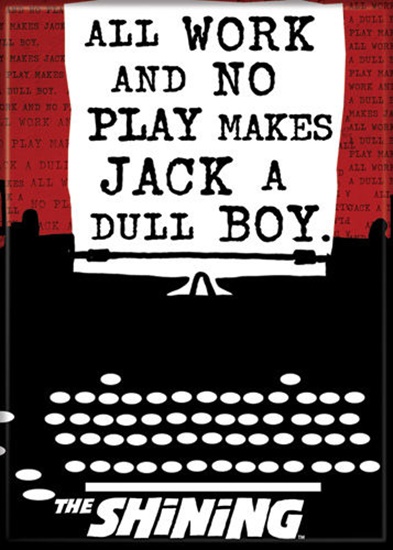
LORELAI: Well, we like our internet slow, okay? We can turn it on, walk around, do a little dance, make a sandwich. With DSL, there’s no dancing, no walking, and we’d starve. It’d be all work and no play. Have you not seen The Shining, Mom?

The Shining is a 1980 horror film directed by Stanley Kubrick, based on Stephen King’s 1977 novel of the same name. The film is about an aspiring writer named Jack Torrance (Jack Nicholson), who accepts a job as caretaker at a spooky old hotel. Supernatural forces conspire to send his sanity into a tailspin, placing his family in danger.

At one point, Jack’s wife (Shelley Duvall) looks at what her husband has been writing on the typewriter, and finds he has just been typing All work and no play makes Jack a dull boy over and over, filling hundreds of sheets of paper in the process. (The phrase is a traditional English proverb about work-life balance).

Although initially gaining a lukewarm reception from critics, The Shining is now regarded as one of the greatest horror films ever made.

New Harry Potter

[Miss Patty is standing at the doorway of her dance studio. Inside, a class of girls walks around with books on their heads.]
MISS PATTY: Now, walk smooth. That’s the new Harry Potter on your heads. If they should drop, Harry will die, and there won’t be any more books.

Harry Potter is a teenage wizard in a series of fantasy books by British author J.K. Rowling (born 1965), the most successful book series in publishing history. The first in the series was Harry Potter and the Philosopher’s Stone (Harry Potter and the Sorcerer’s Stone in the US), published in 1997.

The “new” Harry Potter book the girls are carrying is Harry Potter and the Goblet of Fire, published in July 2000 – the US children’s edition is pictured. Harry Potter fans may be somewhat amused by Miss Patty’s threat.

English class

We see Rory in her English Literature class at Chilton, and the teacher discusses Russian literature, and how it was influenced by both English and French culture.

The teacher mentions Russian author Count Leo Tolstoy (1828-1910), regarded as one of the greatest authors of all time. He is best known for his novels War and Peace (1869) and Anna Karenina (1877), both seen as eminent examples of realist fiction.

The English novelist Charles Dickens (1812-1870) is said by the teacher to be Tolstoy’s favourite author. The perennially popular Dickens is regarded as one of the greatest writers of his era, and Tolstoy did indeed see him as an enormous influence on his own work. His novel David Copperfield (1850) was Tolstoy’s favourite, and in fact Dicken’s favourite of his own novels, being heavily based on Charles Dickens’ life. Other Dickens novels that the teacher mentions as influential on Tolstoy are Great Expectations (1861), A Tale of Two Cities (1859), and Little Dorrit (1857).

We learn that the week before the class studied Russian novelist Fyodor Dostoevsky (1821-1881), whose best-known works include Crime and Punishment (1866), The Idiot (1869), and The Brothers Karamazov (1880).

The French author George Sand (the pen name of Amantine-Lucile-Aurore Dupin, 1804-1876) is mentioned as one of Dostoevsky’s favourites. She wrote numerous novels and short stories, with Consuelo (1850) considered her greatest work.

Honoré de Balzac (1799-1850) is another French author whose works were beloved by Dostoevsky. One of the founders of literary realism in Europe, Balzac is most famous for La Comédie humaine (“The Human Comedy”), a series of more than 90 interlinked novels, stories, and essays depicting French society in the 19th century.

The classroom scene shows what a huge step up in academic standards Rory has taken at her new school: a complete contrast to studying Huckleberry Finn at Stars Hollow High, with the other girls more interested in nail polish than the text. Paris may be obnoxious, but at least she is giving Rory something to aspire to as a student.

We can see that a whole new world of literature will open up to Rory at Chilton, feeding and validating her love of books.

Hunchback

RORY: What are you looking at?
LORELAI: I’m just trying to see if there’s a hunchback up in that bell tower.

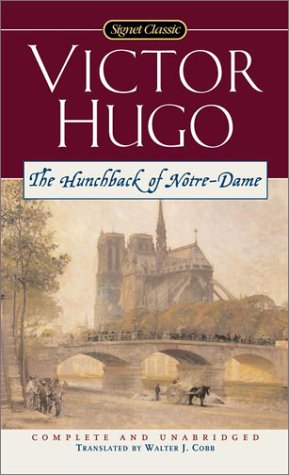
Lorelai is alluding to The Hunchback of Notre-Dame, a Gothic novel by French author Victor Hugo which was first published in 1831. Set in the Middle Ages, the protagonist of the novel is Quasimodo, a hunchback who is the bell-ringer in the cathedral of Notre-Dame in Paris. It has several times been adapted to film. The most recent for Lorelai and Rory in 2000 would be the 1996 animated Disney version.

It is ironic that it is Quasimodo’s job to mark the time of day by ringing out the bells in the cathedral to mark the time of day, when Lorelai’s clock did not go off.

“Off with their heads”

[Lorelai and Rory sit in the Jeep staring at the school]
RORY: I remember it being smaller.
LORELAI: Yeah. And less . . .
RORY: Off with their heads.

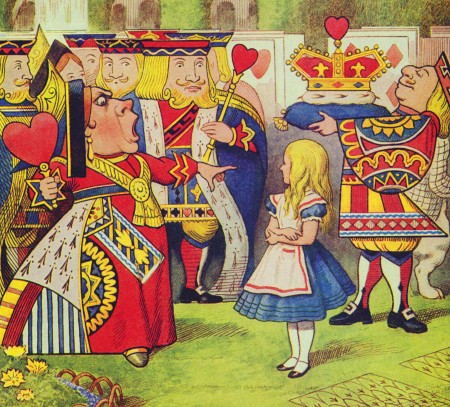
“Off with their heads” is a quote from The Queen of Hearts, a character in Alice’s Adventures in Wonderland, whose furious catchphrase demands immediate death sentences on the flimsiest pretexts.

This nonsensical fantasy novel was written by English author Lewis Carroll (the pen name of Charles Dodgson) and published in 1865. An immediate publishing sensation, it has gone on to become a classic enjoyed by both children and adults. It has been adapted into other media numerous times: as a child, Rory may have seen the 1951 Disney movie Alice in Wonderland, which was re-released on video in 1991 when she was seven – the same age Alice is in the book.

The book begins with a white rabbit looking at his watch and worrying that he is running late, just as Lorelai and Rory began the day behind schedule. The book plays with the concept of time and dates, much as Gilmore Girls does.