Theatre References

The episode begins with a quick flurry of theatrical references at a Friday Night Dinner, suitable for one with the dramatic title, “Presenting Lorelai Gilmore” (as if Rory is the star of the show). We can tell straight away that this episode will be all about presentation, staging, and image – the face shown to the public, and how that contradicts the private, backstage life.

The Sound of Music

The new maid introduces herself as Liesl, which is the name of one of the von Trapp children in The Sound of Music. Lorelai tells the maid that she is Brigitta, and Rory is Gretl, two of the other children (the others are Friedrich, Louisa, Kurt, and Marta).

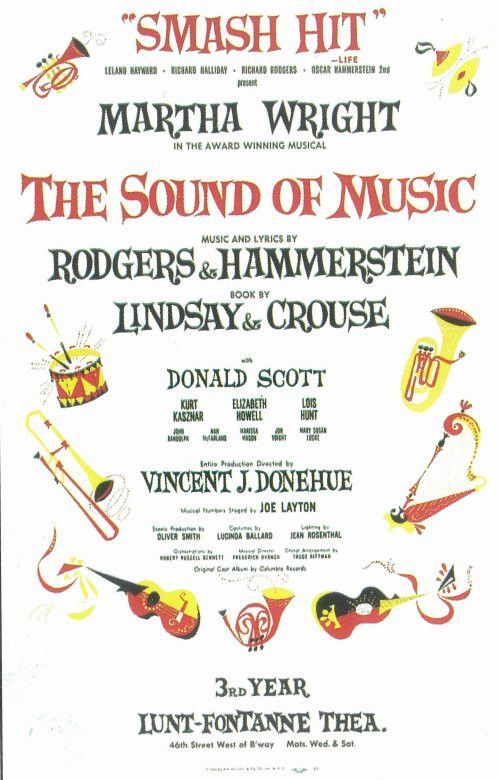
The Sound of Music is a musical with music by Richard Rodgers and lyrics by Oscar Hammerstein., book by Howard Lindsay and Russell Crouse. Based on the 1949 memoir by Maria von Trapp, The Story of the Trapp Family Singers, it is set in Austria just before it was annexed by the Nazis in 1938. Many of the details of the von Trapps’ real life were altered to make the the story more dramatic, and the names of all the children were changed.

The original Broadway production opened in 1959 with Mary Martin and Theodore Bikel in the lead roles. It won five Tony Awards, including best musical, and the first London production opened in 1961. A film version was made in 1965, starring Julie Andrews and Christopher Plummer, which won five Academy Awards, including Best Picture.

Who’s Afraid of Virginia Woolf?

Lorelai compares her arguing parents with George and Martha, from Who’s Afraid of Virginia Woolf?, previously discussed. In the play, George and Martha invite a young couple to their home, and then use their dramatically cruel arguments as a display for them. Lorelai is suggesting that she and Rory are in the role of the other couple.

The Lion King

After suggesting that her parents are providing them with “dinner theatre”, and wishing she had popcorn to enjoy with the show, Lorelai then likens Richard and Emily’s fight to “The Lion King without the puppet heads”. The climax of The Lion King contains a dramatic fight to the death between two lions.

The Lion King is a musical based on the 1994 animated Disney film of the same name, with music by Elton John, lyrics by Tim Rice, and book by Rogers Allers and Irene Mecchi. The musical features actors in animal costumes, as well as giant hollow puppets.

The Lion King made its debut in 1997, first opening in Minneapolis before moving to Broadway. It is still running after more than 9000 performances, is the third longest running musical in history, and has grossed more than $1 billion, making it the highest-grossing Broadway production of all time. The show opened in the West End in 1999, and is still running after more than 7500 performances. The musical has made than $8.1 billion overall.

The Lion King musical and the film are the top-earning titles in box-office for both stage and screen.

Terrence McNally

After cheekily giving her mother a “Brava! Encore!”, Lorelai says, “Does Terrence McNally know about you two?”.

Terrence McNally (1938-2020) was a multi award-winning American playwright, librettist, and screenwriter. Known as “the bard of American theatre”, McNally won five Tony Awards, including a Lifetime Achievement Award. Inducted into the American Theater Hall of Fame in 1996, he won Lifetime Achievement awards from the Dramatists Guild and the League of Off-Broadway Theatres and Producers. In 2018 he was inducted into the American Academy of Arts and Letters, the highest recognition of artistic merit in the US. His career spanned six decades, and he was vice-president of the Council of the Dramatists Guild.

At one time, he was the partner of Edward Albee, who wrote Who’s Afraid of Virginia Woolf?.

Barbara Walters

MAX: We could sit.
RORY: Sit, sure, that’s good. Barbara Walters sits, or walks sometimes if the person she’s talking to has a horse or a ranch or a big backyard sometimes, but usually she just sits.

Barbara Walters (born 1929) is an American broadcast journalist, author, and television personality, now retired. Known for her interviewing skills and popularity, she was the host of numerous television programs. She began her career on the Today Show in the 1960s, and was co-host by 1974, the first female to take such a role, and continued her pioneering efforts by becoming the first woman to work as a co-anchor on a nightly news broadcast for the ABC.

In 2001, Walters was producer and co-host of 20/20 and The View, and had an annual special on the ABC, Barbara Walters’ 10 Most Fascinating People, as well as other interview specials.

Barbara was inducted into the Television Hall of Fame in 1989, received a star on the Hollywood Walk of Fame in 2007, and received a Lifetime Achievement Award from the National Academy of Television Arts and Sciences in 2000.

Doctor Laura

JESS: You know, you don’t know anything about me, or my life, or my mom, or Luke, so why don’t you Doctor Laura someone else?

American talk show host and author Laura Schlessinger (born 1947), best known for her radio show, The Dr Laura Program. With a background as a marriage and family counsellor, Schlessinger typically answers callers’ requests for advice, and gives short monologues on social and political topics.

Her show was highly popular, but around the early 2000s began losing listeners because Schlessinger was giving less relationship advice and more lectures on morality and conservative politics, in particular, her opposition to homosexuality. No doubt this comparison would have infuriated Lorelai, as it was intended to.

John and Jackie

MADELINE: Hey, did you hear that Kimber Slately and Tristin are a major item?

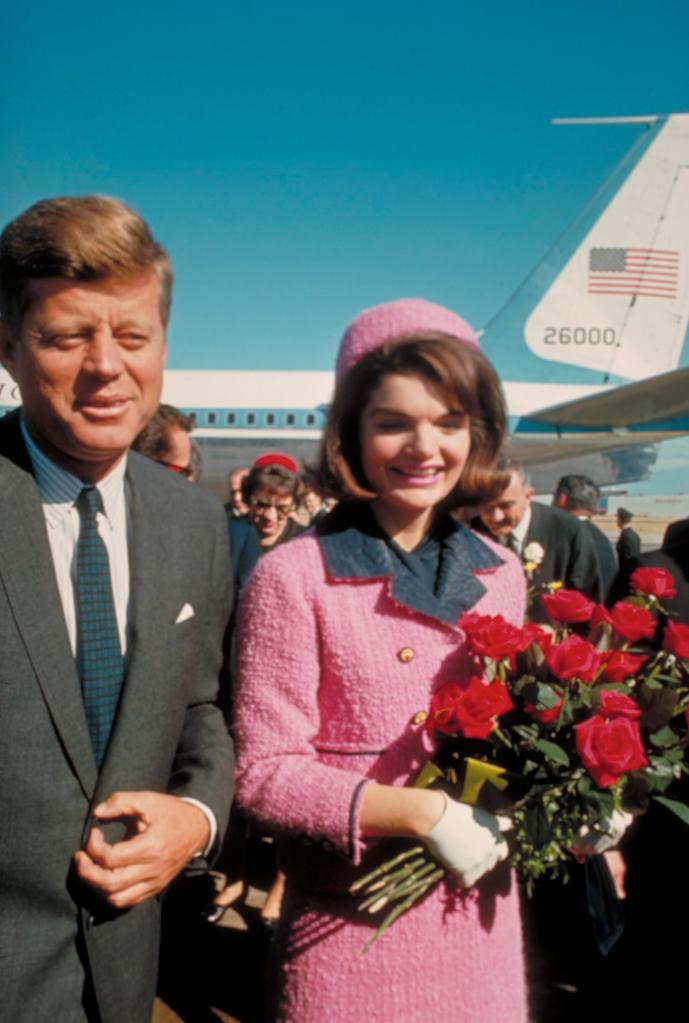
LOUISE: I thought that Kimber and Shawn Asher were this year’s John and Jackie.

Louise is referring to former President John F. Kennedy (1917-63), and his wife Jacqueline “Jackie” Kennedy, nee Bouvier (1929-94). Good-looking and relatively young when Kennedy took office in 1961, they quickly became a golden couple who were popular in media culture, treated more like movie stars than a political family.

Fellini

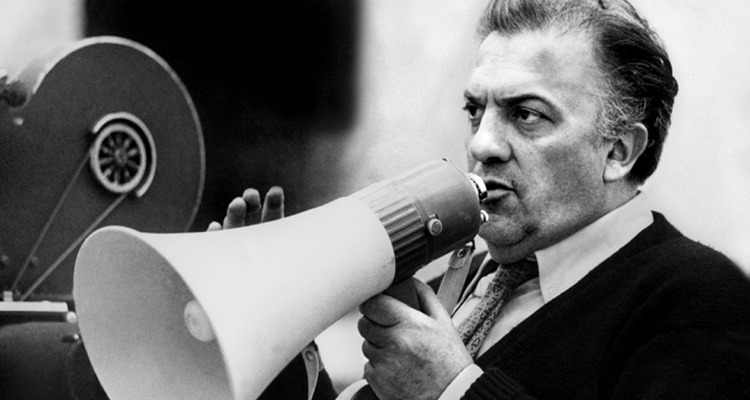
LORELAI: Sookie will cook, Rory will be there. It’ll be a little ‘Hey, welcome to Stars Hollow and see, everyone here’s not straight out of a Fellini film’ kind of an evening.

Federico Fellini (1920-1993) was an Italian film director known for his distinctive style, blending fantasy, baroque, and earthy sexuality. Recognised as one of the greatest and most influential directors, his most famous film is La Dolce Vita (1960).

Lorelai is simply saying that Jess will be able to see not everyone in town is weird.

Jess Mariano (Milo Ventimiglia)

Jess Mariano is Luke’s seventeen-year-old nephew, the son of his sister Liz. He was introduced in Season Two as a romantic interest for Rory, and as a contrast with her boyfriend Dean. Jess is the “bad boy” that Lorelai feared Rory would be attracted to, in the same way she was when she was a teenager.

Jess is introduced when he steps off the bus, the modern teenage equivalent of the mysterious stranger riding into town. The bus says it is going to Hartford, and Jess boarded it in New York, so Stars Hollow must be on the bus route between these points. In real life, the bus route from New York to Hartford goes through Danbury and Waterbury, which doesn’t seem that implausible as far as Stars Hollow’s possible location goes. The bus trip takes about two and a half hours, and we later learn the bus got in at 10 am.

Jess and Luke greet each monosyllabically by simply saying each other’s names. The mirroring is a sign that Jess and his uncle share at least one characteristic – neither of them are particularly talkative.

There has already been a character named Jess in Gilmore Girls – the college boys that Madeline and Louise got with at The Bangles concert in Season 1 were named Jess and Sean. Maybe Jess seemed like a very “New York bad boy” sort of name? Or the writers really like the name Jess?

Both Rory and Jess have unisex names, or names more common on the opposite sex. It’s interesting that the name Jess Mariano has the same rhythm as Dan Palladino, and they’re obviously both of Italian heritage.

Liz

LUKE: Look, his problem is obvious, it’s his mother. You never could count on Liz for anything. Our mom died when we were kids, right? It was just my dad, me and Liz. And my dad worked all the time and I worked in the store with my dad, and Liz was off doing God knows what.
LORELAI: Well, I bet losing her mom so early was kind of hard on her.
LUKE: It was hard on all of us, but we did our part. And then the minute she graduates high school, she is outta here. Didn’t matter that my dad was sick, didn’t matter that the store was failing, she just took off. Married the hot dog king, had a kid, he left, now here we are.

Luke gives Lorelai a potted history of his sister Liz. After the death of their mother while they were young, Luke fell into the role of the “good child” who supported his father and worked alongside him in the hardware store when he wasn’t at school. Liz was the “bad child”who ran around town and did her own thing.

As soon as she finished school, she left town (and went to California?) despite her father being ill and the family business going downhill as a result. Luke now makes it sound as if Liz’s husband worked at (or owned?) the Wienerschnitzel restaurant, not merely another customer. In fact, he had a similar job to the one Luke now has!

Lorelai is immediately sympathetic to Liz, understanding the terrible loss of her mother at a young age, and having personal knowledge of being a wayward teenage girl, family black sheep, and young mother herself.

It possibly explains one of the reasons Luke is drawn to Lorelai. She was a rebellious teen like his sister and even had her child the same year as Liz, and yet while he can only see Liz as a screw-up and a flake, Lorelai is energetic, hard-working, ambitious, and a pillar of their community. Of course, Lorelai wasn’t orphaned in her teens, and her family didn’t go broke, so it’s hardly a fair comparison.

In fact, despite Luke’s disparaging summation of his sister’s character, her life story doesn’t sound particularly dire or even that unusual. She got out of a probably stifling small town to escape a miserable family situation, travelled across the country, met a small business owner (?) or at least someone in employment, got married and had a child. Although she married young, the marriage lasted fifteen years or more, leaving her as a single mother to a teenage boy who seemingly inherited her own rebellious streak.

Luke’s relationship with his sister opens up a number of questions. Does he see Lorelai as the girl who turned her life around with the support of Stars Hollow, the way he wishes Liz had? Does he sometimes cast Lorelai in the role of a ditzy younger sister? Does he give Lorelai and Rory the help and friendship he wishes he could have bestowed on Liz and her son?

And if he had directed his love and care towards his sister and nephew instead, would they be in the mess they are now? Because Lorelai has lived in Stars Hollow for more than ten years, and she didn’t even know Luke had a sibling.

(By the way, Liz is another name from General Hospital – Luke and Laura’s son Lucky married a girl named Liz, and they became a younger generation “supercouple”).

Lewis and Clark

LUKE: Hey!
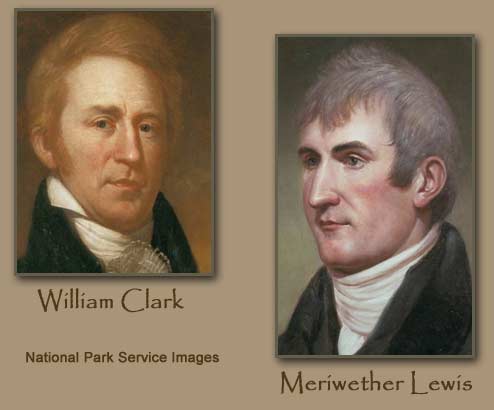
LORELAI: Lewis and Clark have returned.

Captain Meriweather Lewis and his close friend Second Lieutenant William Clark were American explorers who formed an expedition which ran from 1804 to 1806. It was the first American expedition to cross the western portion of the United States, beginning in St. Louis, Missouri, and ending on the Pacific Coast.

Katharine Hepburn

EMILY: You know what, I’m not returning the gift. I’m going to put it away in a closet and you won’t know what it is until you do get married someday.
LORELAI: Tell me now!
EMILY: Sorry.
LORELAI: Come on! Mom, I may never get married. I may be a free spirit my whole life, or fall in love with a separated Catholic guy like Katharine Hepburn did, and then not get to go to his funeral when he dies.

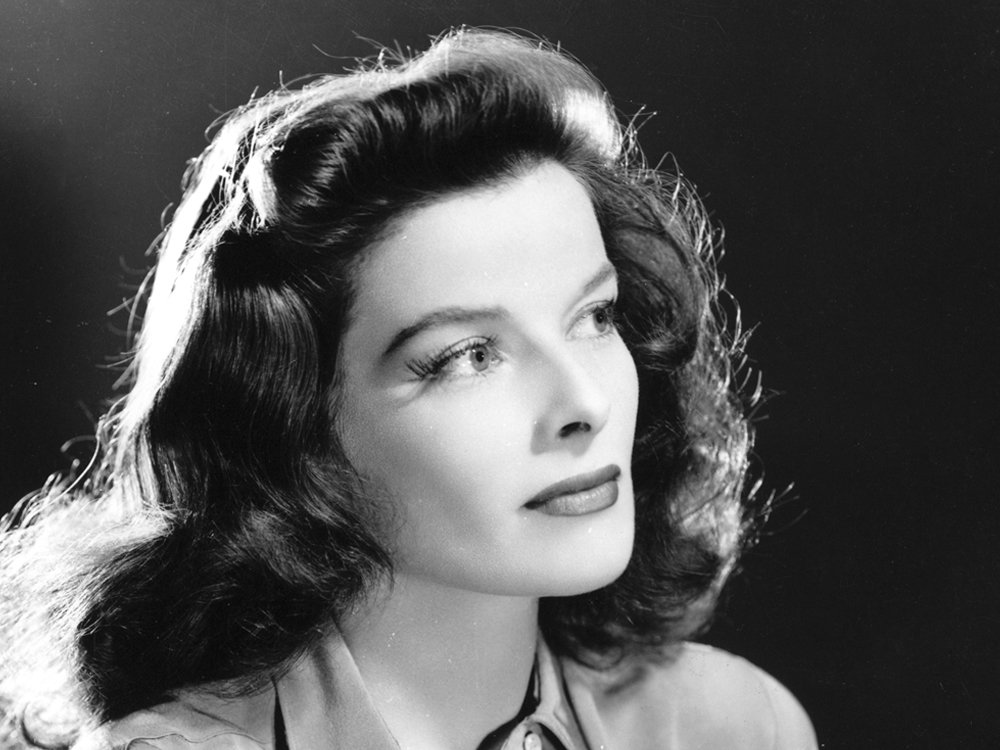
Katharine Hepburn (1907-2003) was an American actress who was born and grew up in Hartford; like Rory, she attended a private school there. A leading lady in Hollywood for more for 60 years, she received four Academy Awards for Best Actress – a record number for any performer. In 1999 Hepburn was named the greatest female star of Classic Hollywood Cinema by the American Film Institute.

After beginning her career in theatre, success on Broadway brought Katharine Hepburn to Hollywood, and she received her first Academy Award for her third film, Morning Glory (1933). This was followed by a series of failures, but she arranged her own comeback by buying the rights to the film The Philadelphia Story (1940), only selling them on condition of starring in itself. The film was a massive success, and is regarded as one of the best screwball romantic comedies of all time.

In the 1940s Hepburn was contracted by MGM, where she frequently played opposite film star Spencer Tracy (1900-1967); their screen partnership lasted 25 years, and produced nine movies. Hepburn and Tracy maintained a private relationship for 26 years, lasting until his death. Spencer Tracy was married, but had been separated from his wife for several years before beginning his relationship with Katharine Hepburn.

Spencer Tracy was a Catholic, but it is not clear if this was the reason for not divorcing his wife (who was an Episcopalian). From comments he made, it seemed more as if he was going along with the wishes of his wife, while Hepburn didn’t interfere and never pushed for marriage. After his death, Katharine Hepburn did not attend his funeral out of consideration for his wife and children.