Proust

LORELAI: (turns around to look at Max’s books) Wow these are beautiful! Hmm, I never read Proust, I always wanted to.

Marcel Proust (1871-1922) was a French author, best known for his monumental seven-volume part-autobiographical novel, À la recherche du temps perdu (“In Search of Lost Time”, earlier translated as “Remembrance of Things Past”), published between 1913 and 1927. He is considered to be one of the most influential writers of the twentieth century.

In a television series where the flow of time is a major theme, it’s not surprising that Proust makes a significant appearance, as his novel is a philosophical meditation on the nature of time, and how “clock” time can be very different to our personal experience of time.

Bouvier des Flandres

The dog Buttercup is an interesting mixture of Cocker Spaniel, Golden Retriever, Rottweiler, and Bouvier des Flandres. (The actual dog does not resemble this description very closely).

Bouvier des Flandres is a large woolly herding dog breed from Belgium; its name means “cowherd of Flanders” in French. President Ronald Reagan and his wife Nancy owned a dog of this breed named Lucky.

Paris is Burning

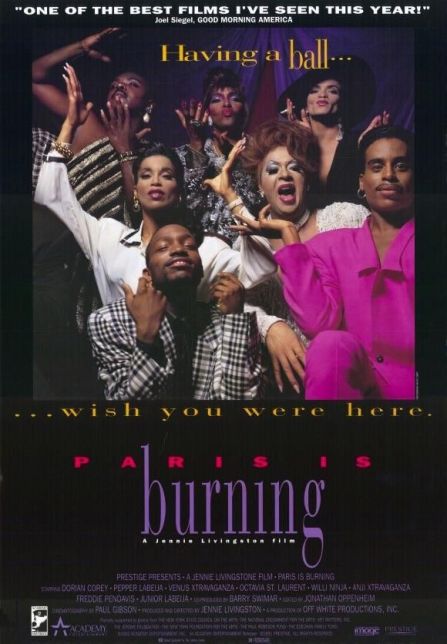
The episode title may be a reference to the 1990 documentary film Paris is Burning, directed by Jennie Livingston. The documentary is about the drag ball culture in New York City, and the drag competitions which take place at the balls. The documentary film received rave reviews and several awards at film festivals; it remains relevant in discussions on LGBT, youth, class, and racial issues.

The film’s title comes from drag performer Paris Dupree (1950-2011), who gave a drag ball with the name. It may have been partially inspired by Adolf Hitler’s reported question during World War II, “Is Paris burning?”, when he wished the city to be completely destroyed rather than re-taken by the Allies.

This episode centres on Paris Geller, who we learn more about in this episode, and who does indeed “burn down” or destroy the relationship between Lorelai and Max. She does so to deflect public attention from her own problems, thus playing a role like the drag performers in the film.

Charo

LORELAI: Rory, there are only two things that I totally trust in this entire world. The fact that I will never be able to understand what Charo is saying no matter how long she lives in this country – and you.

Charo (born Maria Martinez Molina Baeza in perhaps 1941) is a Spanish-American actress, comedian, and flamenco guitarist. In the late 1960s and 1970s Charo frequently appeared on American television as a guest star, and she has had a successful musical career in Latin America for five decades.

Her stage persona has an exuberant manner, wears flamboyant costumes, speaks broken English with a heavy Spanish accent, and uses the meaningless catchphrase “cuchi-cuchi” a lot – hence Lorelai’s difficulty in understanding her.

Jimmy Hoffa

LUKE: So who are you gonna go find now?
LORELAI: Stop.
LUKE: How about Jimmy Hoffa? That’ll keep you busy for a while.

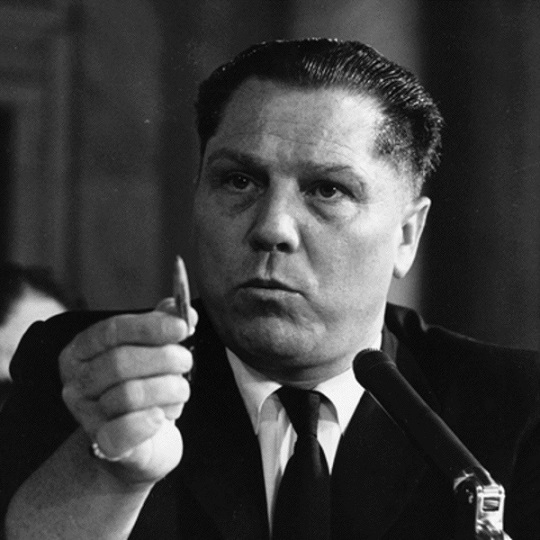
James “Jimmy” Hoffa (1913-1975) was an American union leader who was President of the International Brotherhood of Teamsters from 1958 to 1971. He had links with organised crime, and was accused of jury tampering, attempted bribery, and fraud in 1964. He was imprisoned in 1967, and released in 1971 after being pardoned by President Richard Nixon in exchange for his resignation from the union presidency; he was barred from union activities until 1980.

Jimmy Hoffa vanished in 1975 while on his way to meet two Mafia leaders, and was declared legally dead in 1982. Several people have come forward saying that they know where Hoffa’s body is, or even claiming to have killed him, but their evidence hasn’t been corroborated, or their testimony unable to be proven. The FBI believe that Hoffa was murdered by the Mafia, but the case remains open.

Cosmo Woman

NURSE: Ms. Gilmore, uh, I need you to –
EMILY: It’s not “Ms. Gilmore”, it’s Mrs. Gilmore! Mrs. Gilmore, I’m not a Cosmo Woman!

Emily is referring to Helen Gurley Brown (1922-2012), who became editor of Cosmpolitan magazine in 1965 after the success of her best-selling 1962 advice book Sex and the Single Girl. She championed glamorous, fashionable, and sexually liberated women, who became known as “Cosmo Girls”.

It’s possible that Emily, in her state of distress, has somehow confused Helen Gurley Brown and feminist Gloria Steinem (born 1934) – Steinem became the editor of Ms. magazine in 1972, which featured Wonder Woman on its first cover.

Emily would have been a wife, and then a mother, at the time of the rise of Gurley Brown and Steinem – very proud to be “Mrs. Richard Gilmore”, and the opposite of the independent career woman in Cosmpolitan, and of the woman speaking out against the restrictions of marriage and family in Ms.

I’m not sure whether she says “Cosmo Woman” via mixing up Cosmo Girl and Wonder Woman from Ms. Magazine, or whether she simply can’t bear to refer to herself as a “girl” when she’s a mature-aged woman.

Crazy Bomber

DEAN: So am I like public enemy #1 with you?
LORELAI: #1? I don’t know, would you settle for top five? Because I’m still a little hot for that crazy bomber guy who’s been living in a cave for a year.

Lorelai is most likely referring to domestic terrorist Eric Rudolph (born 1966), known as the Olympic Park Bomber. He perpetrated the Centennial Olympic Park bombing at the 1996 Summer Olympics in Atlanta, and went on to commit a series of anti-abortion and anti-gay motivated bombings between 1996 and 1998 in the southern states of the US.

Rudolph was listed on the FBI’s Ten Most Wanted, and lived as a fugitive in the Appalachian wilderness for five years, camping in the woods. Lorelai assumes that Rudolph must be living in a cave because the authorities were scouring the area in search of him.

Rudolph was arrested in 2003 and sentenced to life imprisonment without parole in 2005. He is currently serving his sentence in a Colorado prison, spending most of the day in solitary confinement.

“Formerly known as”

RORY: Fine, forget it. Should I put your name on Grandma’s present?
LORELAI: Yes, sign it the inn keeper formerly known as her daughter.

Lorelai is making a reference to the American pop singer Prince (1958-2016). In 1993, after a battle with Warner Bros., who refused to release his huge backlog of music at a steady pace, Prince changed his name to a symbol which combined the symbol for male with that for female, and which he later copyrighted as Love Symbol #2 – it had already featured on his 1992 album The Love Symbol Album (it has to be called that as the actual name cannot be said).

Because Prince’s new name was unable to be spoken, he was referred to as “The Artist Formerly Known as Prince” until May 2000, when he reverted to his real name of Prince (he was born Prince Nelson).

Lorelai is saying that her relationship with her mother has come to a complete and bitter end, much like Prince’s relationship with his record label – although in fact Prince was to re-sign with Warner in 2014.

Lorelai refers to herself as an innkeeper rather than an executive manager because she is still thinking of the Christmas pageant, where the innkeeper refuses entrance to Mary and Joseph, forcing them to spend the night in the stable, where Jesus is born. She likewise doesn’t feel like admitting her family into her life.

Emily Post

EMILY: Young man, come in here please.
LORELAI: Hey, Dean, meet my mother, Emily Post.

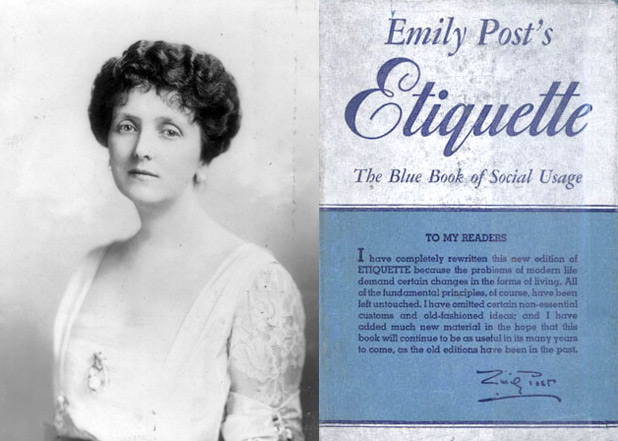
Emily Post (1872-1960) was a famous expert on etiquette. Her 1922 book Etiquette in Society, in Business, in Politics and at Home became an instant best-seller, was popular for decades, and made her name. She went on to write newspaper columns on etiquette, and founded the Emily Post Institute in 1946, which carries on her work.

It’s interesting to wonder if Emily Gilmore is named after her.