PARIS: We were actually discussing modern day Marxism in America, which is not what I would have deemed a ‘come and get it’ sort of conversation, but nevertheless, he came and got it, and I have to figure out what that means to me on a psychological level.
Marxism, a left-wing method of socioeconomic analysis that uses a materialist interpretation of historical development, better known as historical materialism, to understand class relations and social conflict and a dialectical perspective to view social transformation. It originates from the works of 19th-century German philosophers Karl Marx and Friedrich Engels. As Marxism has developed over time into various branches and schools of thought, no single, definitive Marxist theory exists.
NICOLE: Yeah, my father always told me that which does not kill you, makes you stronger.
What does not kill me, makes me stronger. An aphorism of philosopher Friedrich Nietzsche, from his 1888 book, Twilight of the Idols. It is often quoted or alluded to with minor variants in wording, to express resilience. It can hardly be said to be universally true.
LORELAI: Wow, does that guy look smart. I mean it, he’s got the smart look down. The glasses, the furrowed brow, the ticky walk.
RORY: The Kierkergaard.
Søren Kierkegaard (1813-1855), Danish theologian and philosopher, widely considered to the first existential philosopher. Much of his philosophical work deals with the issues of how one lives as a “single individual”, giving priority to concrete human reality over abstract thinking and highlighting the importance of personal choice and commitment. By the mid-20th century, his thought had exerted a substantial influence on philosophy, theology, and Western culture in general.
FRANCIE: This is politics. If you’ve got a problem, tell it to Noam Chomsky. I live in the real world, now blow.
Avram Noam Chomsky (born 1928), linguist, philosopher, cognitive scientist, historical essayist, social critic, and political activist. Sometimes called “the father of modern linguistics”, Chomsky is also a major figure in analytic philosophy. He is a Laureate Professor of Linguistics at the University of Arizona and an Institute Professor Emeritus at MIT, and is the author of more than 150 books on topics such as linguistics, war, politics, and mass media. Chomsky’s latest book at that time was Understanding Power, a collection of transcripts about political activism from lectures and seminars given by Chomsky, published in February 2002.
Francie is thinking of Chomsky’s political views, which are broadly anarchy-syndicalist and libertarian socialist. Many of his books and lectures have been critical of the US government, its foreign policies, and its method of democracy – in particular, the way that political power at presidential level is controlled by the privately wealthy and by the public relations industry. In Francie’s view, his ideas are impractical and theoretical, not “the real world”.
LORELAI: Sookie, Jackson loves you. You’re not seriously telling me the future of your marriage depends on Leon Troutsky over there.
Lorelai makes a pun on the name Leon Trotsky (born Lev Bronstein,1879-1940), Russian-Ukrainian Marxist revolutionary, political theorist and politician. Ideologically a communist, he developed a variant of Marxism which has become known as Trotskyism. After the death of Lenin and the rise of Joseph Stalin, Trotsky gradually lost favour, and he was expelled from the Soviet Union in 1929. He spent the rest of his life in exile and was assassinated in Mexico City in 1940 by an agent of the Soviets.
PARIS: So, I have been racking my brains for weeks trying to figure out exactly who should be my vice presidential candidate, you know? Who would be Yin to my Yang, Joel to my Ethan, Damon to my Affleck, and then suddenly, it hits me – the perfect person … You.
Yin and Yang
An ancient Chinese philosophical concept of harmonising opposites, where Yin is passive and feminine, and Yang is active and masculine, but each force is equal, interdependent, and complementary. Note that Paris designates herself as the active Yang principle!
Joel and Ethan
Joel Coen (born 1954) and Ethan Coen (born 1957), filmmakers. The films of the Coen Brothers span many genres and styles, which they frequently subvert or parody. Their most acclaimed works include Raising Arizona (1987), Fargo (1996), The Big Lebowski (1998), and O Brother, Where Art Thou? (2000).
Damon and Afflleck
Matthew “Matt” Damon (born 1970), and Ben Affleck (born Benjamin Affleck-Boldt in 1972), actors and filmmakers. They wrote the screenplay for the 1997 film Good Will Hunting, directed by Gus Van Sant, in which they also starred. They won the Oscar for Best Screenplay. They later played parody versions of themselves in the film in the 2001 comedy film, Jay and Silent Bob Strike Back, directed by Kevin Smith. [Picture shows Affleck and Damon in Good Will Hunting].
Paris only now chooses Rory as her running mate, with the election mere days away. Shouldn’t she have chosen a vice-presidential candidate ages ago?
RORY: But if I’m doing my [Philosophy] homework, doesn’t that defeat the point of going to see you play?
DEAN: You can’t glance up in between nihilistic theories?
Nihilism is a philosophy that rejects fundamental aspects of human existence, such as truth, knowledge, morality, values, or meaning. Different nihilist positions hold variously that human values are baseless, that life is meaningless, and that knowledge is impossible. It often takes on a despairing tone.
Another reminder that Dean isn’t as stupid as the writers often make him look, he at least knows the word nihilism. It does seem a little disparaging towards Rory’s studies though, with the subtle implication that her homework is meaningless. He may be feeling a little despairing himself by this stage.
Feng shui is an ancient Chinese practice which claims to use energy forces to harmonise people with their surrounding environment. It is generally used in interior design of homes and workplaces. Dating back to at least 4000 BC, its name literally means “wind-water”.
RORY: Really? Try it. The Fountainhead is classic. JESS: Yeah, but Ayn Rand is a political nut. RORY: Yeah, but nobody could write a forty page monologue the way that she could.
The Fountainhead, 1943 novel by Russian-American author Ayn Rand, and her first literary success. The novel is about a ruggedly individualistic architect named Howard Roark, who battles against conventional standards and refuses to compromise his ideals. Rand said that Roark was the embodiment of her ideal man, and the novel reflects her views that the individual is more valuable than the collective.
Twelve publishers rejected the manuscript before Bobbs-Merrill took a chance on it, and contemporary reviews were mixed. However, it gained a following by word of mouth, and eventually became a bestseller. It has had a lasting influence, especially among architects, business people, conservatives, and libertarians. It was adapted into film in 1949, and turned into a stage play in 2014.
We here learn that Rory attempted to read The Fountainhead when she was ten, without success, but tried again when she was fifteen and liked it. Jess is taken aback by her recommending a text beloved of right-wing libertarians and “political nuts”, but Rory says she enjoys it as a piece of literature. The Fountainhead is absolutely full of characters having lengthy monologues where they clearly explain their philosophies, plans, and ideals.
The character of Howard Roark (allegedly based on architect Frank Lloyd-Wright) is a brooding man of few words, rather like Jess. Could Rory be recommending the book to Jess for that reason, to let him know that she likes a book where the protagonist is like Jess? A literary flirtation, like Jess annotating her copy of Howl?
Jess’ later career has a few things in common with Roark – neither of them graduate because they can’t be fettered by a conventional curriculum, both believe themselves to be misunderstood, both would prefer to take any paying job rather than compromise their creative integrity, and both become successful in their chosen fields.
More eye-raising is the character of Dominique, Roark’s love interest, and said to be his perfect match. Their first sexual encounter is so rough that Dominique describes it as a “rape”, and yet comes back for more, again and again. It’s a risque (or even plain risky) thing for a teenage girl to recommend to a boy she likes, and if this is a flirtation-by-literature, Rory seems to have suggested that Jess make things physical, even without her explicit consent.
This is the book Rory is reading on the couch when Lorelai gets home from the fashion show.
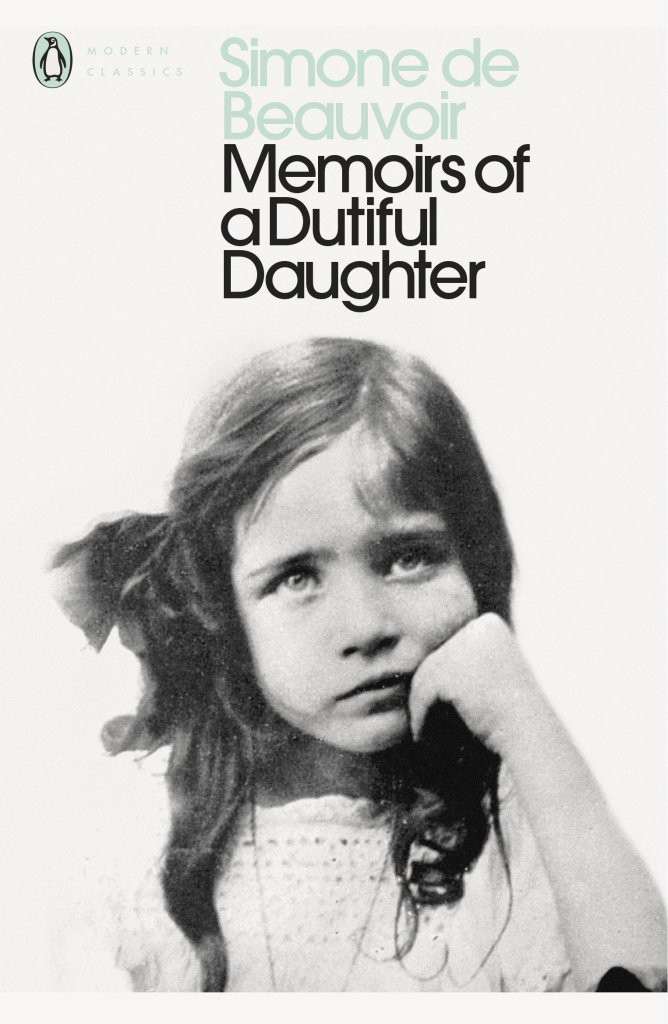
Memoirs of a Dutiful Daughter is a 1958 memoir by French author, existentialist philosopher, and feminist, Simone de Beauvoir, previously mentioned. It’s a beautifully-written, intimate portrait of her life growing up in a privileged, sheltered, upper middle class French family, rebelling as an adolescent against their conventions, and striking out on her own with intellectual ambition and a ceaselessly questioning, philosophical mind.
Rory often reads Lorelai’s books (they both have an interest in female biography and memoir), and this feels like one Lorelai would have been drawn to. She and de Beauvoir both had the same urge to escape a wealthy, claustrophobic background (Lorelai had Rory as part of her escape, while de Beauvoir had Sartre), and Lorelai spoke of always wishing she could use the word existentialist in a sentence.
The title of the memoir is ironic, but Rory really is a very dutiful daughter to Lorelai. Later on, she too will rebel against her mother.




 The Annotated Gilmore Girls