LUKE: Not from your angle. From mine, it was An Evening at the Improv.
An Evening at the Improv, cable television series running from 1982 to 1996. It showcased live comedy from The L.A. Improv comedy club, which opened in 1974, the sister venue to The Improv in New York City, which opened in 1963. Originally for singers, then singers and comedians, it became a stand up comedy club in the 1970s.
Some of the comedians featured on An Evening at the Improv include Bill Maher, Gary Mule Deer, Jerry Seinfeld, Janeane Garofalo, Steven Wright, Rich Hall, Rosie O’Donnell, Adam Sandler, George Lopez, Sandra Bernhard, Tim Allen, Drew Carey, Dave Chapelle, and Jim Carrey.
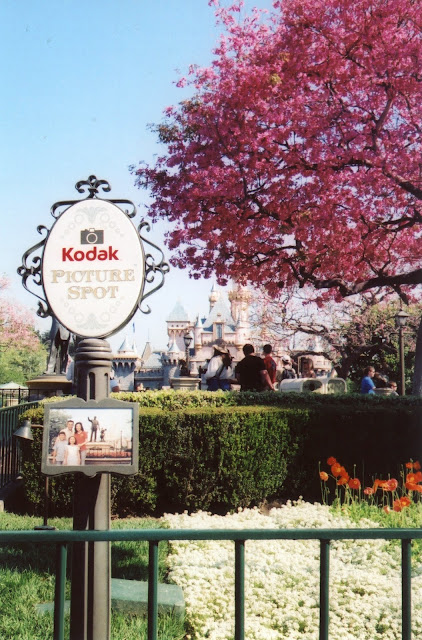
A Kodak Picture Spot, or Kodak Photo Spot, is a location with a Kodak-sponsored sign indicating a recommended spot from which to take a photograph. They are found in areas popular with tourists, and are particularly common in Disney theme parks. This situation lasted until 2012, when Kodak filed for bankruptcy, after which they became Nikon Photo Spots.
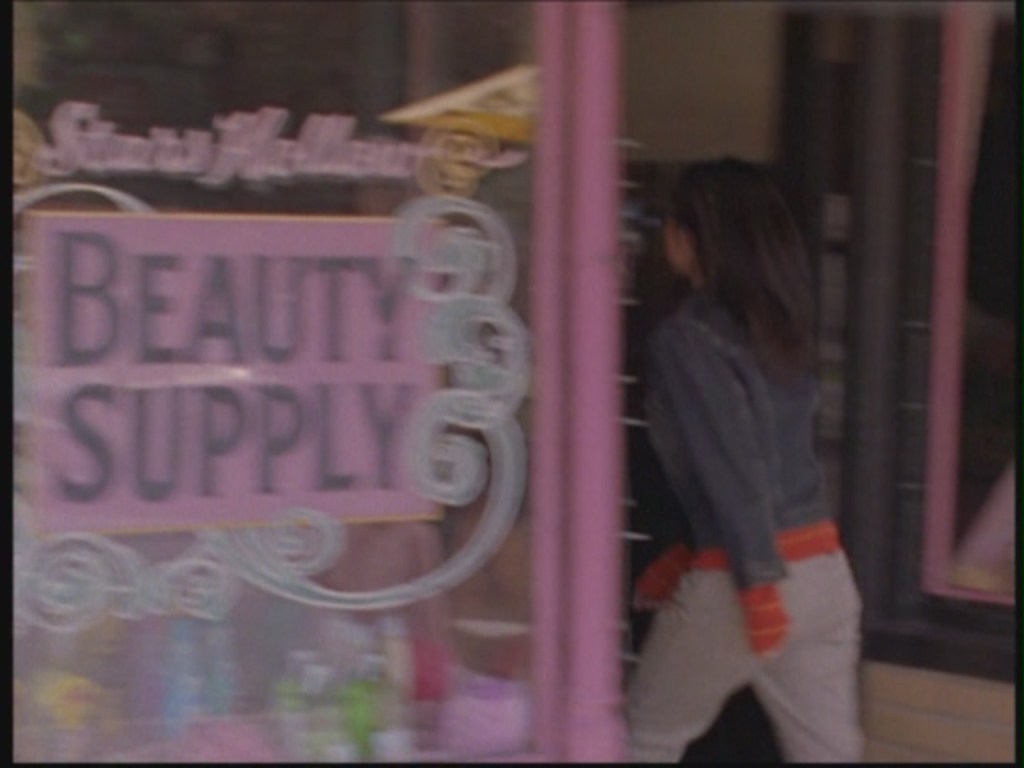
This is the beauty store in town where Rory and Lane buy Lane’s hair dye. Amusingly, it has a typically practical, generic name, like Stars Hollow Agricultural Supply. You don’t get lured into shopping for beauty products in Stars Hollow by something called Charmaine’s House of Glamour, or The Beauty Spot – you buy beauty products in the same pragmatic manner you pick up animal feed or a box of nails.
I take it Lane and Rory don’t usually shop here, as Rory is surprised to find that Shane works at the store – possibly as as an after-school job, I’m not sure if the show ever confirms whether Shane is still in high school.
I’m also not sure if Rory ever knew Shane before – they’re about the same age and live in a small town, so it seems likely, but she never says anything like, “Ugh, that awful Shane, I’ve hated her ever since she stole Jimmy Dandridge’s lunch in Fourth Grade”. Perhaps their paths didn’t cross, but they are not strangers either, so that she was vaguely aware of Shane’s existence, but never gave her a thought. Stars Hollow is just big enough that this is possible, especially if Shane’s family moved to town only in the last few years.
In the US, a junior college is a two-year post-secondary school whose main purpose is to provide academic, vocational and professional education. The highest certificate offered by such schools is usually an Associate degree, although junior college students may continue their education at a four-year university or college, by transferring some or all of their credits earned.
Dean might be planning to attend Goodwin College, a junior college in East Hartford that used to be a school of business. They have student housing available so that Dean would be able to live on campus.
There are three junior colleges in Boston – Bay State College, Fisher College, and Labouré College of Healthcare, which provides training for nurses and is probably not for Dean. Bay State and Fisher are mostly for business and administration degrees. Both Bay State and Fisher do have halls of residence for students to stay in, so Dean isn’t correct about that.
RORY: I don’t know. Your parents just made it sound like . . .
CAROL: Like I was holed up in the Chelsea with a needle sticking out of my arm screaming “Sid” at the top of my lungs?
A reference to Nancy Spungen (1958-1978), American girlfriend of English punk rocker Sid Vicious, and a figure of the 1970s punk rock scene. The two of them were habitutal heroin users, and eventually Nancy’s body was found in the bathroom of their room at the Hotel Chelsea in New York, stabbed to death. Sid Vicious died of an overdose before he could be brought to trial.
Their story is told in the film Sid and Nancy, previously discussed [pictured]. Carol seems to have all the same references as Lorelai as well.
LORELAI: I do know Instanbul is Constantinople, so if you’ve got a date in Constantinople, she’ll be waiting in Instanbul.
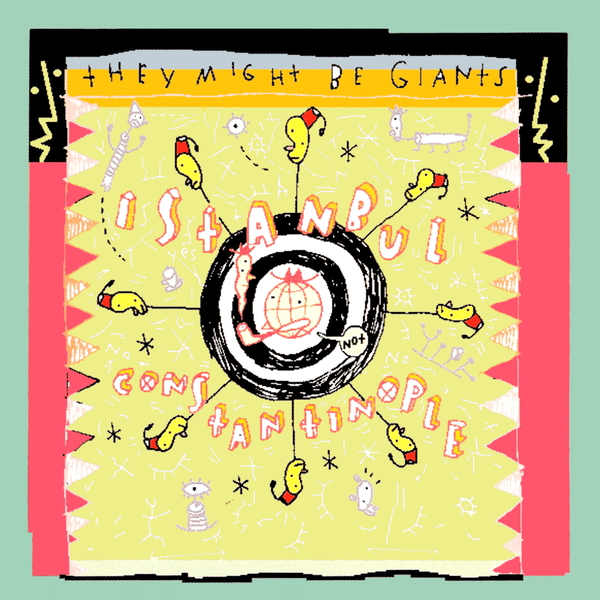
Lorelai refers to the 1953 novelty song “Istanbul (Not Constantinople)”, with lyrics by Jimmy Kennedy and music by Nat Simon. Written on the 500th anniversary of the fall of Constantinople to the Ottomans, the lyrics humorously refer to the official renaming of the Turkish city Constantinople to Istanbul. It’s said to be a response to the 1928 song “C-O-N-S-T-A-N-T-I-N-O-P-L-E”, recorded by Paul Whiteman and His Orchestra.
It was originally recorded by Canadian vocal group The Four Lads and peaked at #10 on the charts, becoming their first gold record. It’s been covered several times, and Lorelai might be thinking of the 1990 version by alternative rock band They Might Be Giants, from their album Flood. Released as a single, it went to #61 in the UK, and has been used on the soundtracks of several animated series, including Liquid Television and Tiny Toon Adventures in the 1990s.
The song is a part of the repertoire of the Yale a capella group, The Duke’s Men of Yale. As we later discover that Richard was in a different a capella group at Yale, is it possible Lorelai first learned the song from her father?
DARREN: Do you know which French city famous for its water was the capital of collaborationist France?
LORELAI: Oh, me? Um, Evian, Perrier, uh, Le Crystal Geyser?
JENNIFER: Vichy.
Vichy is a city in central France on the river Allier, a spa town and resort famous for its warm mineral springs, the direct result of historical volcanic activity – although the volcanoes have been dormant for more than a century. During World War II, it was the seat of government for Vichy France from 1940 to 1942. Officially independent, Vichy France adopted a policy of collaboration with Nazi Germany.
Lorelai quickly says the first brands of mineral water she can think of. Evian has been bottling mineral water from Évian-les-Bains in the French Alps since 1829. Perrier bottles its carbonated mineral water from Vergèze in Southern France, beginning production in 1898. Crystal Geyser is actually an American company, founded in Calistoga, California in 1977.
Westport is a town of 27 000 people in Connecticut on Long Island Sound, part of Connecticut’s affluent “Gold Coast”. Only 50 km or so from New York City, it is the ninth richest city in the US. It would be about an hour’s drive from Stars Hollow.
It is a favourite location in fictional works – it was the home of Samantha and Darrin Stephens on Bewitched, and Lucy and Ricky Ricardo move here to start a new life in I Love Lucy. It also features in the film The Man in the Gray Flannel Suit.
While Luke is serving customers at the diner, Kirk and two young boys come in, ordering old fashioned soda shop drinks. It soon transpires they were sent by Taylor, making a point how necessary such a soda shop is, which Taylor wants to install in the space next to the diner, owned by Luke. Kirk already works for Taylor, and the two boys are presumably in his Boy Scout troop.
Black Cow: Traditional name for a root beer float, which is root beer with vanilla ice cream. In some areas, the ice cream has to be chocolate in order to be called a black cow, and others say brown cow instead. (Root beer is a North American soft drink made using the root bark of the sassafras tree, or the sarsaparilla vine, Smilas ornata). Frank J. Wisner, owner of Colorado’s Cripple Creek Brewing, is credited with creating the first root beer float in 1893. The North American fast food chain A&W Restaurants are well known for their root beer floats.
Chocolate Phosphate: Traditional soda fountain drink, which is chocolate syrup and acid phosphate added to club soda. Acid phosphate is a mixture added to drinks which gives it a slightly tart flavour, and aids carbonation – a partially neutralised solution of diluted phosphoric acid made with salts of calcium, magnesium, and potassium. It’s recently come back into fashion as a mixer for soft drinks and cocktails.
This is the book Jess is reading when his girlfriend arrives to meet him.
A Confederacy of Dunces is a picaresque novel by John Kennedy Toole, written in 1963 but published in 1980, eleven years after Toole’s death by suicide. It became a cult classic, then a mainstream success, winning the Pulitzer Prize for Fiction in 1981. The title refers to an epigram from Jonathan Swift’s essay, Thoughts on Various Subjects, Moral and Diverting: “When a true genius appears in the world, you may know him by this sign, that the dunces are all in confederacy against him.”
The protagonist of the novel is Ignatius J. Reilly, an educated but lazy thirty-year-old man living with his mother in the Uptown district of New Orleans in the early 1960s. He has been called a modern Don Quixote, an eccentric and idealistic slob who disdains pop culture, and believes that his numerous failings are the working of a higher power. Due to a car accident his mother gets in, Ignatius must work for the first time in many years to pay off her damages bill, moving from one low-paid job to another and having various adventures with colourful characters in the French Quarter of the city.
The novel is famous for its rich depiction of New Orleans and its dialects, many locals seeing it as the best and most accurate fictional depiction of the city. A bronze statue of Ignatius J. Reilly is on Canal Street in New Orleans. It has been adapted for the stage, including as a musical comedy, and has often been planned as a film. These various attempts to adapt it for the screen have come to nothing (often with the slated lead actor dying, and once with a studio head being murdered, not to mention Hurricane Katrina devastating New Orleans in 2005), leading to the belief there is a “curse” on it as a film project.
The novel’s title is a comment on how Rory and Lorelai see Jess and his girlfriend in this scene, as a pair of “dunces” who can barely hold a conversation together. However, it is also believable as a modern American classic that Jess might read, complete with a male protagonist who is an intelligent failure railing against the world, his fate, and modern life. This seems to be the sort of hero that Jess can relate to. Note that it’s also set in the American South – a literary setting which Rory is also drawn to, underlining how much they have in common.





 The Annotated Gilmore Girls