“I can’t eat like that and look like her”

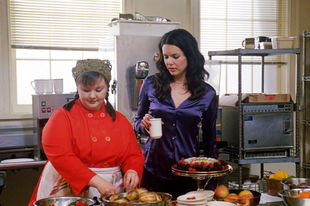
MICHEL: But I can’t eat like that and look like her. [gestures to Lorelai eating a rich omelette]

Michel surely speaks for most of the audience at this point: it drives many fans up the wall that Lorelai lives on sugary, fatty food and still looks amazing – thanks to the magic of television. In reality, Lauren Graham has reportedly been on a diet to stay slim since she was eleven years old (so if you want to look like Lorelai, start dieting at the beginning of puberty).

Sure it’s fiction, but sometimes people ask how Lorelai could eat such an unhealthy diet and remain slender in real life. The average person definitely wouldn’t, but here are some ways it might be possible, in any combination of factors:

1. Genes. Around 5% of the population are lucky enough to be genetically predisposed to remain slim no matter what they eat. Lorelai could be one of those fortunate few. These people tend to remain around the same size as adults as they did in high school, and Lorelai still wears clothes from when she was 17, so it seems possible.

2. Coffee. Lorelai drinks massive amounts of very strong coffee every day, and coffee is known to speed up the metabolism and suppress the appetite, leading to overall weight loss. Furthermore, it is a diuretic, so that coffee drinkers can keep off the “water weight” that doesn’t actually weigh much, but gives a bloated, puffy appearance.

3. She burns up all the excess calories. Although Lorelai rarely does any formal exercise, she walks a lot around Stars Hollow, and she is later said to have an extremely brisk natural walking pace. She is also a very busy, animated person who may be burning up excess calories through everyday physical movement without even thinking about it. This would also give her a reasonable level of very basic physical fitness – Lorelai seems to accomplish all her daily tasks with ease, and rarely seems tired.

4. Binge eating. Lorelai may binge on huge quantities of unhealthy food once or twice a month, but in between eat very little. To outsiders, it would look as as if she was eating 5000+ calories a day, but it could average out to as little as 1200 calories a day, and some days she might eat only eat 400-800 calories. Her fridge often seems to be empty, suggesting there’s a lack of food constantly at hand to tempt her. Those snacks that Sookie makes her at the inn, such as muffins and omelettes, could be all she eats on some days thanks to her appetite-suppressing coffee.

5. It’s all talk, no action. We constantly hear about Lorelai’s huge appetite, but we never actually see her eat anything much. She’ll sit down in front of a burger and fries, but be suddenly called away or storm off before she takes a bite. Or she and Rory will have a table filled with sugary snacks, then in the next scene the table will be cleared and the snacks are gone. Did they eat them all? Or just take a handful and put the rest away? Lorelai and Rory always have tons of leftovers from their junk food binges, suggesting they don’t really eat that much in one sitting. People with big appetites don’t usually have leftovers – they eat everything at once.

6. She’s “skinny obese”. Even if Lorelai is eating far less calories than it looks like, there’s no denying her diet is generally unhealthy (luckily she gets more nutritious food at Friday Night Dinners and from Sookie). People who eat poorly but maintain a normal weight by whatever means can have what is called “skinny obesity” – they look perfectly fine, but their internal organs are surrounded by toxic fat. Michel does warn Lorelai that her diet could kill her, but she isn’t concerned. On the other hand, there’s no evidence that Lorelai’s poor diet is making her unwell: she’s energetic, vibrant, looks healthy, and never seems to have any illness more serious than a headache or allergies.

(See here for more on the purpose of junk food in the themes of Gilmore Girls).

Research on Donna Reed

DEAN: As amazing as this whole thing was, I mean, the music, the outfit, the dinner, I hope you know that I don’t expect you to be Donna Reed. And I don’t want you to be Donna Reed. That’s not what I meant. This just totally got blown out of proportion. I’m actually pretty happy with you.
RORY: I know, and I appreciate that, but aside from this actually being fun, I did a little research on Donna Reed.
DEAN: You did research on Donna Reed.
RORY: Look. See, she did do the whole milk and cookies wholesome big skirt thing, but aside from that, she was an uncredited producer and director on her television show, which made her one of the first women television executives. Which is actually pretty impressive.

After her argument with Dean, Rory looked up Donna Reed on Internet Movie Database (IMDd); this was first formed in 1990, began as a website in 1993, and incorporated in 1996. By this stage at least, she must know Donna Reed was real!

Donna Reed and her husband Tony Owens had a production company named Todon (made from both their names) which produced The Donna Reed Show, and Donna Reed helped develop the show. I can’t find any reference to her actually directing any episodes, though presumably as it was her show she would have had a fair amount of creative control.

Rory’s research actually supports her original argument that The Donna Reed Show is sexist, since Donna Reed’s role as an executive producer was uncredited, with her husband receiving the credit. Oddly enough, she somehow seems to think it negates her argument.

However, this episode of Gilmore Girls wants to make an important point about the history of women in television which is generally overlooked. As a female producer herself, Amy-Sherman-Palladino often had to fight to get her ideas taken seriously, and people who had only seen her name on scripts sometimes assumed it was a female pseudonym adopted by a man – Aaron Sorkin was one suggestion.

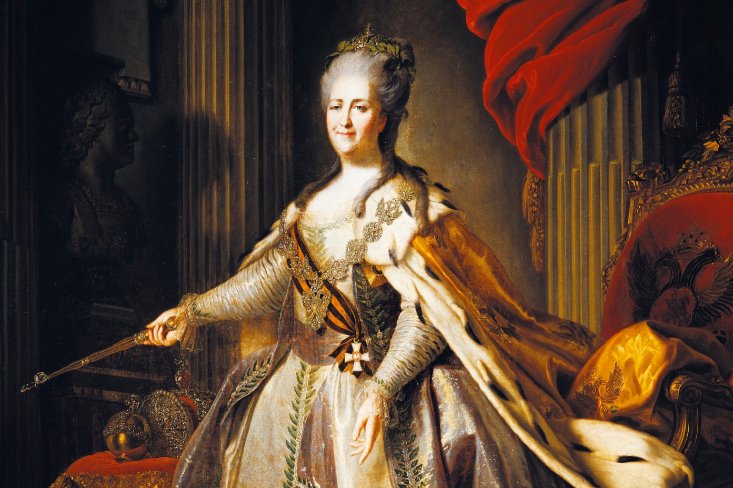
Catherine the Great

While Lorelai is mending her Chilton school sweater, Rory studies for a History test (her midterm exam?), reading through index cards on Catherine the Great.

Catherine II (1729-1796), also known as Catherine the Great, was Empress of Russia from 1762 to 1796, the country’s longest-ruling female leader. Under her reign, Russia grew larger and stronger, and was recognised as one of the great powers of Europe, while the period of her rule is considered the Golden Age of the Russian Empire and the Russian nobility. As patron of the arts, she presided over the Russian Enlightenment, and decreed the first state-funded institute of higher learning for women.

As Rory’s notes say, she was born Princess Sophie Friederike Auguste von Anhalt-Zerbst-Dornburg in Prussia. Although Lorelai jokes that everyone called her Kitten, her nickname was Figchen, a short form of her middle name Friederike. She received the name Yekaterina (Catherine) in 1744 on converting to the Russian Orthodox faith in preparation for her marriage.

Catherine married her second cousin Peter von Holstein-Gottorp, Duke of Holstein-Gottorp (that’s in north-west Germany) in 1745 – not 1754 as Rory says. Their marriage was indeed unhappy, and Catherine detested Peter at first sight. He had a difficult personality, and both of them were unfaithful to each other, with Catherine taking many lovers during her lifetime.

Peter became Peter III, Emperor of Russia in 1762, but six months later was deposed and possibly assassinated as the result of a conspiracy led by his wife Catherine, who succeeded him to the throne.

In an episode focused on women’s roles, this is a reminder of one of history’s most powerful female leaders.

“Not in the budget”

RICHARD: It costs a fortune to travel first class in Europe. We only do it every two years
EMILY: In the fall.
RICHARD: It’s just not in the budget this year.

Richard and Emily didn’t go to Europe the previous fall, so they would normally have gone this fall, except that it’s not in the budget. Most likely that’s because they are paying for Rory’s schooling – a year’s tuition at Chilton would be enough money for two first-class vacations in Europe. (Of course the idea they could have a cheaper holiday is one they can’t get their heads around, and they wouldn’t enjoy it anyway).

Richard and Emily are extremely tactful about this shortfall of money, even after Lorelai and Rory keep cluelessly pushing them on the issue. Think how easy it would have been for them to snap (or even state calmly), “We’re not going to Paris because we need the money for Rory’s education!”. It’s to their credit they never make Rory feel like a financial burden, and are quick to reassure her if someone else tries to imply that she is.

Paris

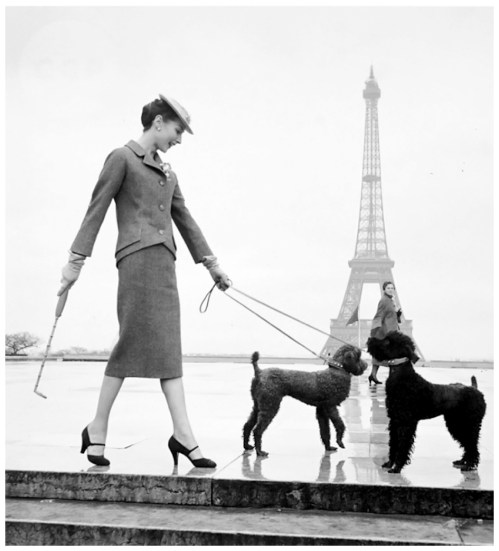
While suggesting that Richard and Emily go to Paris instead of Martha’s Vineyard, Lorelai and Rory mention some of the things associated with this city.

Impressionism: A 19th century art movement associated with small, thin brushstrokes; an emphasis on light and movement; unusual angles; and ordinary subject matters. The movement arose in Paris during the 1870s and 1880s with a number of independent art exhibitions. Famous impressionist artists include Claude Monet, Pierre-Auguste Renoir, and Camille Pissarro.

Poodles: A stereotypical image of Paris is an elegant middle-class woman taking her poodle for a walk. Although poodles were very fashionable in France some decades ago, they have fallen out of favour and are no longer chic. (The photo used was taken by American photographer Louise Dahl-Wolfe, and first published in 1940).

Crème brûlée: A rich, creamy custard dessert with a hard caramel topping. It originated in Spain, and was first given its French name (which means “burnt cream”) in the 17th century. It wasn’t common until the 1980s, and was popularised by Italian chef Sirio Maccioni at his New York restaurant Le Cirque. It isn’t particularly Parisian, although you can certainly eat it while in Paris.

It’s in keeping with their lack of travel experience that Lorelai’s and Rory’s visions of Paris are distinctly dated and second-hand.

“Italians’ feet”

LORELAI Mmm. Kick-ass wine.
EMILY: How poetic.
LORELAI: It’s got a nice smell: earthy, vibrant. I can taste the Italians’ feet.

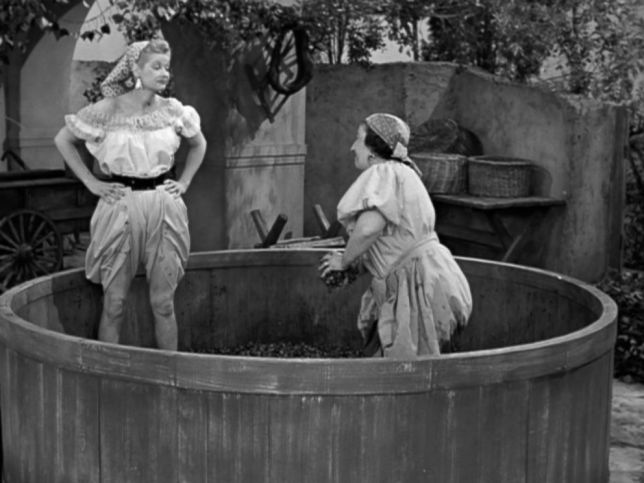
Lorelai is referring to grape-stomping or pieage, a traditional winemaking technique where the grapes are crushed by human feet – evidence of the practice can be found in pictures from ancient Egypt and ancient Rome. Since the Middle Ages this part of the winemaking process is nearly always done by machinery, and even in ancient times there were wine presses to do most of the work.

However, grape stomping has never been completely abandoned, and survives in small pockets. These days it is often a fun event at cultural festivals and wine festivals, and some vineyards will charge you for the pleasure of partaking in the activity.

The popular idea of grape stomping being part of the winemaking process can probably be traced back to I Love Lucy. In the 1956 episode Lucy’s Italian Movie, while on a trip to Rome a film producer suggests Lucy audition for his new movie called Bitter Grapes. Lucy thinks it must be about winemaking, so finds the only winery left in the area that still makes wine using grape-stomping so she can practice the technique in advance.

This probably explains why Lucy-loving Lorelai immediately connects the wine to Italian feet in particular.

Pinging in the brain

Rory complains that her brain “pinged” or “dinked” while she was studying. It sounds like tinnitus, a fairly common condition where you hear phantom noises such as clicking, hissing, or roaring – these often seem to emanate from inside your head.

It can be brought on by stress, which fits with Rory studying hard to the point her head hurts. She never complains of it again, suggesting that the condition spontaneously resolved, which isn’t uncommon with tinnitus.

“Written by a man”


Lorelai says that the scripts for The Donna Reed Show were written by a man, which Rory endorses. Although most of the writers on the show were male, there were female writers too, including Barbara Avedon (creator of Cagney & Lacey) [pictured], Helen Levitt, Erna Lazarus, Peggy Chantler Dick, Kay Lenard, Mathilde Ferro, Jacqueline Trotte, Sheila Lynch, and Janet Carlson.
Amusingly, That Damn Donna Reed was written by a man – Daniel Palladino. There may be a slight suggestion here that just because a man writes a script for female characters doesn’t automatically make it anti-woman or oppressive to them, just as a script by a woman isn’t necessarily a feminist text.

Sister Suffragette

LORELAI: She’s [Donna Reed] medicated.
RORY: And acting from a script.
LORELAI: Written by a man.
RORY: Well said, Sister Suffragette.

Sister Suffragette is a song from the 1964 Disney film Mary Poppins, written by Richard and Robert Sherman. Sung by Glynis Johns in the role of Mrs. Winifred Banks, it is a pro-suffrage song as Mrs. Banks is a supporter of votes for women. The song’s chorus ends with the words, “Well done, Sister Suffragette!”.

Mary Poppins was loosely based on the children’s book of the same name by Australian author P.L. Travers, and directed by Robert Stevenson, with Julie Andrews in the title role. The story is about a magical nanny who comes to care for two children in Edwardian London, and improves the lives of all the family.

Mary Poppins was the #3 film of of 1964 and received universal acclaim from critics. It won five Academy Awards, including a Best Actress for Julie Andrews, and is generally seen as Walt Disney’s crowning achievement. It was released on home video three times during the 1990s, suggesting that Lorelai may have bought it for Rory the previous decade.