RORY: An hour ago you were totally screwing with Dean and now you’re totally nice to me. JESS: You see, it’s the screwing with Dean – that’s an important step to getting here so that I can be nice to you. RORY: So it was a plan … The whole bidding on my basket, it was a plan.
Of course it was a plan! Nobody believed it was anything other than deliberate. Just ask Dean.
RORY: Really? Try it. The Fountainhead is classic. JESS: Yeah, but Ayn Rand is a political nut. RORY: Yeah, but nobody could write a forty page monologue the way that she could.
The Fountainhead, 1943 novel by Russian-American author Ayn Rand, and her first literary success. The novel is about a ruggedly individualistic architect named Howard Roark, who battles against conventional standards and refuses to compromise his ideals. Rand said that Roark was the embodiment of her ideal man, and the novel reflects her views that the individual is more valuable than the collective.
Twelve publishers rejected the manuscript before Bobbs-Merrill took a chance on it, and contemporary reviews were mixed. However, it gained a following by word of mouth, and eventually became a bestseller. It has had a lasting influence, especially among architects, business people, conservatives, and libertarians. It was adapted into film in 1949, and turned into a stage play in 2014.
We here learn that Rory attempted to read The Fountainhead when she was ten, without success, but tried again when she was fifteen and liked it. Jess is taken aback by her recommending a text beloved of right-wing libertarians and “political nuts”, but Rory says she enjoys it as a piece of literature. The Fountainhead is absolutely full of characters having lengthy monologues where they clearly explain their philosophies, plans, and ideals.
The character of Howard Roark (allegedly based on architect Frank Lloyd-Wright) is a brooding man of few words, rather like Jess. Could Rory be recommending the book to Jess for that reason, to let him know that she likes a book where the protagonist is like Jess? A literary flirtation, like Jess annotating her copy of Howl?
Jess’ later career has a few things in common with Roark – neither of them graduate because they can’t be fettered by a conventional curriculum, both believe themselves to be misunderstood, both would prefer to take any paying job rather than compromise their creative integrity, and both become successful in their chosen fields.
More eye-raising is the character of Dominique, Roark’s love interest, and said to be his perfect match. Their first sexual encounter is so rough that Dominique describes it as a “rape”, and yet comes back for more, again and again. It’s a risque (or even plain risky) thing for a teenage girl to recommend to a boy she likes, and if this is a flirtation-by-literature, Rory seems to have suggested that Jess make things physical, even without her explicit consent.
LORELAI: Well, last year Roy Wilkins bought it and I got my sprinklers fixed for half price … And this year my rain gutters are completely clogged, and I thought if I could get the Collins kid to bite, I’d get that taken care of.
We learn that the previous year, in 2001, a man named Roy Wilkins bought Lorelai’s basket at the fundraiser, and she was charming enough to him that he fixed her sprinklers and only charged half price for it. This year, she was hoping that “the Collins kid” might buy her and be inveigled into cleaning her gutters for cheap or free.
It sounds as if since becoming a homeowner, Lorelai has been using the Bid-on-a-Basket Fundraiser as a way to get free or cheap home repairs or home maintenance done. Hmm, you know who is really good at handyman stuff? Luke! And now she’s having a picnic with him.
LUKE: You’re Miss Flexibility over here? LORELAI: Hey, I can be flexible. LUKE: Please. LORELAI: I can. As long as everything is exactly the way I want it, I’m totally flexible.
A keen piece of self-insight from Lorelai.
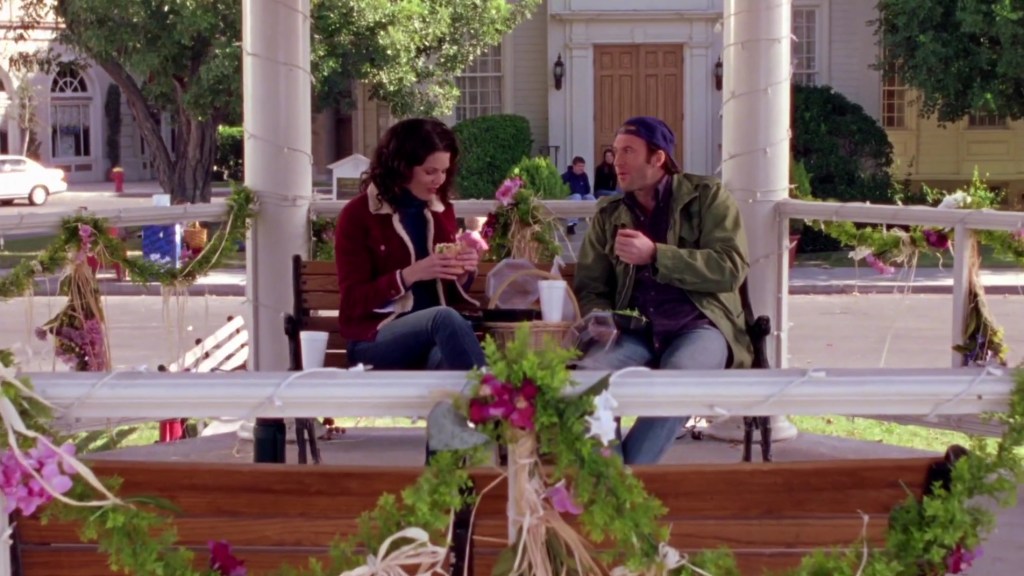
Lorelai and Luke eat their picnic in the gazebo, because Luke can’t stand sitting on the ground to eat (he enjoys hiking and camping – does he sit around the campfire on a deck chair???). He seems to have picked the most romantic spot possible, because it is still decorated with wreaths of flowers.
JACKSON: I think we should get married … Soon. SOOKIE: Are you pregnant? JACKSON: What do you say? Sookie? SOOKIE: Yes! I say yes. Oh my God, we’re getting married!
In typical Gilmore Girls fashion, a marriage proposal comes out of a fight, and the wedding is scheduled to happen as soon as possible.
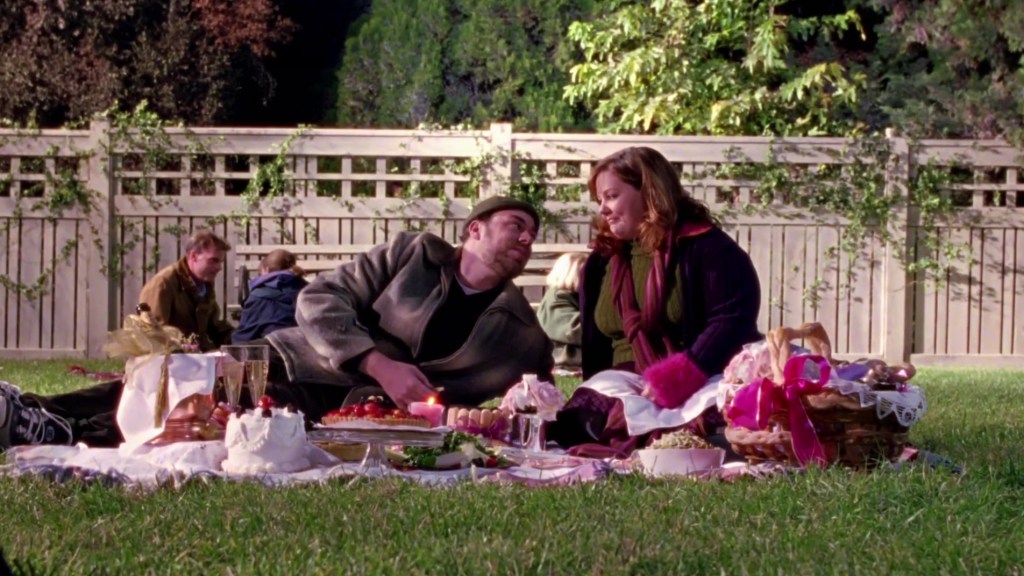
Sookie seems to have packed the basket expecting or hoping for a proposal, because there’s a vase of roses, candles, champagne, and even what looks like a tiny wedding cake with white icing. She may not have been quite so surprised by the proposal as she acts. Is it possible that Sookie deliberately ignored Jackson’s hints about moving in together because she was holding out for marriage?
A bit of trivia – this scene was filmed in the dark, and then the light turned up in editing until it appears to be a sunny afternoon.
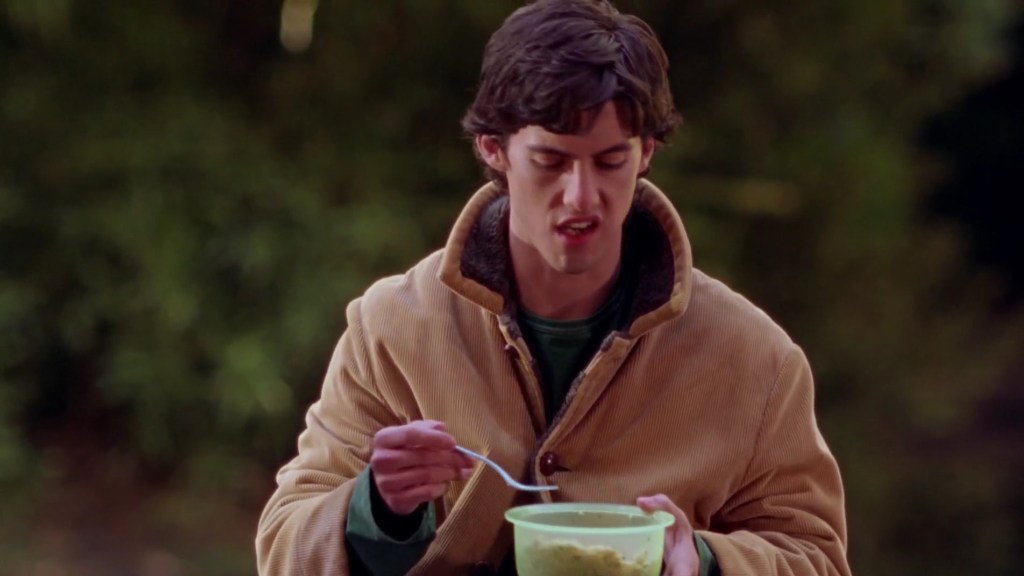
JESS: And Dean would’ve eaten this? [holds up a container] RORY: Yes, he would have. [Jess tastes a forkful of the food and makes a face] JESS: Dean is an idiot. RORY: Dean never would’ve fallen for that.
Dean is often depicted as less intellectual or less quick-witted than Jess, so it’s satisfying to see Rory gleefully point out that Jess has made a naïve error that the savvier Dean wouldn’t have. It’s a reminder to Jess that Dean actually knows Rory, and that they have a shared history of which Jess is ignorant.
A small plastic container of disgusting-looking, potentially very old leftovers
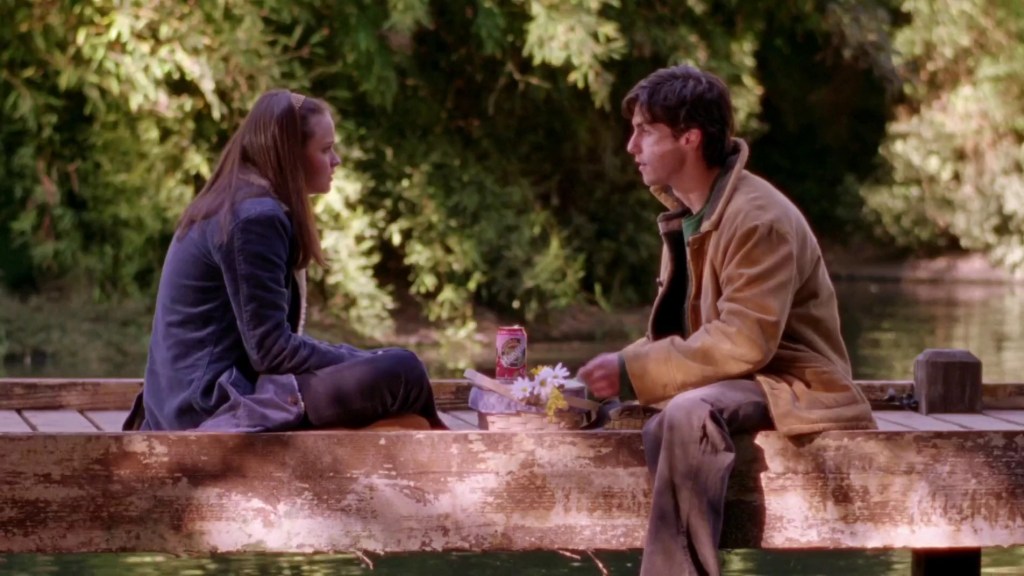
A can of Hansen’s soda (Rory’s favourite brand, she’s always shown drinking it)
Can you believe this went for $90, and Sookie’s was snapped up for $35? There’s no justice. Could it also be saying that Jess is overestimating Rory’s value, or that he’s going to pay too high a price for her?
It’s almost as if Lorelai and Rory’s baskets are trolling the town, because they could have bought something nice from a restaurant, like Lane did, and Sookie would have happily given them something decent to take.
They’re saying, “Sure, you can enjoy our wonderful company. But we won’t cater to your needs in any way, or give you false expectations that providing edible food is something that will ever happen”.
RORY: It wasn’t funny. JESS: Well, if it makes you feel any better, I didn’t intend to do it. Does that make you feel any better?
Oh right. You just coincidentally brought lots of money to a town event you had no interest in and that nobody made you go to, and then you accidentally bid it all on Rory’s basket against her boyfriend?
RORY: On the bridge, that’s where we’re gonna eat? JESS: Yup.
Jess tells Rory that they will be having sharing their picnic on the bridge over the lake, a place in Stars Hollow that he has grown fond of. Later it will become a special place for he and Rory.
The scene of them having a picnic is a homage to the 1958 Southern Gothic comedy-drama film The Long Hot Summer, directed by Martin Ritter. The screenplay is partially based on the 1955 Tennessee William’s play Cat on a Hot Tin Roof, and three works of William Faulkner, one of Rory’s favourite authors (she can’t resist Southern Gothic).
In the film, Paul Newman plays Ben Quick, a crude, magnetic young man with a bad reputation for burning down barns who is expelled from his town and forced to go elsewhere. Joanne Woodward plays his love interest, rich girl Clara Varner, who fights their sexual tension all the way, but eventually falls in love with him. It turns out the enigmatic drifter’s bad reputation is undeserved, and he is actually very ambitious.
The Long Hot Summer received excellent reviews from critics, but didn’t do well at the box office. Paul Newman won Best Actor at the Cannes Film Festival for his role as Ben. It’s been turned into a television series twice, once in the 1960s, then again in the 1980s.
This is another film with a bidding war over a picnic basket, which the masterful Ben wins, itself a homage to the auction in Oklahoma! There is a scene of Ben and Clara sharing their picnic near a bridge, similar to Jess and Rory on the bridge. In the scene, the icy Clara begins to thaw out to Ben, and reveal some of her true self. In the same way, this is the first time that Rory really begins to open up to Jess. Bridges are symbols of transition, showing that Rory and Jess are moving into a new stage of their relationship.
There is a strong hint from the film that Jess is not as black as he has been painted, and there is a foreshadowing of his hidden ambitious streak.
Paul Newman and Joanne Woodward fell for each other on set, and married shortly after the film. Alexis Bledel and Milo Ventimiglia also dated in real life while filming Gilmore Girls.
HENRY: Lane, I like you but I want to be able to actually pick you up, stop the car, and take you out. And I wanna be able to call you, at your house.
Lane’s complicated dating plan predictably goes wrong when Henry tries to call the pay phone at the park where’s having her mother-approved picnic with her cousin David. The phone isn’t working, so Henry calls Lane’s house in desperation, and gets Mrs Kim; he panics and tries to sell her a subscription to the Wall Street Journal.
When Lane calls Henry at his house in Hartford and discovers all this, she suggests they still have time for a date. All he needs to do is drive past, honk twice, go around the block, and on the second go around, Lane will jump in the car while it’s still moving.
Henry rejects this madness, and says he wants a girlfriend he can go on dates with, and phone if he wants to. He has already asked somebody else to attend the prom with him, which is about three months away – I think this means Henry is a year older than Lane, and in his last year of school?
This is the end of Lane’s first relationship with a boy she really likes who returns her feelings, coming to a halt before she even got to go on one date with him. It’s warning to her of what her life will be like if she continues trying to hide everything from her mother.




 The Annotated Gilmore Girls