RORY: Looks like Italy for us! LORELAI: Mamma mia!
Mamma mia, an Italian interjection of surprise, literally meaning “my mom/mum”, possibly in reference to the Virgin Mary.
Lorelai may be thinking of the 1975 ABBA song, “Mamma Mia”, from their self-titled third album. It went to #32 in the US, but was #1 in the UK, Ireland, Australia, Switzerland, and West Germany. It is widely considered one of their best songs, although in a deleted scene of Gilmore Girls, Lorelai refers to it as an earworm.
It is possibly a little insensitive to say this is front of Emily, given that Lorelai ran away from home to work for Mia, who she regards as a beloved mother figure.
Upon learning that Lorelai and Rory are planning to backpack around Europe and stay in hostels after graduation, Richard and Emily first of all think they are joking, then throw a fit about it as unsafe and reckless.
I guess you could justify this by saying that they were simply humouring Lorelai and Rory before, and now they are giving their real opinions, or that they didn’t understand before, but they behave as if this is entirely new information, not information they previously ignored or misinterpreted. It feels like a retcon.
Rick Steves self-published his first European travel guide in 1980, and it found a traditional publisher in 1982. He advocates independent travel, and urges travellers to visit less touristy places (Lorelai and Rory apparently ignore this advice). He hosts travel shows on TV and radio, has his own tour business, a travel website, and of course, writes numerous travel guide books.
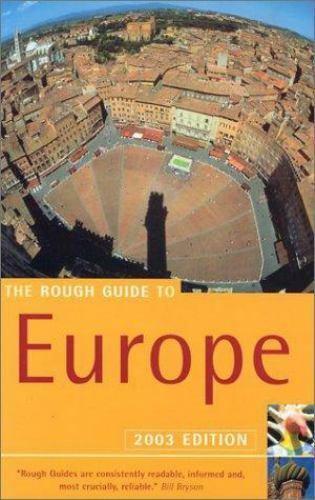
The Rough Guide to Europe on a Budget
Rough Guides Ltd is a British travel guide book publisher; their first title was the 1982 Rough Guide to Greece. Initially aimed at low-budget backpackers, the guidebooks have incorporated more expensive recommendations since the early 1990s, and are now marketed at all budgets. This makes it seem like a rather outdated reference for this episode, although it was probably a book that Lorelai considered in the 1980s, when she first thought about going to Europe as a teenager.
LORELAI: Two dates with this guy and you’re already in cahoots with each other.
In cahoots, informal language meaning “colluding or conspiring secretly”. The word came into English from French, via the Scots. It’s found in Scots English in the 16th century as cahute, French for “cabin, small hut”. It may be a corruption of the French word cohorte, which meant a companion or partner.
Upon getting back from her fishing date with Alex, Lorelai says her next date with him will be camping. In winter! She has become frog girl. The relationship already feels doomed.
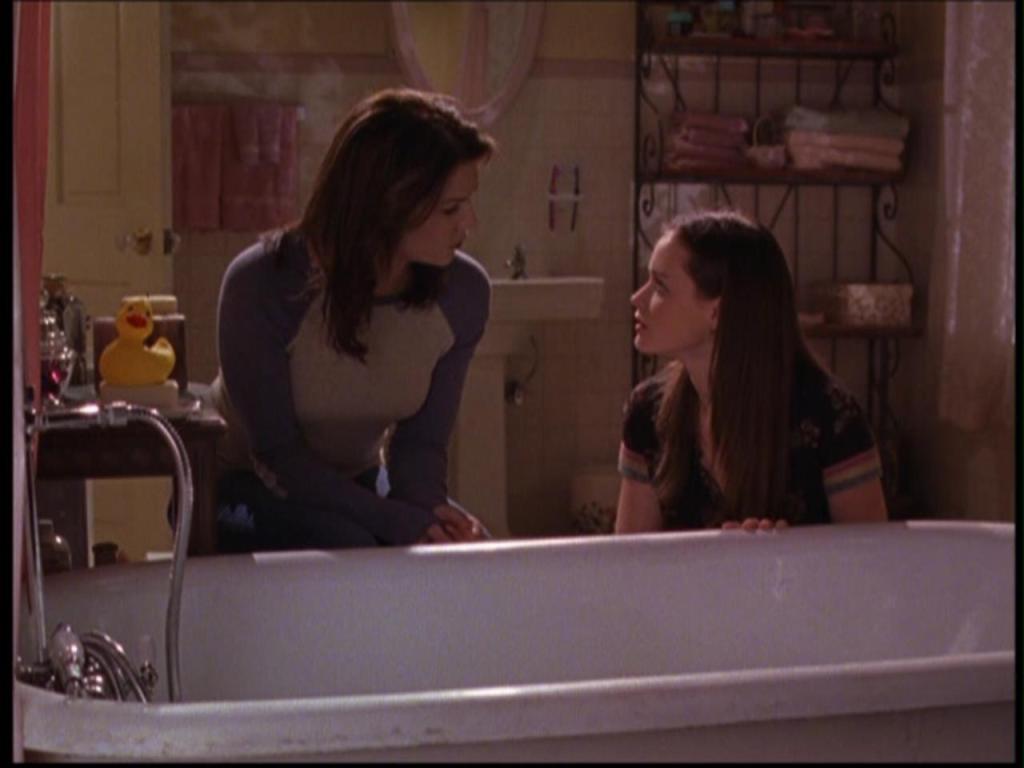
Note the rare chance to see the Gilmore girls’ bathroom in this scene.
MRS. KIM: Reception at Elks Lodge. Two hundred guests. Food goes fast. Let’s move.
The Benevolent and Protective Order of Elks (often known as the Elks Lodge or simply The Elks) is an American fraternal order founded in 1868, originally as a social club in New York City which borrowed rites and practices from Freemasonry. They focus on social activities, charitable causes, and patriotic events. Until 1973 they were an all-white orgnisation, and they only admitted women in 1995.
In real life, there are numerous Elks Lodges in Connecticut, including one in Hartford [pictured] – which you really can hire for weddings. I think this one is meant to be in Stars Hollow, which maybe seems a little small to have an Elks Lodge.
This is the song at James’ wedding, performed by Dave Rygalski, and sung by Ho Kyung.
Composed by Franz Schubert in 1825, it was originally part of his 1825 Op. 52 a setting of seven songs from Walter Scott’s 1810 popular narrative poem The Lady of the Lake, loosely translated into German, where it is known as “Ellens dritter Gesang” (Ellen’s Third Song, in English).
It is often performed and recorded by many singers under the title “Ave Maria” (the Latin name of the prayer Hail Mary, and also the opening words and refrain of Ellen’s song, a song which is itself a prayer to the Virgin Mary), in musically simplified arrangements and with various lyrics that commonly differ from the original context of the poem. It was arranged in three versions for piano by Franz Liszt.
One of Schubert’s most popular works, it has become a fixture at weddings. Although an overtly Catholic song, it is sometimes performed at Seventh Day Adventist weddings, although with a certain amount of disapproval from strict quarters. Apparently Mrs Kim is not as strict in her religion as you might think – perhaps she simply loves beautiful music.
I presume that the pastor performing the wedding service is “Reverend” Melmin (he would actually be a pastor), previously mentioned as helping Mrs Kim select a suitable college for Lane to attend.
Throughout this scene, Rory and Lane do the hair up and make-up for cousin James’ bride from Korea – a woman who remains nameless, and is played by Jessica Shim in her first role. She would go on to a smattering of small TV roles.
The bride is unable to speak English, but Lane speaks Korean, and exchanges a few words with her, asking if she likes her hair (not really, is the answer), and getting her water when she asks for it. Neither Lane nor Rory make any attempt to include her in their conversation, give her any comfort, or even try to teach her just one or two words of English.
She has come from another country, doesn’t speak any English, and is marrying a stranger described as “quiet and skulky”, which sounds like code for lacking the social skills to attract a wife among his peers. Cousin James is played by stand-up comedian and actor E.K., and whatever James’ possible faults, he is at least attractive.
Lane and Rory discuss an unhappy marriage which began with a wedding at the Kim house, between Min Cha, and the “mean man” she married, Wan Nam. There were seven years of Min Cha being told she was stupid and ordered around like a slave before she snapped and attacked her husband. They now live separate lives in the same house, still married.
The chances of the Korean bride having a happy marriage and happy life in America seem quite slim, yet Rory and Lane express no pity over her situation (and not really any for Min Cha either). She is marrying into Lane’s family, yet receives little welcome or signs of kindness from anyone. Mrs Kim doesn’t even bother speaking Korean to her, or in front of her, while talking about her.
It’s rather chilling that Rory and Lane get to have a heartwarming bonding scene together all while virtually ignoring this young woman, doing her up like a doll, and treating her as if she barely exists. She is a prop in the scene, rather than another actor.
RORY: It’s okay not to like Jess. LANE: I said I was happy for you.
Rory has that awkward conversation with her best friend where she gently lets Lane know that she knows she doesn’t approve of Jess, and that’s okay. She doesn’t need to pretend. Lane immediately feels bad about not liking Jess, but says that she’s protective of Rory, and doesn’t want her to be hurt.
Rory asks her to give Jess a second chance (even though she just said it was okay for Lane not to like him), and Lane gamely says that maybe they can double date with she and Dave some time. Double dating seems to be the default position on Gilmore Girls!
We never see if the two couples ever did go out together, but I imagine Jess would have refused – even though he would have a lot in common with Lane and Dave. It seems like a missed opportunity.
PARIS: I hold in my hand evidence accusing one Rory Gilmore of committing high crimes and misdemeanors.
As well as being part of the impeachment process in the US, this may be a possible allusion to the Woody Allen film, Crimes and Misdemeanours, previously discussed.






 The Annotated Gilmore Girls