LORELAI: Hello Rory, we missed you. Not the ottoman, of course, but everyone knows he’s a snob. Napoleon complex, he only really likes the magazine rack.
An ottoman is a small padded seat without a back or arms that can be used as a table, stool, or footstool. They are also known as tuffets, hassocks, or pouffes. The name comes from the Ottoman Empire from where it originated, the seat introduced to Europe in the 18th century.
A Napoleon complex is an imaginary syndrome attributed to people of short stature, where the short person (usually a man), overcompensates for their size by being too aggressive or domineering. In psychology, it is regarded as a derogatory social stereotype and a piece of mysandry. It comes from the idea put about by the British in the 19th century that Napoleon Bonaparte’s short temper was caused by him being of short size. In fact, Napoleon was 5 foot 7, average height for his era.
Presumably the ottoman only likes the magazine rack because it’s the one thing smaller than it is!
MRS. KIM: This was Sherman’s shaving table … General Sherman, famous man, burned Atlanta, liked a close shave.
General William Tecumseh Sherman, previously mentioned. A general in the Union Army during the Civil War, he invaded Georgia with three armies in the spring of 1864. His campaign against Atlanta ended successfully in September of that year with the capturing of the city, and he gave orders that all civilians were to evacuate the city before giving instructions that all military and government buildings were to be burned, although many private homes and businesses were too. This victory made him a household name, and ensured the re-election of President Abraham Lincoln in November that year.
SOOKIE: What do you think, manly [holding up statue]?
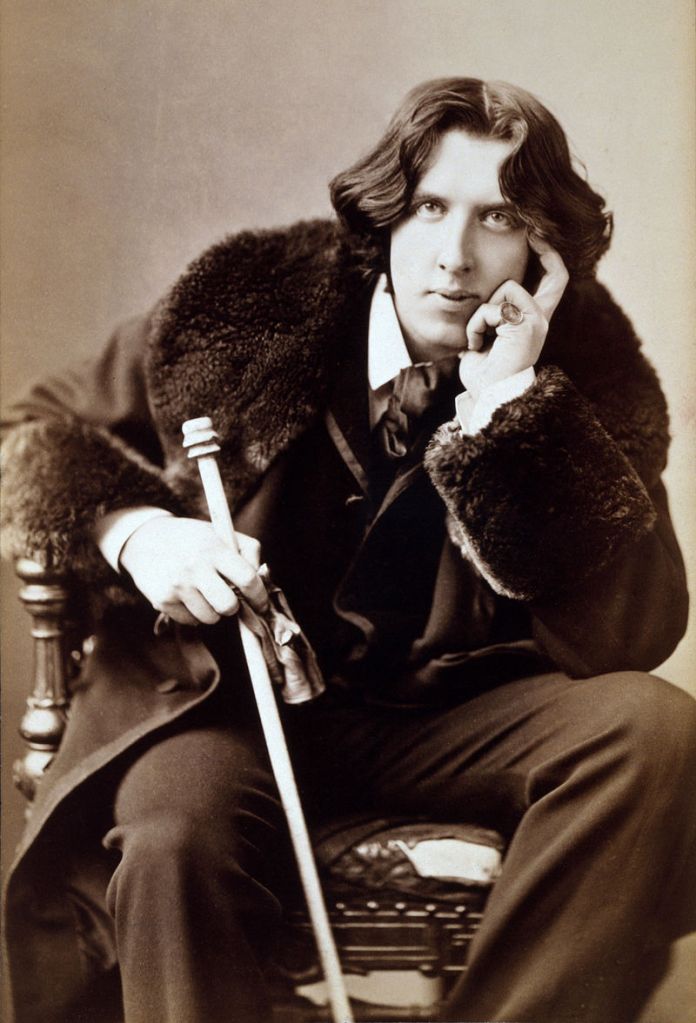
LORELAI: In an Oscar Wilde sort of way, absolutely.
Oscar Wilde (1854-1900), Irish poet and playwright, and one of the most popular playwrights in London in the early 1890s. Best remembered for his sparkling comedies, witty epigrams, and his only novel, The Picture of Dorian Gray (1890).
At the height of his fame and success, while his play The Importance of Being Ernest (1895) was still being performed in London, Wilde prosecuted the Marquess of Queensberry (the father of Wilde’s lover, Lord Alfred Douglas) for libel, but the trial unearthed evidence that led to Wilde’s arrest for indecency with men and boys. He was convicted and sentenced to two years’ hard labour, and imprisoned from 1895 to 1897. On his release, he left for France, and never returned to Ireland or Britain.
The statue that Sookie holds up appears to be a cherub or some other sort of nude small boy. It certainly doesn’t look butch, but Lorelai seems to be saying, not so much that the statue seems “gay”, as slightly paedophilic, because of the subject matter.
Oscar Wilde did take teenagers as young as fourteen as his lover, although to my knowledge, not small children like the statue seems to be (Wilde’s trial was based on his activities with males because of their gender, not specifically with their ages). The full details of Wilde’s case had been published in 2001, with many people shocked, or at least uncomfortable, with how extensive Wilde’s interest in much younger males had been – something which would have seen Wilde imprisoned in our time as well. This may be what Amy Sherman-Palladino had in mind when she wrote this scene.
TAYLOR: This is gonna be a very exciting day. I’m really gonna go all out for this. I even think you’ll be impressed.
LORELAI: Really, even me?
TAYLOR: Yes-sir-ee, Mini-Me, I did not put the word madness in the title for nothing.
Taylor references comedy spy film Austin Powers in Goldmember, a sequel to Austin Powers: International Man of Mystery, previously mentioned. Goldmember had just come out in July 2002, so would be very fresh in their minds (presumably Taylor saw it that summer, which reveals a slightly unexpected side to Taylor).
In the film, spy Austin Powers’ nemesis is Dr Evil, who has a clone of himself at 1/8th size, who he names Mini-Me, played by Verne Troyer. Dr Evil declares Mini-Me his favourite son. Oddly, Taylor seems to be designating himself as Dr Evil??? And Lorelai as his … clone? What? Does Taylor understand how references work? Maybe it’s just as an example of madness at work?
The plot of the film involves more than one example of surprise paternity, which is interesting, given that there is a popular fan theory that Taylor is secretly Kirk’s biological father. He does employ him at Doose’s Market, the video store (which he also seems to own), and has him photograph key events around town. This might explain Kirk’s multiple jobs – they are all, or mostly, given to him by Taylor, who owns a large proportion of Stars Hollow.
LORELAI: Still haven’t found out who put that banana peel on your doorstep, huh?
TAYLOR: No, but I have a list of suspects.
Now that Jess is back in town, surely he is pretty high up on on the suspect list?
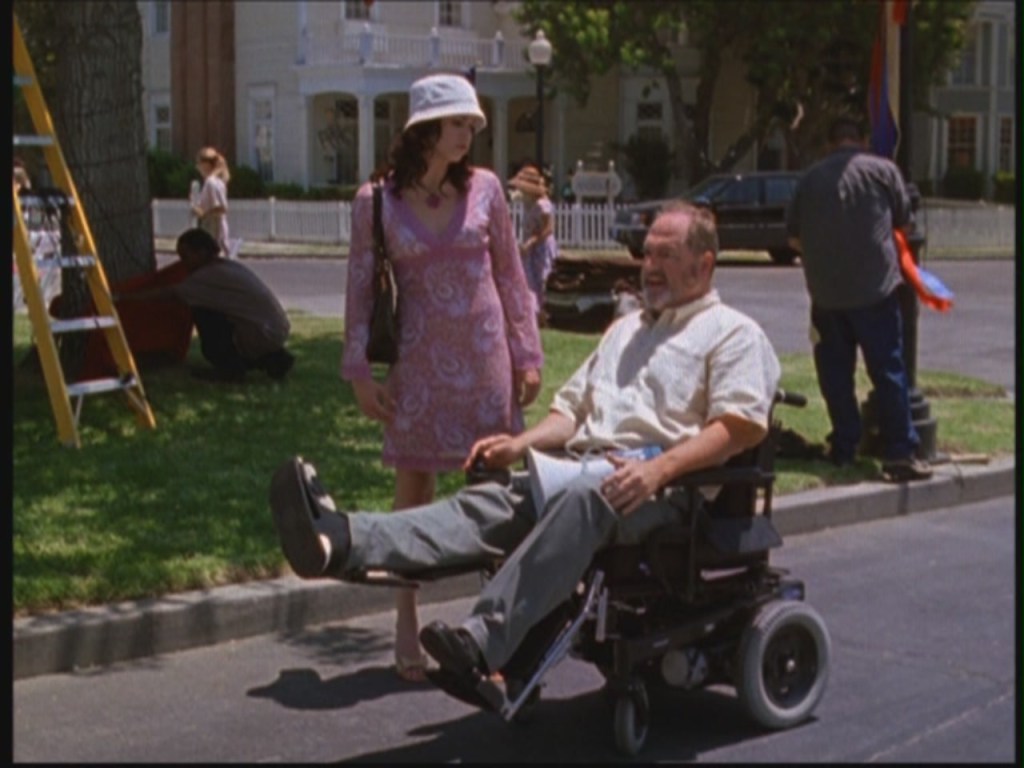
Note that the dress Lorelai is wearing is very similar in colour and design to the pink lace-trimmed nightgown she wore in her dream. Either the dress she was going to wear got into her dream, or she decided to wear something that reminded her of her dream.
PARIS: [sleep talking in background] Woodward . . . Bernstein . . . Harry Thomason. LORELAI: Is that Paris?
RORY: Yeah, she talks in her sleep . . . long in-depth arguments.
Paris references Bob Woodward and Carl Bernstein, previously mentioned, the journalists who broke the story of Richard Nixon and Watergate.
Harry Thomason (born 1940) [pictured], film and television director and producer, best known for the sitcom Designing Women (1986-1993). Thomason and his wife, Linda Bloodworth-Thomason, are close friends with former President Bill Clinton and his wife Hillary, the former Secretary of State, playing a major role in President Clinton’s election campaign. He produced a glowing biographical film called The Man From Hope, the centrepiece of the 1992 Democratic National Convention. Thomason served as co-chairman of the 1992 Presidential Inauguration Committee.
It is not completely clear whether Paris is arguing with Woodward, Bernstein, and Thomason in her dreams, or if she is quoting them in support of her dream arguments. I think the second?
LORELAI: Give me another analysis or I’ll put your Taylor hula-hooping dream into a whole other context.
RORY: I told you, Taylor was supposed to be Dean. I could tell by his freakishly thick head of hair.
Rory had a dream while she was in Washington, apparently sexual in nature, about Taylor hula-hooping. She knows that Taylor was actually a stand-in for Dean, suggesting that she sees Dean as rather boring and irritating, like Taylor. Dreaming of hula-hoops can be indicative of a situation where you keep going around in circles – just as Rory’s relationship with Dean keeps going around the same old circle.
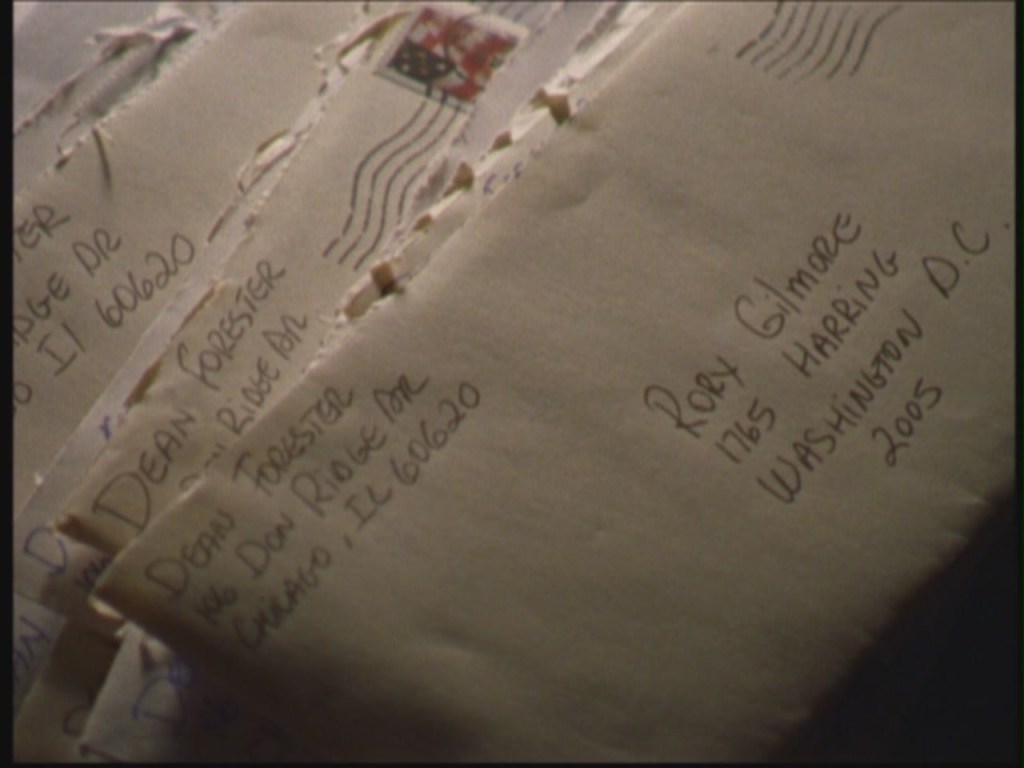
The dream suggests that Rory can’t see any way of breaking free of the dull routine she’s in with Dean. And nothing has changed, because although Rory has a stack of letters from Dean, sent from Chicago, where he’s on vacation, she is trying to write a letter to Jess – having got no further than writing Dear Jess.
We can see Dean’s return address on the envelopes: 106 Don Ridge Drive, Chicago IL 60620. This isn’t a real address – Don Ridge Drive is in Toronto, Ontario, a little nod to Gilmore Girlsfirst being filmed in Canada. The zip code is that of central Chicago – primarily made up of poor African-American neighbourhoods. It seems like an unlikely place for the Forester family to stay with family or friends.
There is a Ridge Drive in Chicago Ridge, a suburban village of around 14 000 people on the outskirts of Chicago. That actually seems far more believable as the area where Dean grew up.
Rory’s address in Washington is 1765 Harring, Washington DC 2005, which is entirely fictional, and doesn’t even look like a proper address, having no building name or street designation. It sounds vaguely like the Hotel Harrington, Washington’s oldest operating hotel, which is centrally located, and within walking distance of landmarks such as the White House, the Capitol, and the Smithsonian. This is certainly the area that Rory would have been staying in.
CHRISTOPHER: Sherry’s pregnant … She just found out and she called me as soon as she found out, and that was her calling to tell me that she found out.
Christopher comes to see Lorelai who is standing on the bridge, waiting for him (another mention of bridges as significant emotional spaces). He tells her that Sherry has called him on his cell phone to tell him she has just discovered she is pregnant – I presume she used a home pregnancy testing kit, as it’s a Sunday.
Oddly enough, Lorelai says, “Women all over the world will line up to see that tiny little woman fat”. Sherry isn’t a tiny little woman, she’s only a few inches shorter than Lorelai, and Lorelai is slim as well. It makes Sherry sound like a stick-thin five foot tall waif, which she isn’t. Not to mention the bizarre thinking that equates being pregnant with being “fat”.
Apparently all the terrible problems Christopher and Sherry were having were not enough to stop them from having (unprotected?) sex. It does beg the question, did Sherry even know they were supposedly having problems and Christopher was thinking of moving out? Maybe all she did was go away on business for a month or so, and Christopher used that as an opportunity to weasel his way back in to Lorelai’s life, telling her some story about how he and Sherry were practically broken up.
As a huge slap in the face to Lorelai, Christopher is going back to Sherry because she’s having a baby. Christopher was never around while Rory was growing up, and he’s apparently never forgiven himself (zero evidence of that, but whatever). He can’t make that mistake again, so it’s back to his girlfriend that he doesn’t love, so he can be a father to their child. (This is actually a terrible basis for a relationship).
It doesn’t make any sense, because he could still be a good father to his second child without going back to Sherry (and I bet while telling her nothing of what he’s been up to with Lorelai in the interim). For that matter, he could have been a good father to Rory while not being with Lorelai all this time.
Notice that when Rory questions why her dad has a work phone call on a Sunday, he responds, “Hey, I have a lot of responsibility now”. Little did he know how true those words would turn out to be!






 The Annotated Gilmore Girls