Tuesday night in Stars Hollow

RORY: Because it’s Tuesday night in Stars Hollow. There’s nowhere to bail to. The 24-hour mini-mart just closed twenty minutes ago.
JESS: So we’ll walk around or sit on a bench and stare at our shoes.

A confirmation that it is now Tuesday, and the previous day was Monday, which doesn’t actually make much sense. Also, we’ve gone from Stars Hollow being the small town that never sleeps and gets up super early, to having a 24-hour mini mart that closes at 7 pm.

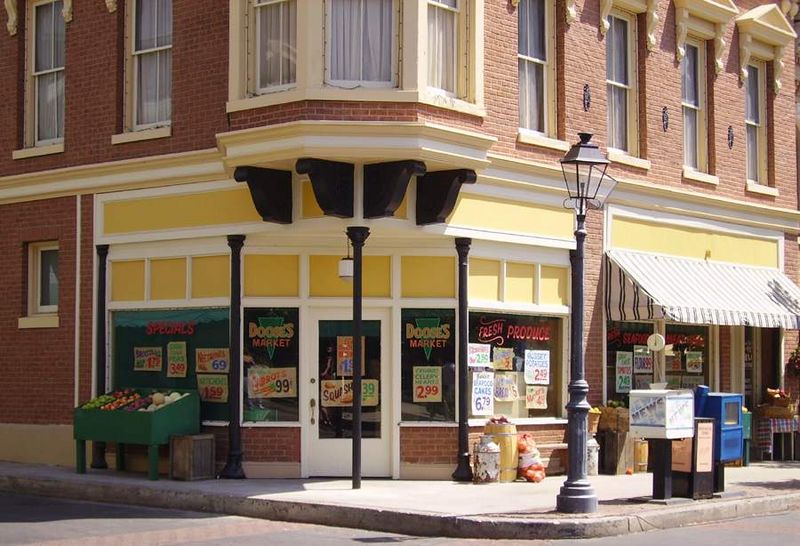
Is the 24-hour mini mart a joke, just referring to Doose’s Market? Because Taylor only seems to fear competition from supermarkets in neighbouring towns, so presumably there is nowhere else to shop in Stars Hollow.

By the way, one of the most befuddling essays I’ve read on Gilmore Girls is one categorically stating that a grocery store like Doose’s Market couldn’t possibly survive in a town of only 9000 odd people, with graphs and pie charts and so on to prove its economic unfeasibility. This is despite the fact that Washington Depot, the real life original inspiration for Stars Hollow, only has about 3000 people, yet has managed to maintain a successful grocery store (Washington Depot Food Market) much like Doose’s for decades.

Jess Snoops Around the Living Room

Luke and Jess arrive slightly late for the dinner party, with Luke implying he’s had trouble convincing Jess to come with him. While Lorelai assures Luke that it’s fine, Jess quietly slips into the Gilmores’ living room, which is off the hall. He looks at the photos on the mantelpiece, and touches the frame of one showing Rory wearing a pink cardigan, half picking it up.

Jess manages to check Rory out before he even meets her, and there’s no mistaking that he’s interested in what he sees. A boy who touches a girl’s photo is probably thinking about touching her, after all.

Lorelai finds him and surely has an idea what he’s up to. She smilingly bundles him out to the kitchen to meet Sookie and Jackson, but she must be getting suspicious of Jess. He’s crept around her living room without asking, and checked out her daughter’s photos. I imagine she is now telling herself to keep an eye on Jess, in case he has more creeping around to do.

Rory’s First Article

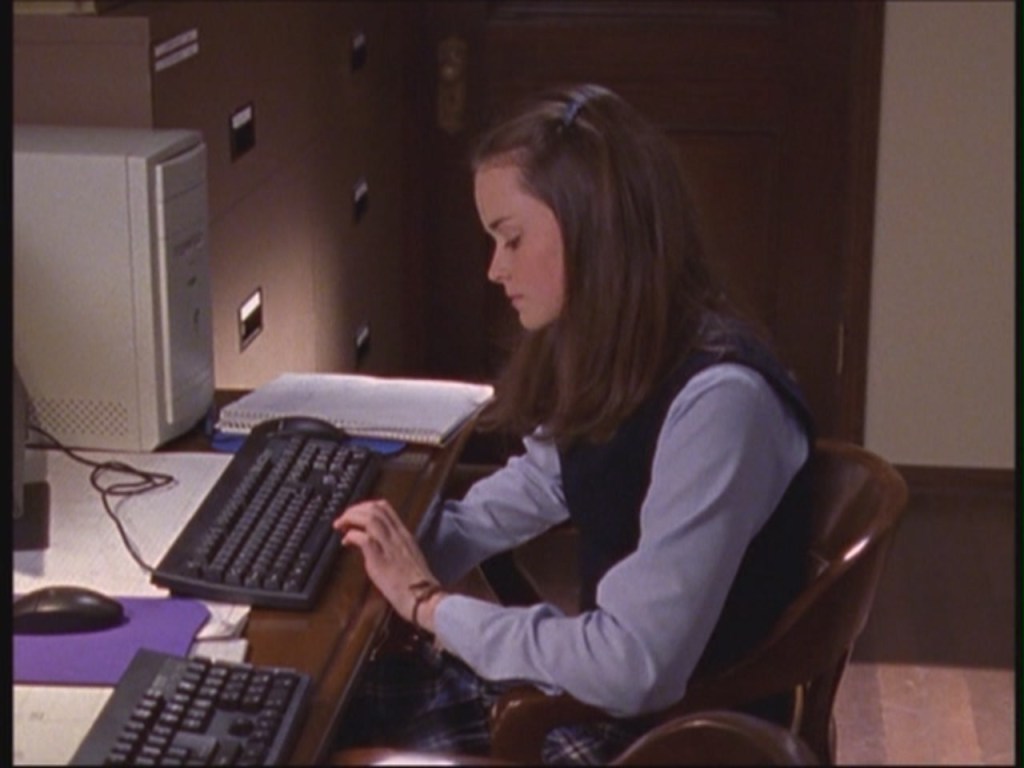
TEACHER: I mean, when you’ve got a reporter who can take an incredibly mundane and seemingly unimportant subject like the re-paving of the faculty parking lot and turn it into a bittersweet piece on how everybody and everything eventually becomes obsolete, then you’ve really got something. Miss Gilmore, I was touched.

This is truly one of the most unbelievable things to happen in regard to Rory’s career as a reporter. The idea that one thousand words on the re-paving of the faculty parking lot, made into a bittersweet piece on how time claims us all, is utterly ludicrous.

It sounds completely hokey and self-indulgent, and a type of journalism more reminiscent of The Simpsons‘ news anchorman Kent Brockman than The New York Times. In real life, Rory would have had her article cut by at least 75%, and a big red pen put through her waffling think piece on re-paving.

And when did Rory hand her article in? It seemed at the last meeting that articles were due at the next day’s meeting (i.e. this meeting). Yet the teacher has already received it from Paris and read it. Possibly Rory was careful to hand it in early, or give it to the teacher herself, to make sure there weren’t any other Paris-caused mix-ups. Or else when Paris said it needed to be “on her desk”, she meant her regular school desk, not her editorial desk. Which seems very confusing.

Wilding

LORELAI: You know, you should meet my daughter. She’s about your age. She can show you where all the good wilding goes on . . .

“Wilding” is an American term which gained media use in the 1980s and ’90s to describe gangs of teenage gangs committing violent acts. It is no longer often used.

The word has an ugly history, coined during the Central Park jogger case of 1989, after a white female jogger was assaulted and raped in Manhattan’s Central Park. Five black and Latino juveniles were convicted of the crime, police contending that the boys said they were “wilding” in the park, the police taking this to mean committing violence.

This has been disputed as a (wilful?) misunderstanding by the police. Other theories are that the boys were repeating the lyrics to the Tone Loc song, “The Wild Thing”, or that they said they were “wiling”, meaning “hanging out, whiling away the time”.

The boys served sentences of between six to twelve years, and all later had their charges vacated after a serial rapist and murderer confessed to the crime while in prison. This was in 2002, so after this episode aired (Lorelai doesn’t know she is referencing falsely imprisoned schoolboys).

So far, Lorelai has linked Jess with prisoners and the Mafia, and joked that he may be going out to hold up a liquor store. Once she actually meets him, she connects him with violent gang rape. At this point, her “jokes” about Jess have become openly hostile, and quite nasty.

As Lorelai has joked about a violent gang rape, and used a word with a racist history to Jess, I wonder if this is when he decided he didn’t like Lorelai very much?

“A thousand words on my desk on Tuesday”

Tuesday is the next day, suggesting that Chilton starts their academic year on the Monday after Labor Day. I don’t know why Paris doesn’t simply say “on my desk tomorrow”, which has a more urgent feeling. Perhaps she’s hoping to confuse Rory again, so that she hands it in a week late.

Also, there is no way that the school magazine would publish a thousand word article about a repaved parking lot. Rory’s article would be more likely to be around 200-250 words.

The Franklin Meeting

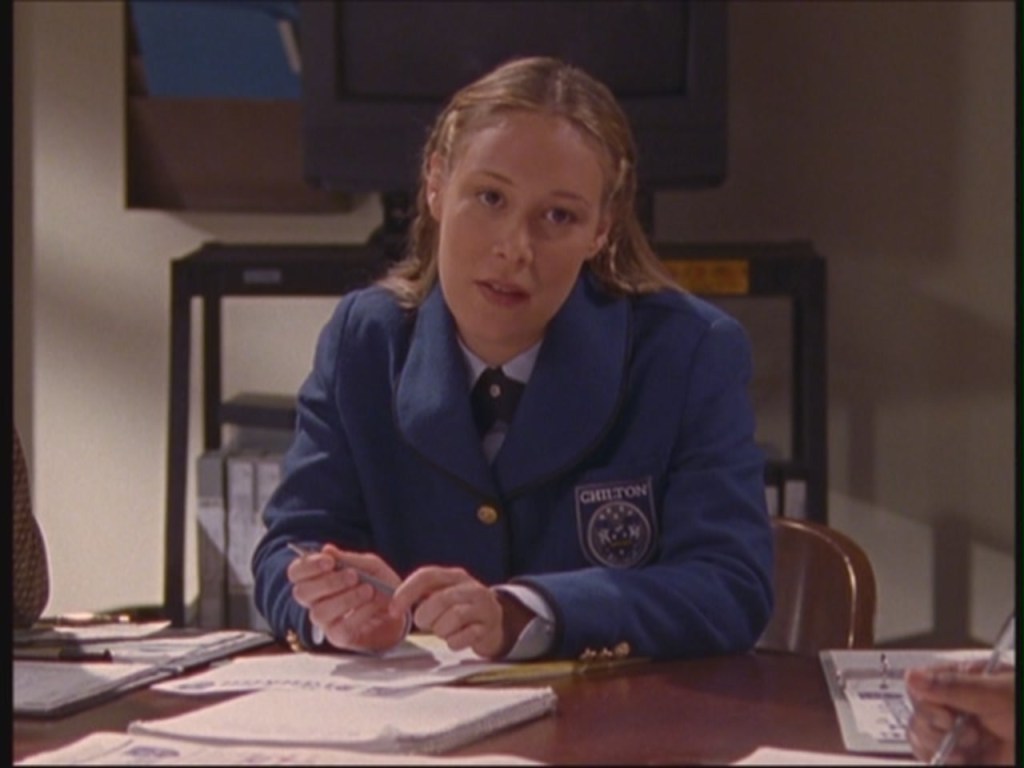
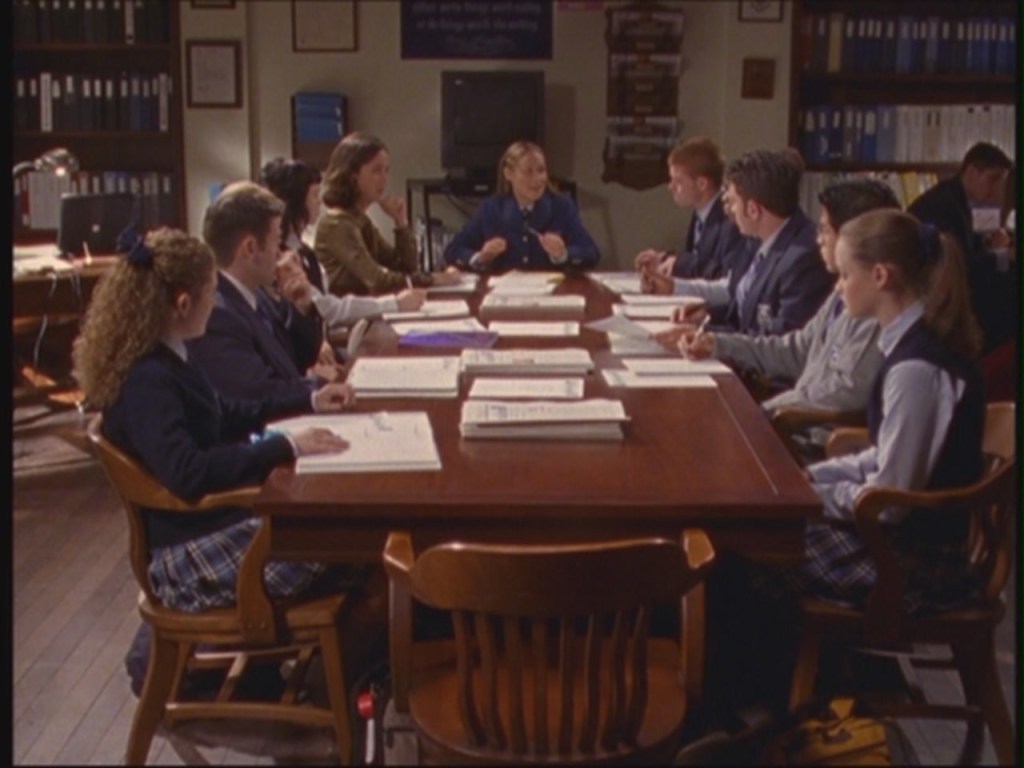
There is a meeting at the end of the school day for all those students interested in working on Chilton’s magazine, The Franklin, previously discussed.

Paris has been chosen as the editor, and plans to use her position to make Rory’s life miserable. She tells Rory the meeting is at 4 pm, but it actually began at 3:15 pm, so that Rory arrives very late (a handy writing technique, so that we don’t see all the boring part of a meeting where everyone introduces themselves and the teacher makes a welcoming speech).

Paris’ evil yet simple scheme of giving the wrong time is one often utilised in film and television, yet would have trouble working in real life. For one thing, the school day ends at 4.05 pm, so the meeting seems to actually take up class time. Wouldn’t Rory have needed permission from a teacher to attend the meeting, and wouldn’t that be a clue it wasn’t after school?

And Rory is so obsessive about schedules and timetables, is it really possible she had no other way of knowing the time of the meeting? There were no flyers on the wall, she couldn’t check with another student, the teacher in charge didn’t mention it? It’s meant to make Paris look like a villain, but in fact it makes Rory look sloppy and careless, or as if she has been so busy learning her new timetable and locker location that she forgot to make a note of the meeting time. At the very least, she’s dopily naïve to trust someone she knows is working against her.

Paris has been chosen as editor, despite being in her junior year, in the first year she is eligible to work on the magazine at all. Wouldn’t a senior year student be chosen as the editor? Or is there a tradition that only juniors work on The Franklin, as seniors have more important things to do? If so, that’s a lot of responsibility to be given when you have no experience. But that seems to be the Chilton way – throw students into the deep end and watch them either sink or swim.

Paris gives Rory the assignment she threatened to as soon as she was named editor – a story on re-paving a parking lot. How she knew such a story would be available four months later is a mystery. If it’s not a coincidence, perhaps she already knew about the re-paving in advance, and had been given a heads-up it would be one of the first stories covered when the new school year began. That she managed to manipulate the situation so that Rory was the only student possible to do the story is a testament to her genius.

Liz

LUKE: Look, his problem is obvious, it’s his mother. You never could count on Liz for anything. Our mom died when we were kids, right? It was just my dad, me and Liz. And my dad worked all the time and I worked in the store with my dad, and Liz was off doing God knows what.
LORELAI: Well, I bet losing her mom so early was kind of hard on her.
LUKE: It was hard on all of us, but we did our part. And then the minute she graduates high school, she is outta here. Didn’t matter that my dad was sick, didn’t matter that the store was failing, she just took off. Married the hot dog king, had a kid, he left, now here we are.

Luke gives Lorelai a potted history of his sister Liz. After the death of their mother while they were young, Luke fell into the role of the “good child” who supported his father and worked alongside him in the hardware store when he wasn’t at school. Liz was the “bad child”who ran around town and did her own thing.

As soon as she finished school, she left town (and went to California?) despite her father being ill and the family business going downhill as a result. Luke now makes it sound as if Liz’s husband worked at (or owned?) the Wienerschnitzel restaurant, not merely another customer. In fact, he had a similar job to the one Luke now has!

Lorelai is immediately sympathetic to Liz, understanding the terrible loss of her mother at a young age, and having personal knowledge of being a wayward teenage girl, family black sheep, and young mother herself.

It possibly explains one of the reasons Luke is drawn to Lorelai. She was a rebellious teen like his sister and even had her child the same year as Liz, and yet while he can only see Liz as a screw-up and a flake, Lorelai is energetic, hard-working, ambitious, and a pillar of their community. Of course, Lorelai wasn’t orphaned in her teens, and her family didn’t go broke, so it’s hardly a fair comparison.

In fact, despite Luke’s disparaging summation of his sister’s character, her life story doesn’t sound particularly dire or even that unusual. She got out of a probably stifling small town to escape a miserable family situation, travelled across the country, met a small business owner (?) or at least someone in employment, got married and had a child. Although she married young, the marriage lasted fifteen years or more, leaving her as a single mother to a teenage boy who seemingly inherited her own rebellious streak.

Luke’s relationship with his sister opens up a number of questions. Does he see Lorelai as the girl who turned her life around with the support of Stars Hollow, the way he wishes Liz had? Does he sometimes cast Lorelai in the role of a ditzy younger sister? Does he give Lorelai and Rory the help and friendship he wishes he could have bestowed on Liz and her son?

And if he had directed his love and care towards his sister and nephew instead, would they be in the mess they are now? Because Lorelai has lived in Stars Hollow for more than ten years, and she didn’t even know Luke had a sibling.

(By the way, Liz is another name from General Hospital – Luke and Laura’s son Lucky married a girl named Liz, and they became a younger generation “supercouple”).
“He’s been getting into some trouble”

LUKE: Well, ’cause apparently he’s been getting into some trouble and Liz is afraid he’s heading for something bad, and rather than handle it herself, she’s just giving up. She’s sending him here so I can straighten him out.

LORELAI: Right. So what kind of trouble has he gotten into?
LUKE: Ah, just kid stuff, you know, staying out late, getting rowdy. I don’t know exactly.

The exact nature of the “trouble” Luke’s teenaged nephew was getting into was never made explicit in the show, so that the characters were free to imagine it for themselves.

Luke optimistically guesses that his nephew has been getting up to trouble in an almost boyishly wholesome way that could have come straight from the pages of Tom Sawyer. Lorelai immediately assumes that the kid is fresh out of juvenile detention and most likely has a criminal record.

Whether either are right, or whether the nephew’s misdemeanours are somewhere between these marks, is something the viewer is free to decide for themselves.

Der Wienerschnitzel

LORELAI: Where’s his dad?
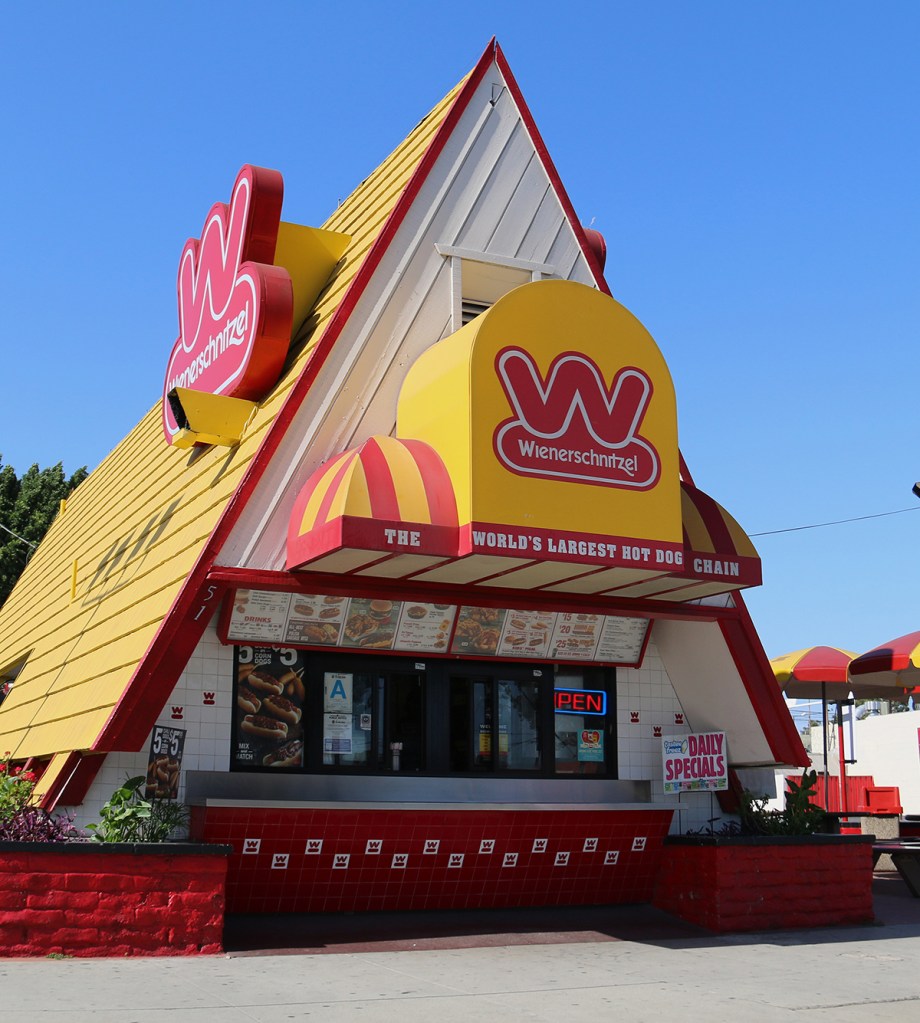
LUKE: Oh well, the great prize that my sister picked up at a Der Wienerschnitzel left her about two years ago, whereabouts unknown.

Wienerschnitzel is an American fast food chain specialising in hot dogs (even though the name refers to crumbed veal, which the restaurant has only served a few times). It was founded in 1961 as Der Weinerschitzel (which is grammatically incorrect as a German phrase). Although the name was changed in 1977, many older customers still use the original name.

Wienerschnitzel is predominantly located in California, which suggests that Luke’s sister Liz met her son’s father there, and that she and her son have been on their own for two years. It is worth noting that this back story changed during the course of the show.

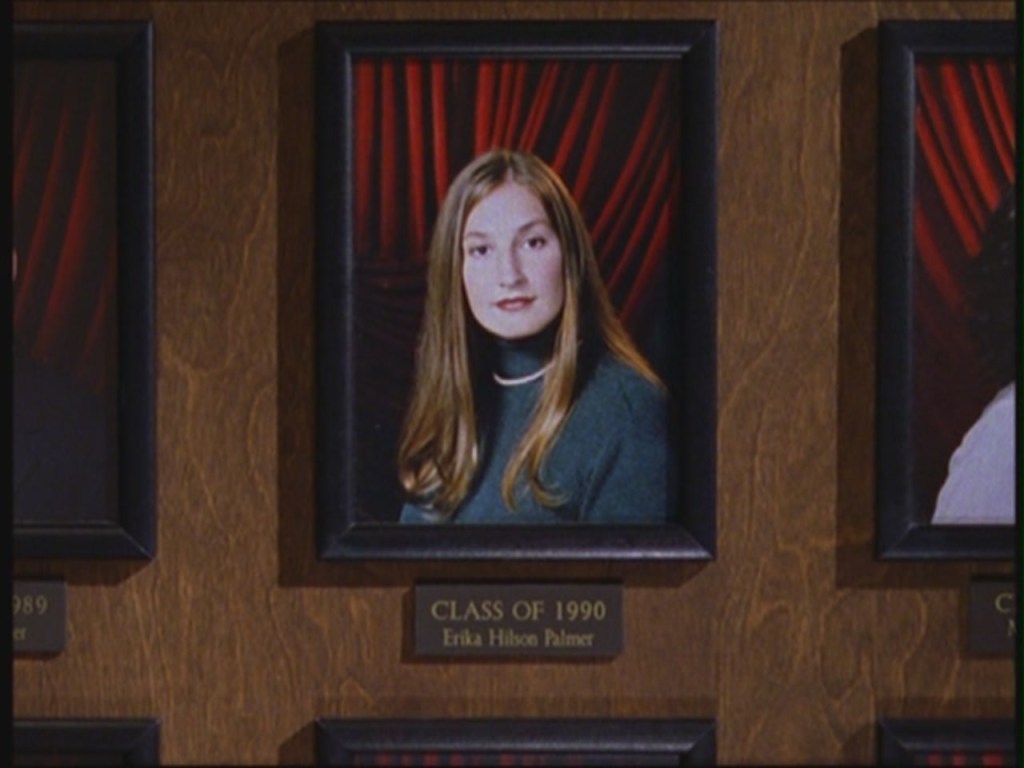
Erika Hilson Palmer

On her way back from going to the toilet, Lorelai has a poignant moment looking at a display of past valedictorians, and makes a point of gazing longingly at Erika Hilson Palmer, the valedictorian for 1990. This is the year that Lorelai would have graduated from university if she’d gone straight from high school instead of having Rory, and it’s a reminder that Harvard was her dream first, and that she seems to have had high ambitions for herself.

In real life, Harvard University does not have class valedictorians.

Reader Sazz has noted that the surname Palmer seems like a nod to Twin Peaks, the television  show directed by Amy Sherman Palladino’s idol, David Lynch (mentioned a short time earlier in this very episode). Twin Peaks centres around solving the mystery of teenage Laura Palmer’s death.