The Kennedy Clan

EMILY: Well, this is just ridiculous. Three intelligent women sitting here in complete silence. There must be something to talk about. Do you know that every night at dinner, the Kennedy clan would sit around the table having lively debates about everything under the sun? They would quiz each other about current events, historical facts, intellectual trivia. Now the Gilmore clan is just as smart and worldly as the Kennedys, so come on – somebody say something.

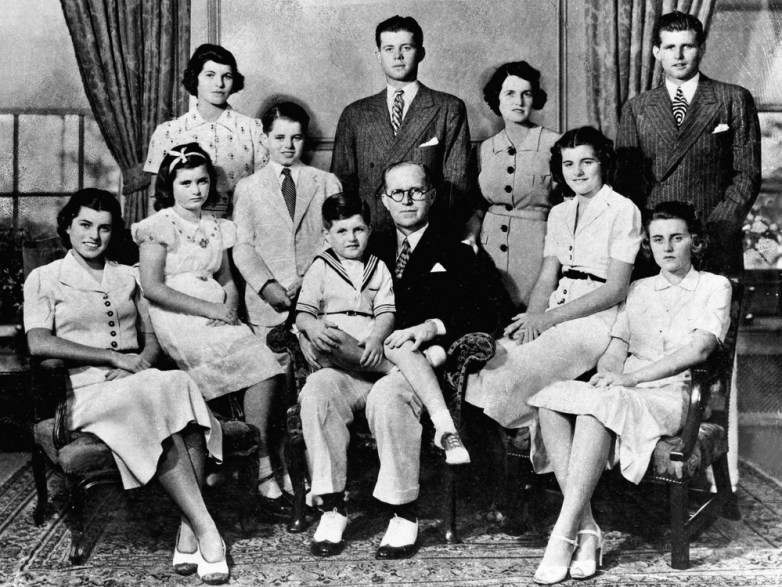
The Kennedy family have been prominent in American politics, business, and public life since the 1880s, with many of them elected to political office since the post-war era. Some of their most famous members include Joseph P. Kennedy, ambassador to the UK 1938-1940; John F. Kennedy, president from 1961-1963; Robert Kennedy, senator for New York from 1965-1968, and Ted Kennedy, senator for Massachussets from 1962-2009.

Emily is correct that the Kennedy family would quiz each other at the dinner table, but it was a far more competitive environment than she makes it sound. Joseph Kennedy would set one of his children a topic to study, and all the others would have to study it too so that they could quiz him or her to see how well they had learned and understood the topic. Joseph would sometimes enliven proceedings with dinner time lectures, complete with maps and notes.

Incidentally, one of the Kennedys is named Rory – Rory Kennedy (born 1968) is the daughter of Senator Robert Kennedy, born six months after his assassination; her name was chosen to sound like his (“Bobby”). She is a documentary film maker, and her first film was American Hollow in 1999, about life in an Appalachian valley (it bears little resemblance to Stars Hollow). I don’t know if Kennedy influenced the choice of Rory Gilmore’s name in any way.
Where It’s At

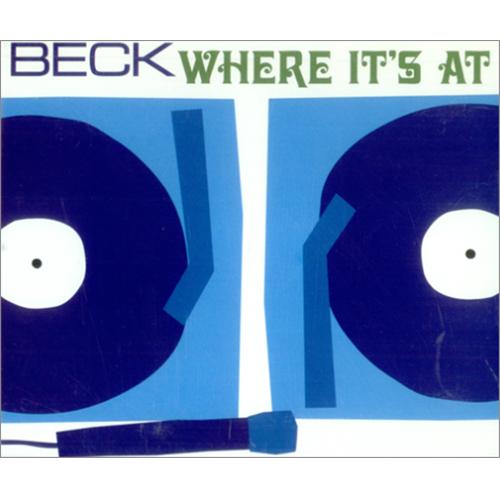
This song by Beck is playing in the background when Rory and Lane arrive at Madeline’s party and continues throughout the introductions to Madeline and Louise.

Where It’s At is from Beck’s acclaimed 1996 album Odelay, although he performed the song in concert earlier, including at Lollapalooza in 1995. The song went to #61 in the charts and #5 in the alternative music charts, earning Beck a Grammy Award for Best Male Rock Vocal Performance, while the music video won Best Male Video at the MTV Awards. The song uses samples from various sources, including one from a sex education album for teenagers – rather apt for Louise and Madeline’s later actions.

The cool alternative music at the party suggests they hired the same (rather implausible) DJ from the Chilton Winter Formal.

“We just broke up”

Lorelai returns home with her lovelorn depression all the deeper after the evening’s events. She was set up with a boring man by her mother, who, when challenged, pointed out that Lorelai has had never had a relationship last as long as three months. If she hoped to find comfort with Luke, even the comfort of friendship, she also witnessed him reuniting with his long-lost ex-girlfriend Rachel, leaving Lorelai on the outer.

Lorelai picks up the phone and calls Max, only to get through to his answering machine. Before she can leave a message, Rory comes home and says “We just broke up”, so that Lorelai must comfort her daughter, whose night was even worse than hers.

We never witness the break up between Rory and Dean, so we don’t know what happened after he said he would drive her home. We don’t know who broke up with whom, or if they really broke up at all. Perhaps Rory is so inexperienced at relationships that she automatically thinks a bad fight means you have broken up, even if nobody says anything. (Maybe Dean thinks that too).

At the very least, we know the relationship between Rory and Dean has gone sour, and that the two of them have missed all the clues that they aren’t really suited to each other that the audience has been picking up on for months.

We also see a different side to Dean that has been hinted at in the past but has now become obvious: when he feels that Rory is not giving him what he is due in the relationship, he becomes angry and sulky, and refuses to listen to her. Unfortunately, it sets up a dynamic where Rory pleads with Dean, and tries to placate him, in a way which suggests she is frightened of his temper.

We saw a little of it in the Donna Reed incident, and now we see it full-blown. Despite the break-up, we will see more of it throughout their relationship. More than anything else, it is probably this unhealthy pattern of behaviour which convinces most viewers that Dean is not right for Rory.

“You don’t get pregnant saying I love you”

RORY: Dean. Please, it’s just not that easy for me. I mean, saying “I love you” means a lot. Think about it from my point of view. I mean, my mom and our life. I mean, my mom said that she loved my dad and then . . .
DEAN: You don’t get pregnant saying “I love you”.

Dean is being almost stubbornly dim-witted here, and refusing to consider how Rory’s family circumstances might have coloured her feelings about love, because her parents were teenagers who loved each other, but didn’t stay together. Lorelai told Rory that she would always love Christopher, but she still refused his marriage proposal, and he went away. In other words, Rory knows that love is not enough, it isn’t any guarantee that your relationship will last. Saying “I love you” is filled with anxiety for Rory, because in her limited experience, the next thing that happens is “Goodbye”.

The fact that Dean’s mind jumped straight to pregnancy might suggest that he was hoping a shared “I love you” might be the first step toward having sex with Rory.

The New Yorker

DEAN: Well, come on, you always bring a book with you and I was just wondering, what’s the three month anniversary book?
RORY: Actually, I brought The New Yorker.
DEAN: A magazine. Really?
RORY: It’s the Fiction Issue.

The New Yorker is an American magazine, first published in 1925, which comes out 47 times a year. Although often focused on the cultural life of New York City, it has a wide audience around the country and internationally. It’s well known for its commentaries on popular culture, rigorous journalism on political and social issues, and attention to modern fiction.

Some of the famous authors who have written for The New Yorker include Alice Munro, Truman Capote, John Cheever, Vladimir Nabokov, J.D. Salinger, Shirley Jackson, James Thurber, John Updike, Eudora Welty, Stephen King, and Dorothy Parker.

The New Yorker traditionally brings out their Fiction Issue during the summer. The June 19 2000 edition was for debut authors, and that Fiction Issue included works by Marisa Silver, David Schickler, Akhil Sharma, and ZZ Packer.

Was the fifteen-year-old Rory who bought that magazine in her summer vacation just looking for great new stories to read, or was she also dreaming of one day being a first-time writer published in The New Yorker herself?

Chase Bradford

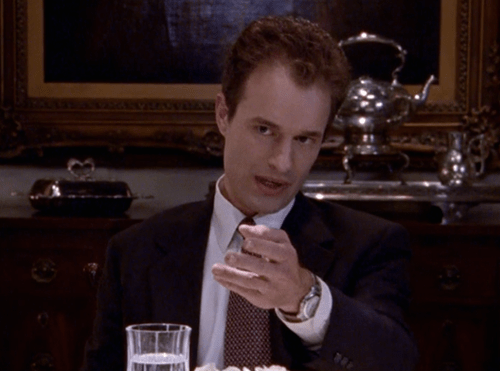
EMILY: Oh, Lorelai, I’d like you to meet Chase Bradford.

Lorelai turns up for Friday Night Dinner without Rory (who’s out with Dean) to find that Emily has wasted no time in attempting to set her up with a former neighbour named Chase Bradford (Paul Cassell), who’s just moved back to Hartford.

It’s really very sudden, as the previous Friday it seems as if Richard and Emily might have tried to get Lorelai back with Christopher, Rory’s father. Lorelai received a marriage proposal from Christopher less than a week ago, which she turned down – I wonder if Emily pushed him into doing that?

Emily is desperate to find Lorelai a man who isn’t “that diner guy”: Lorelai’s recent admission to Emily that she might be interested in Luke appears to have made her extra determined to get Lorelai into a safe relationship. She’s picked out practically the first man to come along, and he’s extremely dull, and slightly creepy. Lorelai might sympathise with Lane, who also feels her mother is starting to lower her standards when choosing blind dates for her.

Chase Bradford’s suitably preppy name might have been inspired by Chase Bank, formerly Chase Manhattan, one of the largest banks in the US. His surname might be after William Bradford, one of the pilgrims from the Mayflower, who became Governor of the Plymouth Colony. He has numerous descendants, many of them wealthy and well-connected, so there might be a suggestion here that Chase is one of them.

“Crazy festival”

LUKE: It’s a crazy festival based on a nutty myth about two lunatics, who in all probability did not even exist. And even if they did, probably dropped dead of diphtheria before age 24. The town of Stars Hollow probably got its name from the local dance hall prostitute. Two rich drunk guys made up the story to make it look good on a poster.

This is Luke’s cynical theory about the Founders Firelight Festival. It actually doesn’t seem too implausible, and gives us another possibility: was Stars Hollow founded on a lie? Or has Luke been so hurt by love that he believes it is always a con?

(Diphtheria is an infection caused by air-borne transmission of bacteria, with the main symptoms being a fever, sore, throat, and a cough. It is fatal in 5-10% of cases, and was much more common before vaccines were available).

Bonfire

TAYLOR: No, no, Patty, you’re wrong. They built the fire to throw themselves on it when their families found them.
MISS PATTY: Taylor, you’re crazy! They built the fire so that they could stay warm their first night here.
TAYLOR: Patty, I am the recording secretary for the Stars Hollow City Council. I think I know how my town was founded!

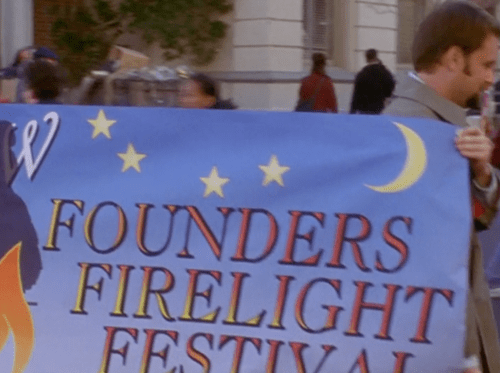
Lighting a bonfire in the town square is the central focus of the Founders Firelight Festival. It seems to stem from a large fire made by the star-lit young lovers whom the town views as the founders – an earthly star to mimic the ones in the night sky.

However, the reason for the fire doesn’t seem to be known for sure. Miss Patty says they lit the fire to stay warm on a cold night, which sounds perfectly reasonable. However, Taylor believes that they lit the fire so that if their families tracked them down, they could throw themselves on it and burn themselves to death rather than be separated again.

The death-by-fire theory doesn’t seem very sensible (there are quicker and less painful ways to kill yourself, for a start), but it is a reminder of the mutual death met by those star-crossed lovers, Romeo and Juliet. It also shows the darker side of love, a fire that can burn and destroy as well as fill you with a warm glow.

It begs the question: does Stars Hollow commemorate a pair of lovers who found each other, and stayed happily together all their lives, or a pair of lovers who found each other, only to kill themselves to make sure they could never be parted again? Miss Patty’s story doesn’t tell us, as it ends with the boy and girl finding each other – what happened after that is never explained.

We probably presume they stayed together, and they and their descendants founded the town (hopefully joined by other like-minded folks at some point, or else the whole town came from the loins of two people, Adam and Eve style).

The alternative is that the town was founded by the grieving friends and family of the lovers, who regretted that they had driven them to suicide, and honoured their memory by founding Stars Hollow (like the Montagues and Capulets coming together after the death of Romeo and Juliet).

Is Stars Hollow a town built on romance and reunion, or grief and guilt? On life and love, or death and darkness? Whether Stars Hollow is magic or tragic seems to be a matter for debate, adding a gloomy lining to the silvery fairy tale of the star-blessed lovers.

Falling Star

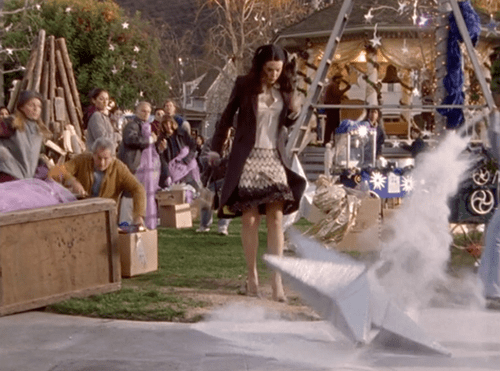
While Lorelai is walking grumpily through the preparations for the Founder’s Firelight Festival, a papier mache star accidentally falls right in front of her, almost hitting her. It’s an apparent sign that the stars above don’t approve of her love-lorn depression which is out of step with the festival and the community, or else they are trying to send her a very strong signal to do something about it. Maybe both.

Bangs

SUMMER: You should get bangs.
PARIS: Thanks for the tip.
SUMMER: You have a long forehead. Bangs would hide that.

Bangs is another word for a fringe, hair cut and styled so that it falls over the forehead. Apart from her classic “mean girl” put-down in the guise of being helpful, Summer may be making a play on the word “bang” for sex, so that she’s telling Paris, “You should get banged”, so that she will chill out and stop getting jealous.