Al’s Pancake World

Rory explains to her dad that the never-seen but often-referenced local restaurant Al’s Pancake World doesn’t actually serve pancakes any more, although it once did. A few years previously Al  switched to international cuisine, but as he had just had new napkins printed out he had to keep the name. Presumably when the napkins run out he will change the name, but he must have a lot of napkins as that never happened. The name of the business suggests it was always international cuisine, just with a pancake theme that was abandoned for some no doubt quirky reason.

Al keeping the name of the restaurant is not dissimilar to the situation with Arnold’s Restaurant in the sitcom Happy Days. Mitsumo Takahashi (Pat Morita), the restaurant’s owner, explains that he goes by the name “Arnold” because he bought the business as Arnold’s Restaurant, and it was too expensive to buy enough sign letters to rename it “Takahashi’s”. Patrons assumed the restaurant was named after him instead of the other way around.
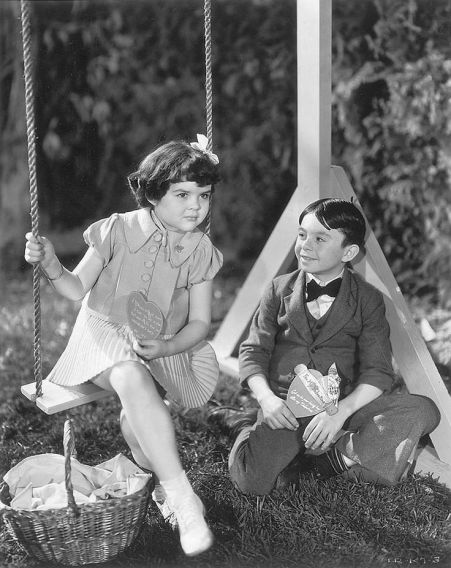
Alfalfa

LUKE: Doesn’t even resemble clever [Kirk’s heckling].
KIRK: I’m dumbing it down for you, Alfalfa.

Alfalfa was a character from the Hal Roach’s Rascals short comedy films, made from 1922 to 1944, popularly known as the Our Gang films, after the first short in the series. The stories are about a group of poor children, and their adventures around their neighbourhood. The films were notable for showing children acting naturally, and ground-beaking for showing black and white children playing together as equals.

Alfalfa, played by Carl Switzer, was one of the most popular characters from the 1935-1940 era, eventually going from sidekick to lead character. His romance with a cute spunky little girl named Darla, played by Darla Hood, was an an ongoing source of comedy in the films. Kirk may identify Luke with Alfalfa because of his obvious romantic interest in Lorelai.

Packaged as The Little Rascals, the shorts were syndicated to television in the 1950s, shown on cable in the 1980s, and from 2001-2003 were on the American Movie Classics network. During the 1980s, The Little Rascals became an animated television show that was part of the Saturday morning cartoon line-up with Julie McWhirter voicing Alfalfa.

In 1994, a feature film of The Little Rascals was released, directed by Penelope Spheeris, and with Bug Hall in the role of Alfalfa Switzer. The movie has a heavy focus on Alfalfa’s romance with Darla (Brittany Ashton Holmes).

Pinky Tuscadero

CHRISTOPHER: And you were the girl in the Pinky Tuscadero tee-shirt sitting right next to me [while he crashed his car].

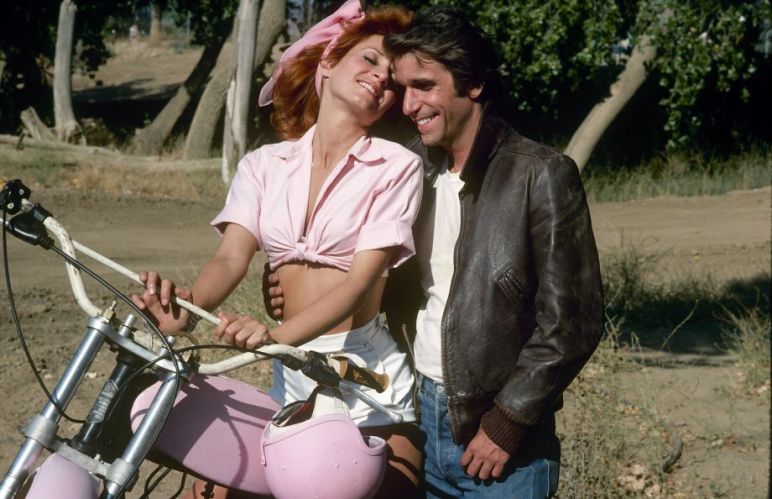
Carol “Pinky” Tuscadero (Roz Kelly), is an old flame of Arthur “Fonzie” Fonzarelli (Henry Winkler) on the classic American sit-com Happy Days, which ran from 1974 to 1984, and reprised her role in an episode of the Happy Days spin-off, Blansky’s Beauties, which aired 1977.

Pinky was a redhead who always wore a trademark pink scarf, and whose catchphrase was “Think pink”. She was a travelling demolition derby driver who could fix cars, and rode a pink motorcycle; her girl gang were called The Pinkettes.

Although she only appeared in three episodes in 1976 – the planned story line where she would be Fonzie’s long-term girlfriend never worked out – Pinky Tuscadero gained a cult following for being a female “Fonzie” who was cool and tough. She clearly made an impression on young Lorelai.

Joan and Melissa Rivers

EMILY: Lorelai, you’re being morbid.
LORELAI: I’m being morbid? … Joan and Melissa Rivers here think I’m being morbid.

Joan Rivers, born Joan Molinsky (1933-2014) was an American comedian, actress, writer, producer, and television host. She was known for her controversial comedic persona, which was often viciously insulting towards celebrities and politicians. Actress Melissa Rivers (born Melissa Rosenberg in 1968) is her daughter, who worked alongside her mother on several occasions.

Joan and Melissa Rivers appeared as themselves in the 1994 television movie Tears and Laughter: The Joan and Melissa Rivers Story, which we learn in the next season is favourite viewing for a mocking Lorelai and Rory.

In the film Joan and Melissa recreate the anguish they went through after the suicide of Joan’s husband and Melissa’s father, Edgar Rosenberg – who had often been the butt of his wife’s jokes during her comedy routine, and whose death was also milked for humour by Joan.

Lorelai equates Richard and Emily’s glee at getting their hands on their dead acquaintance’s house at a good price as being in a similar vein of poor taste.

Joan Rivers was one of Amy Sherman-Palladino’s favourite comedians, and her later TV show, The Marvelous Mrs. Maisel, is about a female comedian in the 1950s who is partly inspired by Rivers.

Wild Kingdom

LORELAI: Well, it started with Rory’s baby chick getting loose in the house and ended with Rory and I up at one in the morning looking for Morey and Babette’s new kitten, who we found asleep in the piano.
SOOKIE: Wow, that’s very Wild Kingdom of you.
LORELAI: Yeah. I’m like the Marlin Perkins of Stars Hollow.

Mutual of Omaha’s Wild Kingdom, often just called Wild Kingdom, is an American nature and wildlife show which first ran from 1963 to 1988. It was hosted by zoologist Marlin Perkins until he had to retire in 1985 due to ill health. Wild Kingdom helped raise ecological and environmental awareness, and its success led to other wildlife documentaries being aired on television, helping to pave the way for the Discovery Channel and Animal Planet. The show was revived on Animal Planet in 2002, and ran until 2011.

Rory and Donna Reed Night

It isn’t obvious what Rory hoped to achieve by holding a Donna Reed Night with Dean, or what she thought she had proved by doing so. If she wanted to confront him with the reality of being an ideal 1950s housewife to show him how unrealistic it is, she is only partially successful.

Dean clearly adores the idea of her cooking for him while dressed in high heels and pearls, and even likes the rather terrible food she has prepared from packets and cans. Rory receives reassurance from Dean that he doesn’t really want her to be Donna Reed, but when she says she would do it all again, he is very quick to show interest in the idea. If anything, she may have awoken a desire in him he didn’t know he had.

If Rory planned to seduce Dean with cuteness to resolve their argument, she succeeded – but at what cost? And why? Was she simply scared of losing Dean, and made a grand gesture to win him back? If so, it’s sad, but probably not unrealistic for a teenager, that a single disagreement over an old TV show could make her so frightened and desperate.

There seems to be an element of wanting to demonstrate to Dean that she can have opinions and an identity that differ from Lorelai. Her choice of teenage rebellion is a bit strange, but she seems to have decided that she will set herself apart from from her mother by being far more willing to change herself and her ideas to please her boyfriend. Little wonder the uncompromising Lorelai thinks a blow to the head might have been involved.

Johnny Angel

This is the song which plays while Rory and Dean are eating their home-made dinner together at Babette’s.

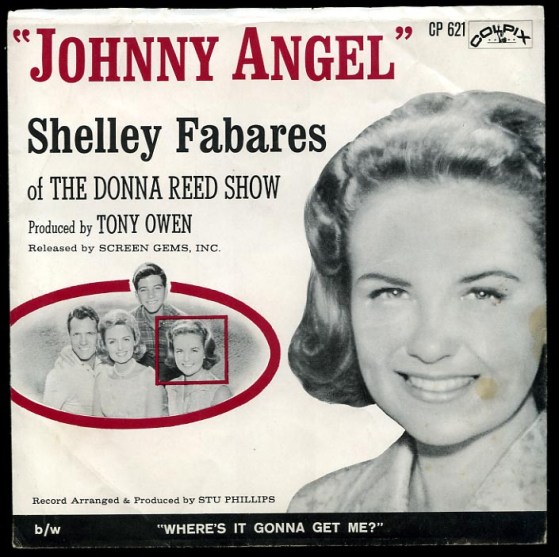
Johnny Angel is a 1962 teen pop song by Shelley Fabares, the actress who played Mary Stone on The Donna Reed Show. It was a cover version of a song written by Lyn Duddy and Lee Pockriss, and had been earlier recorded with little success. The song was the first single released from Fabares’ debut album Shelley!, and premiered on The Donna Reed Show. It went to #1 on the charts, and sold over one million copies.

The song tells of a girl’s great love for boy, as if to say that Rory is making such a big effort for Dean because she really loves him and wants his approval. The link with Donna Reed makes it an apt choice.

“Honey, you’re home”

RORY: Honey, you’re home. Well, say something.
DEAN: Trick or treat?

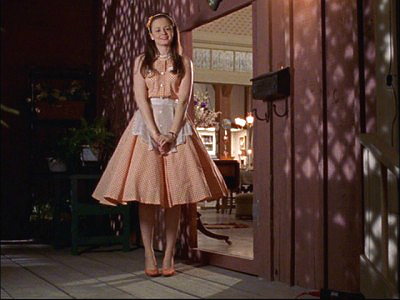
When Rory welcomes Dean wearing her 1950s housewife outfit, she inverts the traditional sit-com catchphrase, “Honey, I’m home!”, perhaps most associated with The Dick Van Dyke Show (1961-1966). Dean doesn’t know what to say, except “Trick or treat?”, the Halloween catchphrase – showing that he recognises Rory is in costume.

Where Rory’s outfit comes from is a complete mystery. It doesn’t look like a collection of clothes she or Lorelai would have at home, and besides she’s been at Babette’s (the dress at least can’t be Babette’s – she and Babette are completely different heights). Did she make a quick stop at a vintage clothing store on the way back from Lane’s, or borrow the clothes from the costume box used for Stars Hollow theatre productions?

In an episode where very little actually makes sense, the dress it just one more unexplained element. It’s almost like those cartoons where characters can pluck anything they need from the air, such as a hammer or a bouquet of flowers.

Lucy Ricardo

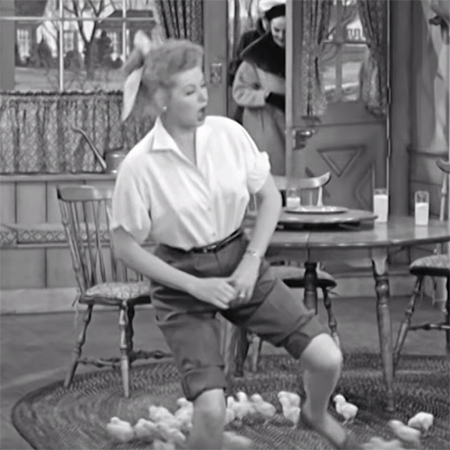
LORELAI: Luke? Stella got out and I don’t know – do I put seed on the floor? Do I make cheeping sounds? Or do I pull a Lucy Ricardo and walk like a chicken so she thinks I’m her mother?

On I Love Lucy, earlier discussed, there was a point in the show when New Yorkers Lucy and Ricky Ricardo began a new life in Connecticut. In the episode Lucy Raises Chickens (4 March 1957), Lucy tries to make money to pay the bills by raising five hundred chickens in the house, and attempts this method of bonding with them.

Martha Stewart

LUKE: No stenciling!
LORELAI: Excuse me – do you even know what stenciling is?
LUKE: Does Martha Stewart do it?
LORELAI: Yes.
LUKE: (firmly) No stenciling.

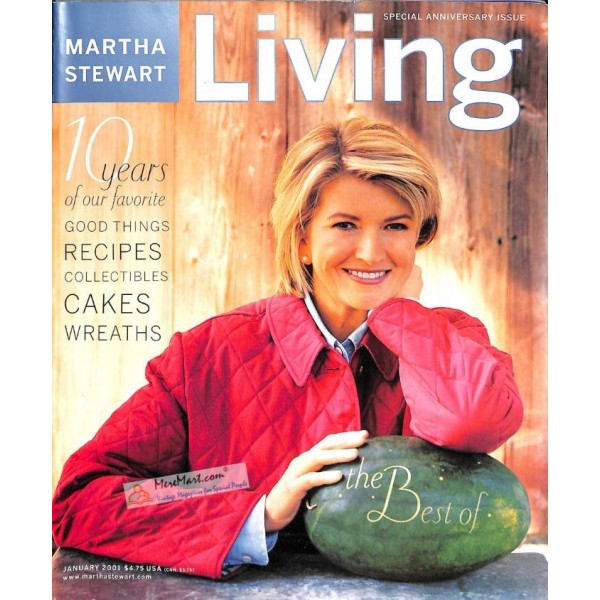
Martha Stewart (born Martha Kostyra in 1941) is an American businesswoman, writer, and television personality. The author of numerous cooking and craft books, her magazine Martha Stewart Living was founded in 1990, and her television show of the same name ran from 1993 to 2005. Both magazine and show focus on entertaining, lifestyle, food, crafts, decorating, and DIY. The model for the program’s TV studio was the Stewarts’ country house in Connecticut.