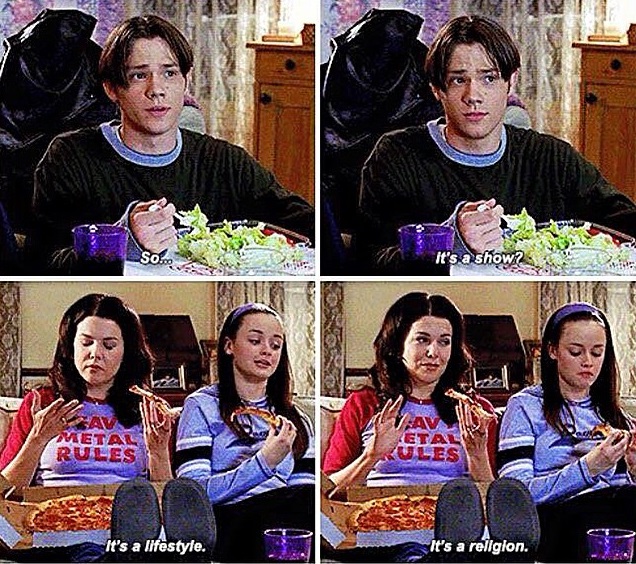
DEAN: So it’s a show?
RORY: It’s a lifestyle.
LORELAI: It’s a religion.
Dialogue which fans have taken and applied to Gilmore Girls itself.
Footnotes to the TV series
DEAN: So it’s a show?
RORY: It’s a lifestyle.
LORELAI: It’s a religion.
Dialogue which fans have taken and applied to Gilmore Girls itself.
LORELAI: Hey, you didn’t wake me up.
RORY: I set the clock.
LORELAI: Yes, but see the clock stops ringing once I throw it against the wall giving me ample time to fall back to sleep, you however never stop yapping no matter how hard I throw you, thus ensuring the wake up process.
Time for another oversleeping story in the Gilmore household. It’s more understandable this time, as they would have got to bed very late after the concert.

Todd tells Lane that his favourite movie is Beethoven, and Lane incredulously asks, “The one with the dog?”.
Beethoven is a 1992 family comedy film directed by Brian Levant and written by John Hughes (as Edmond Dantès). It is about the antics of a big friendly St Bernard dog named after the composer Ludwig van Beethoven, and the way he protects the family who have adopted him. The movie received tepid reviews but was enough of a commercial success to spawn numerous sequels and a television series.
Todd describes his favourite scene as the one where a little dog is running around with a cabbage in its mouth. During the movie, Beethoven’s family help him escape from an experimental lab run by an evil vet, and they release all the other dogs who have been held there. As the evil vet’s henchmen chase the dogs through a marketplace, a Golden Retriever puts an entire cabbage in his mouth, and spends the rest of the scene hanging onto it.
It’s one of those blink-and-you’d-miss-it funny background scenes, so this actually provides a glimmer of hope in regard to Todd’s intelligence. He clearly has a keen eye for detail (although Golden Retrievers are not really “little dogs”; maybe he means it in an affectionate way.) In the Gilmore Girls universe, perhaps even the dimmest people have a knowledge of obscure movie trivia!
SOOKIE: I asked him [Jackson] if he’d like to have dinner sometime.
LORELAI: I know – weeks ago.
For the first eleven episodes, dates in Gilmore Girls can be plotted on the calendar fairly easily. From now on, time becomes more amorphous and elastic, and sometimes even self-contradicts. At this point, a lot of estimating and even guessing will be needed to form any kind of workable timeline.
When Lorelai says the events of the previous episode happened weeks ago, we have no idea if she means two weeks, three weeks, or six weeks in the past. Most likely it is two or three weeks and we are now in early to mid-February – four or more weeks and she would probably say it was a month, or more than a month.
(It’s not possible for me to align the dates on the blog exactly with the vague calendar in Gilmore Girls at this point, or I will run out of time for events to occur in).
From the conversation between Lorelai and Sookie, we learn that Sookie has been single for years (Lorelai is quite hurtful to her about it, but apologises for it). We also discover that this hasn’t been entirely by choice, but because Sookie is very busy working at the inn, and has so many accidents that she has frequent hospital visits as well. This is another example of shortness of time being a factor in the show.
(Max rings the doorbell, arriving for his date with Lorelai)
LORELAI: It’s 8 o’clock. Who shows up at 8 o’clock for an 8 o’clock date?
RORY: I don’t know, maybe a Chilton teacher?
LORELAI: Everybody knows that 8 o’clock means 8:20, 8:15 tops!
Another mention of time and the problems it causes. Lorelai and Rory keep turning up late and getting into trouble for it; here someone else arrives on time and throws their schedule out.

LORELAI: (turns around to look at Max’s books) Wow these are beautiful! Hmm, I never read Proust, I always wanted to.
Marcel Proust (1871-1922) was a French author, best known for his monumental seven-volume part-autobiographical novel, À la recherche du temps perdu (“In Search of Lost Time”, earlier translated as “Remembrance of Things Past”), published between 1913 and 1927. He is considered to be one of the most influential writers of the twentieth century.
In a television series where the flow of time is a major theme, it’s not surprising that Proust makes a significant appearance, as his novel is a philosophical meditation on the nature of time, and how “clock” time can be very different to our personal experience of time.
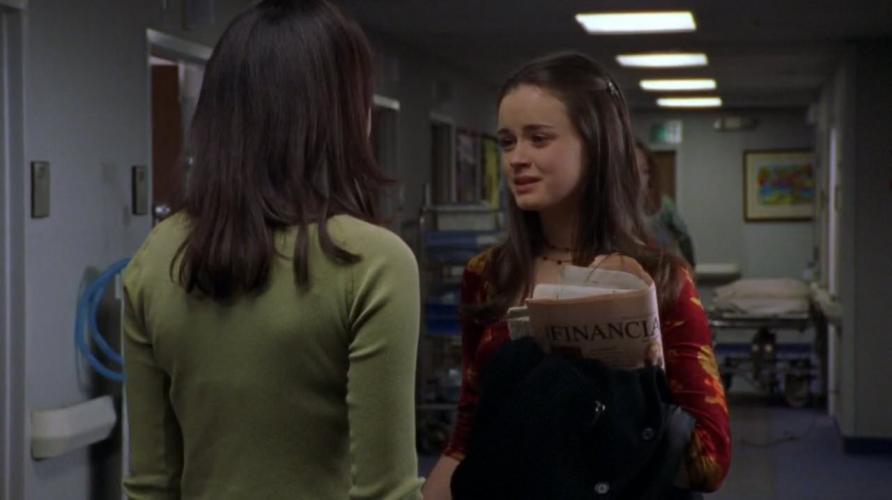
RORY: Nothing like that [she and Dean being out all night] will ever happen again. I swear.
LORELAI: Don’t swear.
RORY: Why not?
LORELAI: Because you are your mother’s daughter.
RORY: What does that mean.
LORELAI: It means things can happen, even when you don’t really mean for them to happen.
Even though Lorelai believes Rory when she says nothing happened between her and Dean, she still doesn’t trust her daughter. That’s because she sees Rory as Lorelai Mark II, and as she doesn’t trust herself, she doesn’t trust Rory. Unfortunately she is setting Rory up to fail at relationships and birth control with her “no matter how hard you try, you will still screw things up” message.
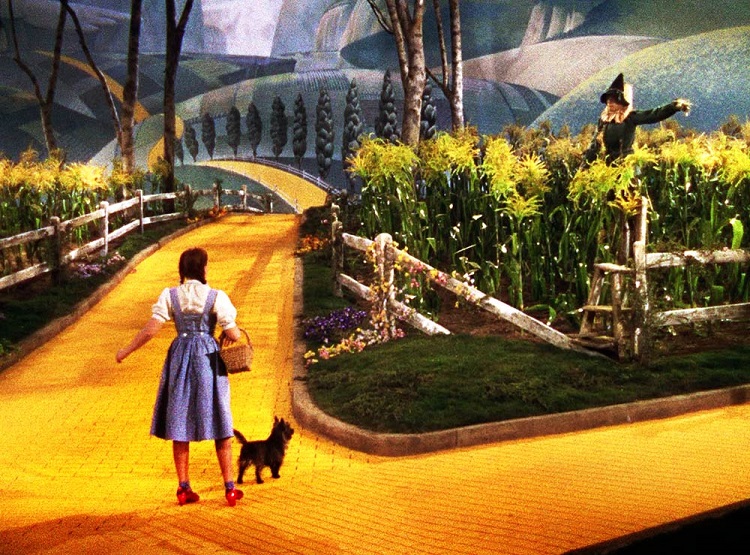
LUKE: Okay, we’re supposed to follow the blue line, around the corner and then we should be –
LORELAI: Where’s the scarecrow when you need him?
Lorelai is referring to the 1939 musical fantasy film The Wizard of Oz, produced by Metro-Goldwyn-Mayer, and based on L. Frank Baum’s 1900 children’s book The Wonderful Wizard of Oz. It was the #9 film of 1939, and a critical success on release, although so expensive to make that it didn’t make much of a profit for MGM. It won two Academy Awards for its music. After being broadcast on TV in 1956, and annually from 1959 to 1991, the film became one of the most famous in history, and is recognised as a cultural icon and one of the best films ever made.
Luke’s comment about following the blue line seems to remind Lorelai of the song Follow The Yellow Brick Road, where Dorothy (Judy Garland) is sent on her journey to find the Wizard by the diminutive Munchkins, after she is given the instruction to follow the Yellow Brick Road by Glinda the Good Witch of the North (Billie Burke). The Scarecrow (Ray Bolger) makes his appearance in the next scene, when the Yellow Brick Road branches off in two different directions, just as the hospital’s blue line does.
There will be many more references to the movie throughout the run of Gilmore Girls, and it serves as an inspiration for the show. Like The Wizard of Oz, Gilmore Girls creates a specifically American fantasy land which is both cosy and uncomfortable, with a story line which contains comedy and drama. Like Gilmore Girls, The Wizard of Oz is a quirky journey of growth where the lesson to be learned is that you already have everything you need before you even set out.
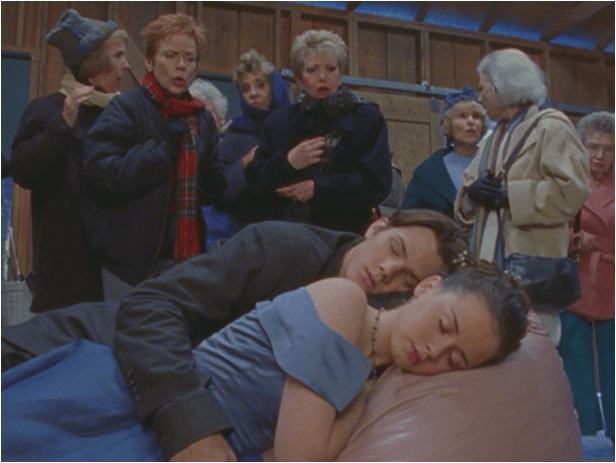
After Rory and Dean accidentally spend the night at Miss Patty’s dance studio together (another mention of the problem of time), all hell breaks loose.
For all that Lorelai and Emily are proud of Rory – so mature, so smart, so cautious – we discover that deep down both of them are terrified that at some point something will switch on inside her and she will become another teenage Lorelai who sleeps with boys and gets pregnant. It takes very little to bring all those fears to the surface, showing that they really don’t trust her at all.
Lorelai, who always touts herself as the cool mom who treats Rory as her best friend, finds that at crisis point she shrieks at and shames Rory in the same way her mother did to her. And the mother and daughter who “never fight” are now not speaking to one another.
 The Annotated Gilmore Girls