Autumn Festival

Early in the episode it becomes apparent that the town of Stars Hollow is about to celebrate its annual Autumn Festival. This is the first major celebration we see in the town, and like the other town festivals, it demonstrates the change of seasons and the turn of the year, just as the Friday Night Dinners wrap up each week for the Gilmores.

The flow of time is one of the primary themes of Gilmore Girls – take notice of how often clocks, watches, calendars, running late, and being short of time are mentioned. Already Rory has had a late acceptance to Chilton, Lorelai has woken up late for Rory’s first day at school, Rory has missed an important test because she arrived too late, Lorelai has fumbled her first date with Max because of time management problems, and missed a relative’s funeral because of the day of the week, and Jackson has felt a shift in the spacetime continuum (suggesting that time in the show is cosmic in its scale).

It is not possible to tell from this episode when the Autumn Festival is held: just that it is in November before Thanksgiving. However in A Year in the Life, it is confirmed that the Autumn Festival is the first weekend in November. We can feel fairly confident that the main events of the episode occur around that time.

(The pumpkins used to decorate the set for the Autumn Festival scenes ended up rotting and emitting a putrid smell. After that, fake pumpkins were used for any autumnal celebrations in Gilmore Girls).

Worship pudding

EMILY: Yes, but you like pudding.
LORELAI: Oh, I love pudding. I worship it. I have a bowl up on the mantel at home with the Virgin Mary, a glass of wine, and a dollar bill next to it.

Another reference to the Virgin Mary – interesting as the saint is the inspiration for the Gilmore surname. Lorelai’s statement brings to mind those primitive shrines where worshippers place votive offerings in front of saint’s statues, such as flowers or coins. Note the implication from Lorelai that she worships alcohol and money.

Rory and Lorelai’s Study Session Junk Food

Take-out fried chicken and French fries (maybe from Al’s Pancake World); the Gilmore girls add horseradish sauce to the fries

Pepperidge Farm chocolate chunk cookies

Lay’s potato chips

Starburst soft candy

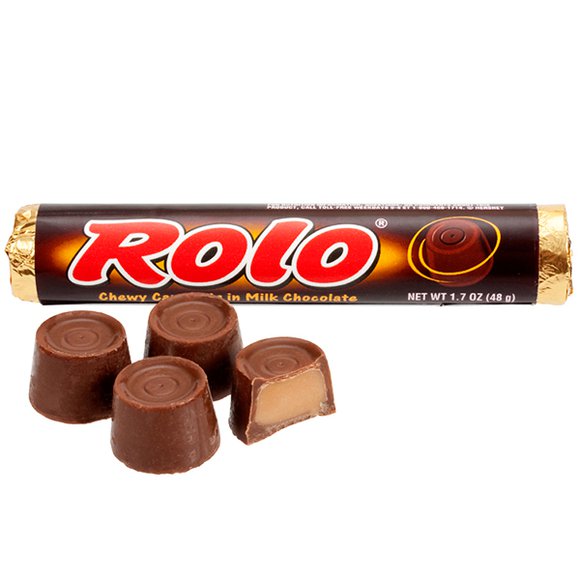
Rolo caramel-filled chocolates

… and more!

This may be the first time we see the Gilmore girls indulging in junk food: it will not be the last. The constant eating of junk food by the slender and healthy Lorelai and Rory is something which sticks in the craw of many fans, who either see it as a ridiculously unrealistic cheap gimmick, or an outright slap in the face to the audience.

But one of the themes of Gilmore Girls is a celebration of American culture. Rory reads classic American literature (like Moby Dick and Huck Finn), they watch classic American TV shows (like I Love Lucy and The Odd Couple), they watch classic American films (like The Shining and The Wizard of Oz), they reference American popular music (such as Elvis Presley and Barbra Streisand), so of course they eat classic American food – which is mostly junk. This in itself isn’t all that unrealistic – 25% of Americans eat junk food every day, just like Lorelai and Rory, and 80% of them eat junk food regularly (the numbers are even higher for children and teenagers, and Lorelai is stuck as a perpetual teen).

Yes it’s a joke, and not entirely a nice one – but there’s some real love there too.  The brand names of the food themselves are raised like totems, and can sound almost like poetry. If America means Mark Twain, Judy Garland, Jack Nicholson, and Lucille Ball, it also has to mean burgers, chili fries, Pop-Tarts and Jello-O.

Just as Rory can read an unbelievable number of book (six at once is normal for her), and she and Lorelai watch an unrealistic amount of TV and movies while still having plenty of time for work, school, and a social life, of course they can also eat insane amounts of junk food. It’s just that we tend to praise the first types of unreality as smart and savvy, and decry the last. In the Gilmore Girls universe, there is both not enough time to get everything done, and plenty of time for books and movies – and plenty of room for all the food you can eat.

Metronome

MISS PATTY: It’s your wedding day. Feel each other. Use the thumping of your heart as a metronome.

A metronome is a device which produces an audible beat at regular intervals. Musicians use it to practice playing to a particular tempo.

This is a music-heavy episode, and the connection between the heart and metronome shows how closely aligned music and emotion is. One of the themes of the episode is how Lorelai must learn to control her feelings to maintain her relationship with Rory, just as the metronome controls the beat of the music.

Travel

RICHARD: I think travelling for a young girl is a very important thing. Your mother never got a chance to travel much.
RORY: I know. She talks about that all the time.

We learn that Rory longs to travel the world, and that, like Harvard, this is another of Lorelai’s dreams which was never fulfilled because she had Rory. We might well begin to wonder if Rory has any dreams of her own, or if they are all second-hand from her mother.

Demerol

DEAN: Lorelai. I like that.
RORY: It’s my mother’s name too. She named me after herself. She was lying in the hospital thinking about how men name boys after themselves all the time, you know, so why couldn’t women? She says her feminism just kind of took over. Though personally I think a lot of Demerol also went into that decision.

Demerol is a brand name for Pethedine, a synthetic opioid medication and the most common narcotic pain relief given in US hospitals during childbirth.

Lorelai’s choosing to give her daughter her own name is another suggestion that she hoped Rory would be a “do-over” version of herself.

Friday Night Dinner

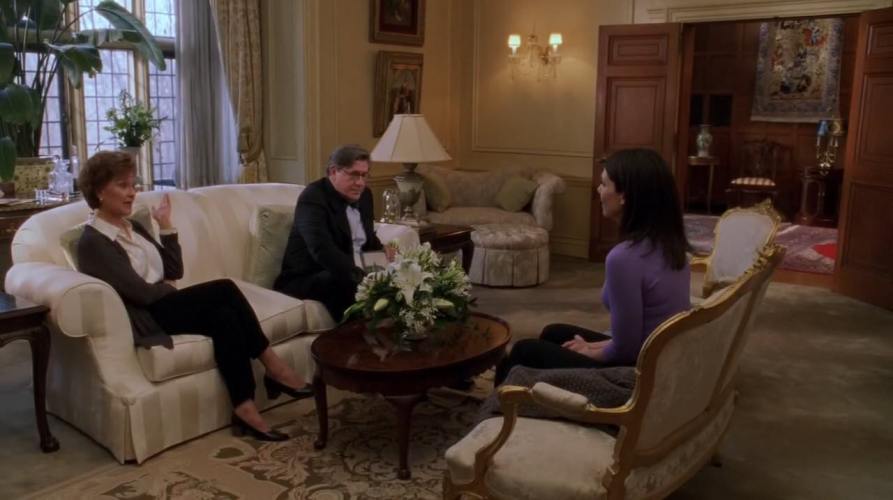
Along with her parents’ agreement to give her money to pay for Rory’s tuition at Chilton, Lorelai must in turn agree to have dinner with them every Friday, thus setting in place the pattern of the entire show. She also has to call them once a week to give an update on Rory’s schooling and her own life – this weekly phone call is not mentioned again, and although Lorelai seems to particularly hate talking to her mother on the phone, we never hear Emily (Kelly Bishop) complain that she has missed a phone call. We must assume that either Lorelai dutifully complied each week, or that Emily almost immediately accepted that she would not follow through. Neither sounds quite likely, knowing their personalities. Maybe Lorelai made Rory do the phone call.

The choice of Friday night for the family dinner fulfils at least three functions:

  1. Friday was the very next day of the week, so Emily was making sure that the dinners began straight away with no chance for Lorelai to change her mind or wriggle out of it
  2. Friday night is a popular night for social events, thus ensuring that plot-wise there was always the potential for conflict over the Friday Night Dinner and other responsibilities
  3. It brings to mind the Jewish Shabbat, with the holy day beginning at sunset on Friday evening, usually celebrated with a family dinner. This gives the Gilmores’ Friday Night Dinner a feeling of ritual and ceremony, and underscores the marking of cycles of time that each dinner symbolises. (I don’t believe this is a stretch, as Amy Sherman-Palladino is of Jewish heritage).

“She’s sixteen”.

When Joey hits on Rory at Luke’s diner, Lorelai scares him off by telling him that Rory is sixteen. In fact she is fifteen, as her birthday is still around six weeks away. Lorelai must be the only mother in the world to put her teenage daughter’s age up when she is approached by an adult male.

Age in the Gilmore Girls is very fluid, and almost meaningless. Lorelai is in her early thirties, but acts like a teenager, yet was a teenager forced to grow up too fast. Rory is a teenager who acts like she’s in her thirties, and often seems completely at sea with normal teenage activities and customs. Characters’ ages are almost never mentioned, and birthdays are rarely talked about or seen celebrated. The age of Stars Hollow itself is something of a mystery, despite the clearly marked sign in the town square.

Time is one of the major themes of Gilmore Girls, with weeks and seasons clearly marked, and yet age as a concept barely exists, as if cycles of time occur and recur without affecting anyone, or as if the characters and towns exist in a sort of ageless dream-time.

Gilmore Girls

Gilmore is a Scottish and Irish surname which means “servant of the Virgin Mary”. A very apt name for a show which revolves around motherhood, and maternal relationships.

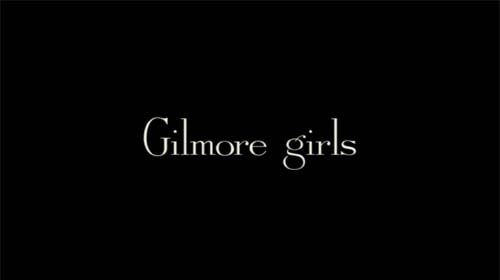
Alternative titles for the show were The Gilmore Girls, and The Gilmore Way, which Lauren Graham thought sounded like a method of natural birth. Eventually Gilmore Girls was decided on. The font for the title card is Solid Antique Roman.

Amy Sherman-Palladino and Dan Palladino chose the name Gilmore after their bank, the Gilmore Bank in Los Angeles. It’s a family-owned community bank operating since 1955, and proud of their friendly customer service where everyone knows your name. That kind of cosy hometown environment must have seemed perfect for a show all about family and community.

There’s an odd sort of logic too, that the money they made from Gilmore Girls went straight back to Gilmore Bank!