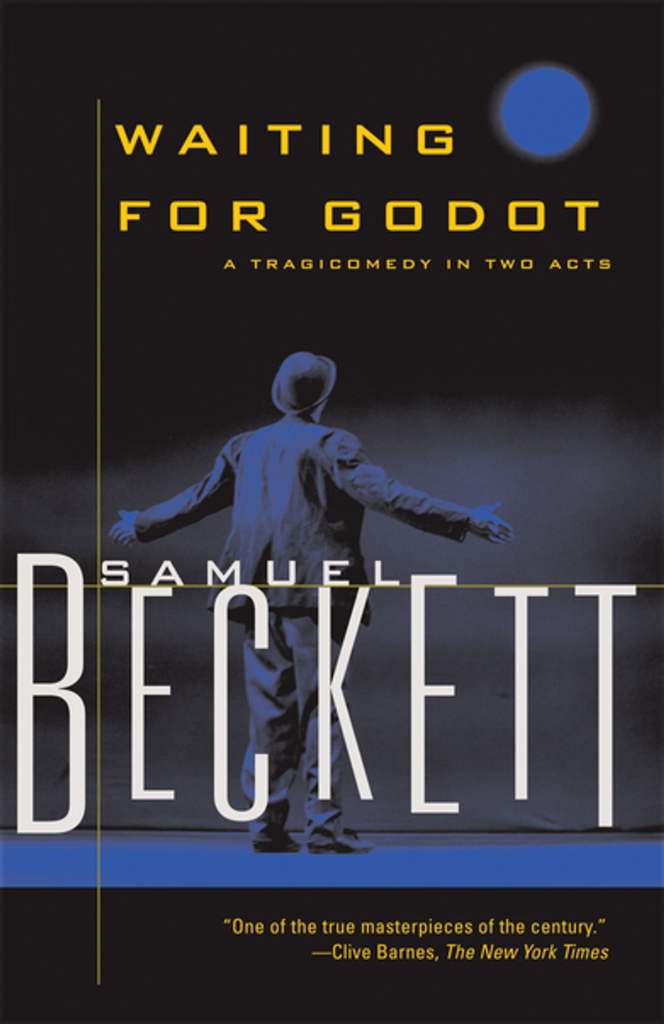
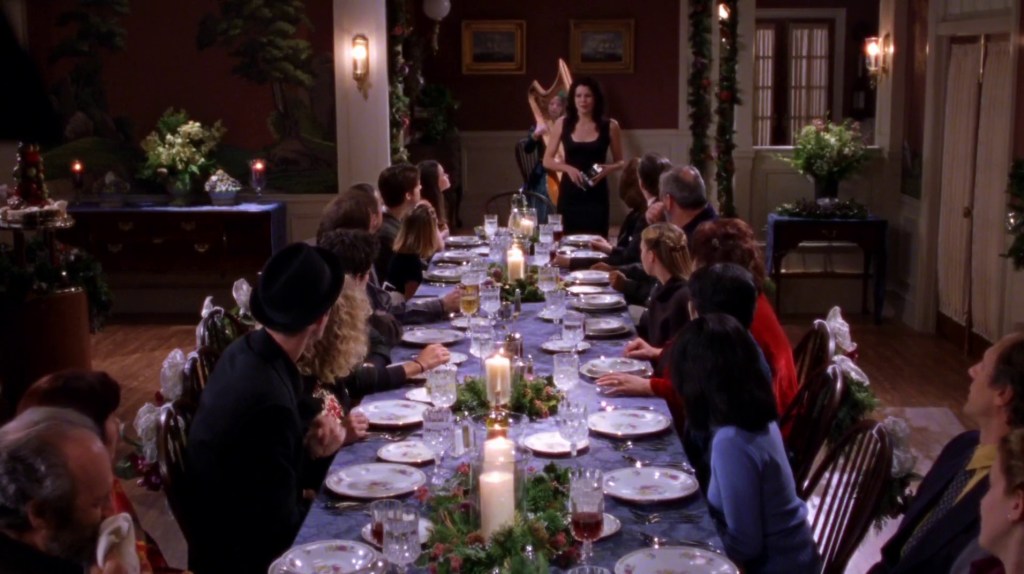
LORELAI: Forever. Godot was just here. He said ‘I ain’t waiting for Richard,’ grabbed a roll, and left. It’s been forever.
A reference to Waiting for Godot, a play by Irish playwright Samuel Beckett, originally written in French in 1948-49 (title: En attendant Godot). The French play had its premiere in Paris in 1953, and Beckett’s English translation of his own play premiered in London in 1955.
In the play two characters named Vladimir and Estragon engage in a number of discussions and encounters while they wait for the Godot of the title, who never turns up. It has been voted the most significant English language play of the 20th century.
PARIS: [on phone] Hola, es Paris. Voy a comer la cena de cas de Rory. Hay mucho mac and cheese!
Paris’ nanny is Portuguese, yet Paris speaks Spanish to her here (is Nanny bilingual? Why can’t she speak English?).
She says, “Hi, it’s Paris. I’m going to eat dinner at Rory’s house. There’s a lot of mac and cheese!”.
She doesn’t translate “mac and cheese” into Spanish, which would be macarrones con queso. Probably because American mac and cheese feels like a completely different dish to what a Spanish-speaker would be expecting, unless she couldn’t think of the right word for it.
This is the song which is playing at the spa while Lorelai is having her facial alone, and when Emily goes to her room and begins chatting.
“Deora Ar Mo Croi” is a song by Irish singer Enya, from her 2000 album, A Day Without Rain. The lyrics were adapted by Enya into Irish Gaelic from a poem by Roma Ryan, written in English. Roma Ryan is Enya’s chief lyricist.
A Day Without Rain was hugely successful internationally, selling 7 times platinum in the US and reaching #2 in the charts. Its popularity surged after 9/11, when Enya’s soulful laments seemed to perfectly capture the nation’s mood. The album was #6 in the UK and #7 in Ireland, and was most successful in Germany and Australia, where it went to #1.
The song’s title can be understood as “Tears In My Heart”, and its lyrics can be roughly translated into English thus:
How wonderful, from morning to night
the sweet voices beside me
and happiness everywhere, without sorrow,
joy in my heart forever.
If I walk away from life,
the sun and the moon at my back
I lack nothing but memories of my own world
Tears in my heart, sadly.
Apart from being believable as the sort of relaxing music that might be played at a spa, the song touches on the emotion behind Emily and Lorelai’s relationship, and that it is hard for Lorelai to simply “walk away” from her life and her memories without losing an awful lot in the process.
This is the book Kirk is trying to buy at the fundraiser, while haggling over the price with Gypsy.
Like Water for Chocolate (in Spanish, Como agua para chocolate) is a novel by Mexican author and screenwriter Laura Esquivel, published in 1989. It is about a young girl named Tita who is forbidden to be with her love, Pedro, and can only express her emotions through cooking. Each chapter of the book contains a recipe for a Mexican dish.
The novel is a magical realist romantic tragedy which has sold more than a million copies in Spain and Latin America, and was also successful in the US. Despite winning the 1994 American Booksellers Book of the Year Award, it received only lukewarm reviews.
The novel was adapted into a highly successful Mexican film in 1992; the screenplay was written by Esquivel. The phrase “like water for chocolate” is a Spanish phrase, referring to emotions that are hot and bubbling over, like water being boiled for making hot chocolate.
Kirk may have enjoyed the film so decided to read the book as well. It’s yet another reference to forbidden love (and food!) in the Gilmore Girls series.
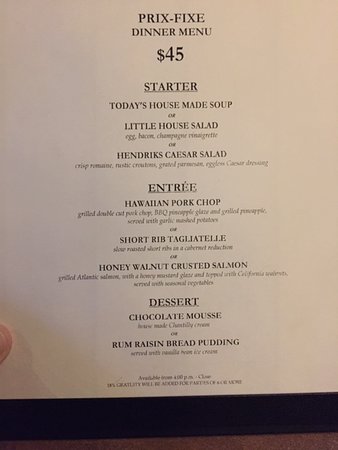
RORY: Where else can we invite them? LORELAI: Al’s Pancake World. RORY: No, it’s Friday. He does his prix fixe menu on Fridays.
Prix fixe is French for “fixed price” – a chef’s menu where there are only a few items, charged at a fixed total price to make an entire meal. It is also known as table d’hôte, literally “the host’s table”.
Apparently the prix fixe menu at Al’s isn’t good, or isn’t worth it.
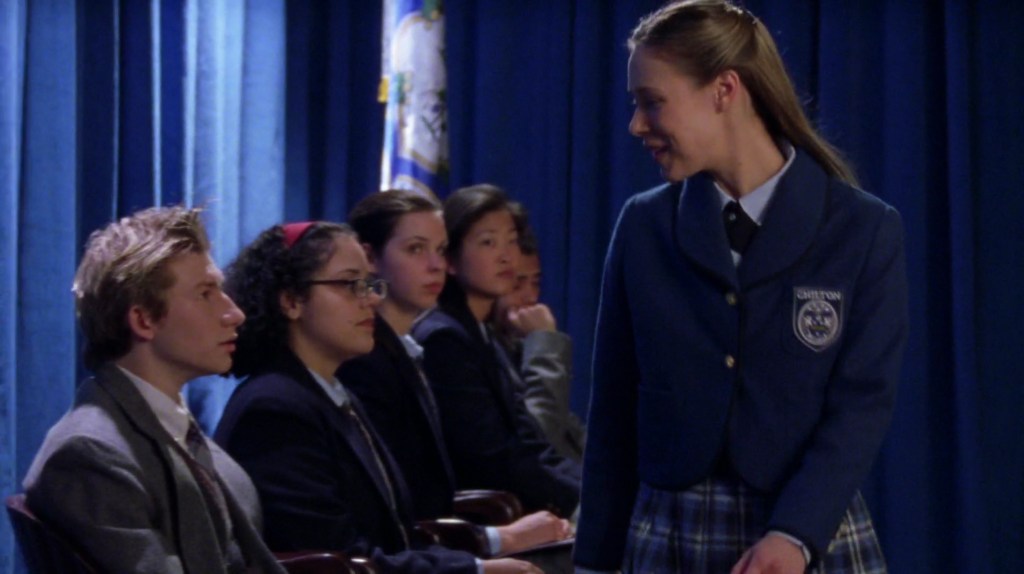
PARIS: Guess we’re going mano a mano today, huh? BRAD: Oh God.
In Spanish, mano a mano literally means “hand to hand”, used to describe a duel between two opposing matadors in a bullfight. In informal American English, it’s used in the same sense as “one on one”, a direct confrontation between two adversaries on equal footing.
Some people wrongly think it means “man on man”, since the Spanish word for “hand” is so similar to the English word man.
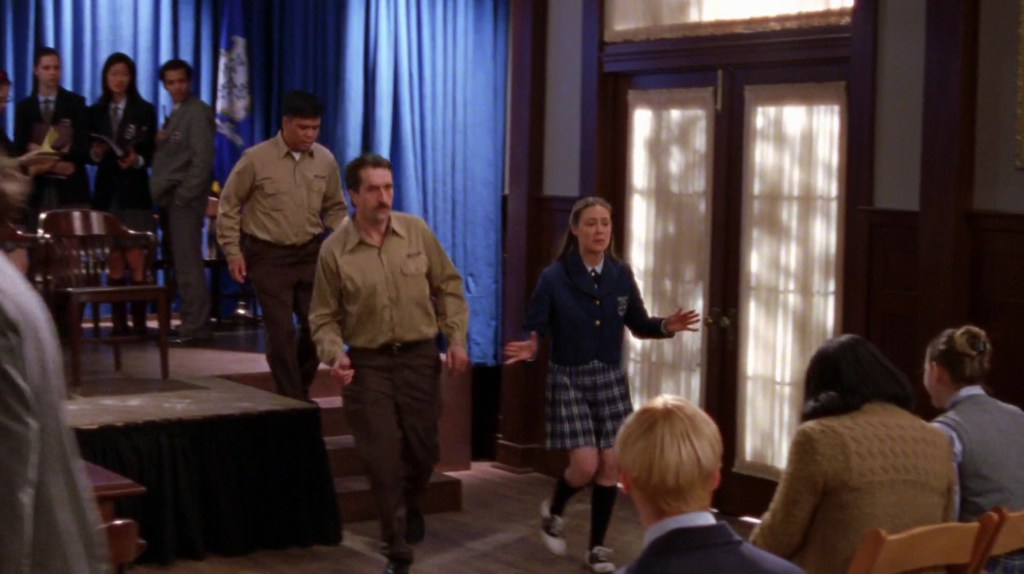
RORY: Yeah, sorry, Paris wanted to do a sound check and she found some problems with the acoustics in the room. PARIS: It’s the layout on this row of seats that’s causing a bass problem. We’ve got to move this whole row over a foot. Esta! Just move these people out. Mueva esta gente, mueva, mueva!
Paris is speaking in both English and Spanish to a pair of Chilton maintenance staff, one Anglo looking, one of Hispanic appearance. The Spanish part is more or less the same thing she says in English: This one! Move it people, move, move!
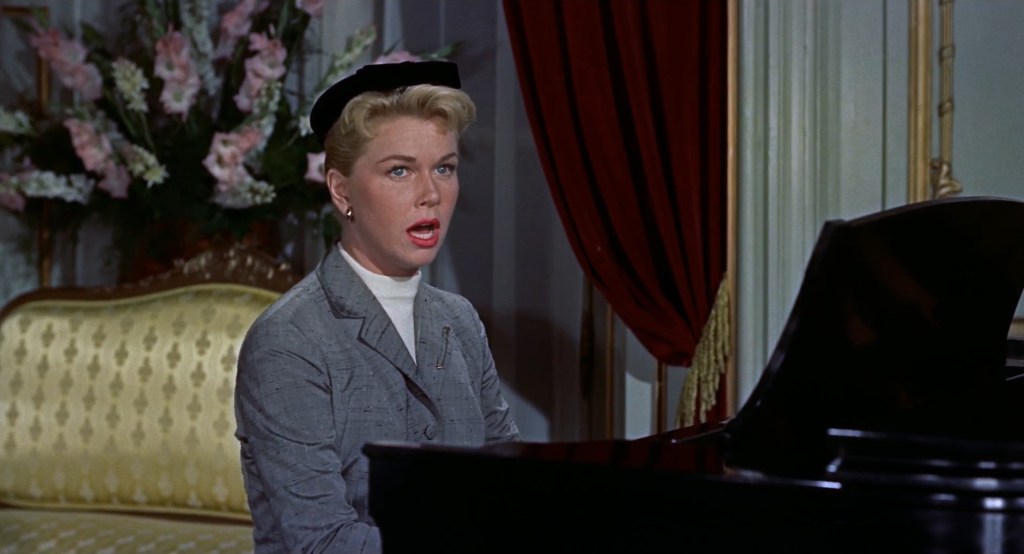
This song plays as Lorelai wakes up happy, gets coffee, goes outside, and falls through the porch. It was written by Jay Livingston and Ray Evans, published in 1955. It was introduced in the 1956 Alfred Hitchcock film, The Man Who Knew Too Much, sung by Doris Day. Her rendition went to #2 in the US and #1 in the UK, and the film received the Academy Award for Best Song. It became Doris Day’s signature song, and is regarded as one of the best songs in cinema history.
The song popularised the phrase que sera sera to indicate a sort of cheery fatalism, although the phrase itself was used as a heraldic motto as early as the 16th century. It is an English mistranslation of “what will be, will be” from the Spanish; in Spanish it would be lo que será, será. No such similar phrase is known of in Spanish or Italian, it has always been an English saying.
In The Man Who Knew Too Much, Doris Day sings the song in the hopes that her kidnapped son will hear it. The song’s message of hope is often used in film and television juxtaposed against disastrous events to create a moment of black comedy, of which we see a very mild version in Gilmore Girls. The joke is that Lorelai has no idea what is coming.
(It might seem unusual to go out on your porch in the your pyjamas early in the morning in the depths of winter to drink your coffee, but Lorelai has that special relationship with snow. And they’re actually in California).
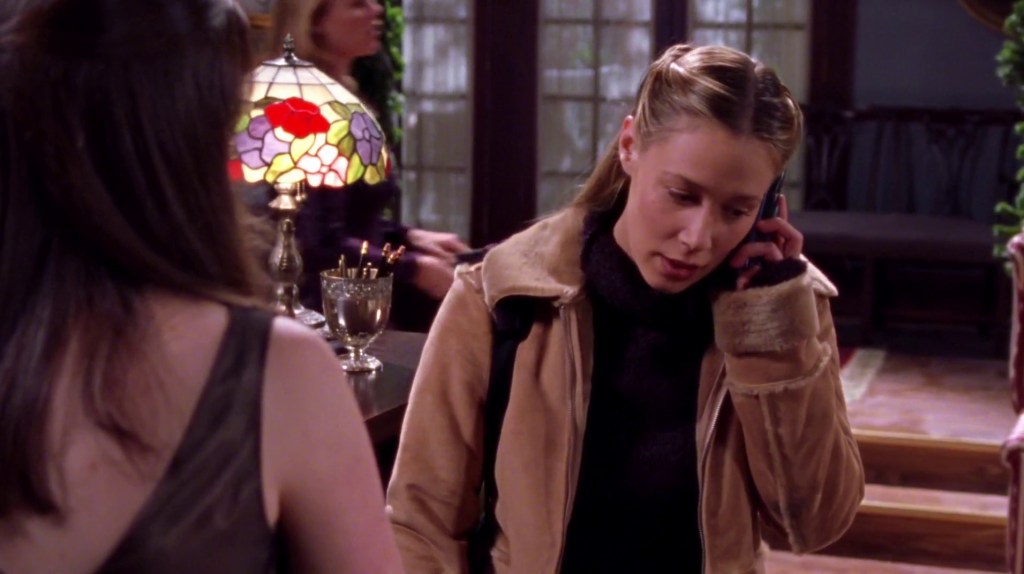
PARIS: I just have to let Nanny know. [takes out cell phone and dials] Nanny? É Paris. Vou jantar com Rory hoje à noite. Eu telefono no caminho de casa. Tchau.
Paris says: Nanny? It’s Paris. I’m having dinner with Rory tonight. I’ll call on the way home. Goodbye.
It’s notable that Paris is now seventeen and still has a nanny, as if she was a small child. Presumably her nanny has been kept on as a loyal retainer and become part of the family, now acting as more of a companion to Paris. Because of Nanny, Paris has become fluent in Portuguese (it is perhaps slightly surprising that Nanny hasn’t become fluent in English after all these years).
Also note that Paris must have spoken about Rory to Nanny often enough that she doesn’t need any explanation or reminders of who Rory is.


 The Annotated Gilmore Girls