LUKE: Nothing? I walk in here and the two of you are like shrapnel.
Shrapnel, the common term for fragments of an artillery explosion (technically not quite correct, but good enough for our purposes). Luke means that Rory and Jess sprung apart when he came in like a bomb exploding in several directions at once.
Luke was so keen to see Jess and Rory together, but the minute he actually finds them just about to kiss, he freaks out. What did he think two eighteen-year-olds were going to do alone together?
LORELAI: Mm, let me see. . . manipulate, evil plan, no free will, pearls – no, I think you about covered it. Oh, wait – did you call my father the Puppet Master?
Puppet Master, a figurative term for someone who controls other people and events, “pulling the strings” in the background, like a puppeteer.
As a fan of the band Metallica, it seems almost impossible that Lorelai would not be thinking of their 1986 song “Master of Puppets”, from the album of the same name. It is one of their most popular and well-known songs.
[Lorelai notices Kirk running right on their heels]
LORELAI: Kirk, what are you doing?
KIRK: I’m drafting you.
Kirk is probably referring to drafting or slipstreaming, a technique used in racing sports, especially cycling and driving, where you remain behind another competitor to reduce the effect of wind resistance, thus allowing you to conserve energy.
In cycling, the effect can be significant. In running, where the speeds are slower, the benefit is much less. One of the problems is that you need to be very close behind the other competitor to get much effect, and this obviously risks antagonising them (like Kirk antagonises Lorelai). It is, however, perfectly legal, and is not classed as cheating, although some might consider it unsportsmanlike.
Indoors, where there is no wind at all, the benefit would be very small, while the chance of annoying others would be greatly increased. This seems on brand for Kirk.
In cycling, one warns another cyclist of their intention by saying, “I’m drafting you” as a courtesy. I have been unable to find any such examples of this in running.
EDIT: One of my favourite things about writing this blog is when someone writes in to correct something I got wrong, or to add something that I missed. I’m only one ordinary person, so there’s no way I can get everything right.
So a big, big thank you to blog reader melcauble for putting me on the right path with this one. I know it probably seems like a long time to wait for a rewrite, but I try to get there eventually.
Lorelai says she could disrupt the town meeting further by doing a soft shoe.
Soft shoe dancing is a type of tap dancing performed in soft-soled shoes in a relaxed, graceful manner. It is particularly associated with vaudeville.
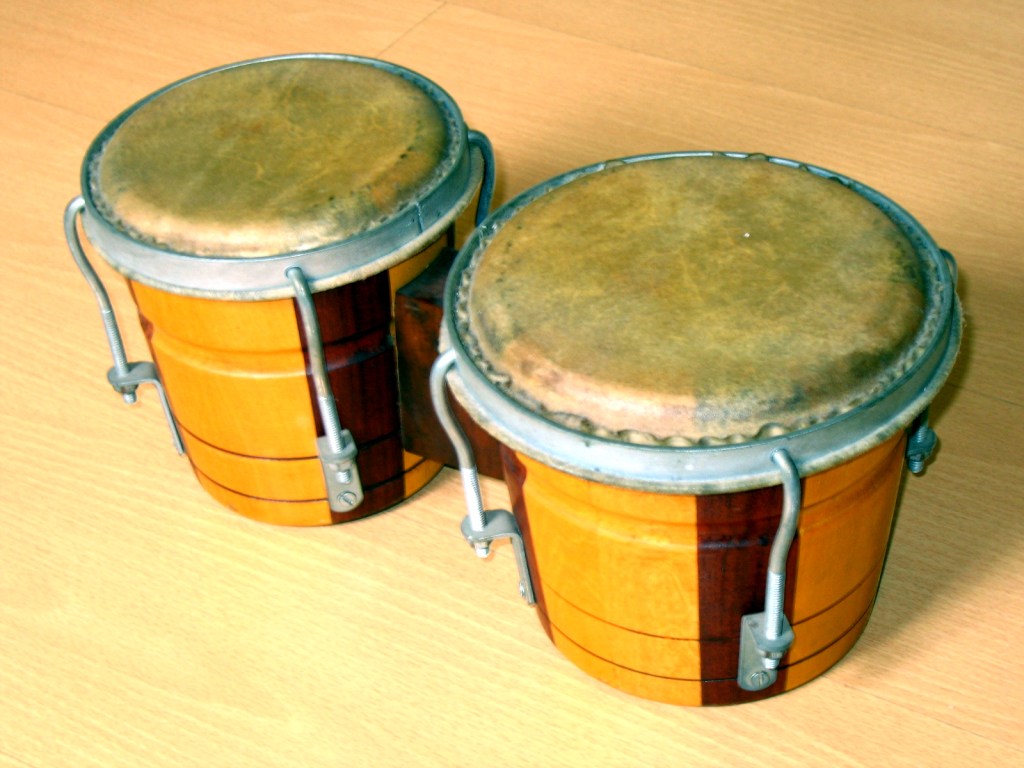
Bongos [pictured]
Rory says she could accompany Lorelai’s soft-shoe dance on the bongos.
Bongos are an Afro-Cuban percussion instrument consisting of a pair of small open bottomed hand drums of different sizes. They are struck with both hands.
Bunions
Lane tells Jess that Rory has bunions from all the walking she has to do since he crashed her car.
A bunion, also known as a hallux valgus, is a deformity of the joint connecting the big toe to the foot. The big toe often bends towards the other toes and the joint becomes red and painful. The onset of bunions is typically gradual, and the causes are not clear, but tight shoes, high heel shoes, family history, and rheumatoid arthritis have been proposed as possible risk factors. Walking a lot doesn’t seem to be a problem (and indeed, Rory is quick to say she doesn’t actually have bunions).
Rory asks to set up an SOS signal with Lorelai in case she needs to leave Sherry’s early. Lorelai decides the SOS signal will be … SOS. Makes sense.
SOS is an international distress signal, made of the Morse code signals for the letters – three dots, three dashes, three dots, as a signal that is both distinctive and easy to remember. In official international use since 1906, it has popularly been imagined as standing for “Save Our Souls” or “Save Our Ship”, and in general use, indicates a crisis or need for action.
Flare
Lorelai says that any time Rory wants to leave, to send up a flare.
A flare is a type of pyrotechnic that produces a bright light without an explosion. They can be used as a distress signal.
“Sign it”
Lorelai refers to several different ways she could say that Rory is going to Harvard. One of them is signing, by which she means American Sign Language, the sign language for the deaf used in North America.
Mime
Another way Lorelai could communicate. Miming means to act out a story using only the body motions, without speech. Mime as a theatrical performance has been used since ancient times.
Morse Code
Another way Lorelai could communicate. Morse code is a method used in telecommunication to encode text characters as standardised sequences of two different signal durations, called dots and dashes. Morse code is named after Samuel Morse, one of the inventors of the telegraph.
LORELAI: He continued talking and I just sat there thinking about Peter Cutler. How was Peter Cutler? Where was Peter Cutler? Was there any chance that Peter Cutler would appear and kill the man sitting across from me talking about torque?
Torque is the rotational equivalent of linear force in physics an mechanics, and is also known as rotational force. Torque forms part of the basic specification of an engine: the power output of an engine is expressed as its torque multiplied by its rotational speed of the axis.
The fact that torque is a homophone of the word “talk” has led to it often being chosen as the title of columns, blogs, magazines, and TV programs about motoring, or for car enthusiasts.
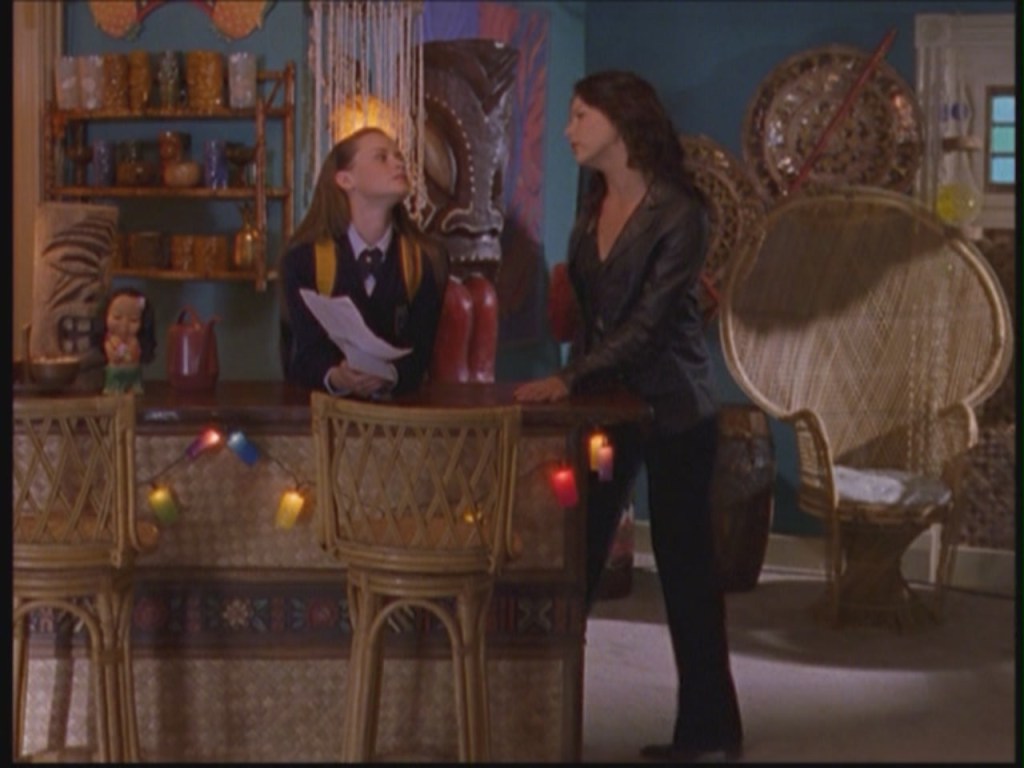
Once inside Dwight’s home, which Lorelai has done her best to turn into a place of imagined horrors, the Gilmore girls naturally love it at once. It has the same kitschy taste that they like, and I think they appreciate that Dwight has decorated the house completely for his own comfort and amusement, a design aesthetic that is in harmony with Lorelai and Rory’s own.
Dwight’s home bar is a tiki bar – that is, a bar inspired by tiki culture décor. Tiki culture is an American movement inspired by a romanticised view of tropical island cultures, mostly Polynesian, catering to American views of the South Pacific. The name comes from Tiki, the Māori name for the first human, often represented in the form of a pendant and frequently appropriated by Europeans as a commercialised good luck charm.
Although tiki bars are generally of broadly South Pacific influence, they tend to serve cocktails from the Caribbean. Because of its colonial nostalgia, and the simplistic view of the Pacific taken by the aesthetic, Tiki culture has been perceived as controversial, culturally insensitive, or racist.
Tiki culture became fashionable during the 1930s as a Hollywood-style image of a leisurely, exotic island lifestyle. It had an explosion of popularity after World War II, as American servicemen returned from tours of duty in the South Pacific, often with souvenirs. It began to decline in the late 1970s but there was a revival in the late 1990s and early twenty-first century, so Dwight is surprisingly on trend in owning a tiki bar.
RORY: You know, I believe there was something at the auction that Mom wanted but she didn’t get. Isn’t that right, Mom? …
LORELAI: I think it was a steamer trunk for Rory to take with her to military school, wasn’t it, honey?
Steamer trunks are a type of vintage luggage named for their location of storage in the cabin of a steam ship (“steamer”). Also called “flat tops”, they first appeared in the 1870s, but were most popular in the 1880s to the 1920s. They are distinguished by their flat or slightly curved tops, usually covered in canvas, leather or patterned paper, and are about 14 inches (36 cm) tall to accommodate steamship luggage regulations. The correct name for them is actually “packer trunks”, but they have been called steamer trunks so widely and for so long that this is now the usual term for them. No longer very handy for luggage, they are often bought in antique shops to be used as decorative items [see picture].
DWIGHT: Welcome to The Oasis! That’s what I named this place, The Oasis, my oasis, a little slice of heaven right here on Earth.
An oasis is a piece of fertile land within a desert or semi-arid environment, often featuring a spring of fresh water surrounded by vegetation. Figuratively, it can refer to a quiet, peaceful place or situation separated from the noise and bustle that surrounds it. Dwight clearly sees his new home as a place of refuge from the stress of life.
Note that Dwight is wearing a shirt with cocktails on it, as if he is already relaxing into vacation mode in Stars Hollow.
Dwight’s house, The Oasis, is the Warner Bros Ranch at the studio lot. It was also the Griswold family home in the 1989 comedy film, National Lampoon’s Christmas Vacation.
EMILY: We have a couple of wonderful writing desks, and some French end tables, rocking chairs, picture frames, lamps, davenports.
Originally, davenport was the name given to sofas made by the furniture makers A.H. Davenport and Company, from Cambridge, Massachusetts. It sold luxury furniture through its showrooms in Boston and New York City in the 19th and early 20th centuries, and made furniture for the White House. They ceased business in 1974.
The word is now used for a rather confusing number of sofa types in the US. It may mean a boxy formal upholstered sofa, like the ones originally made by Davenport, or a sofa which converts into a bed, or a futon-style sofa with storage underneath it, or just a generic word for a large high-end sofa. I’m not actually sure in which sense Emily is using it, but I think either the first or the last is the most likely.
As an extra layer of confusion, a davenport is also a 19th century English word for a small writing desk, but as Emily already mentions writing desks as separate possibilities, I think this one can safely be ruled out.







 The Annotated Gilmore Girls