The Construction Foreman

[Rory taps on a man’s shoulder while he’s sawing a piece of wood.]
RORY: Excuse me.
MAN: Hey, you’re touching a man with a saw. You don’t touch a man with a saw. What are you thinking?
RORY: I’m sorry.
MAN: I could’ve hurt myself. I could’ve hurt you. There’s a ton of hurt that almost happened here.

The construction foreman for Rebuilding Together in Hartford, played by Biff Yeager, is named Tom in the credits. He seems to be the same person as Tom the contractor who will later be seen in Stars Hollow whenever anyone needs some building or renovating work done, but it isn’t made completely clear. He doesn’t have a beard, while Tom the contractor does, but he might have grown one. It’s also uncertain whether he lives in Hartford but travels to Stars Hollow when needed, lives in Stars Hollow but took this job in Hartford for Rebuilding Together, or originally lived in Hartford but later moved to Stars Hollow.

Amazon

DEAN: I just thought we could hang today. Maybe see a movie, get something to eat. We could go to a bookstore, I’ll watch you browse for six or seven hours.
RORY: I would love to, but I have to do this thing today.
DEAN: Blow it off.
RORY: I can’t.
DEAN: Did I mention the bookstore for six or seven hours?
RORY: How about tonight? We can get a pizza and go on Amazon. You’ll be just as bored watching me ordering books, I promise.

Amazon is an American e-commerce company that was founded by Jeff Bezos in 1994, and is now the largest Internet retailer in the world by revenue, and second-largest by total sales, and the most valuable retailer in America. They originally started as an online bookstore, and later diversified. When she’s not buying books from the bookstores in Stars Hollow, Rory apparently orders her reading material from Amazon.

It seems from their exchange that Rory did not bother telling her boyfriend about the volunteer work she signed up for the previous day. It also seems that their “dates” generally revolve around Rory and her interests, with Dean having nothing to do except watch Rory enjoy herself. And further, it seems Rory sees absolutely nothing wrong with this level of selfishness in a relationship, which means she really has learned everything she knows from Lorelai.

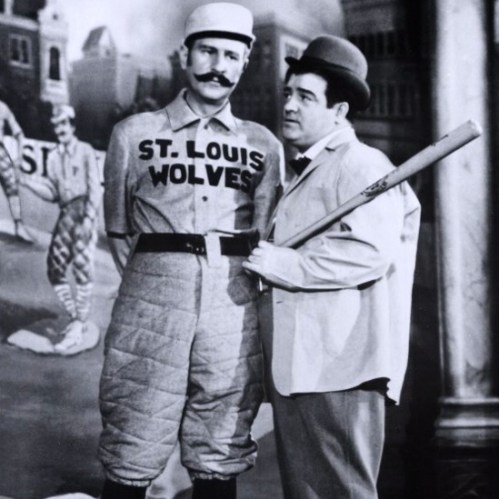
Who’s on First?

DEAN: You’re going to build a house?
RORY: It’s for charity and I’m late, and why don’t you go on inside and you and my mother can continue the “Rory’s building a house” routine, and when that gets boring you can move on over to “Who’s on First?”

“Who’s on First?” is a famous comedy routine by Abbott and Costello, in which Abbott is identifying players on a baseball team for Costello. The comedy comes from the fact that their names sound as if they are answers to Costello’s questions. For example, the first player is named Who, thus the answer to “Who’s on first?” is “Who’s on first”, leading to utter confusion.

This was a style of routine very popular in the early twentieth century, and Abbott and Costello had a big hit with “Who’s on First?” in a vaudeville revue in 1937. In was performed on radio in 1938, and copyrighted in 1944. Abbott and Costello performed it numerous times in their careers, rarely the exact same way twice, and performed it for President Franklin D. Roosevelt several times.

Abbott and Costello included a shorter version of their routine for their 1940 film debut One Night in the Tropics, and a longer version for their 1945 film The Naughty Nineties, considered their best recorded version of the routine. The “Who’s on First?” bit they did for their 1950s television program The Abbott and Costello Show is considered the definitive version.

Busan

Busan is where Lane’s cousins live, and where she will be spending the summer from June to August 2001. The city was called Pusan until 2000, and is pronounced like Pusan (at least that’s how it sounds to English-speakers).

Busan is the second-biggest city in South Korea, and has a population of over 3 million. It is the economic centre of south-eastern Korea, and has a large industrial area, and the biggest port in Korea. It is called the summer capital of Korea, since it has a number of beaches to attract tourists, along with cafes, restaurants, and shopping districts to cater to them.

It is unknown whether Mr and Mrs Kim, or their families, are originally from the Busan area as well as the cousins, but it doesn’t seem too unlikely.

A Connecticut Yankee

RORY: Hey, Henry?
LANE: Called him.
RORY: And?
LANE: He likes me. He’s perfect. I’ll never see him again. You’ll read about it in my novel, A Connecticut Yankee in Busan.

Lane is parodying the title of the 1889 novel A Connecticut Yankee in King Arthur’s Court, by Mark Twain. The novel is a satirical fantasy about a 19th century American engineer who is mysteriously transported to 6th century Britain in the time of the legendary King Arthur. It may be a novel that Lane and Rory once read for English class at Stars Hollow High.

At least Lane and Henry have finally spoken to each other, and everything went well – just as Lane is about to be shipped off to Korea for several weeks.

Lane Gives Rory Her Contraband

Lane comes over to give Rory boxes of all her pop culture contraband for safekeeping while she is in Korea for the summer (she fears it might be forever).

Lane leaves her CDs, magazines, books, posters, three sweaters she borrowed from Rory, and one Diva Glam lipstick which is apparently all her make-up, and probably also from Rory. There also seems to be other clothes, and various cloth knick-knacks such as cushions. Rory says she will treat it like it’s her own, which makes sense, because some of it actually is hers.

Lane also gives Rory a “retrieval kit” in a heavy yellow envelope which might help rescue her from Korea. It has the phone number of where she is staying, a map showing her location, a photo of Lane, and a mock-up of what she will look like in six months time (thinner, so she seems to expect that she will lose weight on a traditional Korean diet). It also contains the phone number for the American consulate, and some Korean phrases written out phonetically, such as “Help”, and “Have you seen this girl?”.

“I mean it Timmy, no falling down the well”

LORELAI: Call me when you get home, and please be careful.
RORY: I will.
LORELAI: I mean it Timmy, no falling down the well.

Lorelai is referencing an old joke relating to the television show Lassie, earlier discussed.

In the show, Lassie would bark to give warning of danger, with her human friends apparently understanding exactly what she was saying. Thus it was parodied as, “Woof, woof!”, “What’s that, Lassie? Timmy’s fallen down the well?”. The joke relates to the 1957-1964 period, when the little boy on the show was Timmy Martin, played by Jon Provost (who called his memoirs Timmy’s in the Well: The Jon Provost Story).

In actuality, Timmy never fell down a well, although he suffered a number of similar situations, such as falling in a lake and getting trapped in an old mine, a pipe, and down a badger hole. The list of Timmy’s perils is very long, and includes wandering onto a minefield and being exposed to radiation, not to mention more mundane concerns like tigers and bears. Lassie did once get stuck down a well herself, though.

Lorelai Gives Rory a Hammer

RORY: What is that?
LORELAI: A hammer.
RORY: It has feathers on it.
LORELAI: Yes.
RORY: Why?
LORELAI: So the rhinestones and bows won’t feel lonely.

This is the hammer referred to in the title, Hammers and Veils. Of course Rory can’t go off to help the needy like anyone else – she has to do it in an especially quirky, girly manner that immediately marks her as special and the centre of attention. It’s the Gilmore way.

Rory wouldn’t even buy purple legal pads for school because they’d make her look unprofessional at Chilton, but somehow she’s happy to take a gold-painted, pink feathered hammer to volunteer work which she is doing through Chilton, and for which the hammer would surely be useless. Maybe she’s more relaxed now that she’s one of the top students in her class.

Typically for the show, Rory is running ten minutes late for her volunteer job in this scene.

Gettysburg Address

LORELAI: You know, the Gettysburg Address was only one page long, and that was about a war.
LUKE: I just call them like I see them.

The Gettysburg Address is a speech given by US President Abraham Lincoln during the American Civil War in 1863. It was delivered at a dedication of the Soldier’s National Cemetery in Gettysburg, Pennsylvania, and is one of the best-known speeches in American history. Famous for its pithiness, in just two minutes Lincoln invoked the founding principles of freedom as set out in the Declaration of Independence, and proclaimed the Civil War to be a struggle for the Union that would bring true equality to all American citizens.

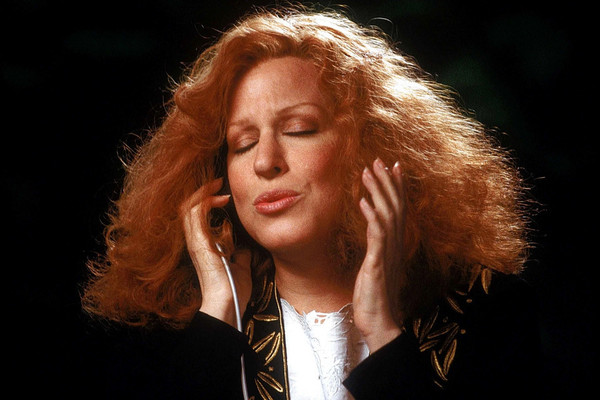
Bette Midler and Chicken Kiev

LUKE: And then after all that planning, the [wedding] reception will still be a disaster because no matter what you do or how carefully you plan, halfway through one of those nauseating Bette Midler ballads, someone’s getting drunk, someone’s sleeping with someone else’s wife, and someone’s Chicken Kiev is landing on the cake.

Bette Midler (born 1945) is an American singer, songwriter, actress, and film producer. She began her career on the stage, and was in Broadway shows such as Fiddler on the Roof in the late 1960s. In 1970 she began singing in a gay bath house, and built up a core following as a solo artist; she has released 14 albums and many of her songs have become hits, including ballads such as The Rose, and Wind Beneath My Wings (possibly the sort of songs Luke is thinking of). She made her film debut in 1979 in The Rose, and has starred in a number of films, such as Ruthless People (1986), Beaches (1988), and The First Wives Club (1996). In her career spanning more than half a century she has won three Grammy Awards, four Golden Globes, three Emmy Awards, and two Tony Awards, as well as selling over 30 million records worldwide.

Chicken Kiev is a Russian dish of chicken fillet stuffed with butter, coated in egg and breadcrumbs, and either fried or baked. It may date to the early 19th century, and is claimed to have been the invention of French chef Marie-Antoine Carême, who spent several months at the court of Tsar Alexander I. However, it only became commonly known in the mid-twentieth century. It is popular in the US, and often included on wedding menus.