Yo-yo

EMILY: With the dot-com bust and the job market dwindling and the stock market going up and down like a yo-yo …

A yo-yo is a toy which is basically a spool on a long string, which can be wound up and down and spun in different directions. They have been used as a toy, aparently since ancient Greece at least. In the US, the Yo-yo Manufacturing Plant was opened in Santa Barbara in 1928 by Filipino immigrant Pedro Flores – the word yo-yo itself comes from the Phillipines. The company was bought by Donald F. Duncan in 1932.

Yo-yos were popular toys in the 1930s, but sales declined after World War II, leading Duncan to launch a comeback campaign in the 1960s. They grew popular again during the 1970s and 1980s, and hit their peak in the late 1990s.

Dot-Com Bust

EMILY: With the dot-com bust and the job market dwindling and the stock market going up and down like a yo-yo, everyone and his brother knows the best chance for success and financial security is not just to go to college, but to go to a top college.

The dot-com burst, or bust, was the ending of the dot-com bubble of 1997-2001, previously mentioned, involving excessive speculation in internet-based services and businesses. Higher interest rates are generally thought of as a major contributor to the dot-com burst. The stock market had a significant downturn in September 2002, the time of the events of this episode, which is why Emily is probably more alarmed about the economy than usual.

The Competition for Harvard

EMILY: I’ve unearthed some shocking statistics. I mean, do you have any idea how hot the competition is to get into a school like Harvard?

LORELAI: Well, yeah, it’s very hot. It’s one of the top schools in the country.

EMILY: In the world. People from China, Russia, India, children from every country apply to Harvard. There’s more competition than ever before.

Lorelai should have already known this. Why is it Emily reading the college magazines to educate herself, why not Lorelai? You can forgive Emily and Richard for being behind the times on college applications in the 21st century, as competition was much less when they went to college, and Emily is trying to catch up.

Lorelai tells Emily that she already knows how hard it is to get into Harvard – which is true, she discovered how low the acceptance rate was in Season 2, when she took Rory for a day trip to Harvard. However, this episode makes clear that she hasn’t really been thinking about it, because the minute she’s forced to, she goes into a panic. And that’s when Lorelai and Emily start getting application anxiety as well.

Early Applications

PARIS: Okay. So, how early should a student get an application in?

MR. ROMAINE: By the due date. Earlier makes no difference. It’s a complete myth that there’s a benefit to be derived from early admission.

This is arguable. You would think the obvious benefit to applying early is a smaller pool of applicants. If applying to Harvard, you cannot apply early to another university, meaning that the restriction of doing so may discourage a lot of people. People who apply early are more likely to gain admittance to the university of their choice – but according to Harvard, that’s because quality candidates are more likely to apply early. Harvard insists there is nothing to be gained from applying early, even though the standard advice is to apply early if you can. The only real drawback is that you have less time to polish your application.

The early application date for Harvard is November 1st, and notifications of their decision are sent out in mid-December. An early decision seems like a good way to avoid application anxiety!

“College paraphernalia”

MS. SAMUELS: I’ve seen applications where the student has circled every activity listed. Again, you’re trying too hard there. One can’t be interested in everything.

MR. ROMAINE: They’re the ones who’ve had college paraphernalia on their walls their whole lives.

MS. SAMUELS: Too hungry, it’s a little immature.

Two more blows to Rory – she wanted to circle every activity on the college application except sports – now she finds out it will come across as someone trying too hard. And she’s had Harvard paraphernalia on her bedroom wall since she was about eleven, and wore a Harvard sweatshirt when she was four years old.

Yes, it’s a little immature, and of course Rory’s college dreams are immature. Her dream of going of Harvard was thought up by her teenaged mother, a girl who’d lost her own dreams and was working as a maid and living in a shed to support Rory. Is it any wonder Lorelai wished for Rory to achieve everything she never could? And can you blame Rory for wanting to make her mother proud and happy, knowing the sacrifices she was making for her daughter?

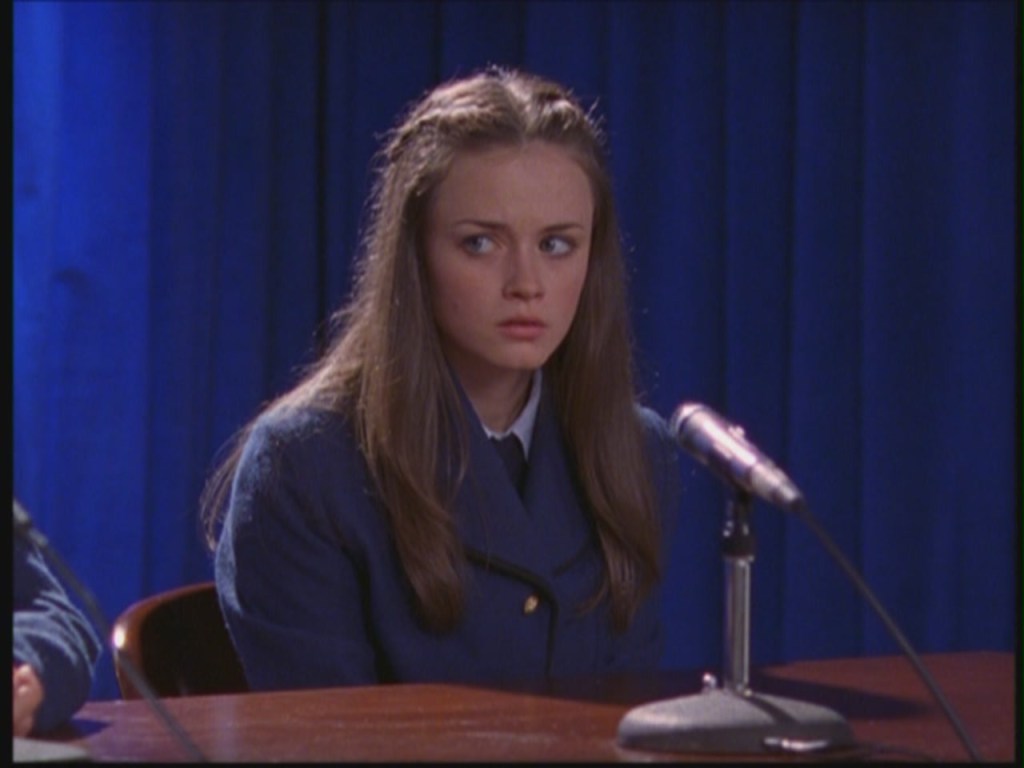
Rory looks increasingly unhappy throughout this scene, as her path to Harvard now looks far from certain. She now has – application anxiety!

“Extracurriculars and volunteer activities”

MR. ROMAINE: If your extracurriculars and volunteer activities are too by-the-book, that says something we don’t like.

MS. SAMUELS: Yes, those activities should have a personality behind them – a focus, a direction.

And here comes the devastating blow to Paris, who now discovers what Chilton really should have explained to her years ago – her volunteering efforts have been too diffuse and various. As explained in an earlier post, she’s done so many different types of volunteer work that there is no focus to them, no pattern to build on that shows what kind of person she is, or what her goals are.

I think Paris should really feel worse than Rory over the advice given so far. Rory has simply had a lame idea for an essay that she hasn’t even started writing yet. She has plenty of time to pick a different topic and work on it. Paris has wasted literally years of her life and probably crippled herself socially doing hours and hours of useless volunteer work that is very unlikely to help her get into Harvard.

“Brain-dead bint in a skirt”

PARIS: Personal anecdote – when I was twelve and I was writing the first of my trial essays in practice for the day I’d write my real essay, I chose Hillary Clinton. Then I realized every brain-dead bint in a skirt would be writing about Hillary, but it was good to clear the pipes.

Bint: British slang, derogatory term for a girl or woman. It dates to the late 19th century, and is borrowed from the Arabic بِنْت‎ (bint, “girl, daughter”). It was adopted by British soldiers to refer to their girlfriends, as the Arabic word is reminiscent of English words for women such as bit, bird, and bitch.

Paris has not only been practising college application essays since she was twelve years old, but has also been a fan of Hillary Clinton since at least the same age. Paris would have been aged twelve in 1996/1997 – at this time, Hillary Clinton had been First Lady of the US since 1993. She took an important role from the very beginning, and was the first First Lady to receive her own office in the West Wing of the White House. She was considered the most openly empowered First Lady since Eleanor Roosevelt.

“Hillary Clinton and her profound influence”

MR. ROMAINE: I’m talking about run of the mill responses, a lack of originality, particularly in the essay category. If I read one more over-adulating piece of prose about Hillary Clinton and her profound influence, my head will explode.

A devastating blow to Rory, who now discovers her winning essay topic is in fact an unoriginal, commonplace idea, which many other girls will choose. Apparently writing an essay about any famous person, or a person you don’t personally know, is a sure-fire loser of an idea. Rory would do better to write an essay about Lorelai – which, for all we know, is what she eventually does.

Princeton University and Ivy League College Consultant

PARIS: My panelists are Jim Romaine, admissions officer at Princeton University, and Ivy League college consultant, Rose Samuels.

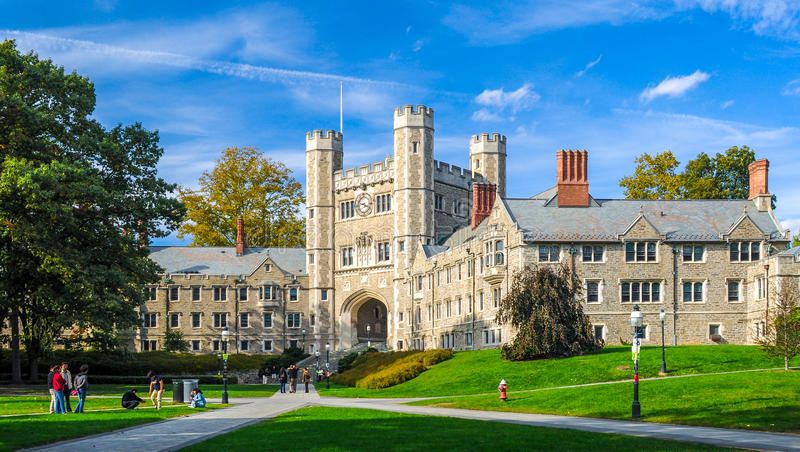
Princeton University, previously discussed. Paris’ boyfriend attends Princeton – I don’t know whether that had any bearing on Paris getting their admissions officer on their panel. I wouldn’t put it past Paris, though.

Jim Romaine and Rose Samuels are of course fictional characters, played by Philip Pavel and Karen Bankhead respectively.

In real life, an admissions officer at Princeton University, Stephen LeMenager, had just been removed (in August 2002) after gaining unauthorised access to student’s files on a Yale admissions website the previous April. The investigation and subsequent scandal may have been what put the idea of using Princeton in this episode – they could have had a representative from any Ivy League university, after all.

Ivy League college consultants, also called independent education counsellors, work with students and their parents to decide which schools a student should apply to. They also guide them through the application and essay-writing processes. Top tier college consultants can cost a small fortune, so this is yet another area where being very wealthy can help you on your path to college.