The “Hidden” Kennedy Family

LORELAI: I can’t believe [the Beales] were related to Jackie.

RORY: Well, the Kennedys kind of hid them in the background for many years.

LORELAI: Well, when you’re a Kennedy, how do you even choose who in the family to hide?

I’m not sure that there’s much evidence that the Kennedy family “hid” Jackie’s relatives away. Jackie and her sister Lee Radziwill certainly didn’t seem to pay them much attention until they began to be featured in the tabloid press as eccentric upper-class hoarders.

However, it’s said Jackie and Lee paid for Grey Gardens to be cleaned up to some extent – the house in the documentary is actually much less of a hovel than it had been previously. And it was Jackie and Lee who approached the filmmakers about the documentary, hoping it could be a way for the Beales to make some money, so they actually helped give them publicity, rather than hid them away.

Lorelai’s snarky comment reflects the number of scandals the Kennedy family have had over the years. She may be specifically thinking of Rose Marie “Rosemary” Kennedy (1918-2005) [pictured], the sister of President John F. Kennedy. Due to a difficult birth, she was developmentally delayed, although it is unknown to what extent, as the Kennedy family kept her life private.

When Rosemary was in the early twenties, she became increasingly irritable, and went into convulsions, as well as attacks of rage in which she would hit other people. At the age of 23, her father, Joseph Kennedy, agreed to her being lobotomised to help control her violent mood swings – he did not tell his wife until the procedure had taken place.

The lobotomy had a devastating effect on Rosemary, whose mental capacity became that of a two year old. She couldn’t walk or speak intelligibly, and was incontinent. She was immediately institutionalised, and separated from her family for over 20 years – her siblings did not know where she was, and the press was told she was “reclusive”. After her father’s death in 1969, she gradually became part of the family again. By that time, she had learned to walk, although with a limp.

Some say that Rosemary was one of the inspirations for Eunice Kennedy Shriver to later found the Special Olympics, although Eunice said that the Games were never about one individual.

“I love these women”

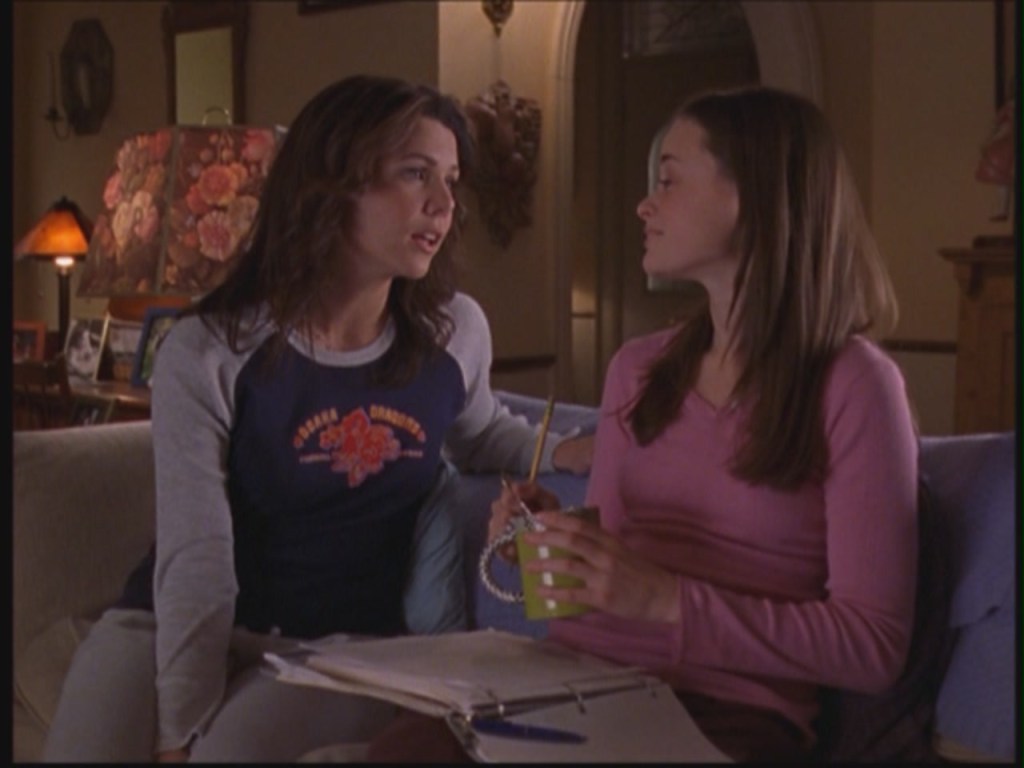
[Lorelai and Rory are on the couch watching television]

RORY: I like these women.

LORELAI: I love these women.

During the cold open, Lorelai and Rory watch Grey Gardens, a 1975 documentary by Albert and David Maysles. The film depicts the everyday lives of two reclusive, upper-class women, a mother and daughter both named Edith Beale, who lived in poverty at Grey Gardens, a derelict mansion in the wealthy Georgica Pond neighbourhood of East Hampton, New York.

Edith Ewing Bouvier Beale (1895–1977), known as “Big Edie”, and her daughter Edith Bouvier Beale (1917–2002), known as “Little Edie”, were the aunt and the first cousin, respectively, of former US First Lady Jacqueline Kennedy Onassis. The two women lived together at the Grey Gardens estate for more than fifty years with limited funds in increasing squalor and isolation.

Throughout the fall of 1971 and into 1972, their living conditions—their house was infested by fleas, inhabited by numerous cats and raccoons, deprived of running water, and filled with garbage and decay—were exposed as the result of an article in the National Enquirer and a cover story in New York Magazine after a series of inspections by the Health Department.

With the Beale women facing eviction and the razing of their house, in the summer of 1972 Jacqueline Onassis and her sister Lee Radziwill provided the necessary funds to stabilize and repair the dilapidated house so that it would meet village codes.

Albert and David Maysles became interested in their story and received permission to film a documentary about the women, which was released in 1976 to wide critical acclaim. Their direct cinema technique left the women to tell their own stories.

The film was controversial from the start, with some feeling that the Beales were being exploited, and that because they were paid for taking part, the documentary was ethically compromised.

“Big Edie” died in 1977 and “Little Edie” sold the house in 1979, dying in Florida in 2002. The fashion designer Liz Lange now owns the house, which has been extensively remodelled and landscaped.

Lorelai and Rory both enjoy eccentric biographies, and stories about mother-daughter relationships, so this film is a natural fit for them. It’s clear they can see a little of themselves in “Big Edie” and “Little Edie” – like the Beales, the Gilmores share the same name. Other similarities are that their home is similarly described as needing work (“The Crapshack”), and they live a life of of genteel squalor, doing exactly as they please. Most importantly, like the Beales, the Gilmore girls are intensely codependent.

It’s hard not to think that Gilmore Girls was influenced to some extent by Grey Gardens – their names even have the same initials!

Yale Brochures

[Later that night, Rory walks into her bedroom, turns out the light and tries to go to sleep. A moment later, she turns the light back on, grabs her Yale brochure from her night table and starts reading it. Upstairs, Lorelai is reading the same brochure in her bedroom.]

The episode ends with both the Gilmore girls reading a Yale brochure, so the viewer can tell that Rory is now seriously considering applying, and Lorelai is also trying to get used to the idea.

The application deadline for Yale is immediately after the New Year, in early January, so Rory has time still to put together a good application.

“Details tomorrow”

RORY: Mom?

LORELAI: [turns around] Yeah?

RORY: Details tomorrow.

LORELAI: Ah, thank God. ‘Cause you know what not knowing these things does to me.

The first time Rory kissed Dean, she told Lorelai all about it shortly afterwards. Now, two years later, she says she will tell Lorelai all about her first kiss with Jess, as if Lorelai is a best friend, not her mother. The lack of boundaries here is getting a bit worrying.

“Don’t study so much that you … try to take over the world”

LORELAI: Don’t study so much that you get brilliant, go mad, grow a big bald egghead and try to take over the world, okay, ’cause I wanna go shoe shopping this weekend.

Lorelai sounds as if she is referring to the fictional character Ernst Stavro Blofeld from the James Bond novels and films, created by British author Ian Fleming. He is a criminal mastermind and the chief antagonist of the series, instantly recognisable from his bald head. He has been played by several actors, but his portrayal by Donald Pleasance is often thought of as “the classic Blofeld”.

Ernest Blofeld gained degrees political history and economics, and also engineering and radionics, but used his formidable intellect for nefarious purposes. He becomes completely insane by the end of the book series, and is obsessed with gaining world domination.

Ernst Blofeld has been often parodied in film and television, including the character of Dr Evil in the Austin Powers movies.

Ovaltine

[Rory is studying on the couch as Lorelai walks into the room with two mugs]

LORELAI: Coffee and Ovaltine.

Ovaltine (originally Ovomaltine), a chocolate milk powder which can either be made into a hot or cold drink. It was developed in Switzerland in 1904, and quickly gained international appeal. By 1915 it was being manufactured in the US, among other countries. The drink is particularly popular in Britain, and the British version is also imported in the US.

It seems that Rory doesn’t have coffee before bed, the way Lorelai does. She may have trouble getting to sleep if she drinks coffee late at night, or the Ovaltine is a comforting childhood ritual.

Rory Apologises to Dean

RORY: I wanna say that I’m sorry … For treating you the way I did. For doing all the things you said I did. I am so, so sorry. It’s all my fault. I don’t know what’s wrong with me. You were the most amazing boyfriend in the world. You made me so happy. You made me laugh, you made my mother like you, you were nice to my friends, you protected me, you even came with me to that stupid debutante ball … I really did love you. Please believe that … I don’t wanna talk about him. I just came to tell you that I’m truly sorry that I hurt you, and that I’m going to miss you so much, and I just hope that someday you won’t hate me anymore.

DEAN: I hope so, too.

Rory apologises to Dean, taking complete responsibility for the relationship failing. Dean, of course, lets her, as a sign he really wasn’t the amazing boyfriend she says he was. The rose-coloured glasses seem to have started almost the moment Rory and Dean broke up for the second time, and it is troubling that the first thing she does after kissing her new boyfriend Jess is to tell her old boyfriend how much she misses him.

In an earlier season, Rory’s kiss with Tristan helped show her how deep her feelings were for Dean, and how unhappy she was that they broke up. Her kiss with Jess seems to have triggered something similar – perhaps a realisation that she has never had a chance to grieve for the loss of Dean before moving on with Jess. There’s a part of Rory that cannot let go of Dean, and this will lead to unfortunate consequences.

“That girl Butterfly who lived in a tree for a year”

DEAN: What do you want?

RORY: Do you remember that girl Butterfly who lived in a tree for a year? I can officially attest that she was nuts.

Rory refers to Julia “Butterfly” Hill (born 1974), environmental activist. She is best known for having lived in a 180 foot tall, roughly 1500-year-old California redwood tree for slightly more than two years between 1997 and 1999. Hill lived in the tree, affectionately known as Luna, to prevent loggers from cutting it down. She is the author of the 2000 book The Legacy of Luna and co-author of One Makes the Difference. Her story has often been alluded to in popular music and culture.

Rory climbs a tree in order to reach Dean while he’s in his bedroom, in the same way she climbed a tree to talk to Lane when she was grounded. There is a slight feeling of Romeo and Juliet, with Rory taking Romeo’s role in talking to Juliet while she’s on her bedroom balcony.

“I have to go”

RORY: I have to go.

JESS: What? Did I do something or –

RORY: No, no. This was . . . you were – are . . . it was wonderful, and I look forward to many similar occurrences in the future, but right now, I have to go. Understand?

JESS: Not at all.

RORY: It’s more fun that way, isn’t it?

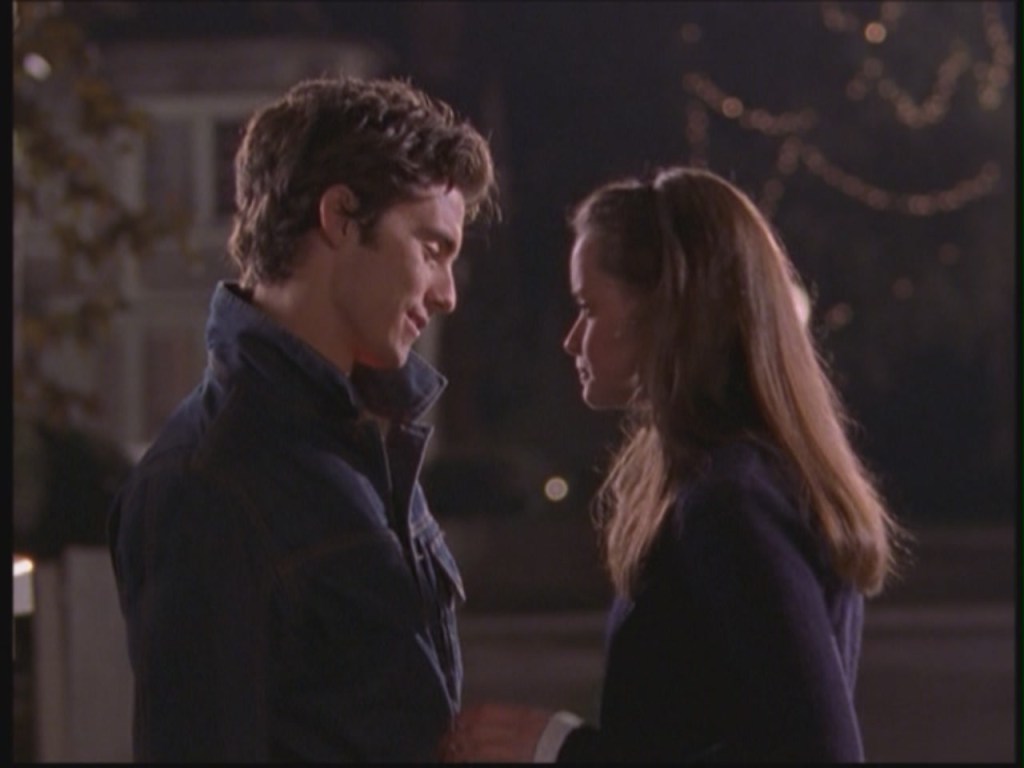
Rory has to go straight after the kiss because she is going to see Dean. Jess may not have found that explanation quite so quirky and charming. It feels as if Rory is being emotionally dishonest with Jess right from their first kiss as a couple. Unfortunately, one of the things she may have learned from being with Dean is that it isn’t always safe to be honest with your boyfriend.

Although seriously, apart from plot drama, did Rory really have to see Dean right after her first kiss with her new boyfriend? This also feels like “the games beginning” between Rory and Jess.

Then She Appeared

A 1992 song by English rock band XTC, written by vocalist Andy Partridge, a track from their album Nonsuch. The album was critically acclaimed, and went to #28 in the UK and #97 in the US, topping Rolling Stone’s College Album Chart.

The lyrics extravagantly describe a man feeling dazzled and even slightly frightened when the woman he loves appears out of nowhere with a beauty compared to the goddess Venus. The song plays during the kiss between Jess and Rory, summing up exactly how Jess feels.