LORELAI: Oh, gee, since I just ate half a bag of marshmallows, six Pop Tarts, four bagel dogs and a really stale Cheese Nip – yup, it’s brownie time, thanks.
Bagel dogs are hot dog frankfurters wrapped in bagel-style breading or bagel dough before baking it. They are similar to pigs in blankets. They can be sold at fast food stands, or bought frozen from supermarkets.
Cheese Nips were small cheese-flavoured crackers, manufactured by Mondelez International under its brand name Nabisco. They were introduced in 1955 and discontinued in 2020.
LUKE: Why, you got a big Frisbee heist going down at six?
A Frisbee is a gliding toy made from moulded plastic that can be used in catching and throwing games. They were invented by Walter Morrison, who got the idea in 1937 when he and his future wife were tossing cake pan back and forth to each other on a beach, when someone offered it to buy it for five times its value.
The first aerodynamically improved plastic discs were manufactured in 1948 by Morrison and his business partner, Warren Francioni and sold as the Whirlo-Way (named after a famous racehorse), then the Flying Saucer, then the Pluto Platter.
In 1957, Morrison sold the rights to Wham-O, whose co-founders Richard Knerr and Arthur Melin called the disc a Frisbee, after the Frisbie Pie Company in Bridgeport, Connecticut. Frisbie supplied pies to Yale University, and students would throw empty pie tins to each other in a game they called Frisby.
The Frisbee’s real success came in 1964, when Wham-O’s vice president of marketing, Ed Headricks, redesigned the Frisbee to make it more accurate, and promoted it as an organised sport. When Headrick died, he was cremated and his ashes moulded into memorial discs. The Frisbee was inducted into the National Toy Hall of Fame in 1998.
LoJack is a recovery system for stolen cars that uses GPS to locate vehicles, notifying police of its location and allowing recovery in less than half an hour. The LoJack system was created and patented in 1979 by William Reagan, a former police commissioner. Its name is meant to be the opposite of hijack.
Although we haven’t developed a LoJack system for lipsticks, there are now similar systems in place to find computers, laptops, and phones, and even lost car keys can give off a sound to alert the owner to their position, so Louise’s idea was ahead of its time.
CY: Louie finally throws the door open, looks at him and says, ‘Did you get a Reese’s Cup tonight?’. And the kid looks in his bag and he says, ‘Yes sir, I did.’ So Louie grabs it, says ‘Thank you very much!,’ then slams the door in his face.
Reese’s Peanut Butter Cups, chocolate cups filled with peanut butter, marketed by The Hershey Company. They were first called Penny Cups, and created in Pennsylvania in 1928 by H.B. Reese, a former dairy farmer who worked as a shipping foreman for candy manufacturer Milton S. Hershey. Reese left his job with Hershey to start his own company, The H.B. Reese Candy Company. In 1963, Reese’s sons merged the company with Hershey, and the Peanut Butter Cups quickly became Hershey’s top selling candy. They remain extremely popular today.
JACKSON: Your mother got her [tape measure] at Neiman Marcus.
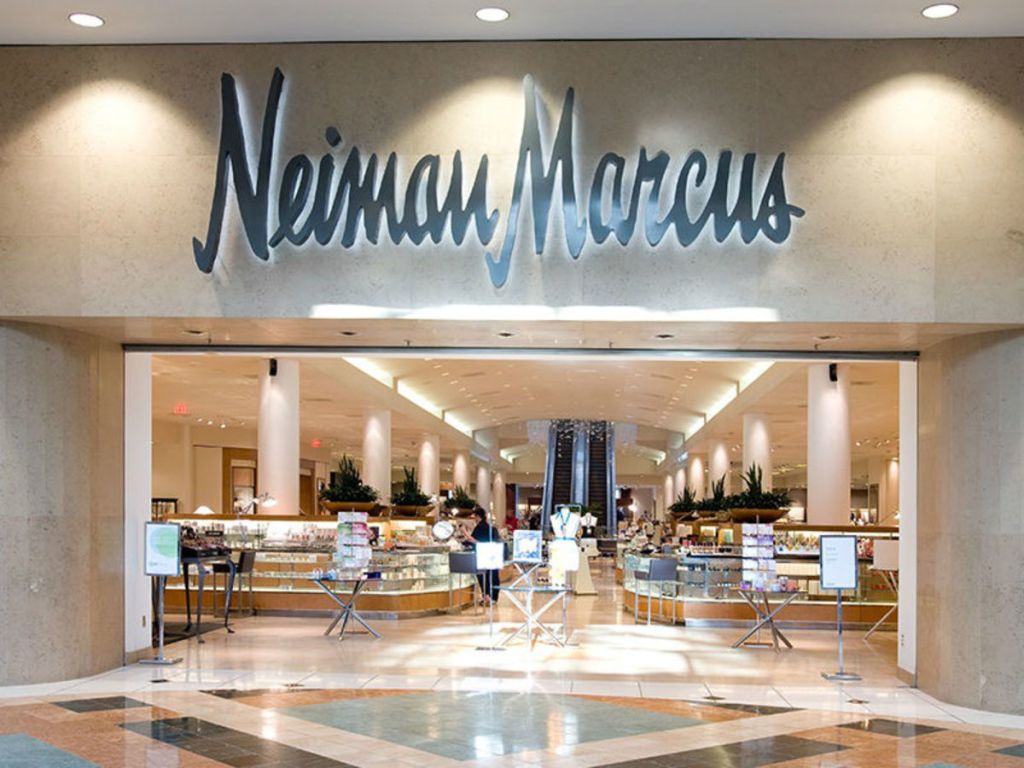
Neiman Marcus, a chain of luxury department stores founded in 1907 by department store workers Herbert Marcus, his sister Carrie Marcus Neiman, and her husband, A.L. Neiman. Its headquarters are in Dallas, Texas. There is a Neiman Marcus department store in West Hartford where Emily could have bought her luxury tape measure.
JACKSON: Remember that sweet, simple, affordable little wedding Sookie and I agreed on with minimal disagreement … Gone. Ancient history. It’s the Library of Alexandria, it’s the Colossus of Rhodes, it’s Pop Rocks, it’s over.
Library of Alexandria
The Great Library of Alexandria in Alexandria, Egypt was one of the largest and most significant libraries of the ancient world, part of a larger institution called The Musaeum, dedicated to the nine Muses, and the source of the modern word “museum”.
It is said to have been founded by Ptolemy II Philadelphus around 285 BC, in an attempt to bring together the best minds of the Hellenistic world and collect all books known at the time – at its height, it may have had as many as 400 000 scrolls. Due mostly to the Great Library, Alexandria became known as the capital of knowledge and learning.
Although there is a popular modern belief that the Library was destroyed in a cataclysmic fire, in fact it gradually declined over the course of several centuries. It was accidentally burned by Julius Caesar in 48 BC, but it is not known how much damage was done. Under the Romans, the Library dwindled from lack of funding, and an invasion by Palmyra in 270 AD probably destroyed what little was left of it.
Colossus of Rhodes
The Colossus of Rhodes was a statue of the Greek sun god Helios, erected in the city of Rhodes on the island of the same name by Chares of Lindos in 280 BC. One of the Seven Wonders of the Ancient World, it was constructed to celebrate a military victory against Macedon. According to descriptions at the time, the statue was 108 feet high – about the same size as the Statue of Liberty – making it the tallest statue in the ancient world. The statue was destroyed in 653 AD by Arab forces. Since 2008, discussions have been underway about building a new Colossus in Rhodes Harbour, so it may not be ancient history for much longer.
Pop Rocks
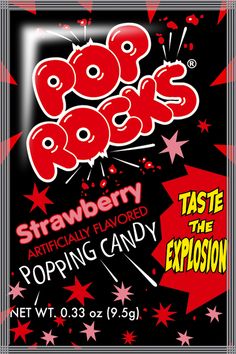
A candy with bubbles in it, causing a small popping sensation when it dissolves. First offered to the public in 1976 by General Foods, sales were withdrawn in 1983, citing its lack of success and short shelf life. After that, Kraft licensed the product to a Spanish company called Zeta Espacial S.A., who distributes it in the US through Pop Rocks Inc., in Atlanta, Georgia. Jackson seems to think Pop Rocks are gone, but they aren’t.
TROUBADOUR #2: A lot of vegetable soup being eaten tonight, yesiree. Hope I don’t put the good people at Campbell’s out of business.
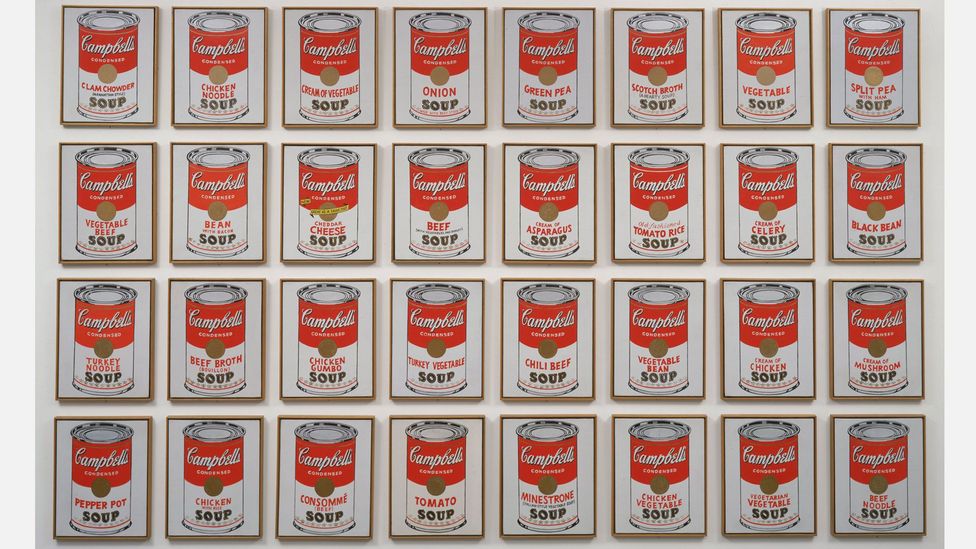
The Campbell Soup Company, trading as Campbell’s, processed food and snack company that is the largest in the US, most closely associated with its flagship canned soup. The classic red and white design of their soup cans have become American icons, and famously the subject of pop artist Andy Warhol’s series of prints [pictured]. The company was started in New Jersey in 1869 by Joseph A. Campbell and Abraham Anderson.
Of course the Second Troubadour/Second Market Guy won’t put Campbell’s out of business – they are massive. He is referring to putting Taylor out of business, and this is another jab at him.
LORELAI: It’s an upside down world where the Horchow House is considered low-rent and diamonds less than twenty-four carats are Cracker Jack trinkets and Bentleys are for losers who can’t afford a Rolls.
Horchow House
I think Lorelai is referring to The Horchow Collection, a mail order business for luxury goods started in 1971 by Broadway producer Samuel Horchow.
Cracker Jack
A brand of caramel-coasted popcorn and peanuts, well known for containing a mystery item, a toy novelty item of low value. The first lot of Cracker Jack was sold in 1896. A 24-carat diamond is the highest quality there is.
Bentley
A British manufacturer of luxury cars, founded in London in 1919, and a subsidiary of Volkswagen since 1998.
Rolls
Referring to Rolls-Royce, a British luxury car business established in 1904 in Manchester through a partnership with Charles Rolls and Henry Royce. It changed a number of times, and in 1998 was bought by Volkswagen. The Rolls-Royce trademark was bought by BMW in 2003, and has no direction connection with the original company.
Equal is a brand of artificial sweetener, using aspartame as its primary sweetening ingredient. Its owned by Merisant, headquartered in Chicago. It was one of the first artificial sweeteners to be marketed to the public in the 1980s.
LORELAI: Do I . . . ugh . . . I am Cathy Coffee, mister, the bastard offspring of Mrs. Folger and Juan Valdez.
Cathy Coffee
I think a fictional coffee mascot that Lorelai has invented and is now personifying.
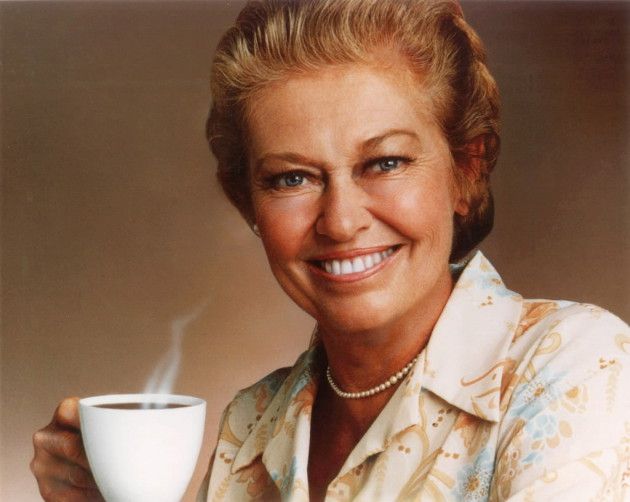
Mrs Folger [pictured]
Mrs Olson, or “The Folgers Coffee Woman” was in a string of television commercials for Folgers Coffee during the 1960s and ’70s. Mrs Olson was a Swedish neighbour who always recommended a cup of Folgers Coffee to other people in the commercial. She was played by an actress named Virginia Christina, born Virginia Ricketts (1920-1996).
Juan Valdez
A fictional character who has appeared in advertisements for the National Federation of Coffee Growers in Colombia since 1958. He is an icon for both coffee and Colombia. He was portrayed by a Cuban actor named José F. Duval until 1969, then by Colombian actor Carlos Sánchez. Since 2006, Juan Valdez has been portrayed by Carlos Castañeda, a coffee grower from a small town in Colombia.





 The Annotated Gilmore Girls