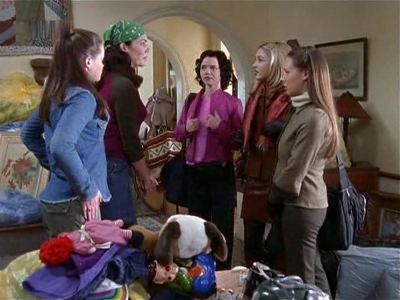
Dean and Rory’s Argument

Dean might have kept his mouth shut in front of Lorelai, but now he and Rory are alone they end up arguing about The Donna Reed Show. He basically can’t see anything wrong with a woman cooking dinner for her husband and family, and points out that’s exactly what his mother did for years, and now that she works, she still does it on the weekends.

Their different family backgrounds have helped shape their differing values, and Rory cannot really find a way to respect Dean’s experiences and views without feeling that she is betraying Lorelai, and the way she was raised. In fact, she sounds as if she’s beginning to have doubts about whether Lorelai is completely in the right.

Her argument that it’s okay for Dean’s mother to cook if she wants to because women have choices now doesn’t really make sense. If women (like Mrs. Forester) are free to do as they wish now, then why is Rory getting upset about how things were in a previous era? Why is it even an issue? And how exactly does it affect her?

Rory’s read books on feminism, but isn’t able to explain her feminist ideals to Dean. Perhaps she’s afraid that if she did so, the difference in their opinions and values would become too starkly obvious. Or maybe she wonders if Simone de Beauvoir can really help in this situation.

When Dean says that Rory only thinks the way she does because of her mother, it raises the question, yet again, as to whether Rory even has an identity of her own apart from Lorelai. Perhaps because of this comment, she doesn’t confide in Lorelai as to what’s bothering her, or what she plans to do.
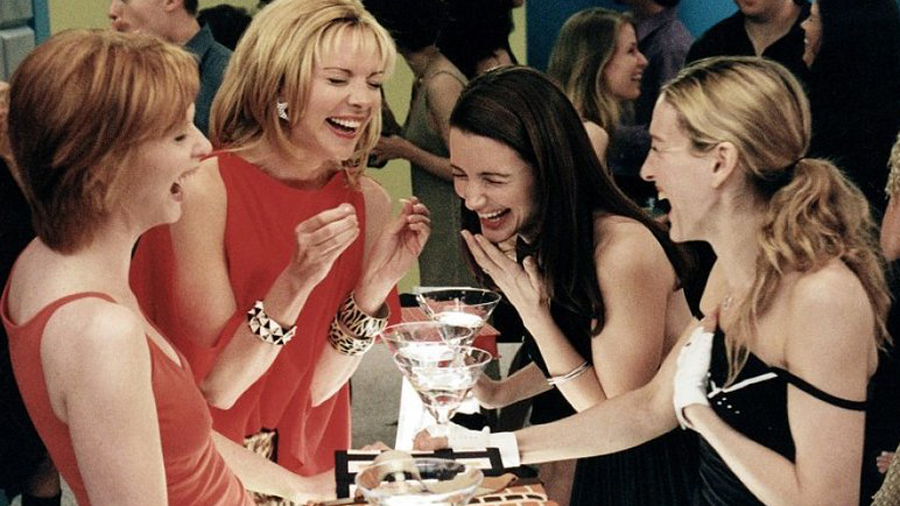
“Four girls talking dirty”

BABETTE: He’s [the new kitten] just the cutest thing. But he’s so teeny. There’s no way he can go with us and I would hate for him to stay all alone in the house so I was thinking maybe Rory could come over and house-sit for the evening.
RORY: I’d love to.
BABETTE: Oh great! We’ve got a kitchen full of food and Morey just got cable so you can watch those four girls talking dirty if you want to.

Babette is referring to Sex and the City, an American romantic comedy-drama television series, originally running from 1998 to 2004 on the cable channel Home Box Office (HBO). The show was based on the 1997 book of the same name by Connecticut-born author and journalist Candace Bushnell, which drew on her column of the same name for the New York Observer, describing the dating lives of herself and her friends.

The “four girls” in the show are the narrator, journalist Carrie Bradshaw (Sarah Jessica Parker), PR businesswoman Samantha Jones (Kim Cattrall), art gallery assistant Charlotte York (Kristin Davis), and lawyer Miranda Hobbes (Cynthia Nixon). The four friends have many sexually frank discussions (“talk dirty”) about their various relationships, and story lines include subjects such as oral sex, bondage and discipline, infidelity, pregnancy, abortion, and sexually transmitted infections.

Sex and the City has won numerous Emmy, Golden Globe, and Screen Actor’s Guild Awards, and is now regarded as a classic television show, still with a cult following. The show led to two feature films, and a prequel series, The Carrie Diaries.

It’s an interesting little throwaway in an episode devoted to The Donna Reed Show. Times certainly changed for women on TV between the mid-1960s and the early 2000s, but it’s a matter for debate whether any real progress was made, or whether the images of femininity on Sex and the City are any less glamourised, idealised, and unrealistic than on The Donna Reed Show.

Sex and the City, as a quippy, pop culture-laden, female-centred show created for a female audience, and focused on a successful single woman who’s attractive and glamorous, whose daughter is an aspiring journalist, is another forerunner to Gilmore Girls.

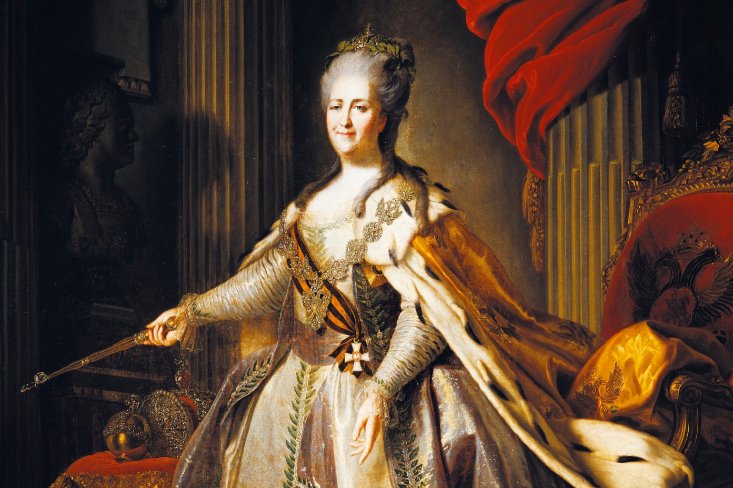
Catherine the Great

While Lorelai is mending her Chilton school sweater, Rory studies for a History test (her midterm exam?), reading through index cards on Catherine the Great.

Catherine II (1729-1796), also known as Catherine the Great, was Empress of Russia from 1762 to 1796, the country’s longest-ruling female leader. Under her reign, Russia grew larger and stronger, and was recognised as one of the great powers of Europe, while the period of her rule is considered the Golden Age of the Russian Empire and the Russian nobility. As patron of the arts, she presided over the Russian Enlightenment, and decreed the first state-funded institute of higher learning for women.

As Rory’s notes say, she was born Princess Sophie Friederike Auguste von Anhalt-Zerbst-Dornburg in Prussia. Although Lorelai jokes that everyone called her Kitten, her nickname was Figchen, a short form of her middle name Friederike. She received the name Yekaterina (Catherine) in 1744 on converting to the Russian Orthodox faith in preparation for her marriage.

Catherine married her second cousin Peter von Holstein-Gottorp, Duke of Holstein-Gottorp (that’s in north-west Germany) in 1745 – not 1754 as Rory says. Their marriage was indeed unhappy, and Catherine detested Peter at first sight. He had a difficult personality, and both of them were unfaithful to each other, with Catherine taking many lovers during her lifetime.

Peter became Peter III, Emperor of Russia in 1762, but six months later was deposed and possibly assassinated as the result of a conspiracy led by his wife Catherine, who succeeded him to the throne.

In an episode focused on women’s roles, this is a reminder of one of history’s most powerful female leaders.

Martha’s Vineyard

RORY: So when do you guys leave for Martha’s Vineyard?
RICHARD: Ah, we’re not going to Martha’s Vineyard this year.

Martha’s Vineyard, often known as The Vineyard, is an island off Cape Code in Massachusetts, known for being an affluent summer colony. More than half the island’s homes are occupied only seasonally, and the population of around 16 000 can rise to over 100 000 in the summer.

Notice how cleverly the dialogue goes from wine, to wine making, to The Vineyard.

Donna Reed

DEAN: So, who’s Donna Reed?
LORELAI: You don’t know who Donna Reed is? The quintessential ’50s mom with the perfect ’50s family?
RORY: Never without a smile and high heels?
LORELAI: Hair, that if you hit it with a hammer, would crack?

Donna Reed, born Donna Mullenger (1921-1986) was an American actress and producer, with a career lasting over 40 years, and roles in more than 40 films. She is well known for her role as Mary Bailey in the 1946 film It’s a Wonderful Life, and in 1953 won Best Supporting Actress playing Lorene Burke in From Here to Eternity.

The Donna Reed Show made her a household name and earned her a Golden Globe for Best Female TV Star, and several Emmy nominations. She also appeared on television in The Love Boat, and as Miss Ellie Ewing on Dallas from 1984-85, her final role.

As Lorelai and Rory only talk about Donna Reed in regard to her role on The Donna Reed Show, it suggests that they are ignorant about her life and career otherwise, or simply discount it. You can’t help but feel that the writer is setting them up as straw feminists.

The Good Witch

LORELAI: Think fast [throws them a tee-shirt each]. Tee-shirts for all the girls because I’m the Good Witch of the – hey, aren’t you missing a couple of kids?

Another reference to The Wizard of Oz, earlier discussed. In the film, Glinda the Good Witch of the North (Billie Burke) welcomes Dorothy to Oz, gives her the ruby slippers, and sends her to the Emerald City to find the Wizard of Oz. It is also Glinda who helps Dorothy get home to Kansas. She is a rather glamorous and bountiful mother figure, which seems to be how Lorelai sees herself (and she does help/force Madeline and Louise to get home safely).

Everest

[Pan to Sookie and Lorelai climbing stairs]
SOOKIE: Did you ever see Everest?
LORELAI: No.
SOOKIE: It’s a good movie.

Everest is a 1998 45-minute IMAX documentary film about the difficulties involved with climbing Mount Everest, the highest peak in the world. Narrated by Irish actor Liam Neeson, it focuses on the 1996 Mount Everest disaster, in which a group of climbers became trapped by a blizzard near the summit. Everest received good reviews, and made $128 million during its theatrical run – the highest gross of any documentary to this date.

This is the closest that Sookie gets to making a complaint about having to buy cheap seats, as she likens their climb to their seats to struggling up Mount Everest.

Concert Interruptus

The episode title is a play on coitus interruptus, a method of birth control where the penis is withdrawn from the vagina prior to ejaculation, also known as withdrawal or the pull-out method. In the same way, the concert in the episode is interrupted when Madeline and Louise withdraw or “pull out” of the proceedings.

Amusingly, Lorelai also ruins or “interrupts” the girls’ chance of achieving coitus with the boys they pick up at the concert, giving it another layer of meaning.

Sookie and Jackson

This episode marks the beginning of Sookie and Jackson’s relationship, and from now on we can feel completely secure that Sookie’s relationship needs are taken care of, and that any star-crossed lovers dating plot-lines will belong to Lorelai and Rory, the protagonists of the story.

As Sookie was originally going to be played by Alex Borstein (Drella), and Borstein was then married to Jackson Douglas, who plays Jackson in Gilmore Girls, it is likely that that it was always planned for Sookie and Jackson to be a couple eventually.