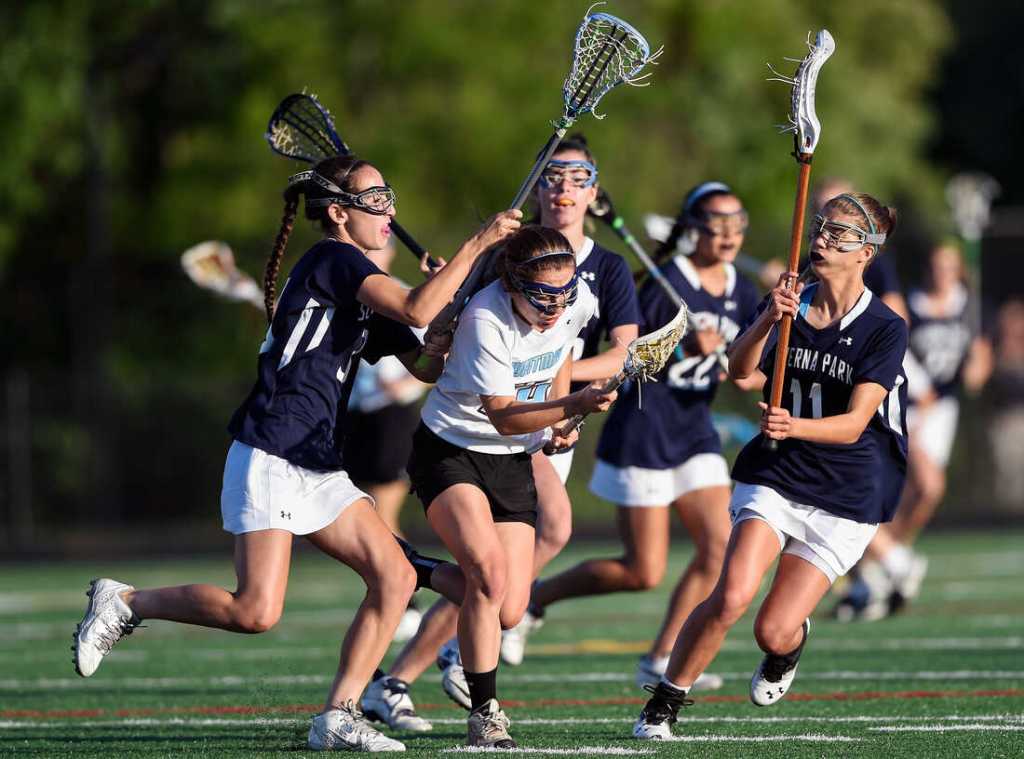
Lacrosse is a team sport played with a stick with a net on it and a ball; the stick is used to carry, pass, catch, and shoot the ball into goal. It is the oldest organised sport in North America, with its origins with the indigenous people of North America, going back as early as the twelfth century. The game was extensively modified by European colonisers to create the current game. It is commonly played in schools and colleges in the US, and there are professional leagues as well.
Lorelai jokingly refers to Rory as “the lacrosse kid” in acknowledgement of her quote from The Karate Kid – an example of something being referenced twice in one episode of Gilmore Girls, without the title of the work ever being used.
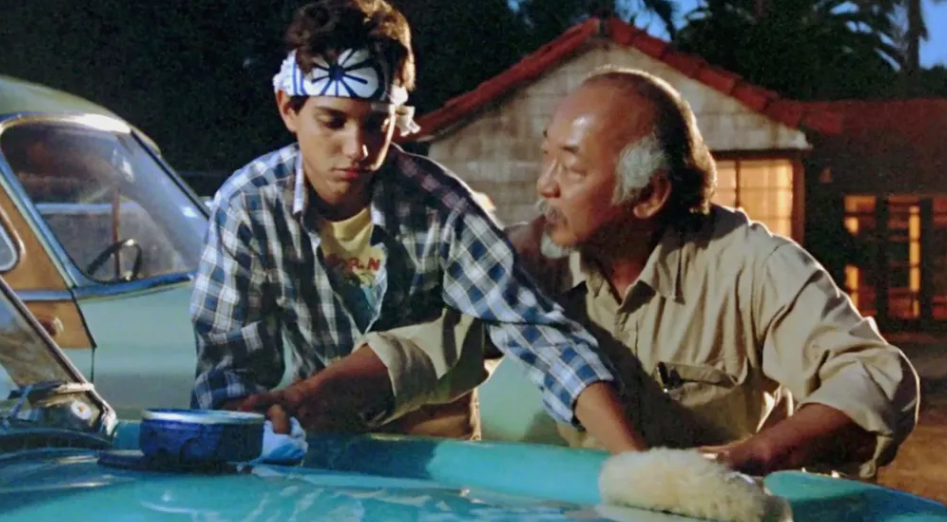
Rory quotes from the 1984 martial arts drama film The Karate Kid, directed by John G. Avildsen, and written by Robert Mark Kamen, who had earlier success with his screenplay for the 1976 boxing film, Rocky. It stars Ralph Macchio as karate student Daniel LaRusso, and Pat Morita as his mentor, Mr. Miyagi. The film was a commercial success, becoming a sleeper hit, and the #5 film of 1984. It received positive reviews, and launched Macchio’s career, while revitalising Morita’s, who had mostly been known for his comedic role as Arnold onHappy Days. It has also been credited with popularising karate in the US.
Mr Miyagi is the handyman in Daniel’s apartment, and when he defends Daniel from bullies with his unexpected karate skills, Daniel asks him to teach him karate. However, to his dismay, at first all Mr Miyagi does is give him chores to do, such as waxing his car – instructing Daniel how to do so with the words, “Wax on, wax off”.
Only later does Daniel realise that all the chores (waxing, sanding, painting) are teaching him the hand movements for karate and giving him muscle memory. Thus he learns to trust his mentor, knowing that even the seemingly mundane tasks he is given are a valuable part of his training.
Rory says this line teasingly to Lane, to remind her that every line she puts in her band advertisement has to be paid for out of her wages, and that if she’s going to make the ad really long, she’d better start waxing more tables. Rory is being realistic – Lane’s advertisement is ridiculously long and expensive!
It’s possible that on a deeper level, this quote from The Karate Kid is also saying that Mrs Kim is the Mr Miyagi to Lane’s Daniel. Although Lane’s mother seems harsh and stern, she is actually teaching her daughter some valuable lessons. Lane is certainly not afraid of hard work, and has a strong work ethic, which can only be of help in learning and practising music. And the Kim’s house is filled with music – religious music, but at least Lane has been brought up to listen to it. This could be a tiny hint that Mrs Kim is not a complete monster, and has had at least some positive effects on Lane’s musical aspirations.
The “big kahuna” is an idiomatic phrase meaning “the boss, the leader, the head of an organisation, the big one”. It’s borrowed from Hawaiian, where the word kahuna means an expert in any field, but is often thought of as referring to a shaman or high priest.
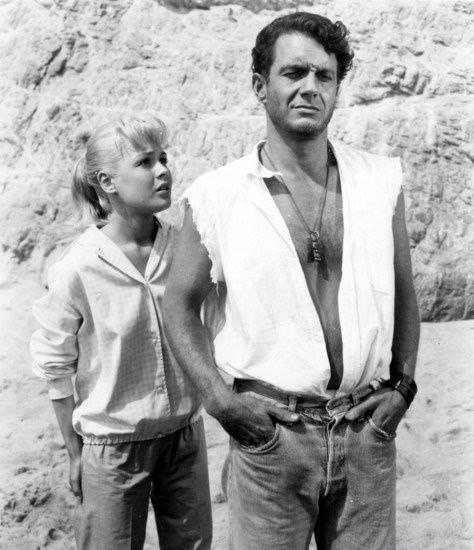
The term became known from the 1959 comedy film Gidget, in which “The Big Kahuna”, played by Cliff Robertson, was the leader of a group of surfers [pictured]. Beach party movies of the 1960s often used the term, such as Beach Blanket Bingo, where “The Big Kahuna” was the best surfer on the beach.
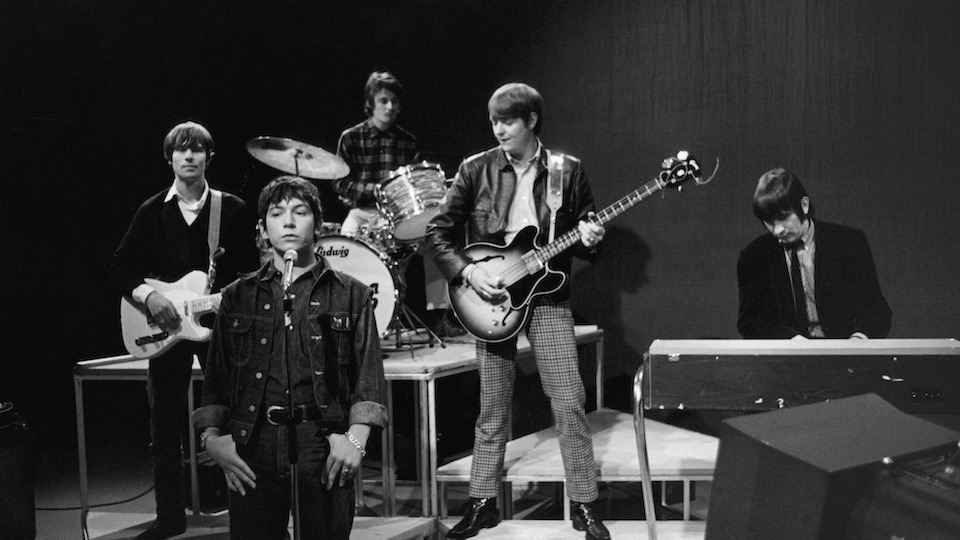
The Animals [pictured]: English rhythm and blues and rock band, formed in 1962. They were known for their gritty, bluesy sound and deep-voiced frontman, Eric Burdon, most famous for their signature song and international #1, “The House of the Rising Sun”, as well as hits such as “We Gotta Get Out of This Place”, and “Please Don’t Let Me Be Misunderstood”. After a new line-up, they moved to California in 1966 and achieved commercial success as a psychedelic and hard rock band, with hits such as “San Franciscan Nights”, and “When I Was Young”, before disbanding at the end of the decade. They were inducted into the Rock and Roll Hall of Fame in 1994.
A-ha: Norwegian synth-pop band founded in Oslo in 1982 by Paul Waaktaar-Savoy (guitar), Magne Furuholmen (keyboards/guitar/vocals), and Morten Harket (vocals). Their 1985 debut album, Hunting High and Low, is their most successful – it yielded international hits such as “Take On Me” and “The Sun Always Shines on TV”, and went to #1 in Norway, #2 in the UK, and #15 in the US. They are the most successful global pop act to come out of Norway, and the first Norwegian band to be nominated for a Grammy. Their music has often been included in music soundtracks, they performed the theme song for the 1987 James Bond film The Living Daylights, and are one of the highest-grossing bands of all time.
I feel as if the commercial success and international acclaim of these bands might be what caused Lane to cut them from her extensive list. A-ha is probably a “guilty pleasure” because it is pop, rather than rock.
JESS: Seemed to me like you’re still pretty together. I half expected you to break into a barn and put on a show.
Jess is referring to the 1950 musical film Summer Stock, directed by Charles Walters, starring Judy Garland, and previously mentioned. In the film, Judy Garland’s character, Jane, owns a farm, and one day her actress sister Abigail (played by Gloria DeHaven) breaks into her barn to rehearse with her fiancé, theatre director Joe (played by Gene Kelly), along with their theatre troupe.
Jane reluctantly allows them to go ahead, and inevitably gets sucked into the action by taking part in their show, including their big song and dance numbers. By the end, Jane has dumped her boring farmboy fiance Orville (played by Eddie Bracken), and winds up with Joe, while Abigail has, slightly implausibly, been smitten with Orville. The film was a box office success, and is iconic in popular culture, often referenced in songs and music videos.
Note that Jess likens Rory and Dean to a couple who break up to find different partners – this is essentially what ends up happening.
JESS: Plus, the two of you walking around the other day like some damn Andy Hardy movie.
Andy Hardy, previously discussed. This is the second time that Rory and Dean have been compared to an Andy Hardy movie – the first time it was by Lorelai, showing how spookily in tune Lorelai and Jess’ opinions are.
Jess gives away here that he was watching Rory with Dean just as hard as she was watching him with Shane. He’s angry with Rory, and hurt at how she has treated him, but by no means indifferent to her or over her.
Shane, 1954 Western film, directed by George Stevens and based on the 1949 novel of the same name by Jack Shaefer. It stars Alan Ladd as Shane, a mysterious drifter who rides into an isolated Wyoming valley. After protecting the homesteaders with his skilful gun-fighting, Shane rides off again, as mysteriously as he came, with the young boy he befriended desperately crying, “Shane, come back!”.
Shane was the #3 film of 1953, and received rave reviews for its stunning cinematography – it received the Academy Award in this category. It is regarded as not only a classic of its genre, but a masterpiece of cinema itself.
I’m not really sure, but it’s possible that the character of Jess’ girlfriend Shane was named after the pornographic actress and director (born Shannon Hewitt in 1969), who had attained some notoriety in the 1990s. Her Shane’s World video series revolved around taking porn stars to exotic or interesting locations and filming them in a documentary style, likened to “gonzo pornography”. This is just close enough to Jess’ interest in gonzo journalism to be provocative, at least. Note that Shane has a unisex name, like Rory, and like Jess himself.
LORELAI: My life stinks. Hey, let’s look into each other’s eyes and say “I wish I were you” at exactly the same time – maybe we’ll pull a Freaky Friday!
Freaky Friday, previously mentioned, and referenced to indicate Lorelai and Rory swapping places.
This is the song that Luke sings to Lorelai, in order to tease her about being asked out by Kirk. “Love Is in the Air” is a 1977 disco song by Australian singer John Paul Young, written by George Young and Harry Vanda, and released as the lead single from John Paul Young’s album Love Is in the Air. It went to #3 in Australia, and was a world-wide hit, going to #5 in the UK and #7 in the US, but most popular in Norway, Sweden and South Africa, where it went to #2. It went to #1 on the Billboard Adult Contemporary chart.
The song was featured in the 1992 Baz Luhrmann film Strictly Ballroom, remixed with a ’90s dance beat. Re-released as a single from the Strictly Ballroom soundtrack, it went to #3 in Australia, and was most popular in New Zealand at #2.
It is a bit surprising that Luke knows this song, and most likely watched Strictly Ballroom, which doesn’t seem like his sort of film. Maybe he went to it with a girlfriend?



 The Annotated Gilmore Girls