Midnight Express

RORY: Hey, maybe on our big trip to Europe we could go to Prague and stay in his [Havel’s] cell.
LORELAI: Absolutely. And then we can go to Turkey and stay in that place from Midnight Express.

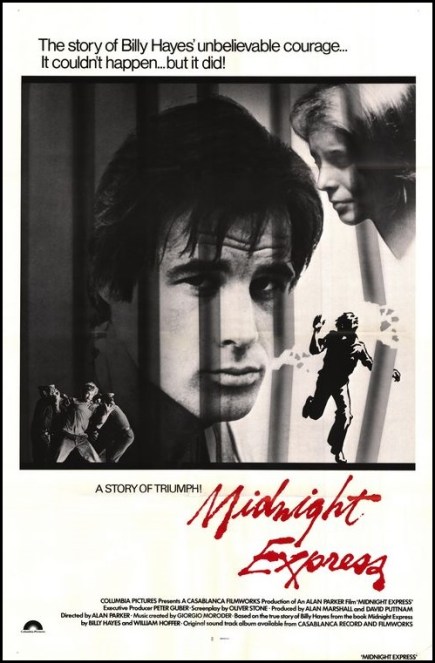
Midnight Express is a 1978 drama film directed by Alan Parker, with screenplay by Oliver Stone, and based on the memoir of the same name by Billy Hayes. Hayes was a young American college student who was sent to prison in Istanbul for trying to smuggle hashish out of Turkey. The film’s title is prison slang for an escape attempt. Midnight Express did well at the box office and gained critical praise, receiving four Academy Awards.

The film differed from Billy Hayes’ book in several significant ways. In the film, Hayes spent several years in Sağmalcılar Prison (still in existence), although in real life he was in two other prisons as well, and escaped from a different one. As filming in the prison wasn’t an option, Midnight Express was filmed at Fort St. Elmo in Malta, which is a war museum.

This is another reminder of Rory and Lorelai’s planned trip to Europe, and that Rory seems to have Prague on the itinerary.

Someone to Watch Over Me

This is the song which plays while Luke sadly watches Lorelai and Max together on their date in the snow.

Someone to Watch Over Me was written by George and Ira Gershwin, for the 1926 stage musical Oh, Kay!, where it was sung by Gertrude Lawrence. It went on to become a jazz standard, recorded numerous times, and several times used in films – including What’s Up Doc? (1972), referred to earlier.

The version used on the show is sung by Rickie Lee Jones, from her 2000 album It’s Like This.

Errol Flynn

RICHARD (to Emily): You also knew that you wanted to marry Errol Flynn.
RORY: Really? Grandma had a thing for the pirate guy?

Errol Flynn (1909-1959) was an Australian-born American actor. First appearing in the 1933 Australian film In The Wake of the Bounty as mutineer Fletcher Christian, he got his first leading role in Hollywood in the 1935 film Captain Blood, where he played the rebellious buccaneer Peter Blood. After this he tended to be cast in romantic swashbucklers, often opposite Olivia de Havilland.

Flynn had a reputation as a womaniser and a voyeur, and in 1942 he was accused of statutory rape. Even though he was acquitted, his reputation was damaged. (Flynn actually picked up a teenage girl at the trial, and ended by marrying her; later he had a serious relationship with a 15 year old girl, adding some weight to the statutory rape accusations).

Emily’s attraction to a star seen as a hell-raiser and a rogue, dangerous for girls to be around, hints at a rather steamy side to her own sexual nature.

“Potato, po-tah-to”

RICHARD: Perhaps instead of that horrible salmon that keeps showing up.
EMILY: That salmon is a fine delicacy.
RICHARD: Mm, potato, po-tah-to.

Richard is referring to the song Let’s Call the Whole Thing Off, written by George and Ira Gershwin, where the lyrics say, “You like potato and I like po-tah-to, You like to-may-to and I like to-mah-to”. The characters decide that their differences, such as the way they pronounce certain words, are not worth ending their relationship over.

The song was written for the 1937 musical comedy film Shall We Dance?, directed by Mark Sandrich and starring Fred Astaire and Ginger Rogers. The film wasn’t a raging success, but the song has proved enduring, being often re-recorded and used in other films.

When people say “potato, po-tah-to” (or “to-may-toe, to-mah-to”), they mean that the difference of opinion they are having with someone is trivial and not worth arguing about.

House on Haunted Hill

This is the movie that Lorelai takes Max to see at the movie theatre run by the Black-White-Read Bookstore in Stars Hollow.

House on Haunted Hill is a 1959 horror film directed by William Castle. It stars Vincent Price as an eccentric millionaire who invites five people to a haunted house he has rented; each person will receive $10 000 if they stay the entire night in the house. Made on a shoestring budget, it was a huge success and is still regarded as a horror classic.

Amusingly, Max will soon be staying the entire night in Lorelai’s house.


“What’s up, Teach?”

MAX: Well, well, well.
LORELAI: What’s up, Teach?

Probably a play on “What’s up, Doc?”, the famous catchphrase of Bugs Bunny in the Warner Brothers cartoons. It was first used in the 1940 animated film A Wild Hare, and director Tex Avery chose it as a common phrase used at the time in his native Texas.

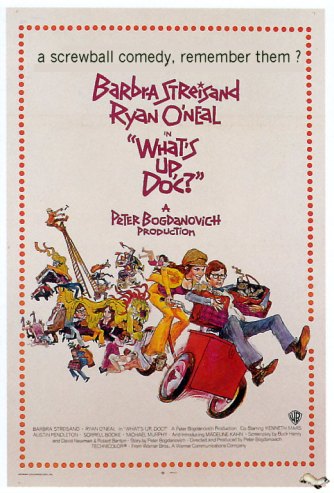
It’s also very possible Lorelai is thinking of the film What’s Up, Doc?, a 1972 screwball comedy directed by Peter Bogdanovich, and starring her favourite, Barbra Streisand. The #3 movie of 1972, it is considered one of the greatest comic films of all time.

The movie ends with the lovers kissing as they watch the 1950 Bugs Bunny film, What’s Up, Doc? Maybe Lorelai is already thinking of kissing Max at the movies, as she is just about to take him to one.

Fairy godmother


LORELAI: When I was five, I had a really bad ear infection and I had been home in bed for a week and I was very sad. So I wished really hard that something wonderful would happen to me, and I woke up the next morning and it had snowed. And I was sure that some fairy godmother had done it just for me. It was my little present.

Little Lorelai was thinking of the fairy godmother in fairy tales such as Cinderella and Sleeping Beauty. This story explains Lorelai’s love of snow. It also lets us know that when she unexpectedly sees Max in her town, she is thinking that this is another miraculous gift from her “fairy snowmother”.