RORY: Francie, so good of you to stop by. I know how busy you are. Gum? [hands her a piece]
FRANCIE: What’s your damage, Gilmore?
A reference to the movie Heathers, previously discussed. In the film, “What is your damage?” was a way to sarcastically ask what sort of mood someone was in. It’s from the 18th century slang “What’s the damage?”, meaning how much does something cost.
There have been several references made to this film in Gilmore Girls to highlight a “mean girl” plot line.
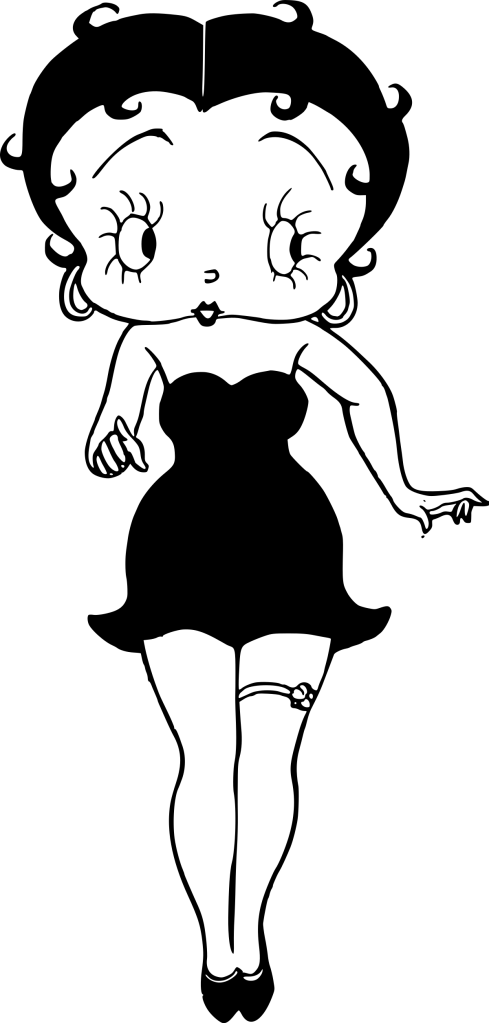
EMILY: I brought flowers over and can’t find a decent vase. All I could find was a ceramic Betty Boop head.
Betty Boop, an animated cartoon character created by Max Fleischer, featuring in theatrical cartoons during the 1930s. A caricature of a Jazz Age flapper, she is is a teenager who is drawn as both child-like and sophisticated. Fleischer said that he wanted her to be based on singer Helen Kane, although she is often said to resemble Clara Bow. She is regarded as the first animated sex symbol, and some see her as a feminist icon.
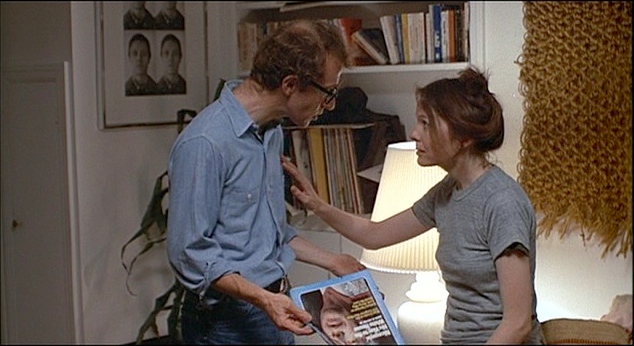
LORELAI: I have a spider whose previous credits include the bathtub scene from Annie Hall trapped under that cup.
DEAN: The size of a Buick?
Buick is a division of the US car manufacturer, General Motors. In the North American market, Buick is a premium automobile brand, selling luxury vehicles positioned above GM’s mainstream brands, while priced below the flagship luxury Cadillac division.
Dean is quoting fromAnnie Hall, when Alvy describes the spider as “the size of a Buick”. He obviously knows the film, and probably watched it with Lorelai and Rory.
[Picture shows a 1977 Buick – the same year Annie Hall was released].
In the movie, there is a scene where Annie calls Alvy to come over to her apartment at 3 am even though they have broken up – which turns out to be because there is a spider in her bath. It turns out to be two very large spiders. After Alvy deals with the spiders, he and Annie get back together.
It’s interesting that Lorelai references this scene to Dean, who has broken up with Rory and now unexpectedly turned up at her house. It seems like she thinks of it because she wants Rory and Dean to also get back together, as if Dean killing the spider will somehow bring Rory back to him, as Alvy gets Annie back.
CLAUDE: And you, my dear? [how much French do you speak?]
LORELAI: Even less. Uh, voulez vous couchez avec moi ce soir? That’s about it …
CLAUDE: It’s a pop song, ah, Monique . . . I did not know that.
MONIQUE: “Lady Marmalade”.
“Lady Marmalade”, a 1974 pop song written by Bob Crewe and Kenny Nolan, performed by R&B group Labelle, it went to #1 in the US and Canada. The song has been covered several times, including the 2001 version from the Moulin Rouge! soundtrack by Christina Aguilera, Mya, Pink, and Li’l Kim, which also went to #1.
The song is famous for the repeated refrain of Voulez-vous coucher avec moi?, which translates to: “Do you want to sleep with me?”.
Monique gets Lorelai’s joke and is familiar with the song – the 2001 version went to #12 in France, although earlier cover versions had charted there as well, if not so high.
RICHARD: And this is our international contingent, Claude and Monique Clemenceau. They’re just in from France.
The Clemenceaus have been given the same surname as Georges Clemenceau (1841-1929), Prime Minister of France from 1906-1909, and again from 1917-1920, leading France through the end of World War I.
It is surely not a coincidence that Georges Clemenceau has a Connecticut connection. He fled France in 1865 due to involvement in radical politics during the regime of Napoleon III. He ended up teaching at a girl’s school in Stamford, Connecticut, where he fell in love with one of his students, Mary Plummer (1849-1922). They married in 1869 and moved to France a year later. They separated in 1876 and divorced in 1891, after which Clemenceau had Mary sent back to the US. From his time in the US, Clemenceau developed a strong faith in American democratic ideals.
Georges Clemenceau was a friend, biographer, and supporter of the famous French artist Claude Monet. Given Claude’s first name, this also does not seem like a coincidence. Notice that the name Monique sounds similar to Monet, as if both French guests have been named after the painter.
Claude is played by Michael des Barres, an English marquis, actor and rock singer. He played Murdoc in the original Macgyver and had a lead role in the show’s reboot, and replaced Robert Palmer in the band The Power Station, fronting the band at the 1985 Live Aid concert. He has had roles in numerous TV series and some films, including To Sir With Love, Pink Cadillac, and Mulholland Drive. A long-term campaigner against drug abuse, he is currently a radio host for Sirius XM.
Monique is played by Lydie Denier, a French-American model, singer, and actress. She has appeared in a few films and a number of TV programs, including General Hospital, Melrose Place, and Spin City.
[Jackson pushes open the door and holds up the turkey]
JACKSON: Did someone say . . . Jackson?
[the crowd cheers]
LORELAI: Wow, it’s like Thunderdome in here.
Thunderdome is a fight-to-the-death gladiatorial arena in the 1985 Australian post-apocalyptic dystopian film Mad Max Beyond Thunderdome. It is the third instalment of the Mad Max series, and is directed by George Miller and George Ogilvie, starring Mel Gibson and Tina Turner. The film was a modest commercial success and received mostly positive reviews, with praise for the lead actors, and for the creative action and fight scenes.
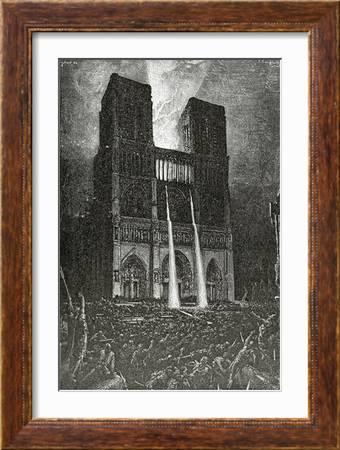
Quasimodo, the title character from The Hunchback of Notre Dame, previously discussed. In the book and the 1939 film, Quasimodo pours boiling oil from the cathedral onto his attackers – in the film, he uses the rain spouts on the gargoyles to do this.





 The Annotated Gilmore Girls