Strudel

EMILY: So do you get your lunch at school or do you bring it with you? Because Rosa made a fabulous leg of lamb yesterday. I bet it’d make a wonderful sandwich.
RICHARD: Take her up on that. It is good. And demand a slice of strudel.

Strudel is a dish made from layers of thin pastry with a filling, usually (but not always) sweet. It became popular in the 18th century throughout the Hapsburg Empire, so is a dish originating in Austria, but also common throughout Central and Eastern Europe.

Strudel pastry was heavily influenced by the filo pastry used in Turkish cuisine, such as baklava. It is very fine and elastic, and is supposed to be rolled so thin that you can read a newspaper through it.

The best known strudel is apple strudel, and the second best known is a strudel filled with a sweet soft cheese filling. However, almost any kind of fruit can be used, and so can jam, nuts, vegetables such as spinach, and meat fillings.

That Rosa makes both blintzes and strudel suggests she may be from somewhere in Eastern Europe, perhaps Hungary or the former Czechoslovakia. There is a chance that Rosa is meant to be an East European Jew, perhaps (for example) a Czech who was rescued as a child and sent to Allied countries during World War II. If so, she would be quite mature-aged, and probably older than Richard and Emily.

Blintzes

EMILY: Now, we have eggs, fruit, toast, pancakes, blintzes.

Blintzes are a variant of the Russian pancakes called blini – they are thin wheat pancakes folded over to form a casing for a filling (such as fruit, jam, chocolate paste, or cheese), and then sauteed or baked. The word blintz is Yiddish, possibly derived from Ukrainian.

Blinis are a traditional food in Slavic countries. In pre-Christian times, they were served at the end of winter to celebrate the rebirth of the sun (I guess because they are round and yellow-ish, like the sun). This tradition continues in the Orthodox church, as the timing fits in with the start of Lent, when people are encouraged to eat up all their butter, eggs, and milk – foods forbidden during the Orthodox Lenten season.

Blintzes were introduced to North America by Jewish immigrants from Eastern Europe. They are traditionally served on holidays such as Hanukkah and Shavuot (a spring festival).

As blinis and blintzes are traditionally eaten in spring in Paganism, Christianity, and Judaism, it makes sense that they feature in an episode set in April.

Up With People

LORELAI: Okay, then just meet me in town around four, and we’ll get some Indian food, and spoil our dinner. What do you say to that?
RORY: Whatever.
LORELAI: Hey, love the enthusiasm. Hey, does Up With People know about you?

Up With People is an educational organisation founded in 1965, intended to inspire young people to make a difference. After training, each UWP group is sent on a tour of various communities to participate in service projects, learn about different cultures, and perform peppy musical stage show productions. They have been criticised for their right-wing politics and cult-like behaviour.

In a later season we learn that Lorelai actually can’t stand Indian food, although Rory loves it. It’s not clear if Lorelai offering to get Indian food is a continuity issue, or if Lorelai is making a huge concession for Rory in order to cheer her up. It’s notable that Lorelai plans to eat a second dinner though – possibly because she intends to eat as little Indian food as possible.

Balthazar’s

LANE: Then he [Henry] said, “It was fun meeting you the other night.”
RORY: What?
LANE: He didn’t say which night. Like he didn’t remember which night. Like he’s mixing me up with another girl from another night. For all I know, he thought he was calling the hot blonde he met at a hopped up night at Balthazar’s.

Balthazar is a French restaurant in SoHo, Manhattan which opened in 1997 and is owned by Keith McNally. Famed for both its food and atmosphere, it is a favourite place for celebrity-spotting. It is notable that Lane gets the name wrong, not being familiar with trendy New York eateries.

Rory points out the obvious implausibility of Henry, a sixteen-year-old private school student from Hartford, being hopped up (on drugs) at Balthazar and meeting hot blondes, but Lane is not in a logical mood.

Teriyaki Joe’s

LORELAI: I thought you were gonna go antiquing.
RORY: Yeah we did. And then we had lunch.
LORELAI: Oh, really? Where?
EMILY: Teriyaki Joe’s.

Teriyaki Joe’s is yet another of the restaurants in Stars Hollow that we never hear about again. Teriyaki is a Japanese cuisine style where meat and fish are grilled over a barbecue plate and marinated or sauteed in a sweet and spicy sauce. Originally developed in the 17th century by Japanese cooks, teriyaki cuisine became popular in the US during the 1990s.

“Whopper over kimchi”

LANE: No, they’d [Henry’s parents] know.
RORY: Know what?
LANE: Know that I listen to the wrong music and wish I could go blonde without looking like an idiot. Or that I’d take a Whopper over kimchi in a heartbeat.

The Whopper is the signature hamburger at the American fast food chain Burger King. It’s a hamburger patty on a sesame seed bun with lettuce, tomato, sliced onion, mayonnaise, ketchup, and pickles. You can add optional ingredients such as cheese, bacon, or mustard at your request. There is a Burger King in New Britain, just south of Hartford – presumably Lorelai and Rory took Lane to Burger King at least once.

Kimchi [pictured] is a traditional Korean side dish made from salted and fermented vegetables, most commonly cabbage or radishes, combined with seasonings such as chilli, garlic, and ginger. A staple food in Korea, the origins of kimchi date back at least 2000 years, although the chilli wasn’t added until the 17th century. It is the national dish of North and South Korea.

Graham Cracker and Broiler

JACKSON: Or take a graham cracker, spread a little [jam] on it, break up a chocolate bar, throw it in the broiler for a couple of minutes, and you’re gonna be singing show tunes all evening.

A graham cracker is a type of cracker which is made from coarse wholemeal flour and sweetened with honey; it is very similar to a digestive biscuit. Graham crackers were inspired by the teachings of the Rev. Sylvester Graham, who preached the importance of a wholefood vegetarian diet – one of the first vegetarian movements in the US. The crackers were first marketed to Graham’s followers, but he didn’t invent them or profit from them. They are now made by a variety of brands, and can also be home made.

A broiler is the American word for the grill on the top of the stove – in American usage, grilling means the heat comes from below, while broiling means the heat is coming from above.

So if you would like to try out Jackson’s recipe, take a digestive biscuit, spread a bit of home made raspberry and peach jam on it, cover it in a broken up chocolate bar, and pop it under the grill for two minutes until the chocolate melts.

Jam

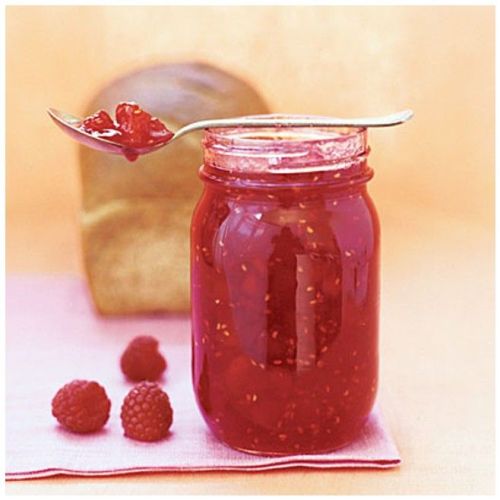
JACKSON (to Lorelai): Yeah, and I also brought some of my raspberry peach jam. I think you’re gonna like it. Put it on ice cream.

This might confuse some non-Americans, because one of the earliest Americanisms often learned is that in the US they call jam “jelly”, and jelly is “Jell-O“. So what does Jackson mean by “jam”?

The US Food and Drug Administration has some very clear rules on what constitutes “jelly” or “jam”. Jelly is made from the clear juices of fruit, then boiled with sugar and pectin so that it sets into a spreadable consistency. Despite the name, it doesn’t have gelatine in it, and is much sweeter than the fruit jellies made in the UK that are eaten with meat (eg bramble jelly). For some reason, jelly is considered a food more suitable for children, or is more popular with children.

Jam is made from boiling mashed fruit with sugar until it is able to set into a spreadable consistency (it’s basically what everyone calls jam). It may not need pectin to make it set, as many fruits already have pectin in them. For some reason, it considered more suitable for adults than jelly, or is more popular with adults. It is usually of a runnier consistency than jelly, which is why Jackson suggests using his raspberry and peach jam as a topping for ice cream.

In Star Crossed Lovers and Other Strangers, we learned that Jackson planned to begin making his own jams, preserves, and tomato sauce – the jam he gives Lorelai must be an example of what he has made so far.

Pot Roast

LORELAI: One minute it’s, “Pass the pot roast”; the next minute it’s, “Hey, have a pile of money”. Things are never boring at the Gilmore house.

Pot roast is an American dish made by braising a piece of beef, then slow cooking it in a covered dish with liquid added that can be made into gravy. Vegetables such as carrots, potatoes, and onions are commonly added as well.

The dish is a variation of the French dish boeuf à la mode, which was introduced by French immigrants to New England, and influenced by later German immigrants who also marinated and slow cooked roasts to ensure tenderness.

(The Gilmores didn’t really have pot roast that night, they ate rabbit.)

Lorelai is certainly right that being handed piles of money whenever you need them is part and parcel of being a Gilmore. She and Rory are supposedly struggling and working hard, but any time life gets a bit too tough you know someone will come along and bail them out financially.