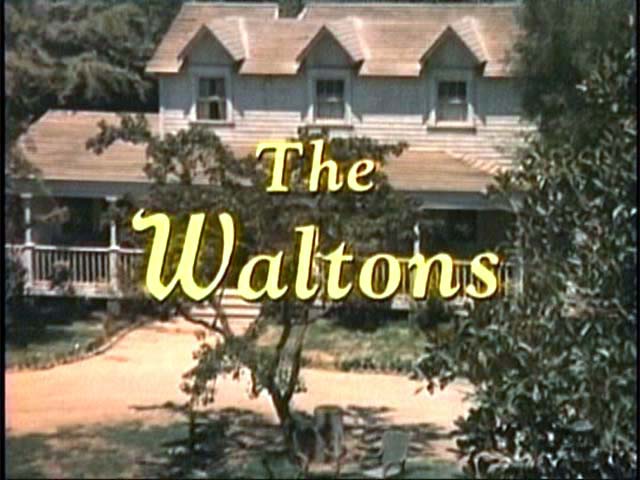
The Waltons

LORELAI: And while some have called it [giving birth] the most meaningful experience of your life, to me it was something more akin to doing the splits on a crate of dynamite.
RORY: I wonder if the Waltons ever did this.

The Waltons (1972-1981) was a wholesome family drama TV series about the Walton family in rural Virginia, and their experiences living through the Great Depression and World War II. It was based on the film Spencer’s Mountain, from a novel of the same name by Earl Hamner Jr., who would go on to be an executive producer on the TV series. Extremely popular, the Waltons won several Emmy Awards.

The Waltons had a couple of things in common with Gilmore Girls. Both shows were set in small towns with quirky townsfolk, and the protagonist of The Waltons, John-Boy Walton (based on Earl Hamner Jr.) went to university in a nearby town and became a journalist, just like Rory Gilmore. Both shows were filmed at Warner Brothers studio, and the set for the Waltons’ house was used for The Dragonfly inn in Gilmore Girls.

Cinderella

LORELAI: Let me see. Maybe we should really embrace the whole tulle thing. Go totally modern Cinderella.

Lorelai is referring to the 1950 animated Disney film Cinderella, based on the French fairy tale by Charles Perrault. Cinderella was a massive critical and commercial success for Walt Disney, and was the #3 film of 1950. It is considered one of the greatest animated films of all time.

In the film, Cinderella wears a silver-white ballgown which is made blue in promotional materials; reproductions of the dress made for children and teens tend to be made from tulle.

Neither Lorelai nor Rory ends up wearing a tulle dress to Rory’s first birthday party, so I’m not sure what happened to the dresses Emily bought them. As Lorelai tells Emily they wore them to the party, maybe she tore all the tulle off and they wore the slip dresses that were underneath? Or perhaps Lorelai is simply lying.

At the very least, the lacy green cardigan that Rory wears wasn’t made by her mother – Lorelai wore it to Friday Night Dinner in Kill Me Now, and Rory must have borrowed it.

Lorelai Leigh

We learn in this episode that Rory’s full name is Lorelai Leigh Gilmore. This seems like an homage to the character Lorelei Lee (played by Marilyn Monroe), from the 1953 musical comedy film Gentlemen Prefer Blondes, directed by Howard Hawks. It is based on the 1949 musical, which in turn was based on the best-selling 1925 novel of the same name by Anita Loos. Gentlemen Prefer Blondes was the #9 movie of 1953, and both the film and Monroe’s performance were praised by critics.

In the film, Lorelei Lee loves wealthy men and the high life, and is also accused in court of theft. This may help prepare us for Rory’s own character arc.

The Fly

LORELAI: You didn’t build one of those machines like in The Fly did you? We’re not going to find you wandering the streets wearing a raspberry head crying, “Eat me!”

The Fly is a 1958 sci-fi horror film directed by Kurt Neuman, based on the short story of the same name by George Langlaan. In the film, a scientist mutates into a human fly after accidentally mixing his atoms with that of a fly which flew into his matter transportation machine. At one point, he can be heard crying, “Save me!”.

The film was a commercial success, and is now regarded as a superior example of a 1950s B-Grade sci-fi film. Sadly, the director died a few weeks after the film’s premiere, never realising he had made the hit of his career.

Elvis and Jim Morrison

Lorelai jokes that Elvis and Jim Morrison will attend Rory’s birthday party and bring chips.

Elvis Presley (1935-1977) was an American singer and actor. One of the great icons of the twentieth century, he is often referred to as The King of Rock and Roll or The King. Elvis’ first single, Heartbreak Hotel, came out in 1956 and went straight to #1. Later that year he made his film debut in Love Me Tender. Successful in rock, pop, blues, and gospel, Elvis is one of the biggest-selling musical artists in history. He won three Grammy Awards, including a Lifetime Achivement Award, and has been inducted into numerous musical halls of fame.

James “Jim” Morrison (1943-1971) [pictured] was an American singer, songwriter, and poet. He was the lead singer of The Doors, an influential rock band founded in 1965 that also included Ray Manzarek, Robbie Krieger, and John Densmore. The band shot to fame in 1967 when their song Light My Fire went to #1. Since his death, Morrison has remained famous, and is regarded as as the archetypal sexy, rebellious rock star. He, along with the other members of The Doors, were inducted into the Rock and Roll Hall of Fame in 1993.

Jean-Paul Sartre

LORELAI: He [Jim Carrey] is funny but I didn’t mean funny, funny. I’m being philosophical.
SOOKIE: Oh. Very serious face. Jean-Paul Sartre.

Jean-Paul Sartre (1905-1980) was a French philosopher, writer, and critic. Highly influential, he was a leading figure in 20th century Marxism, existentialism, and phenomenology, and was famous as the lover of fellow philosopher Simone de Beauvoir. His best known work is Being and Nothingness (1943). He was awarded the Nobel Prize for Literature in 1964, but declined to accept it.


Torches and Villagers

MICHEL: That is why I left France.
LORELAI: Huh. I thought it had something to do with the torches and the villagers.

Lorelai is most likely referring to the 1931 horror film Frankenstein, directed by James Whale and with Boris Karloff as the monster. It was based on a play inspired by the 1823 novel of the same name by Mary Shelley. Frankenstein was the #1 film of 1931, and is regarded as one of the greatest films of all time.

In the movie, a group of peasants form a search party for the monster after it has killed, and use torches to set a windmill ablaze with the monster inside. Although similar scenes had occurred in earlier films, this seems to be the one everyone is talking about when they refer to villagers with torches.

A Room of One’s Own

Rory reads this 1929 book by Virginia Woolf on the bus to Hartford. A Room of One’s Own is a long essay based on a series of lectures that Woolf gave to female students at two women’s colleges at Cambridge University in 1928. It combines fiction and non-fiction to discuss a history of women’s writing, and to argue for a place for women within the literary tradition.

Woolf states that for a woman to write fiction, she must have a modest income, and a private place to write – a room of her own. This is another feminist text that Rory reads, and it seems that the aspiring journalist is already positioning herself as a woman writer. It is ironic that the book asks for women to be given a private space, as Dean intrudes on Rory’s privacy on the bus.

Cinnamon’s Wake

The episode title is a play on Finnegan’s Wake, the 1939 comic avant-garde novel by Irish author James Joyce. Experimental in style, it is considered one of the most difficult works of fiction in the English language. Upon publication, critics were baffled and hostile, but it is now thought to be Joyce’s literary masterpiece.

The title of the novel comes from a 19th century comical Irish ballad, about a man named Finnegan who falls from a ladder and is thought to be dead, but comes back to life at his own wake. Death and resurrection is a central theme of the novel as well. No such luck for Cinnamon, however.