A 1992 song by English rock band XTC, written by vocalist Andy Partridge, a track from their album Nonsuch. The album was critically acclaimed, and went to #28 in the UK and #97 in the US, topping Rolling Stone’s College Album Chart.
The lyrics extravagantly describe a man feeling dazzled and even slightly frightened when the woman he loves appears out of nowhere with a beauty compared to the goddess Venus. The song plays during the kiss between Jess and Rory, summing up exactly how Jess feels.
RORY: I can’t believe I had a meeting at Yale today … And I can’t believe the only name that popped into my head when he asked for my role model was Gloria Estefan.
Gloria Estefan (born Gloria Garcia in 1957), Cuban-American singer, actress, and businesswoman. She began her career as lead singer of Miami Sound Machine, previously mentioned, and released her first solo album in 1989. She has 38 #1 hits, and her success has been credited with paving the way for other Latin musical artists.
Hailed as “the Queen of Latin Pop” by the media, Gloria Estefan has won seven Grammy and Latin Grammy Awards, multiple Billboard awards, was BMI Songwriter of the Year, received the Presidential Medal of Freedom in 2015, was a Kennedy Center Honors recipient in 2017, and was honoured with an American Music Award for Lifetime Achievement. She was inducted into the Songwriters Hall of Fame, and has a star on the Hollywood Walk of Fame, and the Las Vegas Walk of Fame.
She has been named one of the top artists of all time, is the second best selling female Latin artist in history, and one of the best-selling female singers of all time.
George Michael, born Georgios Panayiotou (1963-2016), English singer, songwriter, and record producer. He is considered one of the leading icons of the MTV generation, and a leading creative force in music production, songwriting, vocal performance, and visual presentation.
George Michael rose to fame as one half of the music duo Wham! Their first two albums, Fantastic (1983), and Make it Big (1984), went to #1 in the UK and the US, and their biggest hit singles include “Wake Me Up Before You Go-Go”, and “Last Christmas”.
George Michael’s first solo single was “Careless Whisper”, which was released on Make it Big, and went to #1 globally. His debut solo album Faith was released in 1987, going to #1 around the world, and producing four #1 hit singles. He was the best-selling musical artist of 1988, and Faith won a Grammy in 1989. He released three more best-selling albums between 1990 and 2004.
Lorelai refers to the fact that George Michael’s sexuality became public knowledge after he was arrested in 1998 for soliciting an undercover policeman in a public toilet in Will Rogers Memorial Park in Beverley Hills, California. The charge was public lewdness. He was fined $810 and sentenced to 80 hours community service. He later made fun of the incident in the music video for his song “Outside”.
George Michael was accused of taking part in anonymous public sex in a toilet on Hampstead Heath in London in 2006, and in 2006 and 2008, he was arrested for possession of drugs in public toilets in London. But that’s all in the future at this point.
LORELAI: Mm, let me see. . . manipulate, evil plan, no free will, pearls – no, I think you about covered it. Oh, wait – did you call my father the Puppet Master?
Puppet Master, a figurative term for someone who controls other people and events, “pulling the strings” in the background, like a puppeteer.
As a fan of the band Metallica, it seems almost impossible that Lorelai would not be thinking of their 1986 song “Master of Puppets”, from the album of the same name. It is one of their most popular and well-known songs.
RICHARD: Well, I’m no Perry Como, but my shower hasn’t kicked me out yet.
Pierino “Perry” Como (1912-2001), singer, actor and television personality. During a career spanning more than half a century, he recorded primarily vocal pop and was renowned for the intimate, easy-listening genre. He sold millions of records and pioneered a weekly musical variety television show.
Como received five Emmys, a Christopher Award, and a Peabody Award. He received a Kennedy Center Honor in 1987 and was inducted into the Academy of Television Arts & Sciences Hall of Fame in 1990. Posthumously, he received the Grammy Lifetime Achievement Award in 2002 and was inducted into the Long Island Music Hall of Fame in 2006. He has the distinction of having three stars on the Hollywood Walk of Fame for his work in radio, television, and music.
RICHARD: I’m going to be going back there next week. There’s going to be a little reunion of the Whiffenpoofs … It’s an a cappella singing group I belonged to at Yale.
The Whiffenpoofs are a real a capella singing group at Yale University. Established in 1909, it is the oldest such group in the US. The line-up is completely replaced each year, and is always composed of rising seniors, who may take a year’s absence in order to go on tour nationally and internationally. Cole Porter is their most famous alumnus.
EMILY: Really, Lorelai, you can’t wait ten minutes for another salad? The situation’s that dire?
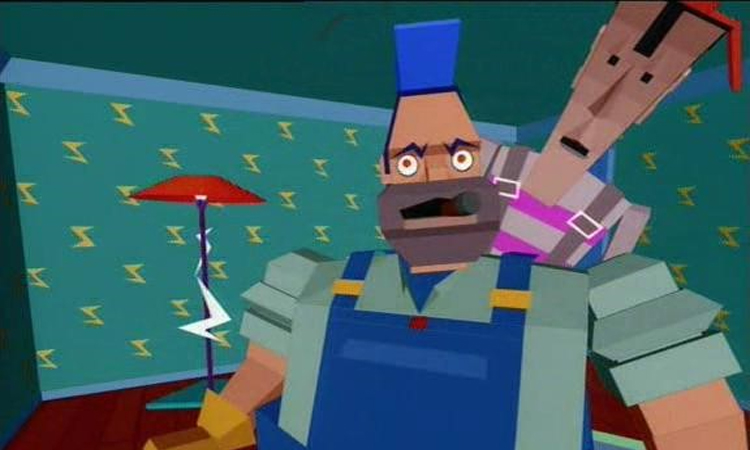
LORELAI: Four salads ago, no, not dire. Right now it’s ‘your money for nothing and your chicks for free.’
Lorelai refers to the song “Money For Nothing” by English rock band Dire Straits – so she’s saying that they are now in “dire straits” due to waiting for their food for so long. The lyrics don’t have the exact line that Lorelai says, but it’s pretty close. There are numerous repeated lines about getting your money for nothing and chicks for free, in slightly different iterations.
“Money for Nothing”, with backing lyrics by Sting, was released as a single from the band’s 1985 album, Brothers in Arms. It’s memorable for it’s groundbreaking animated music video, and repeated refrain of I want my MTV. It was Dire Straits’ most successful single, reaching #1 in the US and Canada, and #4 in the band’s native UK.
In July 1985, Dire Straits and Sting performed it at Live Aid. It won a Grammy, and two MTV Music Video Awards in 1986, and in 1987 was chosen as the first video to be played on MTV Europe.
LORELAI: Hey, unh, Luke, uh, we need a couple of donuts, and, uh, some of those extra legs Heather Mills is sending over to Croatia.
Heather Mills (born 1968), English former model, businesswoman, and activist. She came to public attention in 1993 when her left leg had to be amputated below the knee after a motorcycle accident. However, she continued to model while wearing a prosthetic limb.
Mills set up a trust which sent prosthetic limbs to people (mostly children) who had lost limbs stepping on landmines. Because she went through several prosthetic legs while her stump healed, she also had the idea of delivering discarded prosthetic limbs to amputees in Croatia, the first ones arriving in 1994. They weren’t really “extra legs”, and they weren’t always legs either.
She married rock star Paul McCartney in 2000. They divorced acrimoniously in 2008.
DAVE: Uh, well, you mentioned this thing last time we talked and it sounded very Blue Velvet so I figured I would come by and check it out.
Blue Velvet, 1986 neo-noir mystery thriller directed by David Lynch. Blending psychological horror with film noir, the film stars Kyle McLachlan, Isabella Rossellini, Dennis Hopper, and Laura Dern, and is named after the 1951 song of the same name. The film is about a college student who returns home to visit his ill father, and makes a grisly discovery in a field. This leads him to uncover a vast criminal conspiracy, and into a relationship with a troubled lounge singer.
The film initially received a divided response from critics, with many stating that its explicit content served little artistic purpose. However, David Lynch won Best Film and Best Director at that year’s National Society of Film Critics Awards. It came to achieve cult status, and is now widely regarded as one of Lynch’s major works, and one of the greatest films of the 1980s. It has been ranked as one of the best films of all time, and one of the greatest mystery films ever made.
Dave has come to see Lane just because he missed her, a clear sign to her that he returns her feelings. Strangely, he decides to arrive at the marathon around 5 am, when the marathon is just about to end! This episode doesn’t have a confusing timeline (it’s all made very clear), it’s simply an unbelievable one.
A popular big band era jazz standard recorded by Glenn Miller. It’s based on the 1930 composition “Tar Paper Stomp” by Wingy Manone, in a new arrangement by Joe Garland, with lyrics added by Andy Razaf. First released by Edgar Hayes and His Orchestra in 1938, the 1939 Glenn Miller version was inducted into the Grammy Hall of Fame in 1983. It is considered one of the most important musical works of the 20th century.
Sing, Sing, Sing (With a Swing)
A 1936 song by Louis Prima, who first recorded it with the New Orleans Gang. It’s been recorded many times, most notably by Benny Goodman. Part of the big band and swing eras, it’s a favourite for film and television soundtracks.
Walkin’ My Baby Back Home
A 1930 jazz song written by Fred E. Ahlert, with lyrics by Roy Turk. It charted in 1931, with highest-charting versions of that year by Nick Lucas, and Ted Weems, with both reaching #8. Nat King Cole’s 1951 version also went to #8, and it was most successful in 1952, when Johnnie Ray took it to #4.
A 1914 popular song by Harry Carroll, with lyrics by Harold R. Atteridge. Originally recorded by the Heidelberg Quintet, it topped the charts for six weeks during the outbreak of World War I.
These Foolish Things (Remind Me of You)
A 1935 song by English songwriters Eric Maschwitz (under the name Holt Marvell), lyricist and Jack Strachey, the composer. It is said to have been inspired by a youthful romance with cabaret singer Jean Ross. The song wasn’t an immediate success, even after featuring in the 1936 London revue Spread It Abroad, until famous West Indian pianist and singer Leslie Hutchinson found the music on top of Maschwitz’s piano, and liked it. He recorded it the same year, and after this it became a great success, recorded by musicians all over the world, including Benny Goodman, and Billie Holliday, whose version peaked at #5 in 1936.
A String of Pearls
A 1941 song composed by Jerry Gray, with lyrics by Eddie DeLange. It was recorded by Glenn Miller becoming a #1 hit. It is a big band and jazz standard.
All the music at the dance marathon is provided by the band, The Swingin’ Deacons, a band from Lynchburg, Virginia. They have a 1999 album, House of the Blues Swings!




 The Annotated Gilmore Girls