“You were a Trekkie?”

RORY: You were a Trekkie?
LUKE: I was not a Trekkie.
LORELAI: Uh uh, I do believe that denying you were a Trekkie is a violation of the Prime Directive.
RORY: Indubitably, captain.

Trekkie: a fan of the Star Trek franchise. Many serious fans dislike the term, preferring “Trekker”. Long stereotyped as hyper-obsessive supernerds, and even satirised by Star Trek itself.

Prime Directive: in Star Trek, the Prime Directive is a guiding principle that prohibits its members from interfering with the natural development of alien civilisations.

“Indubitably, captain”: Possibly the sort of thing Rory thinks that Mr Spock would say to Captain Kirk. The closest thing to it is a piece of dialogue from the 1987 series, Star Trek: The Next Generation, when Data says, “Indubitably, sir. Indubitably” to Captain Picard.

Lorelai is an arch-hypocrite to characterise Luke as a Star Trek nerd because he wore a Star Trek tee-shirt, and make fun of him: she is a huge fan of the show herself, and has made numerous references to it, including to Luke. In fact, she uses Star Trek lingo to make fun of Star Trek, something everyone, but most of all Luke, should have picked her up on.

Also note that Rory has done the same thing in regard to Lane’s erstwhile crush, Rich Bloomenfeld – she made a snarky comment about him wearing the same Star Trek tee shirt every day when he was younger. It’s essentially the same joke as this, with Luke wearing a Star Trek tee-shirt when he was younger. Like Lorelai, Rory is a hypocrite; she has made references to watching Star Trek herself.

Fun fact: the name Lorelei appears in the animated series of Star Trek (1971-present). In the 1973 episode, The Lorelei Signal, a compelling musical signal lures the Enterprise to a remote planet, where the female inhabitants drain the male crew of their life force. During the process, the men’s judgement is affected as they experience euphoric hallucinations – rather like the way men behave around the two Lorelais in Gilmore Girls! In the episode, it is up to the female crew members of the ship to take command and rescue the men, so it’s a real girl power instalment.

Santa Barbara

LORELAI: So, Mia, how’s living in Santa Barbara?
MIA: Horrible. Did you know the damn sun shines all the time out there?
RORY: They’ve written songs about that.

Santa Barbara is a coastal city in California about ninety miles north of Los Angeles. Situated on the Pacific Ocean with a dry sunny Mediterranean climate, it is promoted as “The American Riviera”. Due to its geographic positioning, it has both cooler summers and warmer winters than surrounding areas, and despite what Mia says, it tends to be wetter in winter than its surrounds too, although rainfall is very variable.

It’s the sort of expensive place that wealthy people retire to, suggesting that Mia has done very well out of the hotel industry. Is it really possible she got that rich just from the Independence Inn? Surely she has other properties or investments as well? Maybe she’s a wealthy widow?

People in Stars Hollow seem to be strangely attracted to distant California. Christopher and Liz ran away to California to start new lives, Fran went on holiday there, Mia retired there. The writers live there, the show’s filmed there …

I’m not aware of any famous songs about the sunshine of Santa Barbara specifically that Rory might be thinking of, but there’s several songs about California.

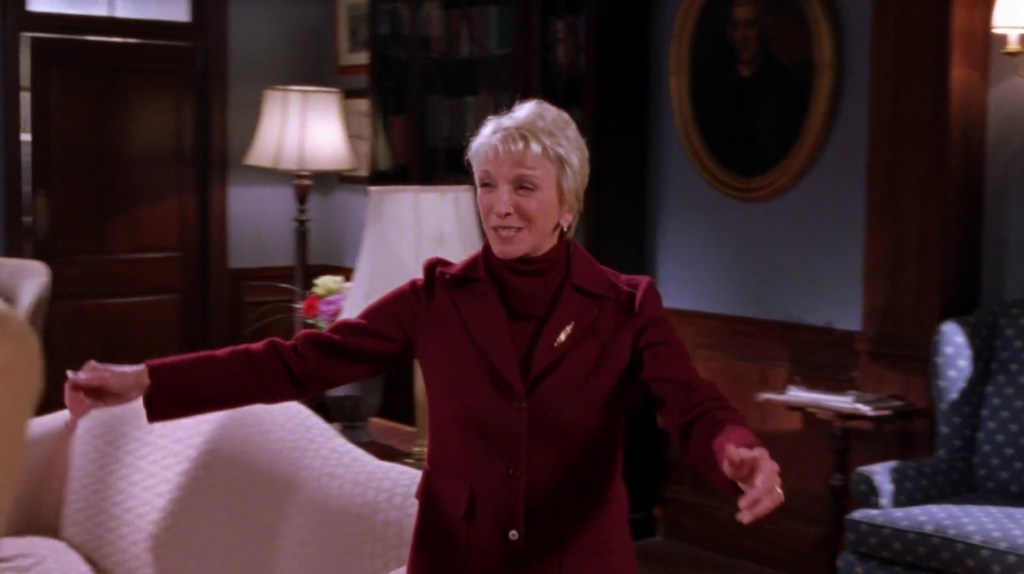
Mia Halloway (Elizabeth Franz)

In this episode, we meet Mia Halloway, the never-before-seen-or-heard-about owner of the Independence Inn, and therefore Lorelai, Sookie, and Michel’s boss. Her unannounced appearance leads to a certain amount of flustered rushing about, but Mia hasn’t come to inspect them – this is more of a social visit.

Mia is cast in the role of fairy godmother and kindly innkeeper, the woman who rescued Lorelai and Rory when they ran away from Richard and Emily’s house. It is clear that the Gilmore girls love her, and see her as a substitute mother/grandmother. They seem much closer to her than they are to Emily, their actual mother/grandmother, and feel freer in the way they express themselves and joke around. Mia conveniently faded out of the picture before Lorelai and Rory became a regular part of Emily’s life again … there would probably have been some friction otherwise.

We’re meant to see Mia as a sort of fantasy mother figure (Mama Mia!), with all the loving fun stuff, and none of the difficult painful stuff attached. The trouble is, I can’t help thinking that this is the woman who put teenaged Lorelai and her baby to live in the potting shed, when we now know they arrived in the depths of autumn, already very cold in Connecticut!

I think the issue is that the scriptwriters (including Amy Sherman-Palladino) wrote the potting shed as some quaint, adorable little wooden cottage with rosebud wallpaper and curtains at the window, and the scenery people produced … well, a pretty standard corrugated metal garden shed, not possible to put wallpaper on, and obviously utterly freezing in winter, particularly at night (and very hot in summer).

It seems more like something the wicked stepmother would have come up with for Cinderella, not the fairy godmother. Another issue is that Gilmore Girls appears to be set in a fantasy TV Connecticut where it never gets any colder than southern California.

We only learn that Mia’s surname is Halloway from the credits. Given the time of year Lorelai and Rory first arrived in Stars Hollow, the connection with Halloween is made very clear, as if Mia herself is the embodiment of supernatural forces bringing them to their correct destination.

A fun connection is that actress Elizabeth Franz was born in Akron, Ohio, the same place Richard Gilmore is sent to for work in this episode.

“Hey, did you look up angina?”

SOOKIE: That woman [Fran] is gonna live forever.
LORELAI: Not necessarily. Hey, did you look up angina? I forgot to.
SOOKIE: Yeah, it’s nothing major.

Why would Lorelai need to look up angina? Her own father has it! Is she so selfish she’s just forgotten about that, or never bothered to find out what angina is? Or did the writer (Daniel Palladino) simply ignore the events of Forgiveness and Stuff (written by John Stephens)?

Sookie isn’t really correct that angina is “nothing major”. It doubles the risk of a cardiovascular event, and that risk rises with increasing age. For an elderly person, it can be of serious concern, and in fact Fran does die from a heart attack in a future season. Richard Gilmore also has a heart attack later on, and eventually dies too.

Chalk Outline

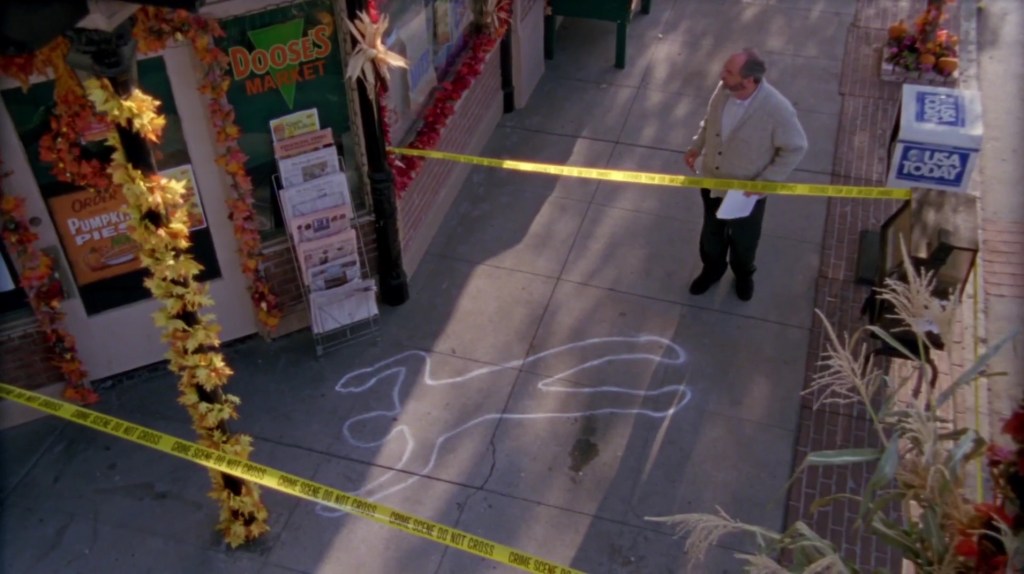
When Rory and Lane walk past Doose’s Market, there is a chalk outline of a person’s body drawn on the pavement outside the store, marked off with police tape. A crowd has gathered, and Taylor is having a fit, being calmed down by a local policewoman.

What the police officer should have told him is that a chalk outline to show where somebody has died is a trope which mostly exists in film and television (first shown in a 1958 episode of Perry Mason). In real life, police don’t usually draw a chalk outline to mark the place where someone was killed. The trope goes back to the days when police did so – not for the public, but to give crime reporters something they could photograph without showing an actual dead person.

She could have at least told Taylor that, in universe, the police did not draw the chalk outline!

Thousand-Yard-Stare

RORY: Yikes. What kind of vibe are you giving her?
LANE: Oh, my patented Keith Richards circa 1969 ‘don’t mess with me’ vibe, with a thousand-yard Asian stare thrown in.

The thousand-yard stare is a phrase often used to describe the blank, unfocused gaze of soldiers during wartime who no longer react to the horror they’re living through. More generally, it can apply to any victim of trauma.

The phrase was popularised during World War II after Life magazine published a 1944 painting by Tom Lea, titled The Marines Call It That 2000-Yard Stare [pictured], but became especially known during the Vietnam War, when it decreased to a slimmer, punchier 1000-yard stare.

Lane dramatically compares her life being brought up in a traditional Asian-American household as akin to that of someone with PTSD on a battlefield.

Fran and the Dragonfly

FRAN: But I can’t sell you the property … I just couldn’t. You know, I have no siblings and no children and in a way, that place is really the only family I have. I’m the last Weston left, so I plan to own it forever.

It turns out that the old Dragonfly Bed and Breakfast, which Lorelai and Sookie wish to buy, is owned by Fran Weston, who runs Weston’s Bakery (the bakery with the round cakes that Rory pointed out to Dean when they met, and the same Fran that Lorelai and Rory defrauded of free cake wedding cake samples).

Lorelai and Sookie are sure that sweet old Fran will be happy to sell them The Dragonfly without driving a hard bargain, but although Fran is thrilled at the idea of them starting their own inn, she refuses to sell. She is the last of the Westons, having no siblings or children, and the Dragonfly is the closest thing she has to a family. It doesn’t make a lot of sense, because she has left the property derelict, which isn’t a great way to treat your family. Surely giving it a new lease of life would be better for the Dragonfly? Maybe Lorelai should have just paid for all that cake she ate.

Lorelai and Sookie try to tactfully ask what happens to the property when Fran dies, but she doesn’t take any of their hints, and acts as if she is immortal, so that they reach a frustrating impasse. I feel as if Lorelai and Sookie should have at least made an offer and put it in writing – the temptation of cash might have eventually changed Fran’s mind.

“Who taught you about all this business stuff?”

LORELAI: So, who taught you about all this business stuff? Your dad?
LUKE: Please. My dad didn’t even have a checking account until I finally got taller then he was. He bought this land with cash from working construction, built this place himself. Didn’t have a bookkeeper, an accountant, or anything.
LORELAI: Wow, so you had no one showing you the ropes.
LUKE: Nope, I figured I had to just dive in on my own, fail if that’s my destiny, and forget what the experts say.

Note that this back story changes slightly later on.

Is it really possible that Luke learned nothing at all from his father before he died? William Danes ran a hardware store, he must have known something about business, and Luke worked alongside him when he wasn’t at school. Surely he picked up a few hints at the very least, especially as William would have been expecting him to take over the store one day (which, in a sense, he did).

Van Gogh

EMILY: The [painter] from Italy had some sort of breakdown.
RORY: Oh my God.
LORELAI: Hey, it didn’t hurt van Gogh, the guy should thank me.

Vincent van Gogh (1853-1890), Dutch post-impressionist painter who posthumously became one of the most famous and influential figures in the history of western art. In only a decade, he created more than two thousand oil paintings, most of them in the last two years of his life, his work becoming brighter, bolder, and more dramatic as his style developed.

Van Gogh suffered from psychotic episodes and delusions, and neglected his physical health, drinking heavily and not eating properly. His friendship with the painter Paul Gauguin ended with a confrontation during which van Gogh partially severed his own ear in a fit of rage. He spent time in psychiatric hospitals, but after being discharged, his depression continued. He is believed to have shot himself in the chest with a revolver, dying two days later.

Van Gogh was commercially unsuccessful during his lifetime, but attained widespread success over the ensuing decades, and today his works are among the world’s most expensive paintings to have ever sold. His legacy is honoured by the Van Gogh Museum in Amsterdam.

Although van Gogh suffered lifelong mental health issues, it is thought he may have had an acute breakdown when he severed his ear, as he had no memory of the event. It certainly did hurt him – he ultimately killed himself. But Lorelai probably means it didn’t do his career any harm, as the mental illness and suicide have only given him an aura of tortured, misunderstood genius in the public imagination. [picture shows a Van Gogh self-portrait].

It’s clear the Italian painter’s Lorelai-caused breakdown also hurt him – a year later, he was apparently homeless or destitute, found rummaging through Emily and Richard’s recyclables. It was typical of Emily not to check that he was okay, or offer him help – after all, it was her daughter that supposedly drove him to madness! Hopefully he was just working on an art installation and looking for materials, or something.