A Frank Lloyd Wright Situation

LORELAI: Mom, you know, if you’re not a little nicer to your help, you might find yourself in a Frank Lloyd Wright situation … Mrs. Wright apparently had this major problem with her help. She was very rough on them and they totally hated her. So this guy who had worked for her forever, he had finally had enough … Anyhow, Mrs. Wright invites this whole posse of people over for dinner and they’re all sitting around eating, and Mr. Disgruntled Servant Guy goes outside and locks all the doors and windows and douses the whole house in gasoline and sets the place on fire … So the house is on fire, and people are freaking out, so they run to the doors but the doors are locked, so a few of them try to get out through the windows, but Mr. Angry-Puss is standing outside with an ax hacking them to death and so they all died.

Lorelai refers to the famous architect Frank Lloyd Wright (1867-1959). It’s often been speculated that he was one of the inspirations for the character of Howard Roark in Ayn Rand’s novel, The Fountainhead.

Although Lorelai typically gets her facts a little mangled, the seemingly outrageous story she relates about him is essentially true. The woman involved wasn’t Wright’s wife, but the woman he had left his wife for and was living with in a domestic partnership that was considered scandalous at the time.

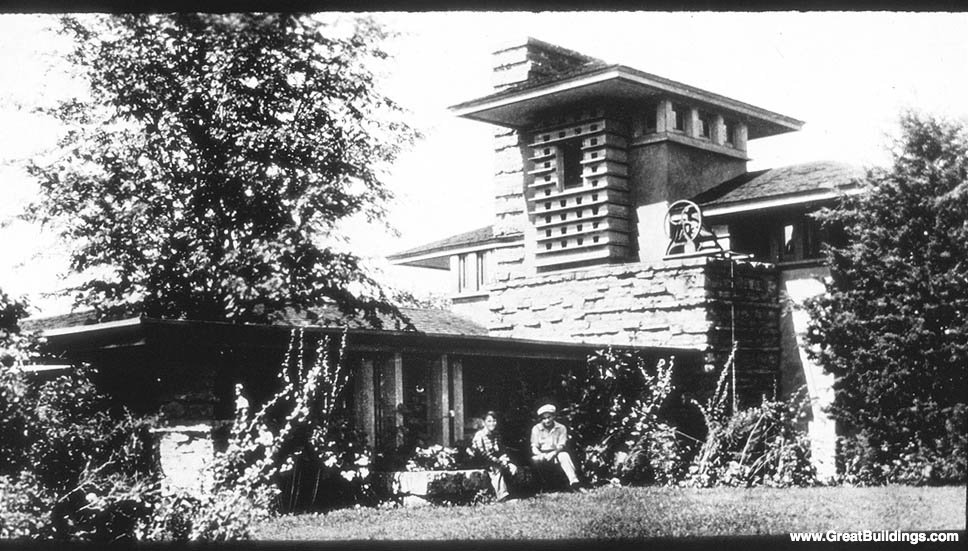
Her name was Mary “Mamah” Borthwick, a translator who had left her husband and children to be with Wright in 1909, living together since 1911 (after her divorce came through), in a house Wright built for Mamah in Spring Green, Wisconsin, called Taliesin (“shining brow” in Welsh).

In 1914, their recently-hired servant Julian Carlton, a man from Barbados who was mentally unstable, set fire to their house and murdered seven people with an axe as they fled the burning structure. The dead included Mamah Borthwick, her two visiting children, aged 8 and 12, a gardener, a draftsman, a workman, and the son of Wright’s carpenter. Carlton attempted suicide straight after the attack, and starved himself to death in jail despite receiving medical attention.

Julian Carlton never did give a motive for his actions, but there’s some evidence that he had disputes with the workmen, and that he knew he was about to lose his job. There’s no evidence that it had anything to do with Mamah Borthwick herself, and the victims, apart from Borthwick and her children, were not dinner guests, but workmen employed by Frank Lloyd Wright.

The devastated Frank Lloyd Wright rebuilt the house in Mamah’s honour, but it burned down again in 1925 after being hit with a lightning storm. It was rebuilt again, and this third version of Taliesin is now open for tours and events.

[Photo shows Taliesin as it was in 1911]

Heather Mills

LORELAI: Hey, unh, Luke, uh, we need a couple of donuts, and, uh, some of those extra legs Heather Mills is sending over to Croatia.

Heather Mills (born 1968), English former model, businesswoman, and activist. She came to public attention in 1993 when her left leg had to be amputated below the knee after a motorcycle accident. However, she continued to model while wearing a prosthetic limb.

Mills set up a trust which sent prosthetic limbs to people (mostly children) who had lost limbs stepping on landmines. Because she went through several prosthetic legs while her stump healed, she also had the idea of delivering discarded prosthetic limbs to amputees in Croatia, the first ones arriving in 1994. They weren’t really “extra legs”, and they weren’t always legs either.

She married rock star Paul McCartney in 2000. They divorced acrimoniously in 2008.

Haight-Ashbury and Electric Kool-Aid

BABETTE: Yeah, Taylor, this protest is gonna be very mellow, very peaceful.

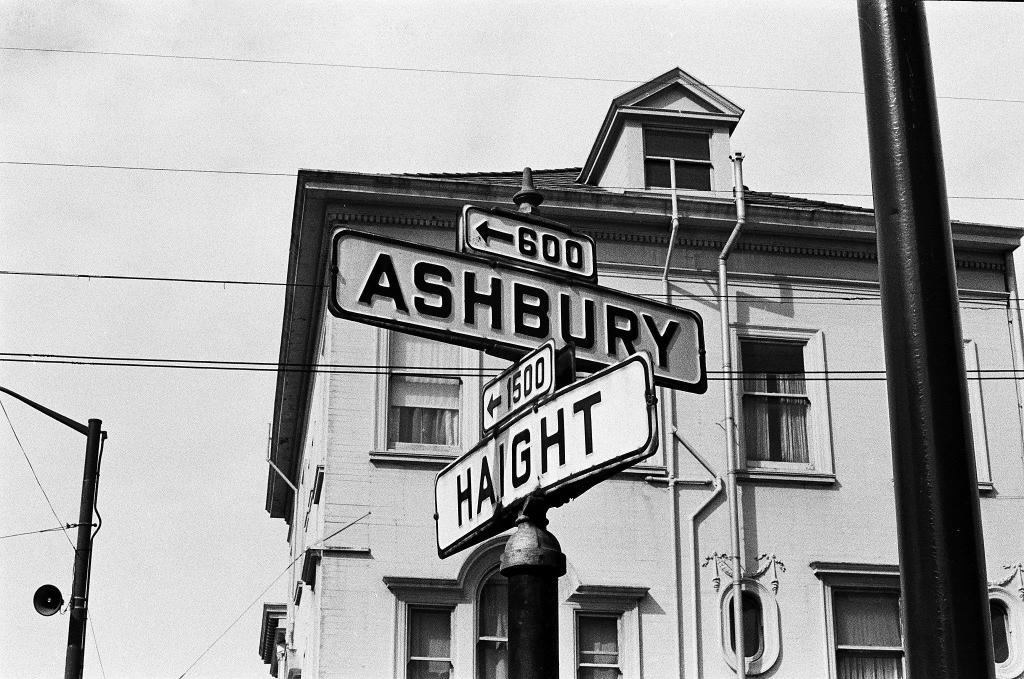
TAYLOR: Well, you can hang out in Haight-Ashbury and drink as much electric Kool-Aid as you want, Babette, but I’m preparing for the worst.

Haight-Ashbury, a district of San Francisco, named for the intersection of Haight and Ashbury streets. The neighbourhood is known as one of the main centres of the hippie counterculture of the 1960s, although it was also a centre for the Beat counterculture in the 1950s.

The Electric Kool-Aid Acid Test by Tom Wolfe, previously discussed.

Garvey Avenue

LORELAI: “Oh, and lots of cars stopped at a blue light on Garvey Avenue. Why a blue light? Well, ‘cause blue’s the new red.”

Garvey Avenue is a major road in the San Gabriel valley of Los Angles’ Eastside district [pictured]. For the purposes of fiction, there may be some confusion or conflation with Garvey Street, which is in the city of Everett in Massachusetts, three miles north of Boston, once a part of Charlestown and still bordering it. That might possibly be seen as confirmation that Christopher and Sherry live in the Charlestown area of Boston.

It’s just minutes from here”

LORELAI: It’s gonna be Harvard [that Rory’s going to].

SHERRY: Well, I certainly hope so. It’s just minutes from here. Did you know that? …I’ve already clocked it – two point seven miles, which is nothing. I’ve already checked out the best late afternoon route for her to take to come over after classes.

Lorelai has already driven to Harvard University – how can she not be aware how close it is to Sherry and Christopher, that she also just drove to? The fact that Cambridge is right next to Boston must surely be a bit of a giveaway.

I’m not sure exactly where Sherry and Christopher live, but the Bunker Hill area in Charlestown is 2.7 miles from Harvard, which is a nine minute drive [pictured]. This is the oldest part of Boston, and Christopher did say he’d like to live somewhere historical. Any further west, north or south, and they wouldn’t be living in Boston, and any further east, they would be too far away.

If so, for Rory to visit them, she would need to take a bus, and would still have a walk of at least twenty minutes. The other way would be to take the subway, which would require a change in the middle, and there would then be a ten minute walk. A fifteen minute bike ride might be easier.

The knowledge that Rory going to Harvard means her spending a lot more time with Christopher and Sherry must surely be making it seem less attractive to Lorelai.

The Shakers

TAYLOR: Well, fine, if you feel like that, maybe I will just stop showing up altogether. Maybe I’ll convert to something else and give them my generous weekly donation …

REVEREND SKINNER : Maybe the Shakers in Woodbury would take him.

RABBI BARANS: Yeah, he’s already got the beard. Can you make furniture, Taylor?

The United Society of Believers in Christ’s Second Appearing, more commonly known as the Shakers, are a Christian founded in England in the 1740s. They emigrated from England in the 1770s and settled in Revolutionary colonial America. They were initially known as “Shaking Quakers” because of their ecstatic behaviour during worship services.

They practice a celibate and communal utopian lifestyle, pacifism, charismatic worship, and their model of equality of the sexes. They are also known for their simple living, architecture, technological innovation, music, and furniture.

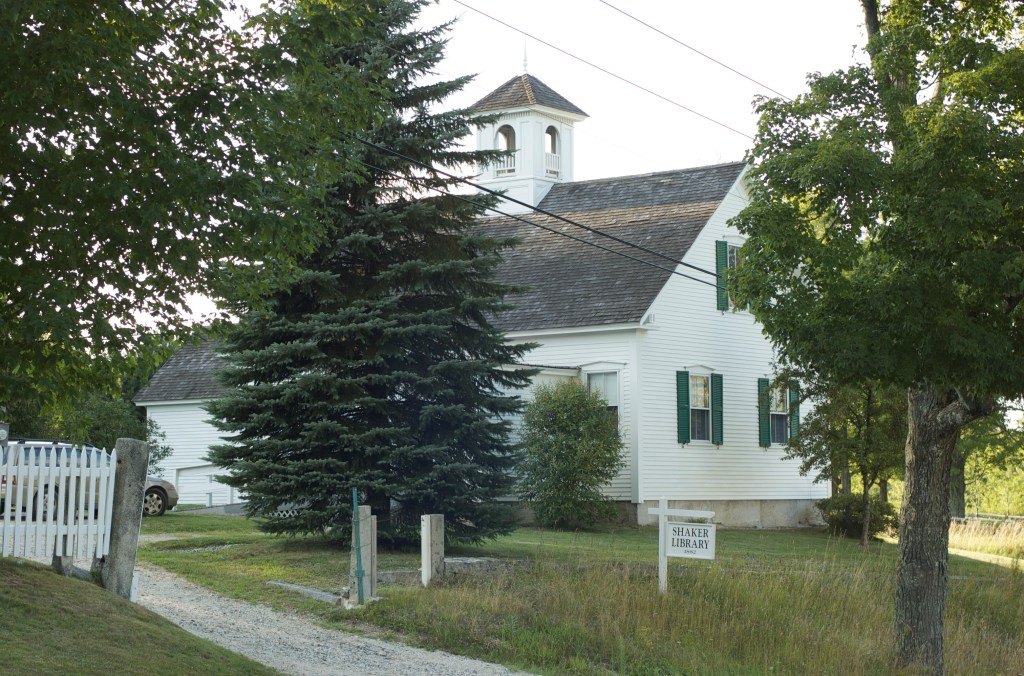
In real life, there are only two Shakers left in the US, Arnold Hadd and June Carpenter, who live in the Sabbathday Lake Shaker Community in Maine [pictured]. The idea of them living in nearby Woodbury is purely fictional. Of course, the reverend and the rabbi may just be teasing Taylor.

Florida

[Gypsy looks under the hood of Jackson’s truck]

GYPSY: Oh, goody, a trip to Florida!

Florida, previously mentioned several times, a state in the Southeastern region of the US, between Georgia and Alabama. It is the only US state which borders both the Gulf of Mexico and the Atlantic Ocean, and was the first state in the continental US to be permanently settled by Europeans – by the Spanish, in St. Augustine, in 1556.

The Spanish named it La Florida, because of its verdant greenery, and because it was discovered by Juan Ponce de Leon during the Easter season, or Pascua Florida (Festival of Flowers). Florida is the third most populous state in the US, and is a popular place for vacations, because of its warm climate, theme parks, and beaches.

“It’s all the way in Boston”

RORY: Yeah, but … it’s all the way in Boston.

LORELAI: I’ll drive you there if you want … Yeah, I’ll do some Boston shopping …

Boston is about two hours drive from the location of Stars Hollow, which is a significant journey, but never made to seem like a big deal in this episode. Lorelai and Rory would have spent four hours getting to and from a baby shower, but Lorelai makes it sound like a fun shopping trip. Mind you, this is the woman who drove to New York to go shopping, and drove home again without getting out of the car.

Brooke Shields

LORELAI: I once told a store my name was Squeegy Beckinheim just to see how many catalogs they would sell my name to, and apparently my name is to catalog companies what Brooke Shields’ picture is to Chinese restaurants.

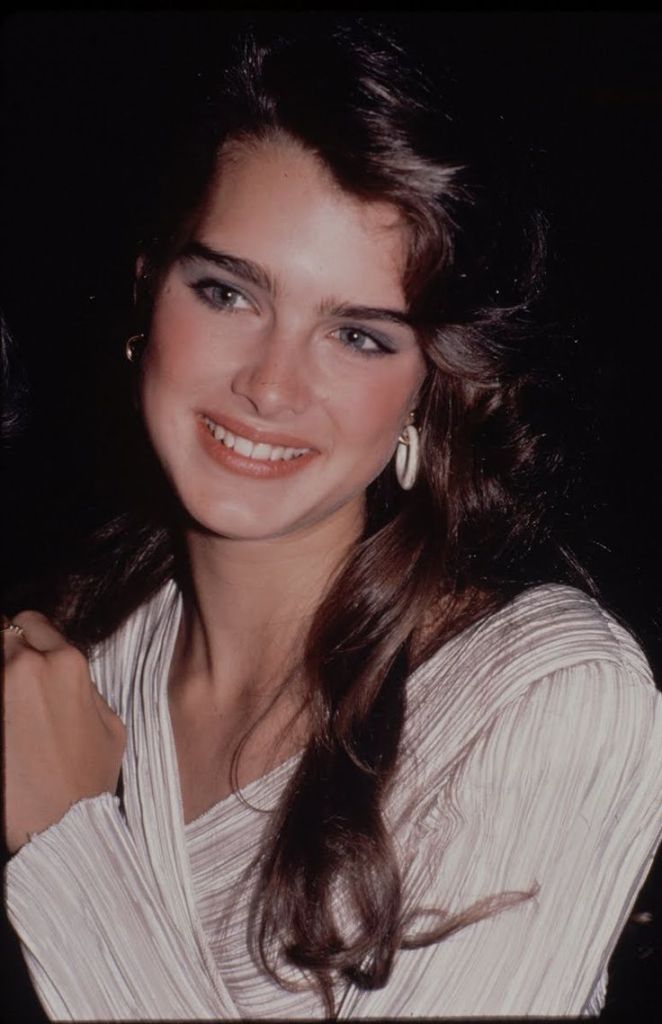
Brooke Shields (born 1965), actress and model. She began her career as a child model and gained critical acclaim at age 12 for her leading role as an underage prostitute in the film Pretty Baby (1978). She continued to model into her late teenage years and starred in several dramas in the 1980s, including The Blue Lagoon (1980), and Endless Love (1981).

She returned to acting in the 1990s and appeared in several films, as well as starring in the TV shows Suddenly Susan and Lipstick Jungle. She is currently a voice actor on animated TV show Mr Pickles, and its spinoff, Momma Named Me Sheriff.

Lorelai refers to the practice of restaurants putting up photos of their famous customers, and sometimes, famous people they wish were customers. Brooke Shields may have eaten at a lot of Chinese restaurants when she was young – she was brought up by a “bohemian” single mother, and like Lorelai and Rory, they often had Chinese food for dinner. Brooke Shields does have a regular Chinese restaurant – Mr Chow, which opened in Manhattan in 1979, and became an upscale hotspot in the 1980s. Her favourite Chinese food is chicken sticks and fried seaweed.