The “big kahuna” is an idiomatic phrase meaning “the boss, the leader, the head of an organisation, the big one”. It’s borrowed from Hawaiian, where the word kahuna means an expert in any field, but is often thought of as referring to a shaman or high priest.
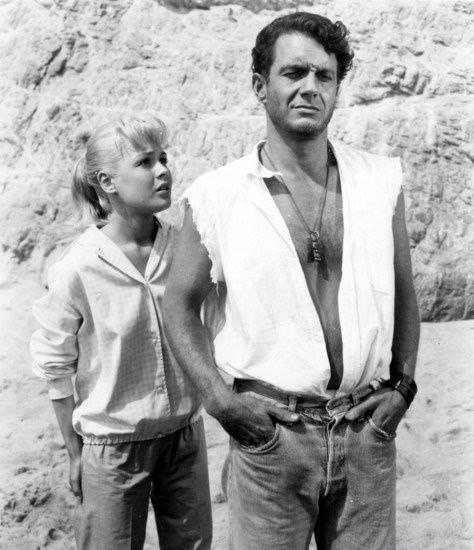
The term became known from the 1959 comedy film Gidget, in which “The Big Kahuna”, played by Cliff Robertson, was the leader of a group of surfers [pictured]. Beach party movies of the 1960s often used the term, such as Beach Blanket Bingo, where “The Big Kahuna” was the best surfer on the beach.
SOOKIE: So how are you planning on telling [your parents about Christopher]?
LORELAI: I thought I’d do it like Nell. You know, chicka chicka chickabee.
Lorelai refers to the 1994 drama film Nell, directed by British director Michael Apted, and starring Jodie Foster as Nell Kellty, a young woman who has to face people for the first time after being raised by her mother in an isolated cabin. It is based on the play Idioglossia by Mark Handler, inspired by his experiences living in the Cascade Mountains in the Pacific Northwest, and by identical twins Grace and Virginia Kennedy (born 1970), who invented their own language. Their story is told in the 1980 documentary Poto and Cabengo (the twins’ own names for themselves).
In the film, Nell likewise speaks her own language in a strange and unique accent. She says “Chicka chicka chickabee”, which is her way of saying “dear one, beloved” (a variation on chickadee and chickabiddy, both used as endearments in some regions of the US).
Nell was a commercial success and received mixed reviews, with Foster’s performance being warmly praised.
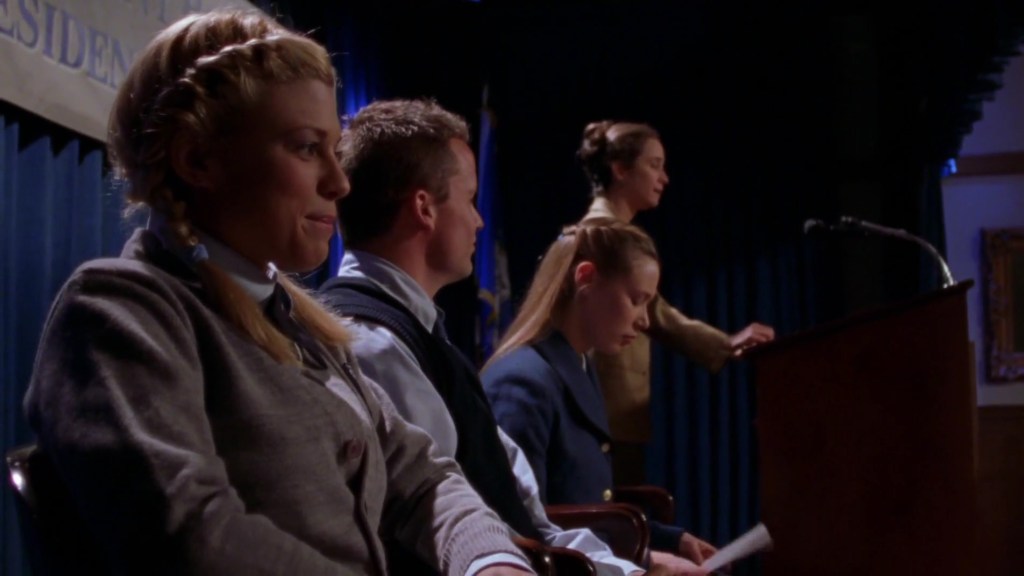
One of the candidates running against Paris is named Schatzi Leason. Schatzi is a German endearment meaning “dear one, treasure”, and is rarely given as a legal name. The male candidate is named Reese McGinly.
LORELAI: Huh. You know what I just realized? Oy is the funniest word in the entire world … I mean, think about it. You never hear the word oy and not smile. Impossible. Funny, funny word.
Oy, a Yiddish interjection expressing surprise and dismay. Often combined with vey, an interjection expressing distress or grief, to make oy vey (“oh no, woe is me”, more or less).
With the, a characteristic in Ashkenazi Jewish mode of speech in the US, meaning “in regard to, about, in the manner of”, generally in a disapproving tone to suggest that it’s too much or too often eg “You’re always with the jokes”, “Enough with the new house talk”.
Poodle, a curly-coated game dog which probably originated in Germany, first bred to retrieve wildfowl from water after hunting. It’s German name Pudel means “splash”, and it’s related to the English word puddle.
Already, a characteristic in Ashkenazi Jewish mode of speech in the US. At the end of a sentence, it expresses a frustrated impatience with a situation which should have been dealt with long ago eg “Will you two stop fighting and get a divorce already?”.
So Lorelai’s catchphrase means (roughly translated), “Oh no, there is a surfeit of poodles – this situation needs to be dealt with immediately, as it should have been rectified a long time ago!”.
Fans are divided as to whether Lorelai’s off-the-cuff catchphrase is actually funny. It’s certainly very Jewish.
LORELAI: Rory, I was supposed to graduate from high school. Go to Vassar. Marry a Yale man and get myself a proper nickname like Babe or Bunny or Shih Tzu.
A shih tzu is a breed of toy dog originating from Tibet. They have a short snout, large round eyes, long coat, floppy ears, and a playful, friendly disposition. Their name translates to “lion” in Mandarin, and the breed is considered sacred in Buddhist mythology.
LORELAI: So you’ve been just Nanooking it this whole time, just sending out for whale blubber and mukluks? [adjusts thermostat]
Nanook of the North [pictured], a 1922 silent film documentary/docudrama written, produced, and directed by Robert J. Flaherty. The film follows the struggles of an Inuk man named Nanook, his wife Nyla, and their family as they travel, trade and search for food in the Canadian Arctic. They are shown hunting a walrus, building an igloo, and going about their everyday tasks. Nanook and his family are portrayed as fearless heroes, enduring rigours beyond the comprehension of most Westerners.
The film has been criticised for fictionalising events and presenting them as reality. For example, “Nanook” was really named Allakariallak, and Nyla (aka Alice) was not his wife, but one of Flaherty’s common-law wives. The cast were scripted to behave in a more “authentic” Inuit way, such as using traditional hunting weapons rather than guns, and acting as if they had little knowledge of Western culture. Many things had to be staged, because of the difficulties of filming with one fixed camera in a harsh environment.
Nanook of the North was ground-breaking cinema, capturing authentic details of a culture that was then little known to outsiders, and filmed in a remote location. Hailed unanimously by critics, it was also a box-office success, and is still viewed as an enthralling documentary. As the first full-length feature documentary to achieve financial success, it paved the way for the entire genre. Nanook of the North was remastered and released on DVD in 1999, so Lorelai and Rory could have actually seen it.
Whale blubber is an important part of the traditional diet of Inuit people, valued for its high energy value, nutritional content, and availability. Mukluks are soft boots, traditionally made from caribou hide or sealskin, worn by the Indigenous people of the Arctic.
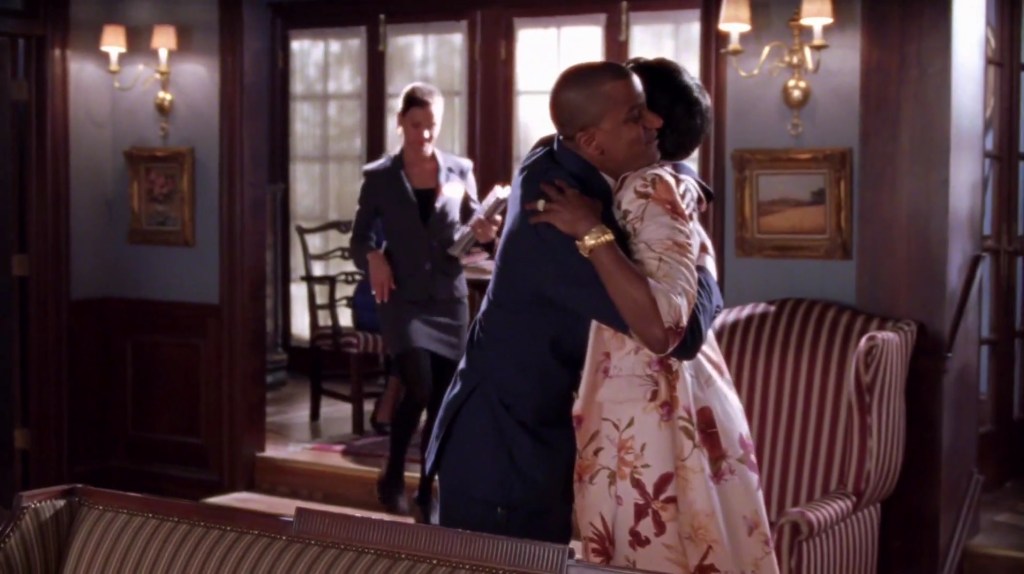
GISELLE: Ah! Mon dieu, you are gorgeous! Come, come! Embrassez maman!
MICHEL: Maman, j’aime ton visite.
Giselle says, “Ah! My God … Give Mom a hug!”.
Michel replies, “Mom, I love your visits”.
Giselle has apparently visited Michel several times before, but this seems to be the first time she has ever been to his workplace, as Lorelai and Sookie have never met her before. Michel was going to pick his mother up from the airport, but she came on an earlier flight so she could buy him presents, which seems to explain why she has turned up at the Independence Inn unannounced.
PARIS: Well, she’s all we’ve got so you need to do whatever it takes to make it happen, otherwise maybe you shouldn’t be the group leader.
LOUISE: A coup d’état, how exciting.
A coup d’état (French for “blow of state”), is the sudden violent overthrow of an existing government by a rival faction in an illegal seizure of power.
PARIS: It’s not the Bhagavad Gita, Madeline. It’s simple instructions for the business fair.
The Shrimad Bhagavad Gita, literally meaning “the song by God” in Sanskrit, often referred to as Bhagavad Gita, or just the Gita. It’s a 700-verse Hindu scripture that is part of the epic The Mahābhārata, dated to the first millennium BC.
It is the best known of the holy scriptures of Hinduism, presenting a synthesis of Hindu philosophy and yogic ideals. It was a personal inspiration to Mahatma Ghandi, and has been often read, studied, and appreciated by westerners and non-Hindus. Many Christians, Muslims, Buddhists, and atheists have read the Bhagavad Gita for spiritual advice and life lessons.
Madeline’s comment suggests that she isn’t stupid – just slow, thorough, and careful in how she absorbs information.







 The Annotated Gilmore Girls