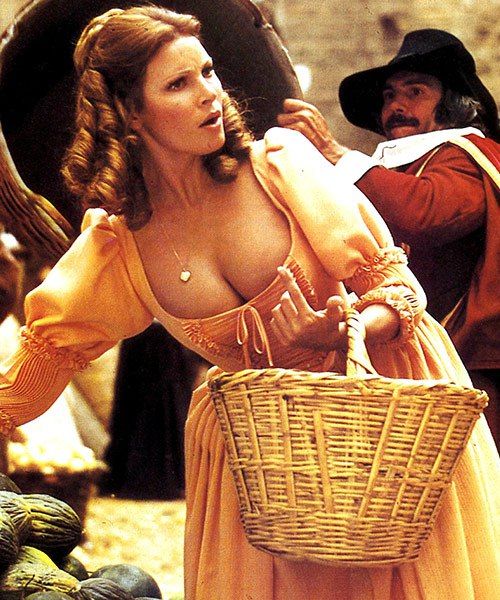
“They get all the sex”

LOUISE: I’ll be the lady-in-waiting. The one with the low-cut blue velvet Renaissance dress.
PARIS: Lady-in-waiting is not a political office.
LOUISE: No, but they get all the sex.
PARIS: What?
LOUISE: Watch a movie.

In period films, it is fairly common to have the lady-in-waiting be the “sexy” figure, as compared to the noble, romantic, or dull queen or princess she is companion to. A classic example is Racquel Welch in The Three Musketeers (1973); she plays the lady-in-waiting Constance, and all her gowns are low-cut to display her assets [pictured].

Louise seems to be thinking of a specific lady-in-waiting in a blue velvet dress, but I don’t know which one. The period film Elizabeth came out in 1998, based on the early reign of Elizabeth I; as they are studying her in Government that would seem the most likely candidate. However, there is no dress such as Louise describes, and although one of the ladies-in-waiting does have sex because of a particular dress, it ends in tragedy for her.

Henry VIII

RORY: Henry VIII started a new church when the old one wouldn’t allow divorce.
PARIS: He also cut off his wife’s head. Is he still your role model?

King Henry VIII, the father of Elizabeth I, and earlier mentioned. He initiated the English Reformation, which separated the Church of England from the pope’s authority. Rory isn’t quite right that he started a new church – the Church of England already existed, but was originally under Rome – but she is generally correct about the reason.

Henry VIII tried to have his marriage to his first wife, Catherine of Aragon, annulled by the pope, and when that didn’t work he took control of the church himself to annul his own marriage. It wasn’t technically a divorce – their marriage was declared null and void in 1533, and from then on Catherine was regarded as the widow of Henry’s older brother Arthur, her first husband.

His second wife was Anne Boleyn (c1509-1536), who was the mother of Elizabeth I. They were married in 1532, and he had her executed by beheading in 1536. She was charged with treason, adultery, and incest, but the evidence against her was unconvincing. Her main “crime” was probably failing to produce a son, as apart from Elizabeth, her other pregnancies ended in miscarriage.

Elizabethan government

PARIS: I think that the basic structure of the Elizabethan government is relatively sound. The division of power between the monarchy, the privy council, and the parliament all seem to work.

Elizabethan government was that in England under the reign of Queen Elizabeth I (reigned 1558-1603). Her government was extremely structured and complex, and made up of:

The Monarch – Queen Elizabeth herself, who ruled by divine right. She is generally regarded as one of England’s best monarchs, which is probably why Paris thinks her government would be the best to emulate.

The Privy Council – the queen’s advisors. They gave advice to the queen, but she could rule against them if she preferred. They handled routine administration.

Parliament – was made up of the House of Lords (nobility and upper level clergy) and The House of Commons (ordinary people who were elected to their position). Unlike today, it had very little power, and was mostly there to handle the financial side of things, such as taxes.

Local government – very important in Elizabethan times. Counties, cities, and towns all had their own governments to deal with issues on a local level, while the nobility ran their own manors.

Courts – the justice system was made up of a number of courts, all dealing with different types of crimes, from the most serious offences to petty matters. The wealthy and the poor had different court systems to try them, and there were separate courts for financial and religious issues.

“Grumpy McFarland”

RORY: Grandpa says I remind him of her [Richard’s mother].
LORELAI: That is the biggest compliment that can be wrenched out of Grumpy McFarland, believe me.

I think Lorelai is making a play on Spanky McFarland, one of the characters from the Little Rascals movies, earlier discussed. He was played by George McFarland, and in the earliest movies when he just a toddler, did have a rather grumpy demeanour.

“So tell me more about her”

RORY: So tell me more about her [her great-grandmother] …
LORELAI: Well, let’s see. She moved to London when Grandpa died but she didn’t like to travel, so once a year Mom and Dad would go to visit her, usually leaving me behind, much to my relief by the way, and that’s it.

We don’t know when Richard’s father died, but it was clearly a long time ago, possibly before Lorelai was born. It seems strange that someone who doesn’t like to travel would move overseas to live.

Richard and Emily said they can only afford to go to Europe every two years, but Lorelai says they saw Richard’s mother in London every year. Maybe they used to have more money when Lorelai was a child, or prices were cheaper? Because Lorelai says they “usually” left her behind, it means that she must have been to London with her parents at least once.

As her grandmother is the only one who can seemingly control Lorelai and scare her into uncharacteristically meek behaviour, it makes the viewer wonder if Lorelai would have gone off the rails as a teenager if Richard’s mother hadn’t moved to London. I suspect not, and Gilmore Girls would never have happened.

David Mamet

EMILY: I have to get out everything she’s [Richard’s mother] ever given us. Thirty-five years worth of fish lamps and dog statues, lion tables, and stupid naked angels with their … butts!
LORELAI: Whoa! Stupid naked angel butts? What, did David Mamet just stop by?

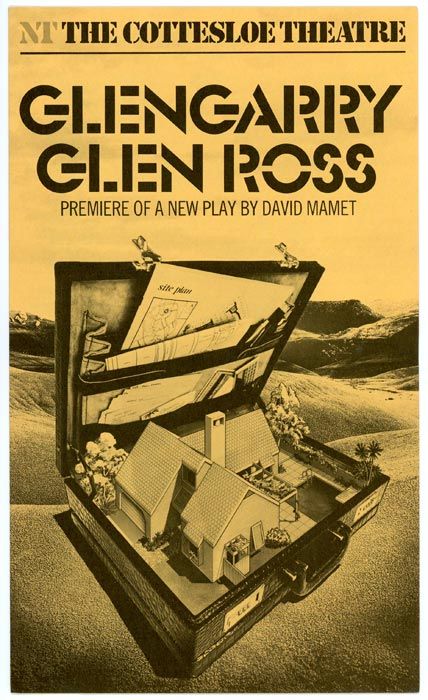
Lorelai is probably referring to David Mamet’s 1983 play Glengarry Glen Ross. It shows two days in the lives of four Chicago real estate agents prepared to do anything, no matter how illegal or unethical, to sell some undesirable real estate. It won the 1984 Pulitzer Prize, and in 1992 was made into into a highly-acclaimed film, with the screenplay written by Mamet.

The play is notorious for its use of profanity, and Lorelai is teasing her mother for her uncharacteristic use of the word “butts”. Maybe the butt model conversation affected her.

David Mamet is one of Amy Sherman-Palladino’s own favourite playwrights.

Emily’s statement suggests that she and Richard have been married for thirty-five years, so since 1965-1966.

Madonna

LORELAI: I still can’t get over that I’m related to God. It’s gonna make getting Madonna tickets so much easier.

Madonna (born Madonna Ciccone in 1958) is an American singer, songwriter, actress, and businesswoman. Regarded as the first multi-media pop icon, she is is known as the Queen of Pop. Her debut album was released in 1983 to immediate success, and was followed by several best-selling albums; her 1998 album Ray of Light won Best Pop Album at the Grammys. Many of her songs have gone to #1 in the charts, including Like a Virgin, Papa Don’t Preach, Like a Prayer, and Vogue. She is the best-selling female recording artist of all time, and in the US is second only to Barbra Streisand. She is the most successful solo act of all time, and the highest-grossing solo touring artist of all time. She was inducted into the Rock and Roll Hall of Fame in 2008.

This is the third time that Lorelai has mentioned Madonna, and I think it is safe to assume that she is one of her favourite singers, especially as Madonna first became a star when Lorelai was a teenager.

Madonna had her Drowned World Tour tour in 2001; she was due to appear in New York at Madison Square Garden during July 25-31 that year. Lorelai’s comment suggests that she may have been trying to obtain tickets to the event. Gilmore Girls episodes didn’t cover this period of the year, so it’s possible that Lorelai and Rory did make it to the concert.