The Lost Weekend

LORELAI: I thought he [Rune] was only here for a weekend.
SOOKIE: Yes, the lost weekend.

The Lost Weekend is a 1945 drama film directed by Billy Wilder, and based on the best-selling 1944 novel of the same name by Charles R. Jackson. It stars Ray Milland as an alcoholic writer, and Jane Wyman as his long-suffering girlfriend, and the “lost weekend” is a weekend vacation the writer planned to take, which turned into him losing himself in drink, and even being committed to Bellevue.

The Lost Weekend was the #11 film of 1945 and won four Academy Awards, including Best Picture, Best Director, and a Best Actor for Ray Milland. It also won the Grand Prix at the 1946 Cannes Film Festival, with Milland picking up another Best Actor Award; it is one of only two films to win the highest award at both the Academy Awards and the Cannes Film Festival.

Sookie doesn’t mean that Rune is an alcoholic; just that he was meant to stay with Jackson for a single weekend, but that weekend is long “lost” as he still hasn’t left some three months later.

Ichiro Motors

This is the Japanese business whose employees are staying at the Independence Inn in Stars Hollow for a conference in this episode.

It is a fictional motor manufacturing company which may have been named after Ichiro Suzuki (born 1937), the Japanese engineer who worked for Toyota and designed the first Lexus, as not only was he involved in the car industry, but his surname is that of a Japanese motor manufacturer.

“The Armbrusters”

LORELAI: God, where is this [inn] again?
RACHEL: Uh, it’s kind of behind the mill. You go over the little footbridge with the mean duck family living under it.
LORELAI: Yes, the Armbrusters.

Lorelai seems to have made a name up for the “mean duck family” under the bridge. Armbruster is a German surname meaning “crossbow”, but in English it sounds a little like “arm bruiser”, which might be what Lorelai is thinking of.

Sears

RACHEL: See, I might consider doing the whole mom thing if I could be guaranteed that I could get one just like her [Rory].
LORELAI: Oh you can, you just have to go to Sears.

Sears, Roebuck and Company, usually just known as Sears, is an American chain of department stores founded by Richard Sears and Alvah Roebuck in 1892. Originally based at the Sears Tower in Chicago, it began as a mail order company and opened its first retail store in 1925. It was the largest retailer in the US until it was overtaken by Walmart in 1989, and merged with Kmart in 2005.

If Rachel had wanted to go to Sears, there is a store in Manchester, Connecticut, just a few minutes drive north of Hartford.

911

RORY: Oh, I’m buzzing. [Takes her pager out of her pocket] … It’s Lane. 911. That’s trig. Gotta go.

As commonly known from movies and television, 911 is the emergency phone number in the US. Trigonometry is obviously Lane’s worst subject at school, so when she pages Rory 911, it means she desperately needs help with her Trig homework.

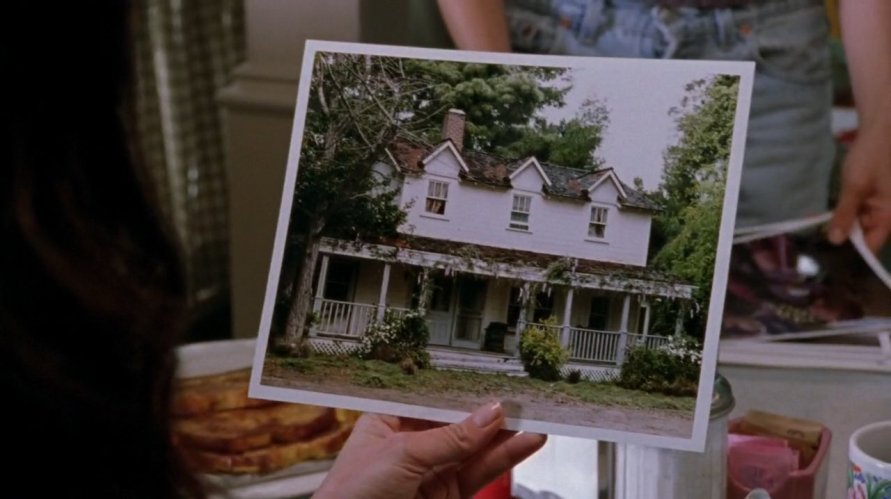
“Old abandoned inn”

LORELAI: What is that?
RACHEL: It’s an old abandoned inn I ran across when I was exploring the other day.
LORELAI: This is the Dragonfly. I totally forgot about this place.
RACHEL: Well, it doesn’t look like it’s been operational in years.

Apparently when a business hasn’t been open for many years, you just forget that the building it was in exists … even when your goal is to open your own inn one day. Good thing Rachel came to Stars Hollow to remind Lorelai it’s still there! It’s amazing how many coincidences surround this woman.

“Do you wear contacts?”

RACHEL: Do you wear contacts?
LORELAI: Me? No.
RACHEL: God, you’ve got amazing eyes.

In the Pilot, Lorelai complained that she felt as if she’d put her contact lenses in backwards, so she does actually wear contacts, and there are numerous references to her wearing either glasses or contacts throughout the series. Maybe Lorelai assumed Rachel meant coloured contact lenses, thinking her eyes were too blue to be natural (and her assumption may have been correct, as wearing normal contacts doesn’t give the wearer “amazing eyes”, just improved vision).

Biedermeier Hutch

EMILY: I made the mistake of telling Peg all my favourite special spots, and that woman moved in and completely wiped them out. You can’t find a decent Biedermeier hutch in all of Connecticut.

Beidermeier was a style of central European furniture design which lasted from 1815 to 1848. It had an emphasis on utilitarian clean lines and lack of ornamentation, and was influenced by the Georgian style from Britain. Beidermeier furniture is typically made from locally sourced wood, such as oak, ash, or cherry, rather than exotic imports.

Vienna was the centre of Beidermeier design, but it was popular among the middle classes in German-speaking countries and Scandinavia. Sometimes American furniture made by German immigrants in the Beidermeier style is also sold as “Beidermeier” – often cheaper than furniture imported from Austria or Germany.

Hutch is an American term for a type of furniture. Usually it describes shelving or cabinets on top of a lower unit that has a counter top, and either drawers or cabinets. A typical example would be the sort of sideboard cabinets used to display china or glassware.

A large European-made Beidermeier hutch might cost more than $1000 today, although a smaller piece could be around $500.

“Lured these two German children”

EMILY: I’ve combed every fine antique store on the East Coast and this is all I could find. I blame Peg Mosley.
LORELAI: Hm, Peg Mosley. Evil, evil woman.
RORY: What did Peg Mosley do?
LORELAI: She lured these two German children to her gingerbread house, and then she tried to eat them.

Lorelai is referring to the well known German fairy tale Hansel and Gretel, which was first published by the Brothers Grimm in 1812. In the story, two children named Hansel and Gretel are abandoned by their parents in the woods, and make their way to a witch’s house. As it is made of gingerbread, they cannot resist eating it, but the witch has a plan to eat Hansel and make Gretel her slave.

Lorelai is making fun of her mother’s rivalry with Peg Mosely by suggesting that any stories she has about Peg are greatly exaggerated.

Maine

RORY: Are these new chairs, Grandma?
EMILY: Why, yes Rory, they are … I got them from a dealer up in Maine last summer. He just finished restoring them.

Maine is the most northerly state in New England, sharing its northern border with Canada. It is well known for its many antique shops, mostly catering to summer tourists. Richard and Emily spend their summers on Martha’s Vineyard off the coast of Maine, so perhaps she bought the chairs on the island itself, or from one of the many antique stores on Cape Cod.