Louise – a lipstick tracking device (rejected as not unisex enough)
Madeline – locker robot to help with homework and carry stuff (rejected as too complex)
Paris – flashy locker first aid kits
Richard says that he loves Paris’ idea, and Rory, as group leader, immediately accepts it as the product they are running with. We never get to hear Brad and Chip’s ideas, which seems rather unfair. Neither of them protest though. Probably because they’re too frightened of Paris.
PARIS: I’m sorry, group leader, could you ask the Pigeon sisters if there is a point to this opus?
The Pigeon sisters are characters from the film The Odd Couple, previously mentioned. They are English sisters named Cecily and Gwendolyn Pigeon who live in the same building as Felix and Oscar. They were played by cousins Monica Evans and Carole Shelley in the original Broadway play, the film, and the 1970 sit-com, although their roles were gradually phased out in the television show.
The Pigeon sisters are friendly, flirtatious, ditzy, and as their name suggests, slightly bird-brained, rather like Louise and Madeline. Paris has no problem tearing down her friends in public; no wonder that Rory isn’t sure whether Paris is her friend or not.
An opus is an artistic work, especially one on a grand scale.
LoJack is a recovery system for stolen cars that uses GPS to locate vehicles, notifying police of its location and allowing recovery in less than half an hour. The LoJack system was created and patented in 1979 by William Reagan, a former police commissioner. Its name is meant to be the opposite of hijack.
Although we haven’t developed a LoJack system for lipsticks, there are now similar systems in place to find computers, laptops, and phones, and even lost car keys can give off a sound to alert the owner to their position, so Louise’s idea was ahead of its time.
PARIS: We dress up the kits with sparkles, colors, pictures of bands. Sport themes for the boys, animal pictures for the puppy and unicorn bunch, chess boards for the Bobby Fischer freaks …
Robert “Bobby” Fischer (1943-2008), American chess grandmaster and the eleventh World Chess Champion. He was a chess prodigy, winning the 1958 US Championship at the age of 14. He withdrew from the public eye in 1975, with reports of increasingly erratic behaviour through the years.
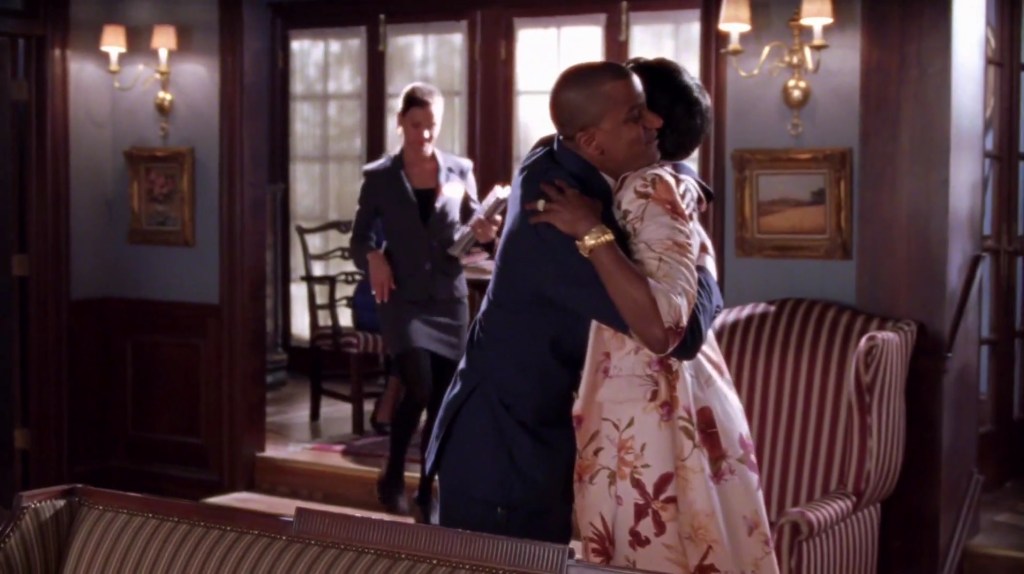
GISELLE: Ah! Mon dieu, you are gorgeous! Come, come! Embrassez maman!
MICHEL: Maman, j’aime ton visite.
Giselle says, “Ah! My God … Give Mom a hug!”.
Michel replies, “Mom, I love your visits”.
Giselle has apparently visited Michel several times before, but this seems to be the first time she has ever been to his workplace, as Lorelai and Sookie have never met her before. Michel was going to pick his mother up from the airport, but she came on an earlier flight so she could buy him presents, which seems to explain why she has turned up at the Independence Inn unannounced.
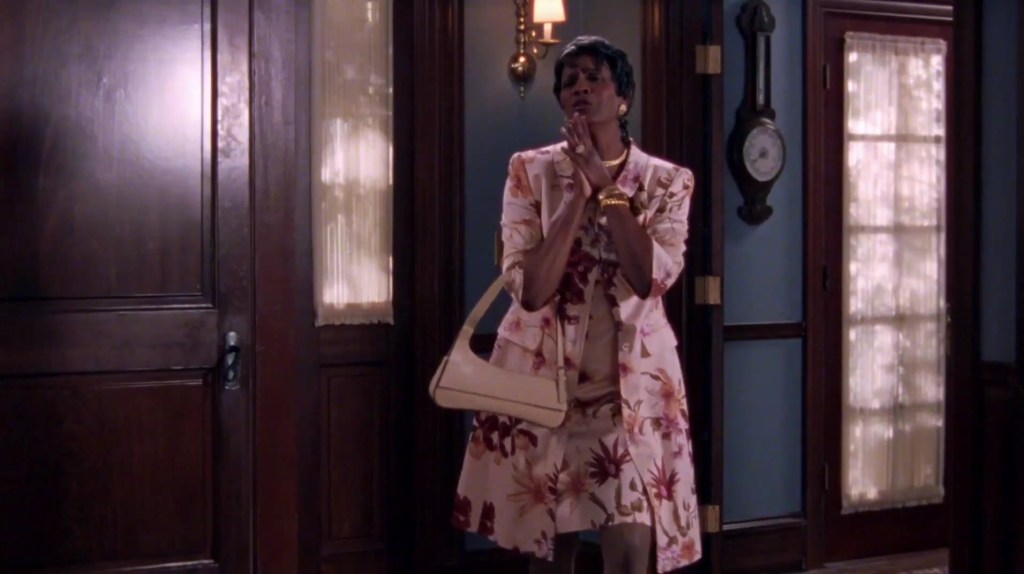
In this episode we meet Michel’s mother, Giselle, who is visiting from Paris. She and Michel adore each other, and are “best friends” mother and son, who love to tease and joke with each other, using a banter that sounds like something out of a Noel Coward play.
This makes them seem quite similar to Lorelai and Rory, who are also self-proclaimed “best friends” with a comic patter between them. Janet Hubert is only fourteen years older than Yanic Truesale, suggesting she is supposed to be a very young glamorous mother like Lorelai.
Michel addresses his mother by her first name at one point, and you can hear the French pronunciation of it – ZEE-ZEHL. Giselle may have possibly been named with the French ballet Giselle in mind, one of the world’s most popular classical ballets.
RORY: So, have a good game. Do that pointing to the outfield thing, that’s always very popular.
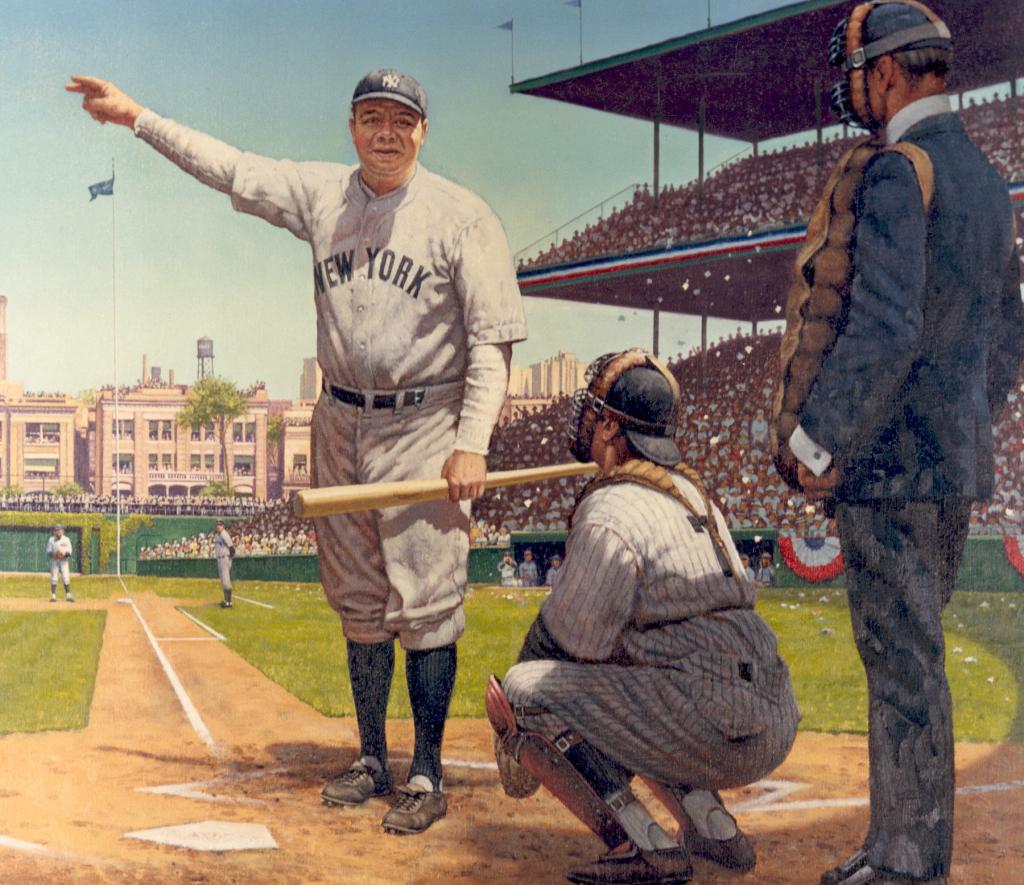
Rory is referring to a famous incident in baseball history, when Babe Ruth pointed towards the outfield before hitting a home run, in the fifth inning of Game 3 of the 1932 World Series, held on October 1 at Wrigley Field, Chicago.
His gesture looked as if it was promising a home run, but initially Ruth said he was simply pointing at the dugout to remind them he had one more strike. It’s also been suggested he was actually thumbing his nose at the opposing team.
Once the story hits the papers, the media-savvy Ruth went along with it. Over the years, his story became more embellished, until he was planning the home run before the game even started, while talking with his wife.
Whatever the truth, it soon became an established baseball legend, and part of American popular culture.
[Picture is the 1976 painting The Mighty Babe by Robert Thom, depicting the “called shot”]
RORY: But if I’m doing my [Philosophy] homework, doesn’t that defeat the point of going to see you play?
DEAN: You can’t glance up in between nihilistic theories?
Nihilism is a philosophy that rejects fundamental aspects of human existence, such as truth, knowledge, morality, values, or meaning. Different nihilist positions hold variously that human values are baseless, that life is meaningless, and that knowledge is impossible. It often takes on a despairing tone.
Another reminder that Dean isn’t as stupid as the writers often make him look, he at least knows the word nihilism. It does seem a little disparaging towards Rory’s studies though, with the subtle implication that her homework is meaningless. He may be feeling a little despairing himself by this stage.
Instead of going to watch Dean’s game, Rory is shoe shopping with Lane. And afterwards, she has Philosophy homework to do (a new subject for Rory). Dean pleads with her to at least bring her homework to the game, which sounds like a terrible idea, and is. Rory reminds him they’re seeing each other that evening, and that’s all the Dean she feels like seeing that day.
It actually seems more healthy that Rory is making time for friends, and school, and Dean in her life, but both Dean and the viewer can feel that Rory is losing interest in him.







 The Annotated Gilmore Girls