MIA: He [Luke] would help people carry groceries home. RORY: Oh, how very Boy Scout-y of you. MIA: For a quarter a bag. LORELAI: Oh, how very John Birch Society-y of you.
The John Birch Society is an ultraconservative, radical far-right political advocacy group. It was founded in 1958 by businessman Robert W. Welch Jnr (1899-1985), who saw it as a way to oppose Communism. Welch owned the Oxford Candy Company in Brooklyn, so maybe he was just on a major sugar high, but he denounced nearly everyone as a Communist agent, including former presidents Truman and Eisenhower.
The society is named in honour of Baptist missionary John Birch (1918-1945), a US military intelligence captain in China who was killed in a confrontation with Chinese Communist soldiers, ten days after the end of World War II. He was posthumously awarded the Army Distinguished Service Medal. Welch saw Birch as the first casualty of the Cold War.
The John Birch Society has had a resurgence with the election of Donald Trump, previously discussed, and its previously fringe views have now become mainstream in right-wing politics.
JESS: Huh. LUKE: That’s ‘Hello, nice to meet you’ in slacker.
“Slacker” is a term for someone who habitually avoids work or effort (Jess actually works at the diner before and after school every day, so can hardly be considered a literal slacker).
The phrase gained a renewed popularity following its use in the 1985 film Back to the Future, when Marty McFly and his father are referred to as slackers (and a group of teen delinquents in Back to the Future II, 1989). The 1990 comedy film Slacker, directed by Richard Linklater, about a group of twenty-something bohemians and misfits, gave it wider circulation. The 1996 comedy Clerks, directed by Kevin Smith, is regarded as the ultimate slacker cult film.
Subsequently, during the 1990s it became widely used to refer to a subculture of apathetic youth who were uninterested in political or social causes, a stereotype of Generation X. It often has connotations of an educated underachiever, or someone who is aimless in life, sometimes for philosophical or nonconformist reasons. This seems to be what Luke has in mind.
LORELAI: So, Mia, how’s living in Santa Barbara? MIA: Horrible. Did you know the damn sun shines all the time out there? RORY: They’ve written songs about that.
Santa Barbara is a coastal city in California about ninety miles north of Los Angeles. Situated on the Pacific Ocean with a dry sunny Mediterranean climate, it is promoted as “The American Riviera”. Due to its geographic positioning, it has both cooler summers and warmer winters than surrounding areas, and despite what Mia says, it tends to be wetter in winter than its surrounds too, although rainfall is very variable.
It’s the sort of expensive place that wealthy people retire to, suggesting that Mia has done very well out of the hotel industry. Is it really possible she got that rich just from the Independence Inn? Surely she has other properties or investments as well? Maybe she’s a wealthy widow?
People in Stars Hollow seem to be strangely attracted to distant California. Christopher and Liz ran away to California to start new lives, Fran went on holiday there, Mia retired there. The writers live there, the show’s filmed there …
I’m not aware of any famous songs about the sunshine of Santa Barbara specifically that Rory might be thinking of, but there’s several songs about California.
MIA: Nice to see you, Lucas. LUKE: You’re the only person in the world who can call me that, Mia.
We now discover that Luke’s name is actually Lucas, and Luke is his nickname. Even Lorelai didn’t know that before. It seems like a definite Star Wars reference, with the film featuring a hero named Luke Skywalker, written and directed by George Lucas (who appears to have been inspired by his own name for Luke S, get it? – both were raised in the desert, and have several other parallels, which George Lucas has admitted).
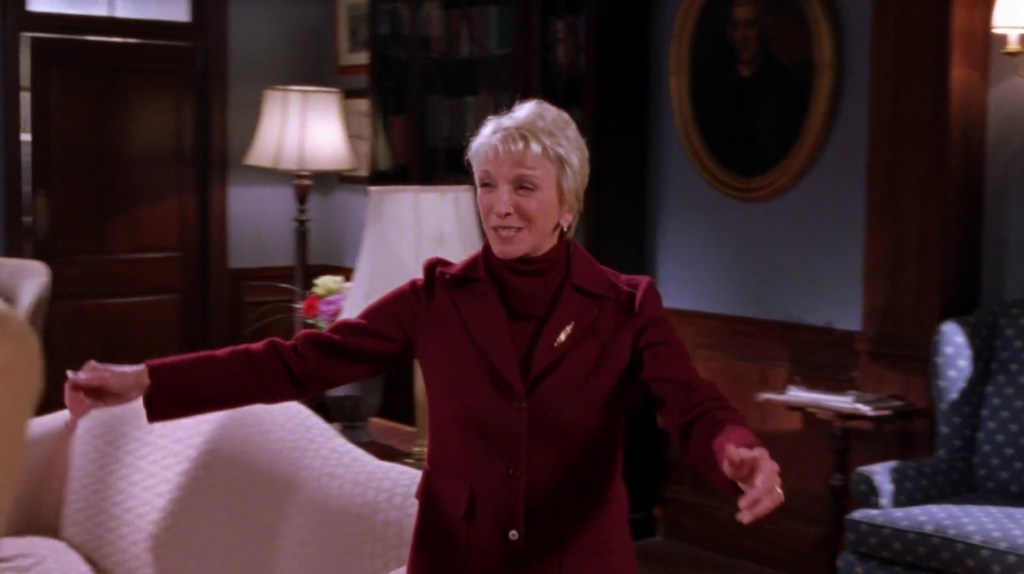
In this episode, we meet Mia Halloway, the never-before-seen-or-heard-about owner of the Independence Inn, and therefore Lorelai, Sookie, and Michel’s boss. Her unannounced appearance leads to a certain amount of flustered rushing about, but Mia hasn’t come to inspect them – this is more of a social visit.
Mia is cast in the role of fairy godmother and kindly innkeeper, the woman who rescued Lorelai and Rory when they ran away from Richard and Emily’s house. It is clear that the Gilmore girls love her, and see her as a substitute mother/grandmother. They seem much closer to her than they are to Emily, their actual mother/grandmother, and feel freer in the way they express themselves and joke around. Mia conveniently faded out of the picture before Lorelai and Rory became a regular part of Emily’s life again … there would probably have been some friction otherwise.
We’re meant to see Mia as a sort of fantasy mother figure (Mama Mia!), with all the loving fun stuff, and none of the difficult painful stuff attached. The trouble is, I can’t help thinking that this is the woman who put teenaged Lorelai and her baby to live in the potting shed, when we now know they arrived in the depths of autumn, already very cold in Connecticut!
I think the issue is that the scriptwriters (including Amy Sherman-Palladino) wrote the potting shed as some quaint, adorable little wooden cottage with rosebud wallpaper and curtains at the window, and the scenery people produced … well, a pretty standard corrugated metal garden shed, not possible to put wallpaper on, and obviously utterly freezing in winter, particularly at night (and very hot in summer).
It seems more like something the wicked stepmother would have come up with for Cinderella, not the fairy godmother. Another issue is that Gilmore Girls appears to be set in a fantasy TV Connecticut where it never gets any colder than southern California.
We only learn that Mia’s surname is Halloway from the credits. Given the time of year Lorelai and Rory first arrived in Stars Hollow, the connection with Halloween is made very clear, as if Mia herself is the embodiment of supernatural forces bringing them to their correct destination.
A fun connection is that actress Elizabeth Franz was born in Akron, Ohio, the same place Richard Gilmore is sent to for work in this episode.
SOOKIE: That woman [Fran] is gonna live forever. LORELAI: Not necessarily. Hey, did you look up angina? I forgot to. SOOKIE: Yeah, it’s nothing major.
Why would Lorelai need to look up angina? Her own father has it! Is she so selfish she’s just forgotten about that, or never bothered to find out what angina is? Or did the writer (Daniel Palladino) simply ignore the events of Forgiveness and Stuff (written by John Stephens)?
Sookie isn’t really correct that angina is “nothing major”. It doubles the risk of a cardiovascular event, and that risk rises with increasing age. For an elderly person, it can be of serious concern, and in fact Fran does die from a heart attack in a future season. Richard Gilmore also has a heart attack later on, and eventually dies too.
POLICEWOMAN: Everyone’s accounted for Taylor. It looks like this is just an elaborate prank. TAYLOR: But it looks so real. Where’d they get the police tape? POLICEWOMAN: Kids have their ways.
TAYLOR: Who’d be depraved enough to pull a stupid prank like this? POLICEWOMAN: Hard to say. [Rory sees Jess standing across the street smirking as he watches the crowd]
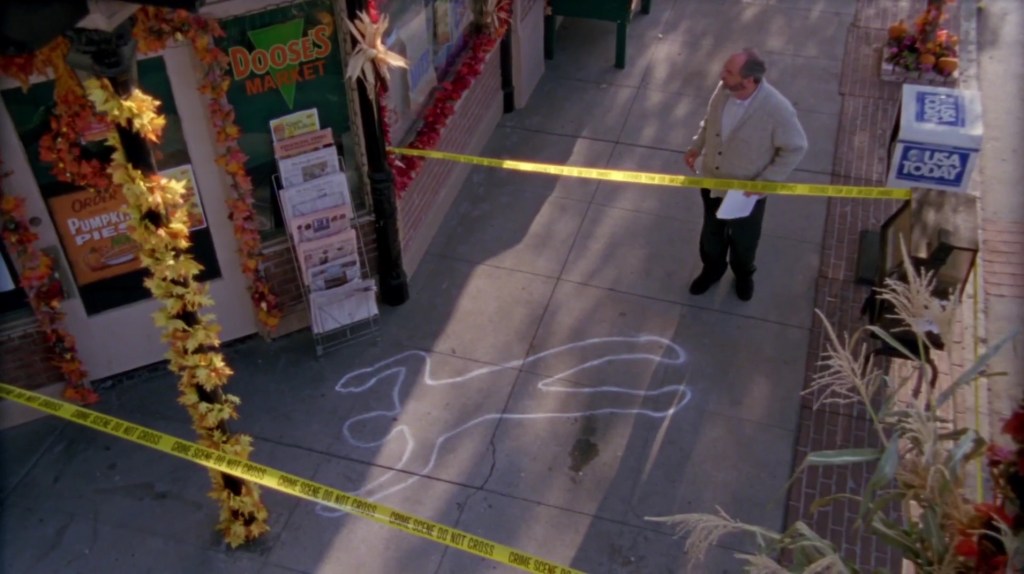
The police officer reassures Taylor that the chalk outline and police tape is just a prank. Somehow, she knows that a child or teenager is responsible. To be fair, Rory also knows – Jess isn’t exactly being subtle here. The police officer seems to be remarkably blasé about someone stealing police tape from the police station. The bizarre way the police behave makes me think that they were in on the prank with Jess, either overtly or tacitly. It’s actually the only way this scene makes any sense.
Once again, one of Jess’ pranks is connected with Rory – it takes place outside the grocery store where her boyfriend works, at a time when he’s doing a shift, so that there’s a good chance of her seeing it. It seems to be a calculated move to get her attention and show off to her, as well as encroaching on her boyfriend’s territory.
In line with the autumnal colours of this episode, Jess wears a dark red tee shirt – Dean is also wearing a red sweater in a bright tone, as if Dean and Jess are the light and dark attractants for Rory (or the public and the private). Red is love and passion, but also aggression and danger, like a red rag to a bull. Both Jess and Dean wear grey sleeveless jackets over their red tops, as if in partial concealment of their feelings. There is nothing on their sleeves – yet.
Jess’s top is a vintage 1980s tee shirt with a Tasman Empire Airways Ltd logo on it – the former name of New Zealand’s flag carrier airline (since 1965, Air New Zealand Ltd). The show keeps connecting Jess with travel, journeys, and flight.
The fire truck going past is also bright red; in fact notice how many things in this scene bear the colour red. It’s a callback to when Rachel was telling Lorelai about her distress in discovering Luke’s romantic preference for Lorelai with the fire department in the background. It’s another painful love triangle situation marked with sinful scarlet, bloody red.
The poster in the background announces another Autumn Festival, nearing the anniversary of Rory and Dean’s first kiss. This suggests that the date is Tuesday 30th October, the day before Halloween. Yes, I know it looks bright and sunny, but that’s because we’re in TV Land, not the real Connecticut!
Does the big number 7 on the fire truck mean that Jess is blessed with luck in his endeavour? Or does it represent the seven days of the week, and the great wheel of time?. It might be a sign that Jess’ time has come. So much can change in just one year.
NOTE: Thank you to reader M for pointing out that the red vehicle is a fire truck or fire engine, not a bus as I incorrectly stated!
POLICEWOMAN: Look, my partner’s doing a headcount to see if anyone in town is missing. Until then, just hang tight.
Stars Hollow supposedly has over 9000 residents – how could one police officer do an entire head count of the town in just a few minutes? And even then, everyone in town being accounted for wouldn’t prove anything. A missing person could be from somewhere else.
When Rory and Lane walk past Doose’s Market, there is a chalk outline of a person’s body drawn on the pavement outside the store, marked off with police tape. A crowd has gathered, and Taylor is having a fit, being calmed down by a local policewoman.
What the police officer should have told him is that a chalk outline to show where somebody has died is a trope which mostly exists in film and television (first shown in a 1958 episode of Perry Mason). In real life, police don’t usually draw a chalk outline to mark the place where someone was killed. The trope goes back to the days when police did so – not for the public, but to give crime reporters something they could photograph without showing an actual dead person.
She could have at least told Taylor that, in universe, the police did not draw the chalk outline!
RORY: Yikes. What kind of vibe are you giving her? LANE: Oh, my patented Keith Richards circa 1969 ‘don’t mess with me’ vibe, with a thousand-yard Asian stare thrown in.
The thousand-yard stare is a phrase often used to describe the blank, unfocused gaze of soldiers during wartime who no longer react to the horror they’re living through. More generally, it can apply to any victim of trauma.
The phrase was popularised during World War II after Life magazine published a 1944 painting by Tom Lea, titled The Marines Call It That 2000-Yard Stare [pictured], but became especially known during the Vietnam War, when it decreased to a slimmer, punchier 1000-yard stare.
Lane dramatically compares her life being brought up in a traditional Asian-American household as akin to that of someone with PTSD on a battlefield.







 The Annotated Gilmore Girls