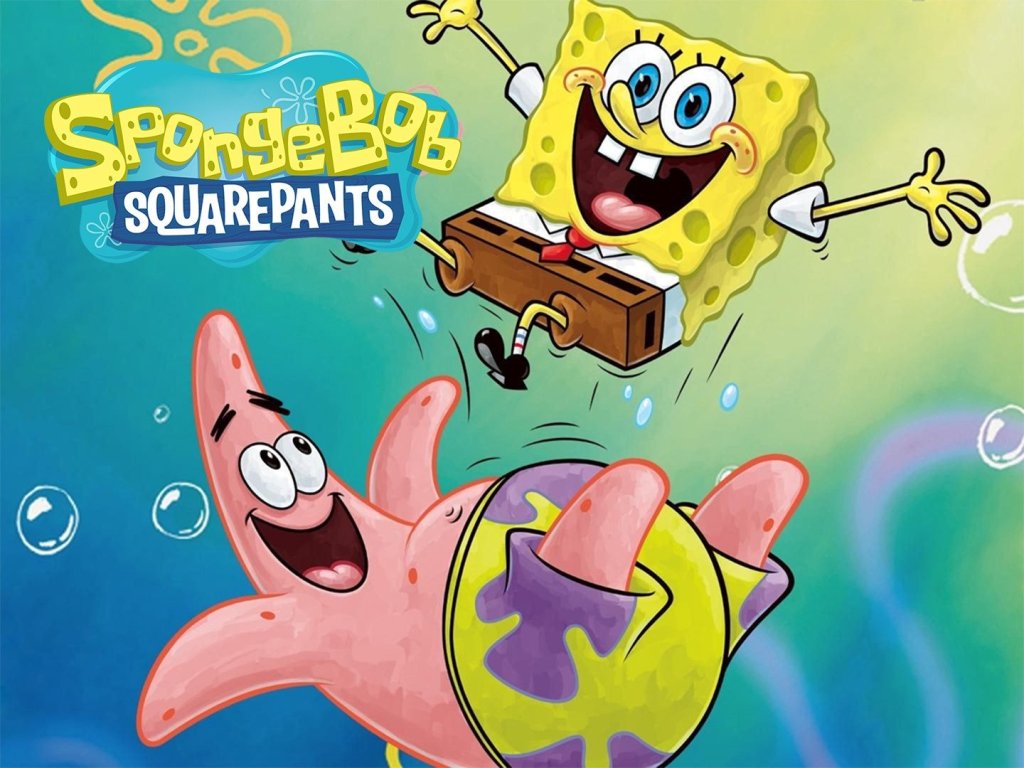
Johnny Bravo and SpongeBob SquarePants

LORELAI: Oh, they want a picture. How about the one of us sticking our heads through the carved out holes of Johnny Bravo and SpongeBob Squarepants?

Johnny Bravo, animated romantic comedy TV series created by Van Partible for Hanna Barbera which aired on the Cartoon Network from 1997 to 2004. The series focuses on Johnny Bravo (voiced by Jeff Bennett), a dim-witted Elvis-esque womaniser who lives with his mother. Episodes revolve around Johnny asking women on dates, although his advances are usually comically rejected, sometimes violently. The comedy derives mostly from celebrity guest star appearances and pop culture references, as well as adult humour – you can see why Rory and Lorelai would be fans of the show! Johnny Bravo helped launch the career of Seth MacFarlane, creator of Family Guy – you can see why writer Daniel Palladino mentions it, as he worked with MacFarlane.

SpongeBob SquarePants, animated surreal comedy TV series created by marine science educator Stephen Hillenburg for Nickelodeon, based on an unpublished educational comic book Hillenburg created in 1989 to teach his students about undersea life. The show revolves around a cheerful yellow sea sponge called SpongeBob SquarePants who lives in the fictional city of Bikini Bottom, beneath the real-life Bikini Atoll in the Pacific Ocean. Here he works as a cook at a fast food restaurant called the Krusty Krab, and interacts with other undersea characters. The show first began in 1999 and is still running, having won numerous awards and inspired an acclaimed Broadway musical, which opened in 2017.

Rory and Lorelai presumably had this photo taken during one of Stars Hollows many festivals. Note that Lorelai immediately suggests sending Harvard a photo of both she and Rory together, as if they are one person, or as if Lorelai will be attending Harvard by proxy.

Lacrosse

LORELAI: Okay, what activities interest you?

RORY: All of them except for the sports.

LORELAI: I thought you were the lacrosse kid.

Lacrosse is a team sport played with a stick with a net on it and a ball; the stick is used to carry, pass, catch, and shoot the ball into goal. It is the oldest organised sport in North America, with its origins with the indigenous people of North America, going back as early as the twelfth century. The game was extensively modified by European colonisers to create the current game. It is commonly played in schools and colleges in the US, and there are professional leagues as well.

Lorelai jokingly refers to Rory as “the lacrosse kid” in acknowledgement of her quote from The Karate Kid – an example of something being referenced twice in one episode of Gilmore Girls, without the title of the work ever being used.

“Wax on, wax off”

RORY: Wax on, wax off.

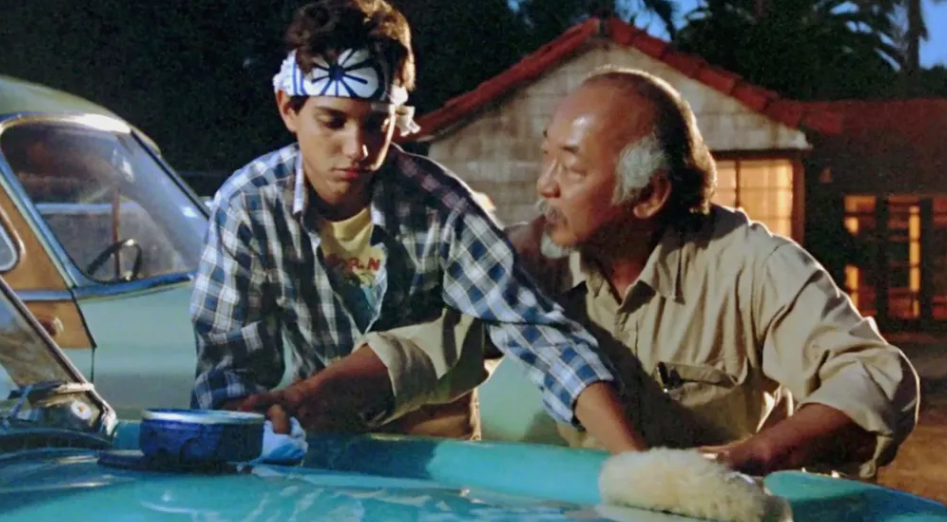
Rory quotes from the 1984 martial arts drama film The Karate Kid, directed by John G. Avildsen, and written by Robert Mark Kamen, who had earlier success with his screenplay for the 1976 boxing film, Rocky. It stars Ralph Macchio as karate student Daniel LaRusso, and Pat Morita as his mentor, Mr. Miyagi. The film was a commercial success, becoming a sleeper hit, and the #5 film of 1984. It received positive reviews, and launched Macchio’s career, while revitalising Morita’s, who had mostly been known for his comedic role as Arnold on Happy Days. It has also been credited with popularising karate in the US.

Mr Miyagi is the handyman in Daniel’s apartment, and when he defends Daniel from bullies with his unexpected karate skills, Daniel asks him to teach him karate. However, to his dismay, at first all Mr Miyagi does is give him chores to do, such as waxing his car – instructing Daniel how to do so with the words, “Wax on, wax off”.

Only later does Daniel realise that all the chores (waxing, sanding, painting) are teaching him the hand movements for karate and giving him muscle memory. Thus he learns to trust his mentor, knowing that even the seemingly mundane tasks he is given are a valuable part of his training.

Rory says this line teasingly to Lane, to remind her that every line she puts in her band advertisement has to be paid for out of her wages, and that if she’s going to make the ad really long, she’d better start waxing more tables. Rory is being realistic – Lane’s advertisement is ridiculously long and expensive!

It’s possible that on a deeper level, this quote from The Karate Kid is also saying that Mrs Kim is the Mr Miyagi to Lane’s Daniel. Although Lane’s mother seems harsh and stern, she is actually teaching her daughter some valuable lessons. Lane is certainly not afraid of hard work, and has a strong work ethic, which can only be of help in learning and practising music. And the Kim’s house is filled with music – religious music, but at least Lane has been brought up to listen to it. This could be a tiny hint that Mrs Kim is not a complete monster, and has had at least some positive effects on Lane’s musical aspirations.

Jackson Browne and “Doctor, My Eyes”

LORELAI: And what’s with Jackson Browne making the list?

LANE: Ah, see, cool people know that he’s more than a mellow hippie-dippy folkie, that he actually wrote some of Nico’s best songs and was in fact her lover before he bored us with “Doctor, My Eyes.” That will separate the poseurs from the non-poseurs.

Clyde Jackson Browne (born 1948), musician, songwriter, and political activist. A precocious teenaged songwriter from Los Angeles in the 1960s, he had his first success writing songs for others. As a sixteen-year-old, he wrote “These Days” for the Nitty Gritty Dirt Band, which became a minor hit for German singer Nico, previously mentioned as one of Lane’s music idols, in 1967. After moving to Greenwich Village, he backed Nico, and they were romantically involved. He was a significant contributor to her debut album, Chelsea Girl, writing and playing guitar on several of the songs.

Jackson Browne’s self-titled debut album came out in 1972, and this includes the track “Doctor, My Eyes”, an upbeat-sounding track about being world-weary. It was a surprise hit, reaching #8 on the US charts, and most popular in Canada at #4. It’s become one of his concert mainstays, but Lane seems to regard his debut album as the start of Browne being “boring”!

Jackson Browne continued to have successful albums, with his signature work being 1977’s Running On Empty, peaking at #3, and with the title track reaching #11 in the US (#4 in Canada). His success continued through the 1980s, and his most recent album is Downhill from Everywhere (2021). He is regarded as one of the greatest songwriters of all time.

Note that Lane has no problems telling Lorelai that she has been lumped in with the uncool “poseurs” for not knowing about Jackson Browne and Nico – even though Lorelai has helped form many of Lane’s musical tastes (this seems very believable from a teenager). Viewers may find it amusing that Lane sees herself as having the ability to separate the poseurs from the non-poseurs, considering she’s quite the musical poseur herself.

David Bowie

LANE: Gotta have Bowie.

RORY: But do you have to list every album he ever recorded, plus your personal rating between one to ten?

David Bowie, born David Jones (1947-2016), English singer-songwriter and actor. He is regarded as one of the most influential musicians of the twentieth century, and acclaimed by critics, particularly for his innovative work in the 1970s. He is known for his constant reinvention of his image, and his music and stagecraft had a significant impact on popular music. During his lifetime, he was one of the best-selling musical artists of all time, and he was inducted into the Rock and Roll Hall of Fame in in 1996. Rolling Stone named him “the greatest rock star ever”, and he is the best-selling vinyl artist of the twenty-first century.

David Bowie has released 27 studio albums, including one posthumously, as well as multiple live recordings and compilations. Nine of his studio albums have gone to #1 in the UK, but only one in the US – his 2016 Blackstar. His 1972 album, The Rise and Fall of Ziggy Stardust, is widely considered his best album, and one of the greatest of all time.

Minwax

LANE: Okay, I just crunched the numbers and at two thousand words and twenty-five cents a word, this stupid ad’s gonna cost five hundred dollars! That’s five months worth of Minwaxing end tables at my mom’s store.

Minwax is a company founded in Brooklyn in 1904 by Arthur B. Harrison. It’s currently headquartered in Cleveland, Ohio. They make Minwax Wood Finish Stain, so Lane is staining end tables (small tables designed to sit next to an armchair or sofa).

This solves the mystery of where Lane gets the money to buy music and other paraphernalia – she gets paid $100 a month (around $25 per week) for staining furniture at the antiques store. It’s not a lot of money, but Lane is thrifty.

Lane refers to it as her “mom’s store”, even though she has a father as well (or she did at the start of the show, anyway). I don’t know if Mrs Kim is the actual sole owner of the store, or if Lane refers to it that way because she sees her mother as the “boss” of the store, being there all the time while her father is mysteriously absent.

By the way, if the antiques at Kim’s Antiques are genuine, staining them would destroy all their value, as they would no longer be authentic. This seems to further call into question the Kim’s dubious business practices as antique dealers.

Faulkner and Sylvia Plath

LORELAI: Or one of your authors, Faulkner or . . .

RORY: Or Sylvia Plath.

LORELAI: Hm, might send the wrong message.

RORY: The sticking her head in the oven thing?

LORELAI: Yeah. Although she did make her kids a snack first, shows a certain maternal instinct.

William Faulkner (1897-1962), previously mentioned, writer known for his novels and short stories set in the fictional Yoknapatawpha County of Mississippi, based on the real Lafayette County of that state. William Faulkner spent most of his life in Oxford, Mississippi, which in his works is renamed Jefferson. The winner of the 1949 Nobel Prize for Literature, he is one of the most celebrated American authors, and widely considered the greatest writer of Southern Literature.

Sylvia Plath (1932-1963) [pictured], previously mentioned several times, poet, novelist, and short-story writer, best known for her confessional poetry, as well as her 1963 novel The Bell Jar, previously discussed. Her posthumous 1982 Collected Poems won the Pulitzer Prize. Clinically depressed for most of her life, she killed herself by gassing herself in the oven. Before she did so, she made her sleeping children (two year old Frieda and one year old Nicholas) a snack of bread and butter, opened their bedroom window, and put tape and towels around the door in an effort to protect them from the fumes. Sadly, her suicide seems to have often become a punchline in television comedy, as with this example.

The Big Kahuna

RORY: Oh, the essay – the big kahuna.

The “big kahuna” is an idiomatic phrase meaning “the boss, the leader, the head of an organisation, the big one”. It’s borrowed from Hawaiian, where the word kahuna means an expert in any field, but is often thought of as referring to a shaman or high priest.

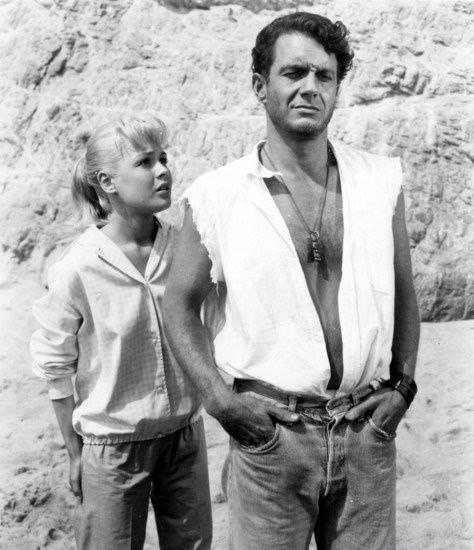
The term became known from the 1959 comedy film Gidget, in which “The Big Kahuna”, played by Cliff Robertson, was the leader of a group of surfers [pictured]. Beach party movies of the 1960s often used the term, such as Beach Blanket Bingo, where “The Big Kahuna” was the best surfer on the beach.

OshKosh Cords

LORELAI: You had these little OshKosh cords and they were way too big and once at the mall, they fell right down to your knees and I said, “Whoa, there, Droopy Drawers!”.

OshKosh B’gosh, children clothing company founded in Oshkosh, Wisconsin. It began in 1895 as the Grove Manufacturing Company by Frank E. Grove, J. Howard Jenkins, and James Clark. Grove was soon bought out and it was renamed Oshkosh Clothing and Manufacturing Company the next year. The B’gosh began being used in 1911, after the manager heard the tagline “Oshkosh b’gosh” in a vaudeville show; it formally became OshKosh B’gosh in 1937.

OshKosh are particularly known for their children’s bibbed overalls, sold since the early twentieth century as a way for parents to dress children like their fathers. They became popular in the 1960s, and since 1984, most of the company’s clothing line is for children. OshKosh have over 300 stores in the US, and are headquartered in Atlanta, Georgia. It’s now owned by Carter’s.

Baby Rory would have been wearing corduroy bibbed overalls from OshKosh [pictured].

Lane’s “A” Bands That Didn’t Make the Cut

LANE: But this is the cut-down version. I mean, just from the letter A, I excluded AC/DC, the Animals, and A-Ha, footnoted as a guilty pleasure.

AC/DC: Australian rock band, previously discussed.

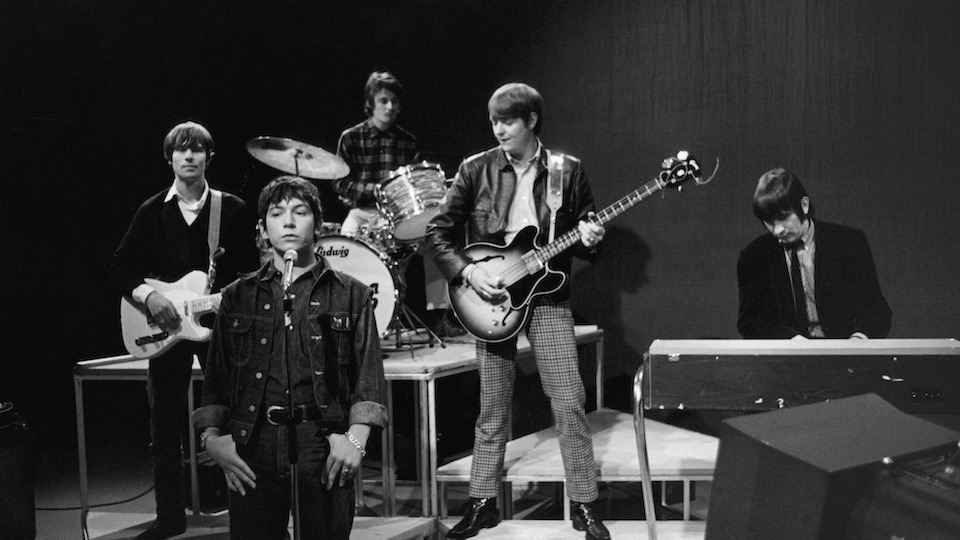
The Animals [pictured]: English rhythm and blues and rock band, formed in 1962. They were known for their gritty, bluesy sound and deep-voiced frontman, Eric Burdon, most famous for their signature song and international #1, “The House of the Rising Sun”, as well as hits such as “We Gotta Get Out of This Place”, and “Please Don’t Let Me Be Misunderstood”. After a new line-up, they moved to California in 1966 and achieved commercial success as a psychedelic and hard rock band, with hits such as “San Franciscan Nights”, and “When I Was Young”, before disbanding at the end of the decade. They were inducted into the Rock and Roll Hall of Fame in 1994.

A-ha: Norwegian synth-pop band founded in Oslo in 1982 by Paul Waaktaar-Savoy (guitar), Magne Furuholmen (keyboards/guitar/vocals), and Morten Harket (vocals). Their 1985 debut album, Hunting High and Low, is their most successful – it yielded international hits such as “Take On Me” and “The Sun Always Shines on TV”, and went to #1 in Norway, #2 in the UK, and #15 in the US. They are the most successful global pop act to come out of Norway, and the first Norwegian band to be nominated for a Grammy. Their music has often been included in music soundtracks, they performed the theme song for the 1987 James Bond film The Living Daylights, and are one of the highest-grossing bands of all time.

I feel as if the commercial success and international acclaim of these bands might be what caused Lane to cut them from her extensive list. A-ha is probably a “guilty pleasure” because it is pop, rather than rock.