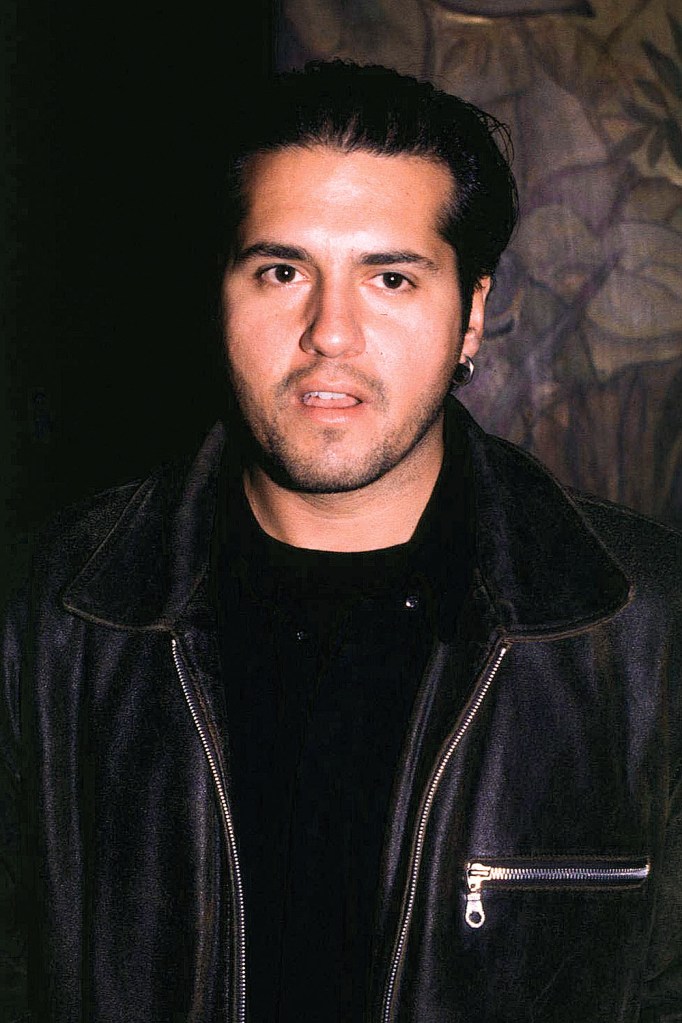
Henry Dumps Lane

HENRY: Lane, I like you but I want to be able to actually pick you up, stop the car, and take you out. And I wanna be able to call you, at your house.

Lane’s complicated dating plan predictably goes wrong when Henry tries to call the pay phone at the park where’s having her mother-approved picnic with her cousin David. The phone isn’t working, so Henry calls Lane’s house in desperation, and gets Mrs Kim; he panics and tries to sell her a subscription to the Wall Street Journal.

When Lane calls Henry at his house in Hartford and discovers all this, she suggests they still have time for a date. All he needs to do is drive past, honk twice, go around the block, and on the second go around, Lane will jump in the car while it’s still moving.

Henry rejects this madness, and says he wants a girlfriend he can go on dates with, and phone if he wants to. He has already asked somebody else to attend the prom with him, which is about three months away – I think this means Henry is a year older than Lane, and in his last year of school?

This is the end of Lane’s first relationship with a boy she really likes who returns her feelings, coming to a halt before she even got to go on one date with him. It’s warning to her of what her life will be like if she continues trying to hide everything from her mother.
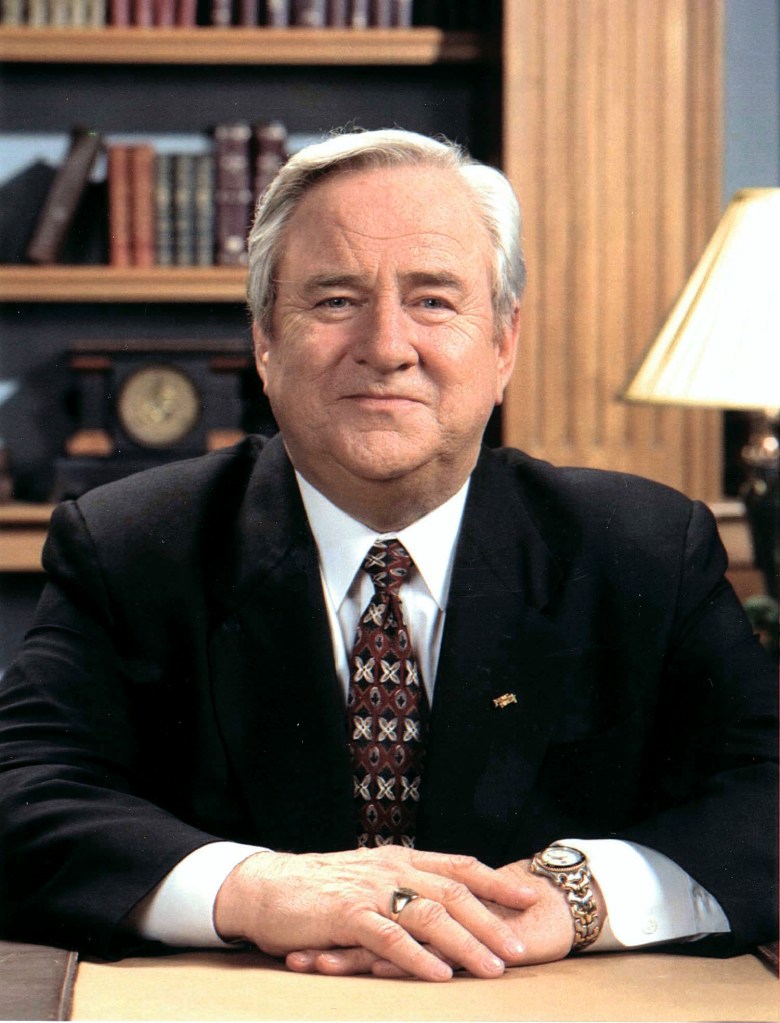
Pat Buchanan, Jerry Falwell, Kathy Lee Gifford

JESS: I don’t know, bet you have a lot of supporters on this. Pat Buchanon, Jerry Falwell, Kathie Lee Gifford.

Patrick “Pat” Buchanan (born 1938), right-wing political commentator, politician and broadcaster. He was an assistant and consultant to Presidents Richard Nixon, Gerald Ford, and Ronald Reagan, and one of the original hosts of CNN’s current events program, Crossfire. He has expressed sympathy for Nazi war criminals and support for eugenics, denied the Holocaust, and called for the lynching and horse-whipping of the young men of colour wrongly convicted in the Central Park jogger case. In 1990, he argued the case for music censorship in a debate on Crossfire.

Jerry Falwell Sr (1933-2007) [pictured], Southern Baptist pastor, televangelist, and conservative activist. He was pro-segregation and pro-apartheid, and a supporter of Anita Bryant’s campaign to oppose equal rights for gay people (he denounced Tinky Winky from the Teletubbies as a gay icon). He sued both Penthouse and Hustler magazine in the 1980s for an article and an advertisement that he believed had defamed him or caused him distress; the courts ruled in favour of free speech.

Kathie Lee Gifford (born Kathryn Epstein in 1953), television presenter, singer, songwriter, and author. She is best known for her fifteen-year run as co-host of Live! With Regis and Kathie Lee. She became a born-again Christian at the age of 12, and was a secretary/babysitter to Anita Bryant. I’m not actually aware of any censorship she has advocated for.

Jane

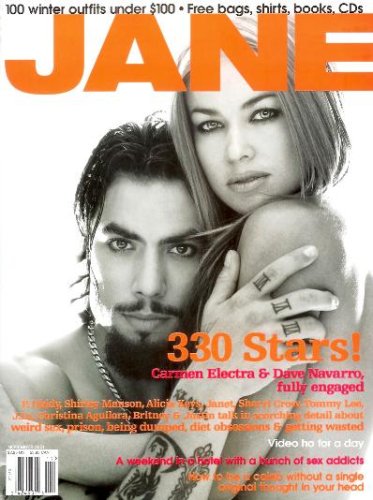
While waiting for the group project meeting to start, Madeline reads Jane magazine (1997-2007). This was a women’s fashion magazine founded by Jane Pratt, aimed at the 18-34 market, and designed for those young women who had grown up with Sassy (1988-1996), a feminist magazine for teenage girls which had Pratt as the first editor. Jane’s reputation was for being witty, quirky, trashy, and occasionally thoughtful, with a readership who saw themselves as “wild and crazy” party girls.

It folded because it’s young readership were now getting more interested in digital platforms, such as Jezebel. Jane Pratt went on to found the infamous xoJane online magazine (2011-2016).

Madeline is reading the November 2001 issue with Carmen Electra and Dave Navarro on the front cover. This issue actually had a double front cover, and you can see Madeline holding up the one with Shirley Manson, P. Diddy, and Alicia Keys on it. The magazine that month had interviews with other music stars, including Jennifer Lopez, Janet Jackson, Sheryl Crow, and Tommy Lee.

Careers of Past Editors of The Franklin

PARIS: This is The Franklin, a newspaper that’s been around for almost a hundred years. There have been at least ten former editors of The Franklin that have gone on to work at the New York Times. Six have gone onto the Washington Post. Three are contributing editors at the New Yorker. I think one even went on to win the Pulitzer Prize.

The Washington Post is a daily newspaper published in Washington DC, with a large national readership. Founded in 1877, it is famous for the printing of The Pentagon Papers, which helped spur opposition to the Vietnam War in 1971, and for breaking the news of the Watergate scandal, which led to the resignation of President Richard Nixon in 1974. It has won 69 Pulitzer Prizes, second only to The New York Times.

The Pulitzer Prize was established in 1917, and awards achievements in journalism, literature, and musical composition, in various categories. There is a huge list of past winners, one of which apparently went to Chilton.

The New York Times, previously discussed.

The New Yorker, previously discussed. Paris says that three former editors of The Franklin are current contributing editors at The New Yorker. Of those born in the US, in 2001 they could only be either Michael Agger, Roger Angell, Ben Greenham, Robert Gottlieb, Hendrik Hertzberg, Robert Mankoff, or Amy Davidson Sorkin. Roger Angell is the only one who attended a private school in Connecticut.

According to Paris, about twenty percent of The Franklin’s editors went on to achieve journalistic greatness, which seems very high. The message is clear: working on The Franklin can be a stepping stone to success in journalism.

Tony Manero

MICHEL: So, is there no dancing here? I was hoping there’d be dancing.
SOOKIE: You need to strut, Tony Manero?

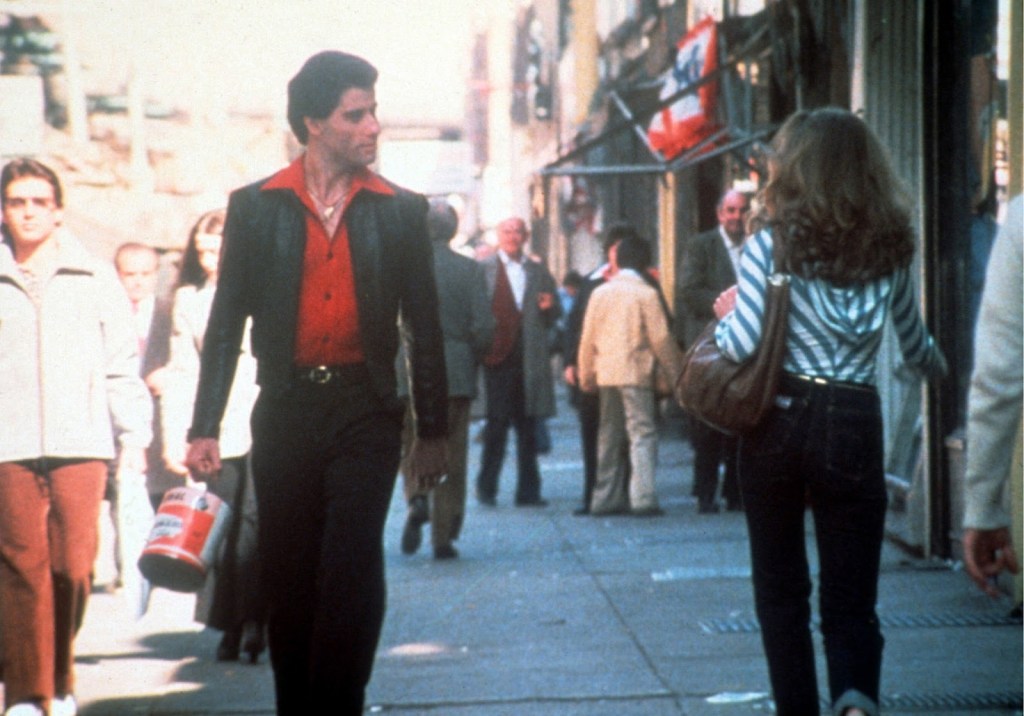
Anthony “Tony” Manero (John Travolta) is the protagonist of the 1977 musical drama film Saturday Night Fever, directed by John Badham, and based on a 1976 New York magazine article by British journalist Nik Cohn, Tribal Rites of the New Saturday Night. In the 1990s, Cohn admitted he’d faked the article on New York disco culture, basing the main character on a man he had briefly seen in a doorway, and an English mod he’d known in the 1960s.

The film revolves around Tony, a young working-class Italian-American man who spends his weekends drinking and dancing at a local disco in Brooklyn. While in the disco, he is the champion of the dance floor, and this helps him cope with a dead-end job, family squabbles, racial tension in his community, and a general restlessness, while he dreams of a better life.

The film begins with an iconic scene where Tony is strutting down the streets of his neighbourhood with The Bee Gees song Stayin’ Alive playing. Both scene and song are referenced in the film’s less-regarded 1983 sequel, Staying Alive.

Saturday Night Fever was a massive box-office success, and the #4 film of 1977. It received excellent reviews, and critics named it as one of the best films of 1977. It helped to popularise disco music, and made John Travolta a household name. The soundtrack, featuring songs by The Bee Gees, is one of the best-selling movie soundtracks of all time.

“Make way for Rory”

BOUNCER: It’s twelve bucks. And it’s eighteen and over.
SOOKIE: Oh, she’s eighteen.
RORY: That’s right. Last week. So it’s a new eighteen, but it’s eighteen, yup.
BOUNCER: You got some ID?
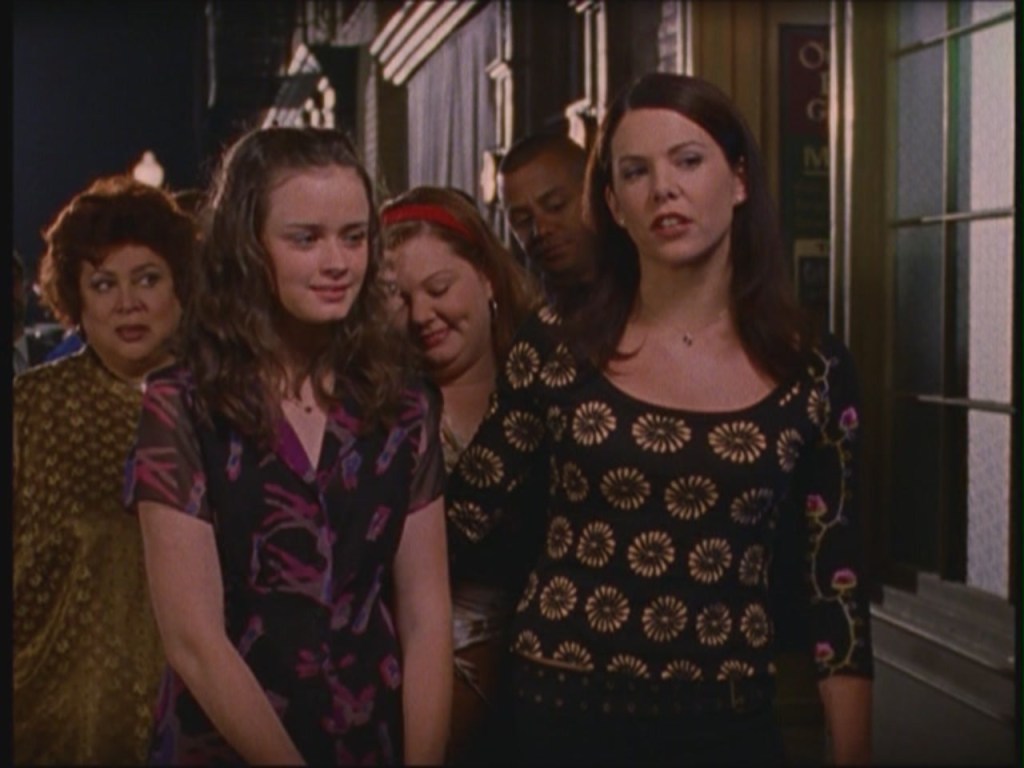
LORELAI: Hey, uh, sir, make way for Rory. That’s her name. And her only name. Rory. Single name, she’s that important. Internationally known international supermodel and sometimes spokesperson for international products.

An in-joke – Alexis Bledel, who plays Rory, was a model before she began acting on Gilmore Girls. She first modelled for Seventeen magazine, and did have to travel as a model.

In real life, it is extremely unlikely that a bouncer would allow a 16-year-old girl without any identification into a nightclub that is 18+, even when accompanied by her parent; the penalties for doing so in the US can be quite strict. Lorelai’s way of getting people to make new rules for Gilmores is really getting quite unbelievable.

Alexis Bledel was almost 20 in this scene, so in real life actually would have been old enough to get into an eighteen and over nightclub.

Max’s Morning Newspapers


Rory explains to Luke that Max likes to read three newspapers each morning.

The Hartford Courant is the largest newspaper in Connecticut, founded in 1764 as The Connecticut Courant – because of this, the newspaper claims to be the oldest continuously published newspaper in the US, and its slogan is “Older than the nation”. Once a Republican paper, it is now more likely to endorse Democratic candidates, and has won several journalism awards. It was bought by the Tribune Company in 2000.

The New York Times is based in New York City, with an international readership and reputation. The 17th most popular newspaper in the world by circulation, it has won 125 Pulitzer Prizes, more than any other newspaper. Founded in 1851, it has been owned by the Ochs-Sulzberger family since 1896 (the real life inspiration for the fictional Huntzberger family in Gilmore Girls). Its motto is, “All the news that’s fit to print”).

The Wall Street Journal, previously discussed.

VJ Day, New York, 1945

MAX: Wait a minute. I recognize this.
KIRK: Nice photo, huh?
MAX: This is VJ Day, New York, 1945.
KIRK: Right. I include it as an example of the excellence that I aspire to.

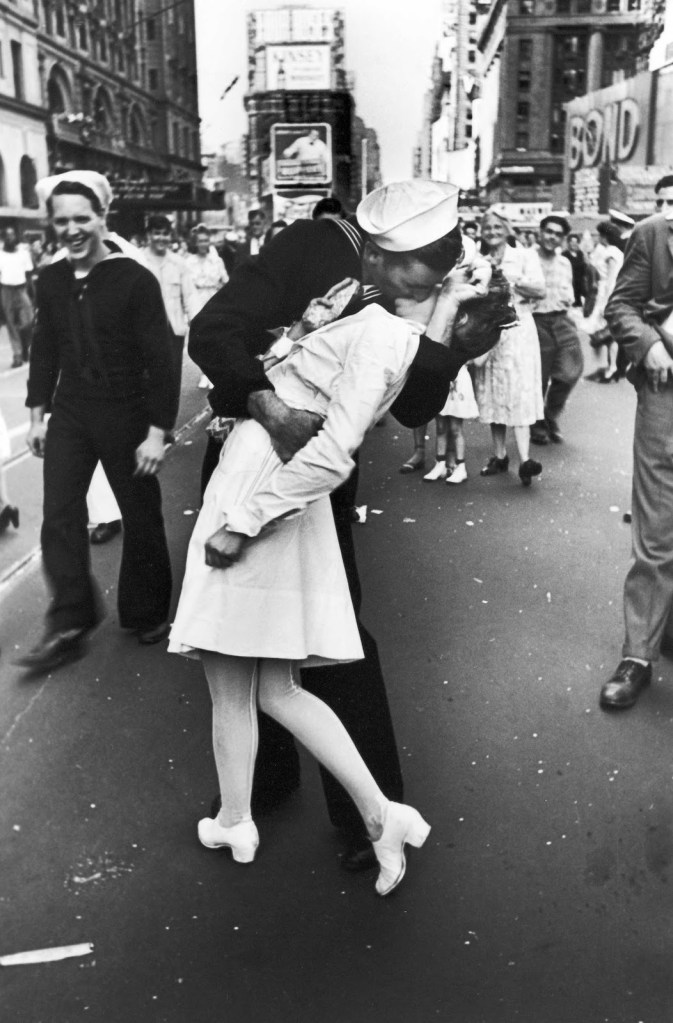
The photo is V-J Day in Times Square by Alfred Eisenstaedt, showing an American sailor kissing a woman in a white dress on Victory over Japan Day in New York’s Times Square on August 14, 1945. The photo was published in Life magazine, and is very famous.

A.J. Benza

LOUISE: Princess Grace didn’t go to college.
PARIS: Thank you for the history lesson, A.J. Benza.

Alfred Joseph “A.J.” Benza (born 1962) is an American gossip columnist and television host. He began as a gossip columnist on the New York Daily News, and in the mid-1990s began appearing on The Gossip Show on E! Entertainment Television, leading to appearances on several chat shows. From 1998 to 2001 he was the host of Mysteries and Scandals on the E! Network.