Jess Snoops Around the Living Room

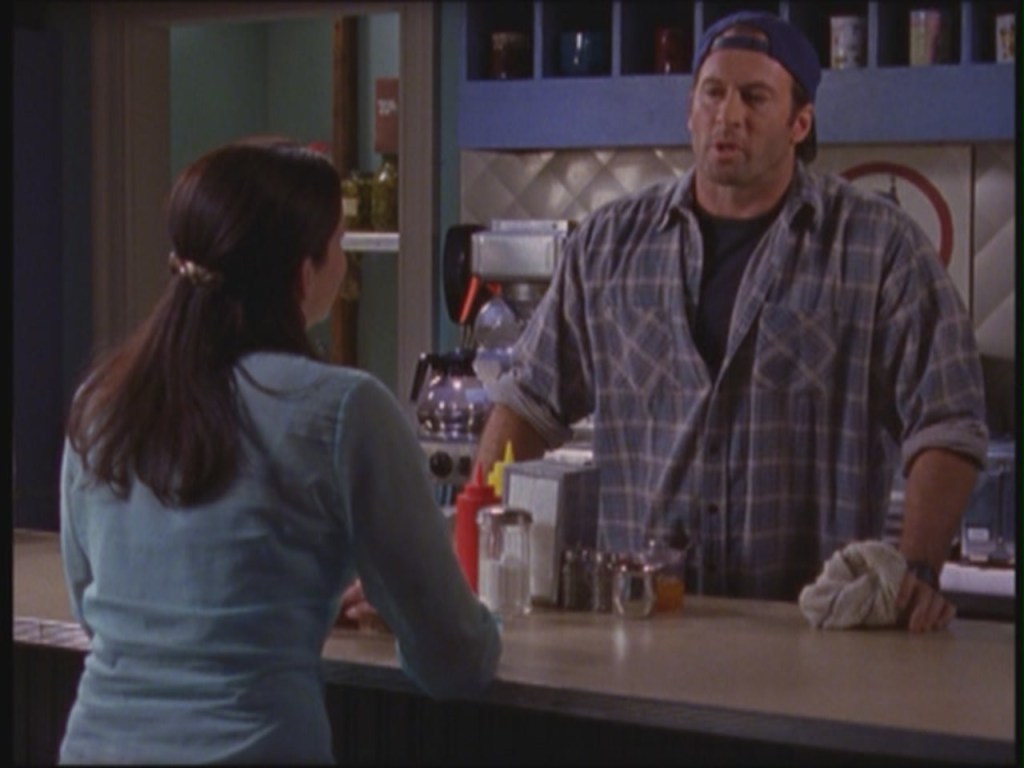
Luke and Jess arrive slightly late for the dinner party, with Luke implying he’s had trouble convincing Jess to come with him. While Lorelai assures Luke that it’s fine, Jess quietly slips into the Gilmores’ living room, which is off the hall. He looks at the photos on the mantelpiece, and touches the frame of one showing Rory wearing a pink cardigan, half picking it up.

Jess manages to check Rory out before he even meets her, and there’s no mistaking that he’s interested in what he sees. A boy who touches a girl’s photo is probably thinking about touching her, after all.

Lorelai finds him and surely has an idea what he’s up to. She smilingly bundles him out to the kitchen to meet Sookie and Jackson, but she must be getting suspicious of Jess. He’s crept around her living room without asking, and checked out her daughter’s photos. I imagine she is now telling herself to keep an eye on Jess, in case he has more creeping around to do.

Wilding

LORELAI: You know, you should meet my daughter. She’s about your age. She can show you where all the good wilding goes on . . .

“Wilding” is an American term which gained media use in the 1980s and ’90s to describe gangs of teenage gangs committing violent acts. It is no longer often used.

The word has an ugly history, coined during the Central Park jogger case of 1989, after a white female jogger was assaulted and raped in Manhattan’s Central Park. Five black and Latino juveniles were convicted of the crime, police contending that the boys said they were “wilding” in the park, the police taking this to mean committing violence.

This has been disputed as a (wilful?) misunderstanding by the police. Other theories are that the boys were repeating the lyrics to the Tone Loc song, “The Wild Thing”, or that they said they were “wiling”, meaning “hanging out, whiling away the time”.

The boys served sentences of between six to twelve years, and all later had their charges vacated after a serial rapist and murderer confessed to the crime while in prison. This was in 2002, so after this episode aired (Lorelai doesn’t know she is referencing falsely imprisoned schoolboys).

So far, Lorelai has linked Jess with prisoners and the Mafia, and joked that he may be going out to hold up a liquor store. Once she actually meets him, she connects him with violent gang rape. At this point, her “jokes” about Jess have become openly hostile, and quite nasty.

As Lorelai has joked about a violent gang rape, and used a word with a racist history to Jess, I wonder if this is when he decided he didn’t like Lorelai very much?

On the Road

Jess is carrying this 1957 book by American Beat writer Jack Kerouac, previously discussed, when he leaves the diner. It looks as if Jess might be looking for a quiet spot to read, just as Rory likes to do.

It immediately establishes Jess as a reader, something which will surely pique Rory’s interest, as she was always trying to get Dean to enjoy great literature (with unsatisfying results). It is also an obvious symbol of Jess’ journey to small town America, and possibly a foreshadowing that Jess does not intend to stick around.

Jess Mariano (Milo Ventimiglia)

Jess Mariano is Luke’s seventeen-year-old nephew, the son of his sister Liz. He was introduced in Season Two as a romantic interest for Rory, and as a contrast with her boyfriend Dean. Jess is the “bad boy” that Lorelai feared Rory would be attracted to, in the same way she was when she was a teenager.

Jess is introduced when he steps off the bus, the modern teenage equivalent of the mysterious stranger riding into town. The bus says it is going to Hartford, and Jess boarded it in New York, so Stars Hollow must be on the bus route between these points. In real life, the bus route from New York to Hartford goes through Danbury and Waterbury, which doesn’t seem that implausible as far as Stars Hollow’s possible location goes. The bus trip takes about two and a half hours, and we later learn the bus got in at 10 am.

Jess and Luke greet each monosyllabically by simply saying each other’s names. The mirroring is a sign that Jess and his uncle share at least one characteristic – neither of them are particularly talkative.

There has already been a character named Jess in Gilmore Girls – the college boys that Madeline and Louise got with at The Bangles concert in Season 1 were named Jess and Sean. Maybe Jess seemed like a very “New York bad boy” sort of name? Or the writers really like the name Jess?

Both Rory and Jess have unisex names, or names more common on the opposite sex. It’s interesting that the name Jess Mariano has the same rhythm as Dan Palladino, and they’re obviously both of Italian heritage.

Fredo

LUKE: There’s nothing to think about. He’s family. You take care of family, period.
LORELAI: Yes, I respect that, but what if he turns out to be Fredo?

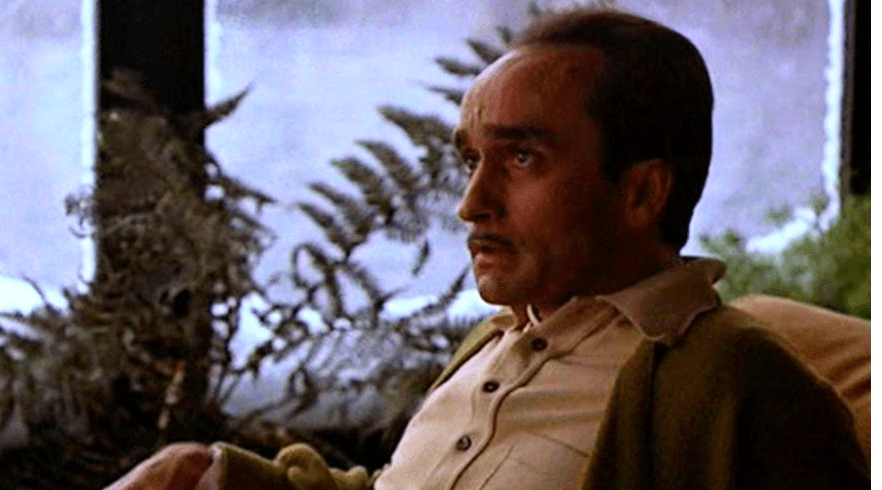
A reference to the film The Godfather Part II, the sequel to The Godfather, previously discussed.

In the films, Frederico “Fredo” Corleone (played by John Cazale) is the middle brother in his family. He is seen as a weak person, with little power or status in the crime family, and given relatively unimportant jobs to do. During the course of the film, his younger brother Michael, who has become the Mafia don, discovers that Fredo betrayed him. He has Fredo killed.

Before Lorelai even meets Luke’s nephew, she is prejudiced against him, and makes none-too-subtle hints that the boy is a petty criminal who may not be worth helping.

Liz

LUKE: Look, his problem is obvious, it’s his mother. You never could count on Liz for anything. Our mom died when we were kids, right? It was just my dad, me and Liz. And my dad worked all the time and I worked in the store with my dad, and Liz was off doing God knows what.
LORELAI: Well, I bet losing her mom so early was kind of hard on her.
LUKE: It was hard on all of us, but we did our part. And then the minute she graduates high school, she is outta here. Didn’t matter that my dad was sick, didn’t matter that the store was failing, she just took off. Married the hot dog king, had a kid, he left, now here we are.

Luke gives Lorelai a potted history of his sister Liz. After the death of their mother while they were young, Luke fell into the role of the “good child” who supported his father and worked alongside him in the hardware store when he wasn’t at school. Liz was the “bad child”who ran around town and did her own thing.

As soon as she finished school, she left town (and went to California?) despite her father being ill and the family business going downhill as a result. Luke now makes it sound as if Liz’s husband worked at (or owned?) the Wienerschnitzel restaurant, not merely another customer. In fact, he had a similar job to the one Luke now has!

Lorelai is immediately sympathetic to Liz, understanding the terrible loss of her mother at a young age, and having personal knowledge of being a wayward teenage girl, family black sheep, and young mother herself.

It possibly explains one of the reasons Luke is drawn to Lorelai. She was a rebellious teen like his sister and even had her child the same year as Liz, and yet while he can only see Liz as a screw-up and a flake, Lorelai is energetic, hard-working, ambitious, and a pillar of their community. Of course, Lorelai wasn’t orphaned in her teens, and her family didn’t go broke, so it’s hardly a fair comparison.

In fact, despite Luke’s disparaging summation of his sister’s character, her life story doesn’t sound particularly dire or even that unusual. She got out of a probably stifling small town to escape a miserable family situation, travelled across the country, met a small business owner (?) or at least someone in employment, got married and had a child. Although she married young, the marriage lasted fifteen years or more, leaving her as a single mother to a teenage boy who seemingly inherited her own rebellious streak.

Luke’s relationship with his sister opens up a number of questions. Does he see Lorelai as the girl who turned her life around with the support of Stars Hollow, the way he wishes Liz had? Does he sometimes cast Lorelai in the role of a ditzy younger sister? Does he give Lorelai and Rory the help and friendship he wishes he could have bestowed on Liz and her son?

And if he had directed his love and care towards his sister and nephew instead, would they be in the mess they are now? Because Lorelai has lived in Stars Hollow for more than ten years, and she didn’t even know Luke had a sibling.

(By the way, Liz is another name from General Hospital – Luke and Laura’s son Lucky married a girl named Liz, and they became a younger generation “supercouple”).

Lorelai Asks Luke for Business Advice

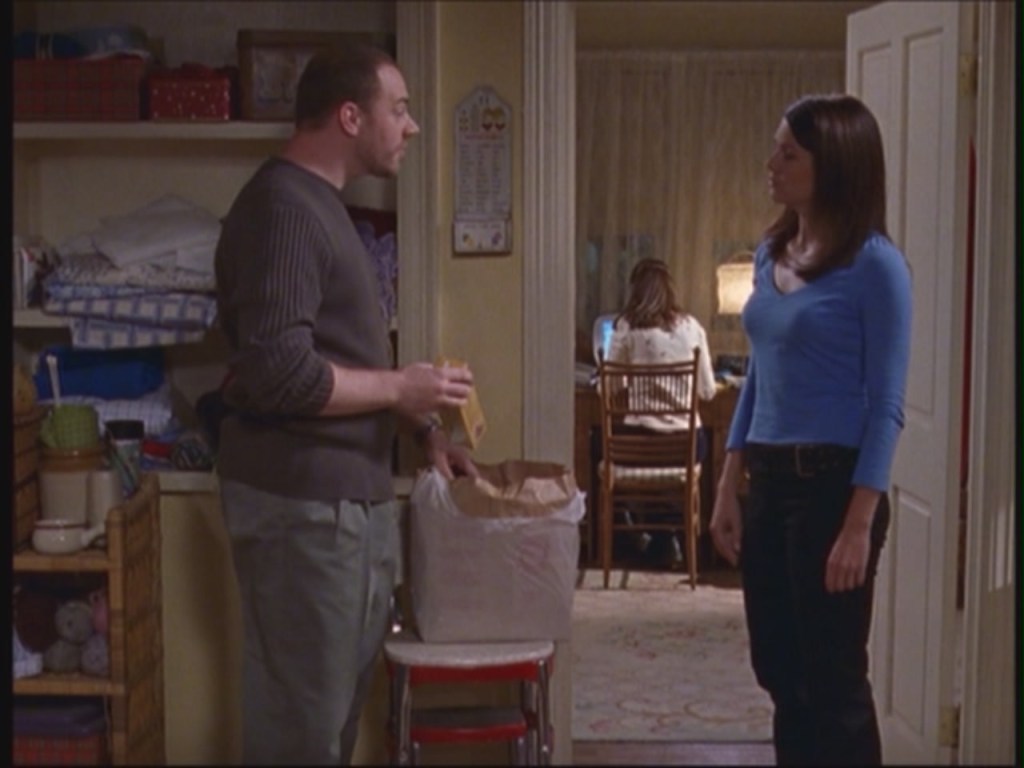
The purpose of the road trip to Harvard was to allow Rory to see something of college life, and see herself as a future college student. For Lorelai, the purpose of the trip was to stay at a working B&B – and even though she didn’t like it, it was a successful concern with happy customers. She can begin to see herself running an inn, and from this moment forth, begins seeking out Luke as a business mentor.

Her dream of running her own inn begins to firm into a reality, and when she leaves Luke’s, she immediately phones Sookie to let her know it’s time they started seriously working towards their goal.

U2

LORELAI: I have earned the right not to be quizzed about my social life by my sixteen-year-old daughter.
RORY: I thought I was your best friend!
LORELAI: When we’re at a U2 concert, you are my best friend. But right now you are my sixteen-year-old daughter and I am telling you I do not want to have this conversation.

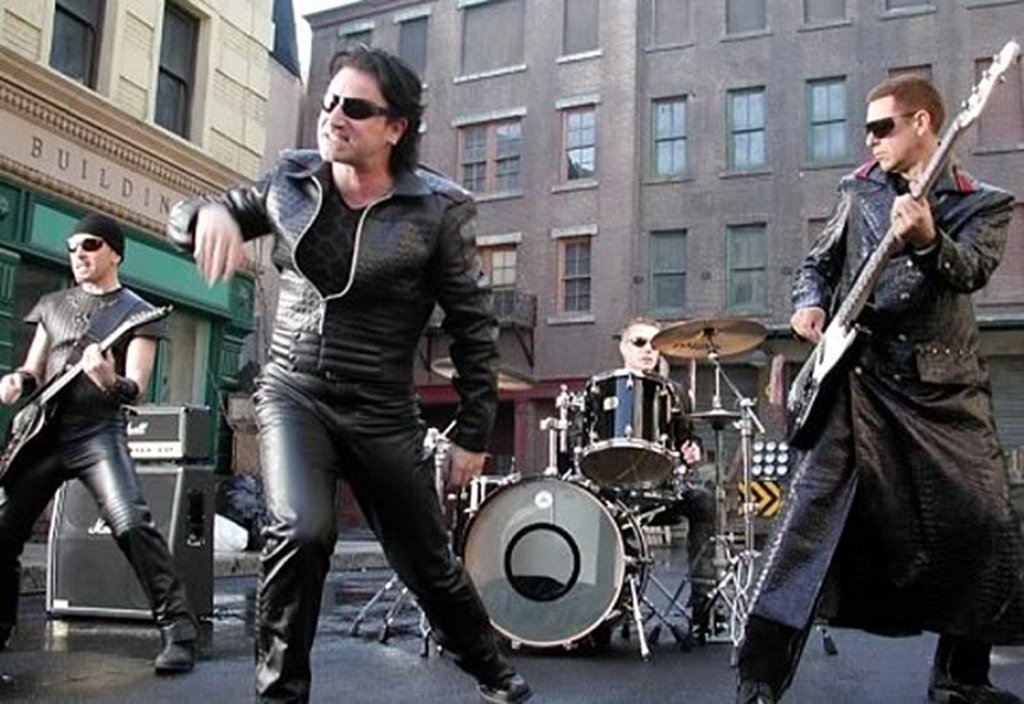
U2 are an Irish rock band, earlier mentioned. It was formed in 1976 and consists of Bono (Paul Hewson), The Edge (David Evans), Adam Clayton, and Larry Mullen Jr. Their debut album was Boy (1980), and their first #1 album in the UK was War (1983), with singles such as Sunday, Bloody Sunday and Pride (In the Name of Love) establishing their reputation as politically conscious. By the mid-1980s they were globally renowned as a live act, and their 1987 album The Joshua Tree made them international superstars; it remains their greatest commercial and critical success. Their most recent album from Lorelai’s viewpoint is All That You Can’t Leave Behind, released in 2000. One of the world’s best-selling musical acts, U2 have won 22 Grammy Awards, more than any other band, and were inducted into the Rock and Roll Hall of Fame in 2005. They are famous for their campaigns for human rights and social justice.

This establishes Lorelai as a U2 fan. U2 gave a concert in Hartford as part of their Elevation tour on June 3 2001, although in the Gilmore Girls universe it seems to have taken place around mid-May – this was the concert that Tristan offered to take Rory to on a date (with PJ Harvey as the support act). It doesn’t seem plausible that Lorelai and Rory attended the concert, although it is just possible, particularly if they went to the real-life concert rather than the fictional one in the show.

U2’s previous concert in Hartford was as part of their Zoo TV tour, and it took place on March 12 1992 – this is the only other U2 concert that Lorelai could have taken Rory to. Unfortunately, the concert would have been when Rory was eight years old, and later Lorelai says that Rory thought she “discovered” U2 when she was ten; Rory could hardly believe that after attending an elaborately staged concert by the band two years before. It is possible that Lorelai is referring to a purely hypothetical U2 concert.

Lorelai lets Rory know that the idea of them being “best friends” is something of a fiction, being entirely at Lorelai’s convenience. As long as Rory is doing exactly as Lorelai wants, they are best friends; once she deviates from that, they are back to being mother and daughter.

Moving Wallpaper

LADAWN: I get so many compliments on this room.
LORELAI: Yeah, are [the flowers on the wallpaper] moving?
LADAWN: It looks like it, doesn’t it? There’s foil in the paper and it gives it that illusion. Isn’t it terrific?

A possible allusion to the 1892 short story, The Yellow Wallpaper, by Charlotte Perkins Gilman. In the story, a woman is sent by her husband for a “rest cure” after suffering postnatal depression. It gradually becomes apparent that the woman is actually imprisoned in a single room, and as her mental state deteriorates, she begins to believe the pattern on the yellow wallpaper is changing and mutating. It is based on Gilman’s own experience, who was forbidden to read or work after suffering what was then called “nervous depression” after giving birth (she got better after eventually ignoring this medical advice).

Reader Stina Töyrä has pointed out the many connections this story has to Lorelai and her situation. Charlotte Perkins Gilman was from Hartford, the grand-niece of Harriet Beecher Stowe, and her surname is similar to Gilmore. The wallpaper at the Cheshire Cat is a creamy yellow colour, and is apparently designed to give the illusion of a moving, changing pattern. The next morning, Lorelai is convinced that the flowers have become taller, and that there are more of them than the night before. Furthermore, as with the woman in the story, Lorelai is mysteriously unable to leave her room at the B&B.

The allusion to the story would provide another example of Lorelai feeling trapped by her situation, and seeing marriage to Max as an imprisonment. Interestingly, it also hints that she may feel that her child has been the catalyst for this, as in the story it is brought on by giving birth. It may be that Lorelai would never have become engaged to Max so quickly if she didn’t have Rory to consider, and that on some level she (unfairly) blames Rory for the mess she’s in.

Thanks to Stina for making this suggestion!