Lorelai and Christopher’s Childhood Duet

CHRISTOPHER: Lucy, Schroeder, you laying on the coffee table.
LORELAI: You pretending it was a piano. God, why is that remembered?
EMILY: Because it was such a wonderful production.
LORELAI: I don’t know if it was a production, Mom. It was just one song.
CHRISTOPHER: Suppertime.
RICHARD: Did you write that? That was really very good.
LORELAI: Dad, that’s from You’re a Good Man, Charlie Brown. It’s a famous musical.

At the age of ten (around 1978), Lorelai and Christopher sang a song for at least Richard and Emily, and possibly Christopher’s parents as well.

The song was Suppertime, from the 1967 musical comedy You’re a Good Man, Charlie Brown by Clark Gesner, based on the characters from the Peanuts comic strip drawn by Charles M. Schulz. The show premiered off-Broadway in 1967, went to London’s West End in 1968, and opened on Broadway in 1971. It had a Broadway revival in 1999.

The show was adapted for television in 1973, when Lorelai and Christopher were about five. This might be where they knew of the musical from, although it’s a favourite for amateurs to perform, and they might have seen a local production, or even been in a school production. The musical was adapted for TV again in 1985.

Suppertime is a song sung by the dog Snoopy, about his excitement in being fed after waiting hopelessly for the food to arrive. It’s a strange song to choose as a duet, because Snoopy sings almost the entire song, with only a few interjections from Charlie Brown. I presume Lorelai sung Snoopy’s part, and Christopher sung Charlie Brown’s – it seems like her to hog the limelight, and like him to do only minimal work. Possibly they chose that song because they were performing it just before dinner was served.

Lorelai and Christopher recall playing the roles of Lucy and Schroeder, in the iconic pose of Lucy lying on the piano while Schroeder plays it. It isn’t clear how this fitted in with the song by Snoopy. In the musical, Lucy and Schroeder have a scene together where he plays Beethoven’s Moonlight Sonata on the piano while Lucy expresses her love for him and asks about marriage, while Schroeder remains detached. This is ironic considering what comes later.
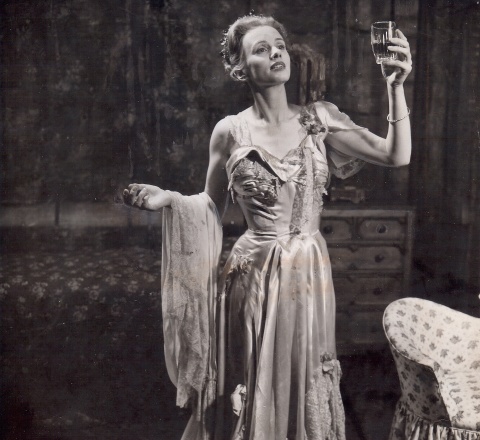
Vivien Leigh and Jessica Tandy

LORELAI: Streetcar Named Desire [explaining Stella the chicken’s name].
SOOKIE: Vivian Leigh or Jessica Tandy?
LORELAI: Hello – Tandy.
SOOKIE: Of course. Continue.

Vivien Leigh, born Vivian Hartley (1913-1967) was an English stage and film actress. She played Blanche DuBois in the 1949 London West End production of A Streetcar Named Desire, and was chosen to reprise the role in the 1951 film version of the play, which was directed by Elia Kazan, who had also directed the Broadway production. Leigh won Best Actress at the Academy Awards for her role, as well as from the BAFTA, The New York Film Critics Circle, and the Venice Film Festival. A Streetcar Named Desire was the #4 film of 1951, and won three other Academy Awards, while gaining high praise from critics.

Jessica Tandy, born Jessie Tandy (1909-1994) [pictured] was a British stage and screen actress who appeared in over 100 theatre productions and had more than 60 roles in film and television; she moved to the US in 1940 and lived most of her life in Connecticut. Tandy played the lead role of Blanche DuBois in the original 1948 Broadway version of A Streetcar Named Desire, for which she won a Tony Award. The play itself, which first opened in New Haven, Connecticut was awarded The Pulitzer Prize for Drama, and Best Play from the New York Drama Critics Circle.

Lorelai’s response indicates that she is privileging Broadway over the West End, and perhaps the stage over the screen version. Possibly there is a little local pride involved too. I can’t see how Lorelai could judge the difference in their performances as the Broadway production was twenty years before she was born. It is notable that Sookie immediately agrees with her, maybe suggesting the Connecticut connection is well known and a source of some pride.

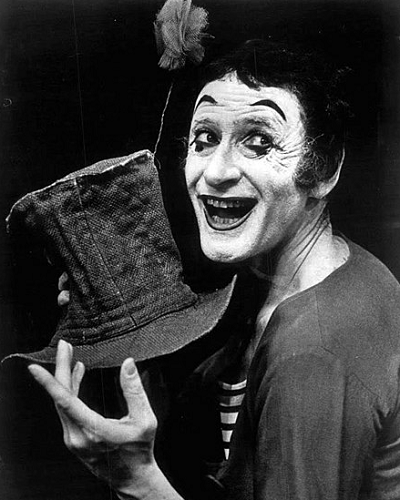
Marcel Marceau

LORELAI: All day long, just chirps like a maniac at the top of her lungs. Now, nothing. Silence. Marcel Marceau chicken.

Marcel Marceau, born Marcel Mangel (1923-2007) was a French actor and mime artist, who called mime “the art of silence”. He was most famous for his stage persona of Bip the Clown, who wore a striped jersey and opera hat. Marceau performed for more than 60 years, winning multiple awards, and helping to inspire the dance style of Michael Jackson.

As a young man during World War II, Marceau worked with the French Resistance to save Jewish children from concentration camps, and also won awards for this humanitarian work.

“Stella!”

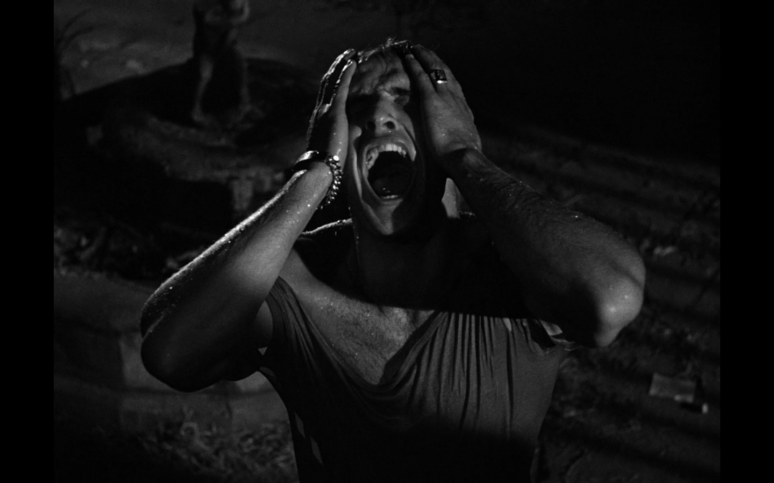
When Lorelai realises that the chick Stella is somehow missing, even though it was in a secure cage and had previously been fine, Lorelai screams out the chick’s name in a way reminiscent of the way Stanley calls to his wife Stella in an iconic scene from A Streetcar Named Desire.

It seems to be a truism in television comedy that anyone named Stella, especially an animal, will escape or disappear so that their name can be yelled in the same manner.

Stanley and Stella

LORELAI: Alright, I’ll name him. [to chick] Hi! Your name is Stanley. Hi, Stanley.
RORY: It’s a girl.
LORELAI: Oh. [to chick] Sorry about the Stanley thing. Your name is Stella. [to Rory] Stella’s nice, and Stella was married to Stanley.

A reference to the 1947 play A Streetcar Named Desire by Tennessee Williams, earlier discussed. In the play, Blanche DuBois’ younger sister Stella is married to Stanley Kowalski, a factory parts salesman.

A Streetcar Named Desire was highly successful on Broadway and in London’s West End, and won the 1948 Pulitzer Prize for Drama. It is regarded as one of the greatest plays of the twentieth century, and is Williams’ best known work. The roles of Stanley and Stella were played by Marlon Brando and Kim Hunter in both the original Broadway production, and the 1951 film version.

I think Lorelai is saying the name Stella is nice, rather than the character, but can’t be quite sure.

River City

TAYLOR: When standards slip, families flee and in comes the seedy crowd. You got trouble, my friends.
LORELAI: Right here in River City!

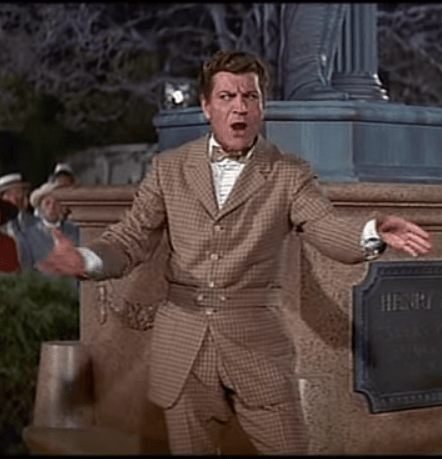
A reference to the 1962 musical film The Music Man, adapted from the hit 1957 Broadway musical of the same name, written by Meredith Willson. Directed by Morton DaCosta, and with Robert Preston in the title role, the film is set in River City, Iowa (based on Mason City) in 1912.

The film is about a conman named Harold Hill who tries to swindle a town by claiming he is raising funds to pay for a marching band. In the song Ya Got Trouble, Harold convinces the townspeople that the pool hall is seducing their boys into sin and vice so that they will sink money into the marching band to save them. The song says repeatedly, “Ya got trouble right here in River City!”.

The Music Man was the #5 film of 1962, and won an Academy Award for its score. Critically acclaimed, it is regarded as one of the best musical films of all time. It was filmed on the same Warner Brothers lot as Gilmore Girls.

Harvey Fierstein

PARIS: My mother is having the entire place redone; she wants all evidence of my father out of there [after their divorce]. So unless you want to sit on no furniture, while watching three Harvey Fierstein impersonators rip up the carpet and paint everything a ridiculous shade of white and call it Angel’s Kiss, then we’re going to have to find somebody else’s house to go to.

Harvey Fierstein is a multi Tony Award-winning actor and playwright, best known for his 1982 Torch Song Trilogy, which he both wrote and originally starred in – it went to Broadway and the West End in London before being made into a film.

Fierstein was openly gay at a time when few celebrities were, and his works often centre on LGBT issues. Paris is simply saying that her mother’s decorators are gay, or appear to be so.

Oscar and Felix

While arguing over whether to eat leftover pizza from the garbage bin – it was only just thrown out and is still in the box – Rory calls Lorelai “Oscar”, and she counters by calling Rory “Felix”.

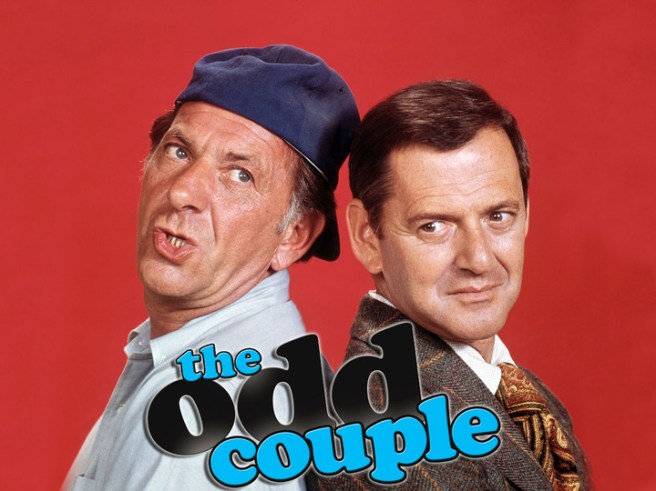
This is in reference to Oscar Madison and Felix Ungar, the main characters from The Odd Couple, originally a 1965 Broadway play written by Neil Simon. In the story, the pair are friends sharing an apartment, with the slovenly Oscar and neat-freak Felix constantly clashing.

The Odd Couple was made into a comedy film in 1968, directed by Gene Saks, and with Walter Matthau and Jack Lemmon starring as Oscar and Felix respectively. Given rave reviews by critics, it was the #4 film of 1968.

It was then made into a television sitcom with Jack Klugman and Tony Randall as Oscar and Felix, originally airing from 1970 to 1975, but still on American television in reruns. This may be the version of The Odd Couple that Lorelai and Rory is most familiar with.

It seems to be an old joke between Lorelai and Rory to see themselves as “the odd couple” – mismatched housemates who nevertheless are very fond of each other.

(Note that Lorelai cleaning out the refrigerator is a call back to the contest she and Rory had at the start of the episode to see who had to clean out the fridge – apparently Lorelai lost).

Someone to Watch Over Me

This is the song which plays while Luke sadly watches Lorelai and Max together on their date in the snow.

Someone to Watch Over Me was written by George and Ira Gershwin, for the 1926 stage musical Oh, Kay!, where it was sung by Gertrude Lawrence. It went on to become a jazz standard, recorded numerous times, and several times used in films – including What’s Up Doc? (1972), referred to earlier.

The version used on the show is sung by Rickie Lee Jones, from her 2000 album It’s Like This.