Anne Heche

SOOKIE: We are crazy for doing this.
LORELAI: We’re beyond crazy. We are ‘Anne Heche speaking her secret language to God and looking for the spaceship in Fresno’ crazy.
SOOKIE: Oh Quiness, Nakka dune notta.

LORELAI: Il el nostra doska don.

Anne Heche (born 1969), actress, director, and screenwriter. First became known as a soap opera actress, before gaining mainstream recognition in the late 1990s in films such as Donnie Brasco (1997) and Six Days, Seven Nights (1998). She was also famous for her high-profile three-year relationship with comedian Ellen De Generes, who came out to the press shortly after she and Anne began dating.

On August 19 2000, the day after her relationship with Ellen ended, Anne drove from Los Angeles to Cantua Creek, near Fresno, parking her vehicle on a roadside. She walked for more than a mile through the desert wearing shorts and a bra before knocking on a stranger’s door and asking for a shower. As she seemed reluctant to leave, the homeowner called the sheriff’s department. When deputies arrived, Heche told them that she was God, and would take everyone up to Heaven in a spaceship (she later said she had taken ecstasy). She was admitted to a psychiatric unit in Fresno, and released after a few hours.

While promoting her 2001 memoir, Call Me Crazy, Anne told interviewers that she had been mentally ill for the first thirty-one years of her life due to horrific sexual abuse by her father (a closeted gay man who died of AIDS when Anne was thirteen), which began when she was only a baby. Her surviving family strongly reject those claims, although even without that, her childhood doesn’t sound like a picnic.

Anne said that she created a fantasy world called The Fourth Dimension and had an alter ego named Celestia who was the daughter and reincarnation of God, spoke her own language, had special powers, and was in contact with extraterrestrials. It seems likely Lorelai read Call Me Crazy, as it is the sort of camp celebrity memoir she could not resist (like Mommie Dearest and Tears and Laughter), although all the information could be gleaned from the press at the time.

Anne Heche stated that she had no further mental health issues after the episode at Cantua Creek, and she has gone on to have a successful career in film and television.

Sookie’s statement means, “Oh God, I cannot do this” in Anne Heche’s invented language. Lorelai replies, “It’s too scary for me now”, in the same language. Anne said this when she believed God wanted her to heal a friend’s injured ankle, however she says she did go on to heal her friend through laying on of hands. Anne shared this information, including the example of her language, with Barbara Walters on 20/20 in early September 2001.

Like Lorelai and Sookie, and many others at the time, Amy Sherman-Palladino mocked Anne Heche mercilessly after going public. Their tone was completely mainstream for the time.

UPDATE: Anne Heche passed away after a car accident on August 12 2022, under the influence of narcotics.

Midori Sour

Libby offers Rory a Midori sour, which she politely refuses. Rory is reading instead of boozing, no surprises there.

Midori is a bright green extremely sweet melon-flavoured liqueur made by the Japanese brewing company, Suntory, but manufactured in several countries. Made since 1964, since 1978 it has borne the name Midori, which is the Japanese word for “green”. A Midori sour is a cocktail which combines Midori, grenadine, and lemon juice.

Kung Pao Chicken and Egg Rolls

Lorelai, Rory, Christopher and Dean have Chinese takeout for dinner on the night before the ball. It includes Kung Pao chicken and egg rolls.

Kung Pao chicken (in Mandarin, Gongbao jiding) is a spicy stir-fried Chinese dish traditionally made from cubed chicken, peanuts, spring onion, and chilli peppers. It is a classic of Szechuan cuisine dating to the 19th century. It’s thought to be named after Qing Dynasty official Ding Baozhen (1820-1886), and his title of Gongbao (“palace guardian”); his surname Ding sounds like jiding (“chicken”), but also can be read “small cube”, like the cubes of chicken in this dish. Westernised versions of Kung Pao chicken can be much sweeter and stickier than the original, with more vegetables, and sprinkled with roasted peanuts; it’s a standard of Westernised Chinese cuisine.

Egg rolls are an appetiser, part of American Chinese cuisine. They are cylindrical rolls filled with shredded cabbage and chopped pork, encased in a thick wheat-flour wrapper, fried in hot oil. Oddly enough, there isn’t any egg in an egg roll. Similar to the Chinese spring roll, they are thought to have arisen in the Chinese-American community of 1930s New York, and are a staple of American Chinese cuisine, often served free by Chinese restaurants.

Du Hast

The song playing in car Christopher’s car when he turns the sound system up. It’s a song by German electro-industrial metal band Rammstein, from their 1997 album Sehnsucht. The song was a #5 hit in Germany, and went to #20 on the Billboard Mainstream Rock Songs chart in the US.

The song’s title translates to “You have” in English, but in German is a play on words with the homophone Du hasst, meaning, “You hate”. Possibly a slightly threatening song to arrive with, although it’s another reminder that Lorelai and Chris are both heavy metal fans.

“Yo prefiero tener los huevos suave”

SOOKIE: Carlito, we’re running out of clarified butter. Ooh, chop that finer. No hard boiling. Yo prefiero tener los huevos suave. Ooh, that looks good. Add a little pinch of oregano, I think we’ve got it.

As Sookie gives instructions to her assistant Carlito, she partly speaks in Spanish. Her one sentence in Spanish can be translated as “I’d prefer the eggs to be soft” – I think she means the eggs to be poached or perhaps soft-boiled, but you can’t actually see what Carlito is doing.

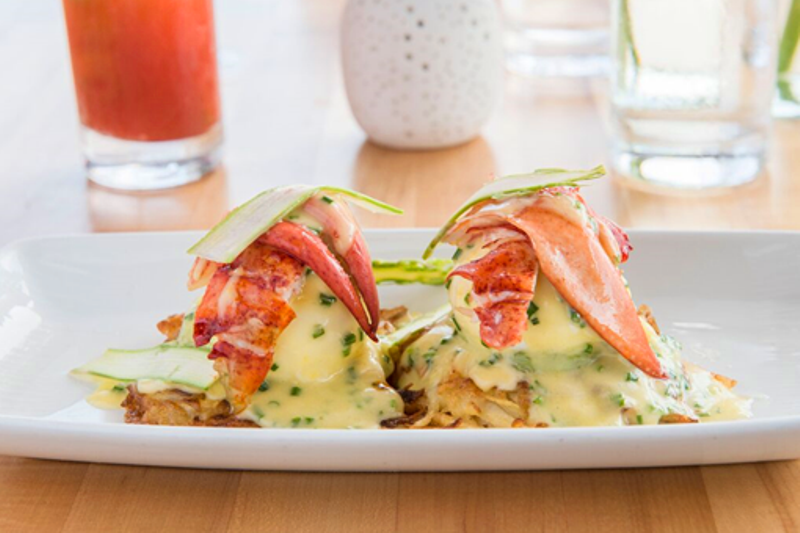
I’m not completely sure, but as Sookie receives her lobster order just after this, it’s possible she is planning to make a variation on Lobster Benedict, where you serve lobster with poached eggs and a hollandaise sauce. Another possibility would be lobster salad with soft boiled eggs – or possibly the eggs and lobsters are for two separate dishes.

Emily and Michel Meet

(They introduce themselves and shake hands)
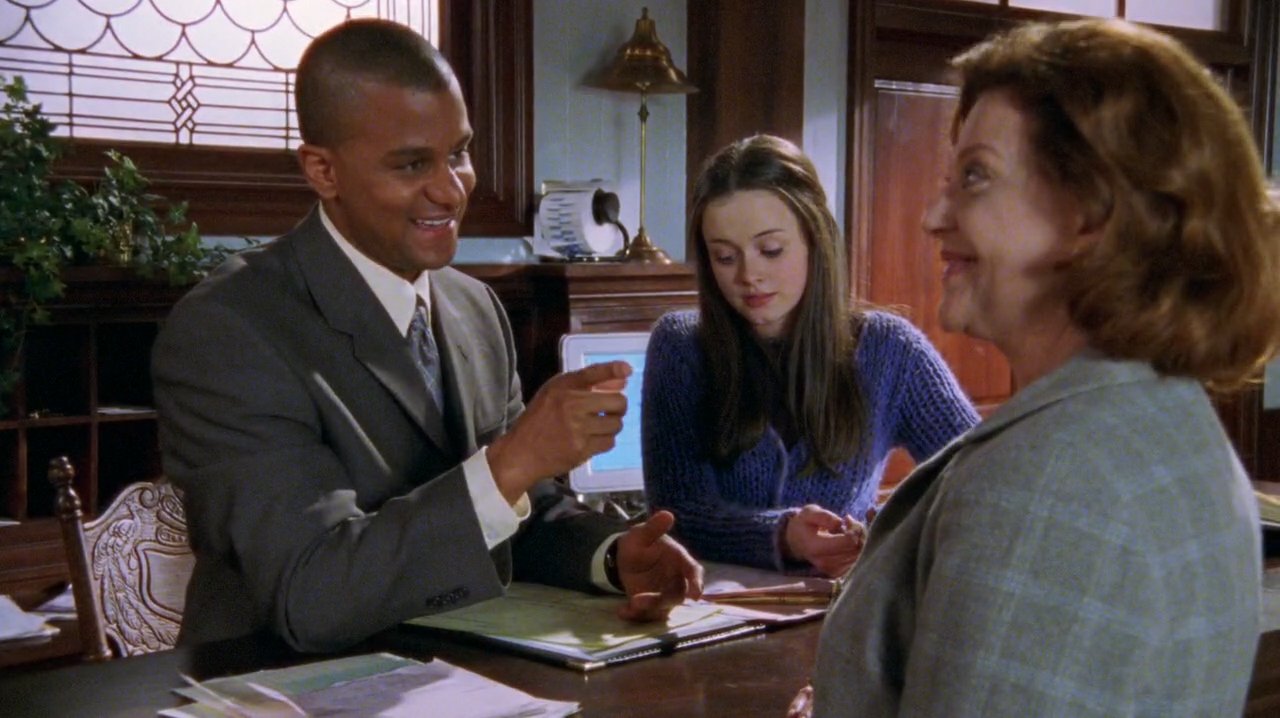
EMILY: Enchantée. D’où venez vous?
MICHEL: Paris.
EMILY: J’adore Paris. Nous y allons chaque printemps.

Emily says, “Pleased to meet you. Where are you from?”, and Michel says he’s from Paris. Emily says, “I love Paris. We go there every spring”.

In fact, Richard and Emily go to Europe every second year in the fall, and specifically refused to go to Paris in the spring, questioning whether there was anything to see at that time of year.

Emily and Michel instantly hit it off, with Emily pronouncing him a “charming man”, and Michel telling Lorelai, “I just love your mother”. It makes sense that the two people who most enjoy  torturing Lorelai would like each other.

Small World Ride

LUKE: Oh God, he’s [Dean’s] got a nerve. I mean, what does he think, he’s gonna do better than Rory? Is he crazy? Jeez. Alright, well forget it, okay. Good riddance, adios, bienvenidos, hasta la vista.
LORELAI: Could we get off the Small World ride and start cooking please?

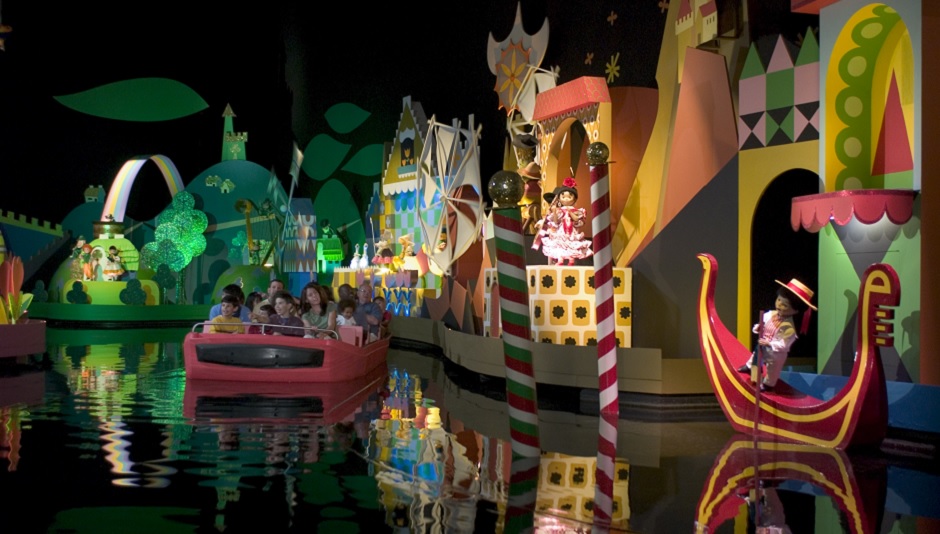
It’s a Small World is a ride at the Fantasyland section of Disneyland, Walt Disney World, and other Walt Disney theme parks and resorts. The ride consists of travelling in small boats through a tunnel, watching animatronic dolls in national costumes of countries around the world, all singing the song, It’s a Small World After All, each in their native languages.

It’s a Small World After All was written by Robert and Richard Sherman, previously mentioned. It is said to be the most-performed and most-translated piece of music in the world, having been played more than 50 million times.

Luke says, “Goodbye, welcome, see you later”, in Spanish, for no very obvious reason. Apparently when he’s upset he babbles in Spanish.

Michel’s Date

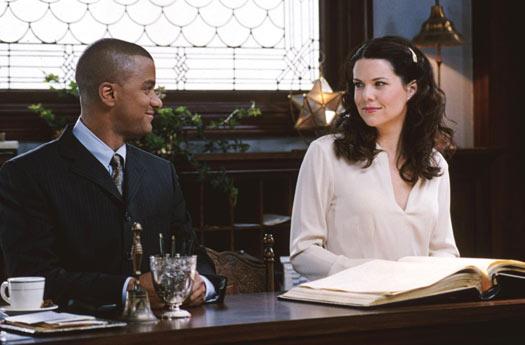
MICHEL [on phone]: No cherie. I can’t wait either. Very soon. You are? Ohhh. Don’t tease me. I promise all this waiting will be worthwhile. I’ll see you then. Goodbye darling.

Michel seems to use the French feminine form of “darling”, cherie, so his date is with a woman. If it was a man it would have been cheri. However, they sound similar enough to leave some gender ambiguity. I think Michel says cherie, but can’t be 100% sure.

Madrid and Cervantes

RICHARD [of his upcoming trip to Madrid]: I think there’s a nice edition of Cervantes in it for you.
RORY: Gracias.

Miguel de Cervantes (1547-1616) was a Spanish writer regarded as the greatest writer in the Spanish language and one of the world’s greatest novelists. His best known work is Don Quixote, earlier discussed – it is sometimes thought of as the first novel, and is a literary classic.

Richard’s comment suggests that whenever he has to travel to a foreign city on business, he tries to buy Rory a book there by an author associated with that city – Cervantes lived and worked in Madrid for most of his life. We know Richard has already bought her something from Prague, quite possibly a book.

Rory simply replies, “Thank you” in Spanish.

(Richard’s trip to Madrid will be on the 12th of March, suggesting it is now Friday 2nd March. It could be Friday the 9th, but in that case it seems more likely that Richard would have simply said he left on Monday).