RICHARD: I’m going to be going back there next week. There’s going to be a little reunion of the Whiffenpoofs … It’s an a cappella singing group I belonged to at Yale.
The Whiffenpoofs are a real a capella singing group at Yale University. Established in 1909, it is the oldest such group in the US. The line-up is completely replaced each year, and is always composed of rising seniors, who may take a year’s absence in order to go on tour nationally and internationally. Cole Porter is their most famous alumnus.
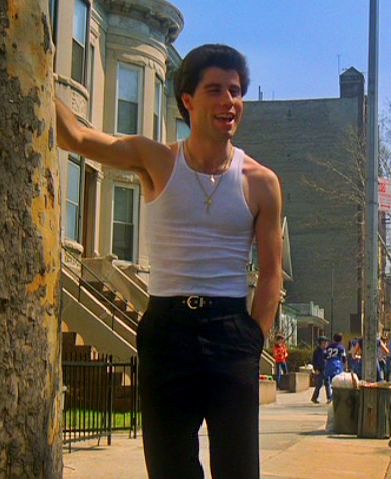
LANE: Go away, Jess. No one asked for a Tony Manero wannabe to drop by.
Tony Manero, the lead character in the film Saturday Night Fever, previously discussed.
Lane really doesn’t like Jess at all, which may be another reason why it’s been hard for Rory to admit her feelings for him. It’s a shame, because Lane and Jess both love music and punk rock in particular, so you’d think they’d have at least one thing in common as a basis for friendship.
Apart from not being impressed by Jess’ behaviour in school, I think Lane has always romanticised Rory’s relationship with Dean, and she can’t imagine Rory with anyone else.
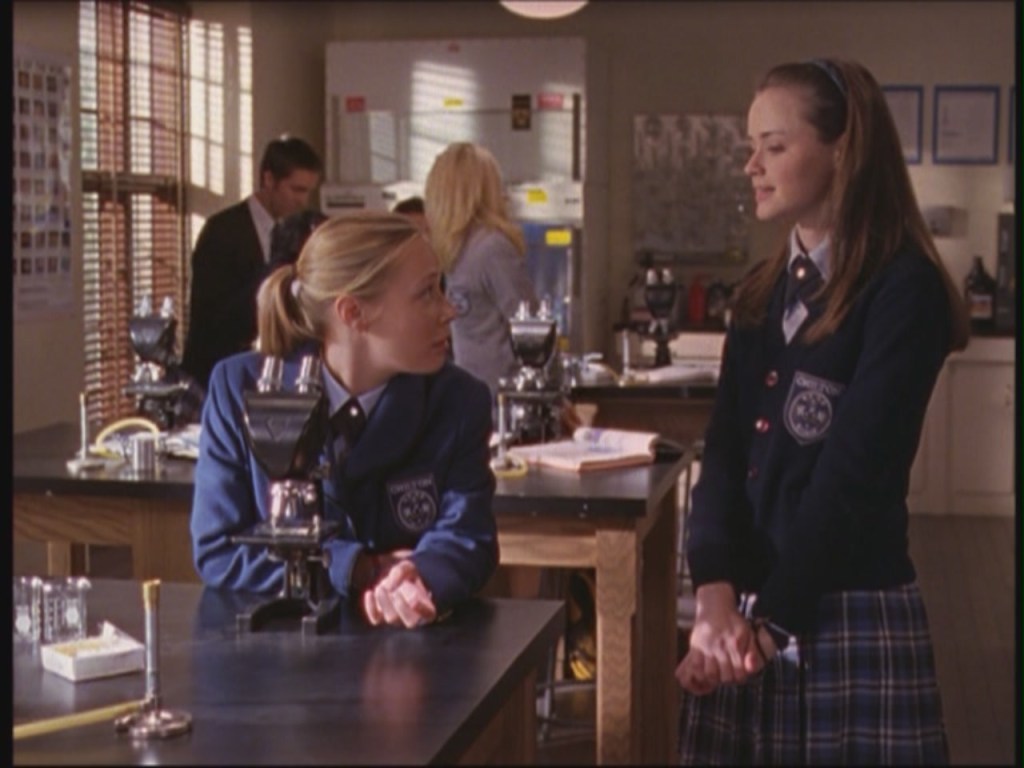
PARIS: Well, we went for coffee, and he talked about how he had a great time on our date, and how he finds me fascinating, and how he thought about me all the time.
In this episode, Paris gets her first boyfriend, Jamie. She is typically in disbelief as to why Jamie would choose her over “idiot” college girls who are prettier and more (sexually) experienced, but Jamie is never shown to be anything other than adoring of Paris.
Having a boyfriend seems to make Paris instantly more relaxed about her academic life. She turns up late to class the next morning after seeing Jamie, even though they supposedly only had coffee after school (must have been some coffee!), and is happy to postpone the work they were supposed to do on the weekend for the school newspaper. Because of this, Rory is able to be her mother’s partner for the dance marathon in this episode.
In “The Deer Hunters”, Rory turned up a few minutes late for class after being hit by a deer, and all hell broke loose. There was a serious suggestion made that Rory might not be suitable for such a strict school as Chilton. Now Paris wanders into class late without any reasonable excuse, and it’s no big deal. The show could never really decide if Chilton was a big, scary, super strict school, or just a normal prep school.
JAMIE: I flunked a pop quiz in poli-sci because I couldn’t stop thinking about you.
Poli-Sci, short for Political Science. A social science discipline dealing with governance and power, constitution and law, and the analysis of political thought, power, and behaviour.
It’s possible that Jamie is doing a Political Science major at Princeton, with plans to work in government and politics when he graduates.
MADELINE: But you guys already have some decent stuff planned out, right?
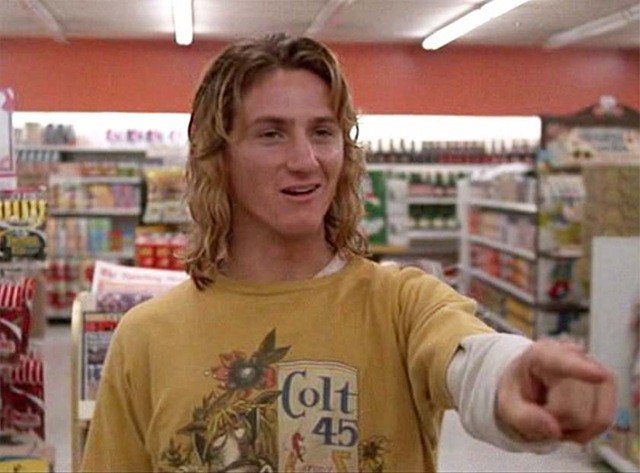
PARIS: Madeline – or may I call you Spicoli?
Paris references the 1982 coming-of-age comedy-drama Fast Times at Ridgemont High, directed by Amy Heckerling (in her directorial debut). The screenplay is by Cameron Crowe, based on his 1981 book Fast Times at Ridgemont High: A True Story – Crowe went undercover at a high school in San Diego and wrote abut his experiences.
The ensemble cast includes Jennifer Jason Leigh, Brian Backer, Robert Romanus, Phoebe Cates, and Sean Penn as Jeff Spicoli [pictured], a permanently stoned surfer – Paris is suggesting Madeline is out of touch with reality as if she is on drugs. The film also marks early appearances by several actors who later became stars, including Nicolas Cage, Eric Stoltz, and Forest Whitaker (the first two in their feature film debuts).
The film initially had modest commercial and critical success, but was a sleeper hit due to word of mouth, and over time became more popular through television broadcasts and home video releases. It is now regarded as a classic and iconic film, and one of the best comedies, as well as one of the greatest high school movies.
The soundtrack to the film peaked at #54 on the album charts and features the work of many quintessential 1980s rock artists, including Jackson Browne, The Go-Go’s, and Jimmy Buffett.
PARIS: I think we need to work. The seventy-fifth anniversary issue of the Franklin comes out next month and I want it to be amazing.
In an earlier episode, Paris said the Franklin was almost a hundred years old. In this episode, we discover it is seventy-five years old, and was therefore founded in December 1927.
LORELAI: It’s gonna be Harvard [that Rory’s going to].
SHERRY: Well, I certainly hope so. It’s just minutes from here. Did you know that? …I’ve already clocked it – two point seven miles, which is nothing. I’ve already checked out the best late afternoon route for her to take to come over after classes.
Lorelai has already driven to Harvard University – how can she not be aware how close it is to Sherry and Christopher, that she also just drove to? The fact that Cambridge is right next to Boston must surely be a bit of a giveaway.
I’m not sure exactly where Sherry and Christopher live, but the Bunker Hill area in Charlestown is 2.7 miles from Harvard, which is a nine minute drive [pictured]. This is the oldest part of Boston, and Christopher did say he’d like to live somewhere historical. Any further west, north or south, and they wouldn’t be living in Boston, and any further east, they would be too far away.
If so, for Rory to visit them, she would need to take a bus, and would still have a walk of at least twenty minutes. The other way would be to take the subway, which would require a change in the middle, and there would then be a ten minute walk. A fifteen minute bike ride might be easier.
The knowledge that Rory going to Harvard means her spending a lot more time with Christopher and Sherry must surely be making it seem less attractive to Lorelai.
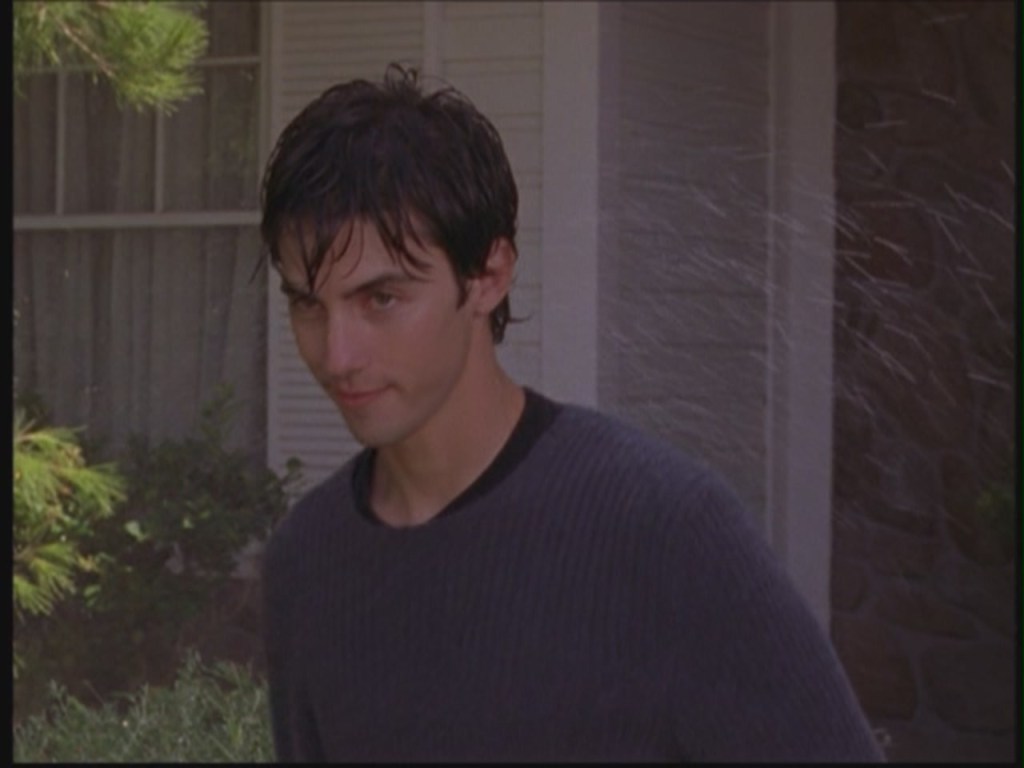
Jess slots into the role of white knight, and comes to Rory’s rescue by switching off the sprinklers for her, getting soaked himself in the process. Again, how fortunate Stars Hollow is having this mini-summer in late October!
This gives Jess and Rory a chance to talk for a minute, and Jess asks her about school and her plans for Harvard – unlike Dean, Jess seems genuinely interested in Rory’s education. However, Rory’s pager goes off, and it’s Dean on his way to help, having just received Rory’s pager message.
Without hesitation, Jess turns the sprinklers back on for Rory, and they share a romantic “moment” together in the water spray before he walks away, Rory gazing after him. Jess knows that Rory is afraid of upsetting Dean, and that Dean will react very badly to Jess having “just happened” to be on her street, and available to help. Rather than cause trouble between them or make things harder for Rory, he chooses to take himself out of the picture – a sign of his growing maturity, and that he cares for Rory.
It is the best moment of a fairly lacklustre episode, although it doesn’t make that much sense that the sprinklers had to be turned back on again. Couldn’t Rory have just told Dean she managed to get the sprinklers off herself? Also, Jess said the spigot had become loose, and needed a harder turn to switch the water off. Now that Jess has tightened the spigot, won’t Dean switch the water off easily, and wonder how on earth Rory had any trouble with it? Or will he just put it down to “girl’s can’t turn off sprinklers, that’s a man’s job?”?
LORELAI: No one asked for the Norton Critical Edition.
W.W. Norton & Company is a publishing company based in New York City. Established in 1923, it has been owned wholly by its employees since the early 1960s. The company is known for its Norton Anthologies (particularly The Norton Anthology of English Literature) and its texts in the Norton Critical Editions series, both of which are frequently assigned in university literature courses.
Norton Critical Editions provide reprints of classic literature and in some cases, classic non-fiction works. However, unlike most critical editions, all Norton Critical Editions are source books that provide a selection of contextual documents and critical essays along with an edited text. Annotations to the text are provided as footnotes, rather than as end notes.






 The Annotated Gilmore Girls