“You’ll get used to it”

RORY: Aren’t you happy?
LORELAI: Yes. I’m happy.
RORY: Well, then it’ll be fine. You’ll get used to it, having Max there.
LORELAI: I know. You’re right. I will. I will get used to it.

Lorelai has a freak out once Max is actually in her bed, in her house, and fears that she will completely lose the life she currently has. More importantly, she fears losing the “me and you secret special clubhouse no boys allowed” relationship she has with Rory.

Rory refuses to participate in Lorelai’s worries about how their life might change, and insists that she likes Max, and Lorelai will be fine about it too once she calms down. It is not clear whether she really has no concerns about adding Max to their household, or she refuses to be used as an excuse by Lorelai to end her relationship with Max.

Lorelai cannot return to bed with Max, and ends up sleeping in Rory’s bed for at least part of the night. This is a callback to how Lorelai and Rory shared a bed for a year or two when Rory was a baby/toddler, showing Lorelai’s need for bodily comfort from Rory, and a return to the complete physical closeness they had at the beginning of their relationship in Stars Hollow.

The Gilmore Girls and Max

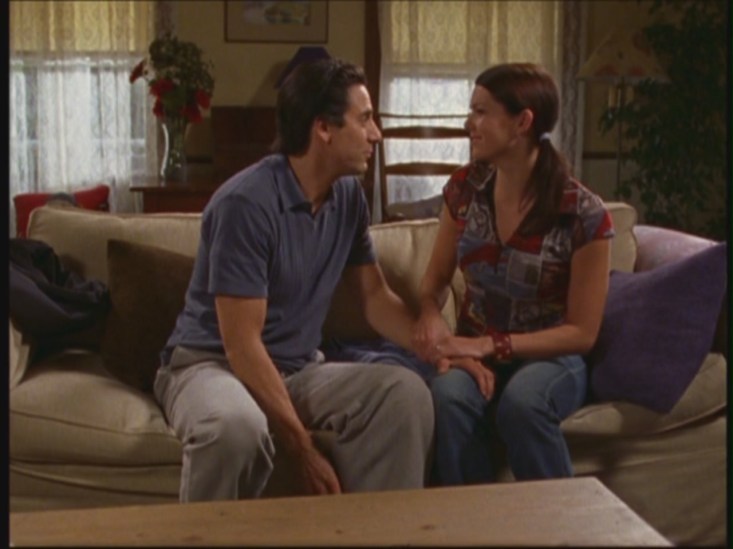
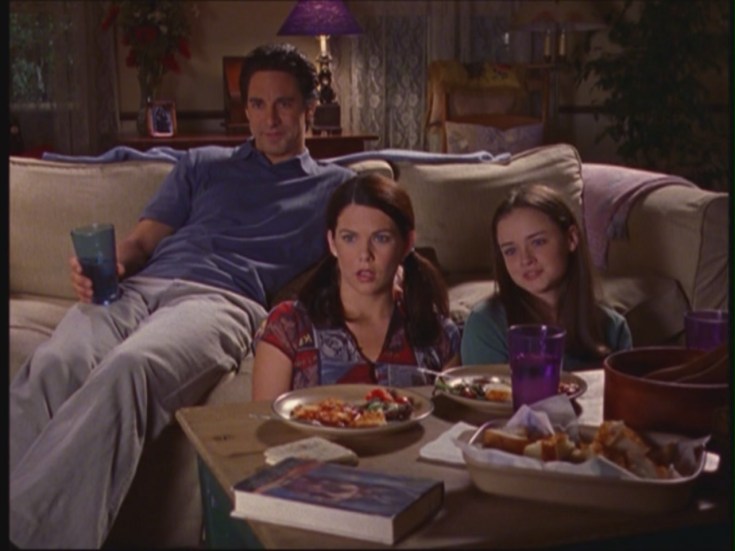
Lorelai and Rory treat Max abominably while he is a guest in their house. He cooks dinner for them, they force him to watch a movie of their choice, talk all the way through it, and don’t allow him to participate, and he has to answer the phone, even though it’s their home, and they are sitting closer to it (Lorelai explains the coffee table is blocking her path, and Rory that her foot has gone to sleep).

You can see that Lorelai and Rory sit next to each other on the floor, leaving Max alone on the sofa – not exactly a great omen for their future marriage. Also note that they have once again left most of a meal uneaten on their plates, even though they are supposed to be big eaters. Maybe it’s all the vegetables Max put in the dish?

If this weekend is a trial run for their future lives together, Max must surely be having some misgivings about that. It does show that Rory has learned how to treat her boyfriend (horribly) by her mother’s (terrible) example.

“Billy Jack” Movie

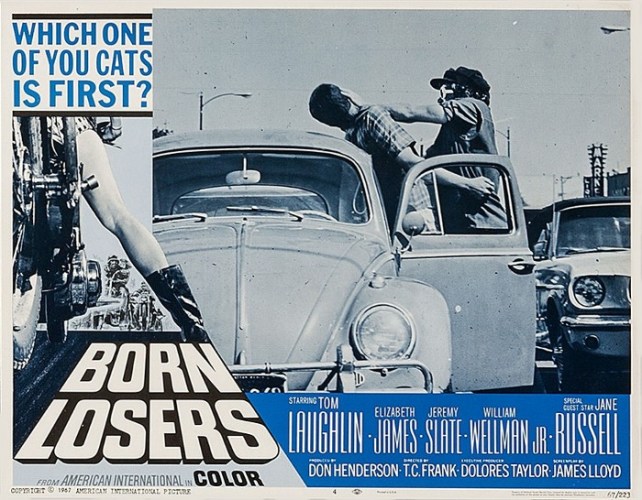
This is the movie that Lorelai and Rory watch with Max. It is one of their favourites: they have it on home video, and have watched it more than ten times; Rory says you cannot watch a Billy Jack movie too many times.

The movie they are watching is The Born Losers, the first of the “Billy Jack” films. It is a 1967 action film which was directed and produced by Tom Laughlin, who also stars in the title role. The film introduces the character of Billy Jack, a mysterious Green Beret Vietnam veteran who is of partial Navajo Indian descent.

The plot involves Billy Jack coming down from his peaceful abode in the Californian mountains to a small town, where he gets into several violent confrontations with the Born Losers motorcycle gang, and must protect others. It is loosely based on a real incident in 1964, when members of the Hells Angels were arrested for raping five teenage girls in Monterey, California.

(Incidentally, this was also the impetus for Hell’s Angels: The Strange and Terrible Saga of the Outlaw Motorcycle Gangs by Hunter S. Thomson, his first book, published in 1966. Could this have been the book that the motorcycle-loving Dean lent to Rory?)

Made on a shoestring budget, the film was a commercial success, and led to several Billy Jack sequels being made. It received generally negative reviews, mostly because of the violence, of which the show gives us a little taste.

The way that Lorelai and Rory watch The Born Losers with Max is a callback to them watching The Donna Reed Show with Dean.

In both cases, the male guest had to provide the food (Max cooked, Dean brought pizza), doesn’t get any choice in what show or movie is watched, and isn’t allowed to comment or voice an opinion on it. He can’t even hear it properly because the Gilmore girls talk all the way through it, which drowns out what they are watching. Any attempt by the male guest to assert his opinions, or even ask what is happening onscreen, is roundly attacked by Lorelai and Rory.

Just as watching The Donna Reed Show led to Rory and Dean having a major argument, watching The Born Losers prefaces a fight between Lorelai and Max.

It demonstrates to us how Lorelai and Rory watch their favourite movies and TV shows – they have a love-hate relationship with the medium, are celebratory and critical at the same time, and both focused on what they are watching, and easily distracted from it. Their viewing style is deeply ironic, taking a pleasure in bad taste which is considered “camp”. They are also highly participatory, giving a running commentatory on the show while adding their own dialogue to it.

You can tell that Lorelai and Rory are used to watching things together, and their viewing habits seem to have been formed as a way to exclude others. They both seem to take a malicious pleasure in forcing Dean and Max into the role of clueless outsider.

“A double date, with adults?”

DEAN: So a double date, with adults?
RORY: No, just with Mom and Max.
DEAN: What’ll it be, like dinner and dancing?
RORY: Yes, and then we’ll enjoy brandy and cigars. No, we’ll probably just grab a bite.

We can see from their exchange that Rory and Dean see adults differently. For Dean, the idea of going on a double date with two adults is strange, and not particularly appealing. For Rory, a double date with her mother and her teacher is normal and potentially enjoyable – she doesn’t see them as “adults”, but as friends, with similar tastes and interests to herself.

Rory often socialises with her mother and other adult friends, so this is what she is used to. It helps to explain why adults seem to adore Rory, and why Rory often behaves more like an adult than a teenager.

“Maybe you should stay here”

LORELAI: So, maybe you should stay here.
MAX: Here?
LORELAI: Yeah. Instead of driving back and forth all weekend, sleep over. I mean, it’s gonna be your place too, soon enough. Look at it like a trial run.

From this we learn that it has been decided that Max will live with Lorelai and Rory in their house in Stars Hollow after he gets married. This decision seems to have primarily been made because it suits Lorelai – there is no way she is leaving Stars Hollow for a man. (Even though she apparently refused to date men from Stars Hollow so they wouldn’t upset Rory: quite a catch-22).

We also learn that in all the time since they first began dating nine months ago, Max has never spent the night with Lorelai in her house – apart from the night he slept on the sofa while Rory was in Hartford with Richard and Emily, and Lane was sleeping in Rory’s room.

On the night Max gave Lorelai her diamond engagement ring, he came over fairly late to give it to her, as she had already been to dinner at her parents’ place, and had to counsel an upset Rory. Even coming over late to see her, Max was not able to stay the night, but had to drive home to Hartford alone.

Some people might think that Lorelai and Max should have had a “trial run” of their living arrangements much sooner than this once they became engaged, and for longer than a single weekend while Max and Rory are on vacation. Even if things went well, it would hardly be a realistic test of how their lives might work afterwards.

Quotes for the Wedding Invitations

Rory selects three quotes for Lorelai to choose from, one of which will be printed on the wedding invitations.

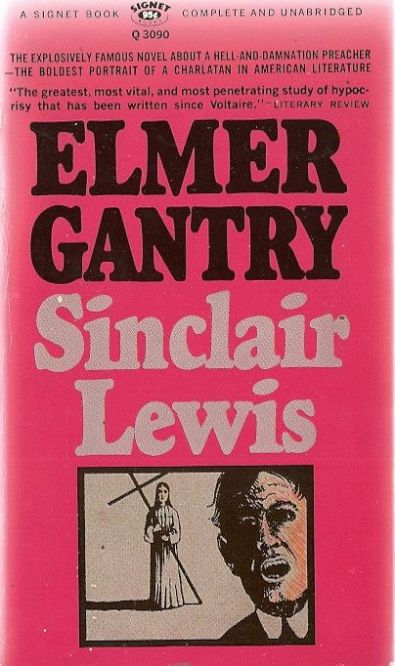
The first one is: “What is love? It is the morning and the evening star.” – Sinclair Lewis

This is a quote from Sinclair Lewis’ 1927 novel Elmer Gantry, a scathing satire on fundamentalist religion. The title character is a religious hypocrite and a fraud. Lorelai obviously knows very little about Sinclair Lewis, who she describes as “sappy”. In fact the Nobel Prize Winner was known for his biting wit and critical eye on American culture and materialism. The quote itself is from the title character, who is being entirely insincere. Rory may have read Elmer Gantry partly on Richard’s recommendation – Sinclair Lewis was a favourite author of H.L. Mencken, and he attended Yale, Richard’s own alma mater.

The second one is: And all went merry as a marriage bell. But hush! Hark! A deep sound strikes like a rising knell!” – Lord Byron

This is from Lord Byron’s 1818 long narrative poem Childe Harold’s Pilgrimage. Semi-autobiographical, it describes a world-weary young man, looking for distraction by travelling through foreign lands. It made its author immediately famous. This section of the poem is about a grand party in Brussels, which is brought to a disastrous and sinister end by the Battle of Waterloo.

Lorelai’s comment is, “Byron and Lewis, together again”. She may be referring to Matthew Gregory (“M.G.”) Lewis, the author of the 1796 Gothic romance The Monk. He and Lord Byron were friends, and travelled together. Rory may have read Byron’s poem because it is mentioned in Herman Melville’s Moby Dick. It seems like Rory to want to follow up on a literary work that is referenced in another.

The last quote is: “We have buried the putrid corpse of liberty.” – Benito Mussolini

The whole quote is, “The Truth Apparent, apparent to everyone’s eyes who are not blinded by dogmatism, is that men are perhaps weary of liberty. They have a surfeit of it. Liberty is no longer the virgin, chaste and severe, to be fought for … we have buried the putrid corpse of liberty … the Italian people are a race of sheep.” It comes from Writings and Discourses of Mussolini, a twelve-volume work published between 1934 and 1940.

The choice of Mussolini seems to be a callback to Lorelai calling Headmaster Charleston “Il Duce“, the title of Fascist dictator Mussolini. She said this to Max during an argument they were having about Rory’s education in The Deer Hunters. Amazingly, this is the quote which Lorelai chooses, an apparent acknowledgement that her freedom is now at an end.

As you can see, all the quotes are completely inappropriate for wedding invitations. The first one is an insincere summing-up of love by a hypocrite and fraud, the second one is about a celebration which ends in disaster, and the third one equates marriage with the death of Lorelai’s liberty, said by a fascist dictator, and referencing a fight between Lorelai and Max.

What message is Rory trying to send with her choice of these quotes? They suggest a deep cynicism in her about marriage in general, and Lorelai and Max’s wedding in particular.

“Your head is much too big for a veil”

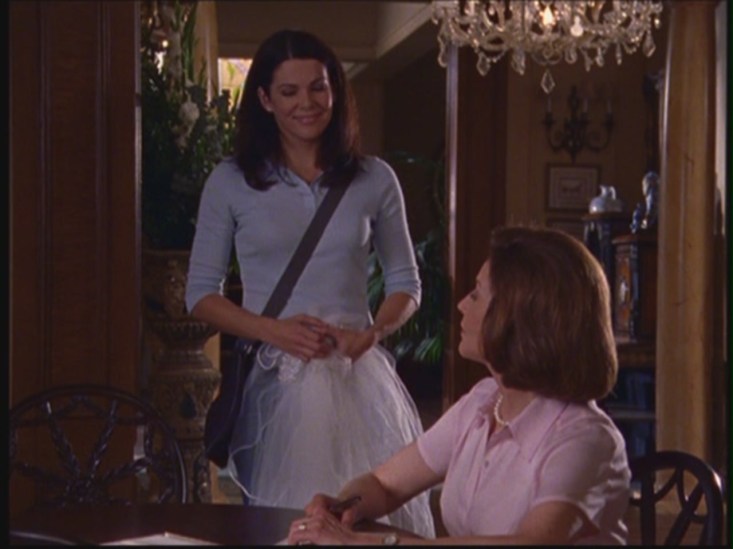
EMILY: Your head is much too big for a veil. You might consider a tiara.
LORELAI: Um, a tiara?
EMILY: That’s what I wore.

A callback to Emily believing that Lorelai had a head that was too big for her body when she was a child, with Lorelai’s first sentence supposedly being, “Big head want dolly”. Apparently Lorelai’s head is still “much too big” to wear a wedding veil.

Emily suggests a tiara instead, and says that’s what she wore as a bride, perhaps indicating that she also thinks of her own head as “too big”, and may be projecting that onto Lorelai. While neither Emily nor Lorelai have enormous heads, they both would look good in a tiara, so Emily’s taste may simply be correct.

Emily does not overtly indicate that she understood or forgave Lorelai after her apology, but answering her original question is a tacit admission that their fight is over. Emily is even worse at talking about her emotions than Lorelai is, but both women are trying to connect in their own ways. Lorelai smiles at her mother’s response, as if this tiny effort was the best she was hoping for.

“I don’t know how to tell you things”

LORELAI: I’m sorry.
EMILY: All right, you’re sorry.
LORELAI: I don’t know how to tell you things Mom. Um, I don’t know if you’ve noticed this or not, but we don’t communicate very well. When something good happens to me, I’m just afraid you’re gonna make me feel bad about it. And when something bad happens to me, I’m always afraid you’ll say “I told you so.” I’m not sure if that’s always fair, and I’m sure I share part of the blame for this circle we get into, but you think your words don’t have any effect on me, but they do. And, I just didn’t want to feel bad about this, so I waited. And I really didn’t mean to hurt you.

Lorelai apologises to Emily for her part in their fight, explaining that she’s scared to tell Emily anything, good or bad, for fear of how she will react. She makes it clear it wasn’t done as a deliberate act to hurt Emily.

Emily makes no sign that she is even listening to Lorelai, and continues writing the letter she was working on when Lorelai interrupted her. As Lorelai pours out her heart to her, the most Emily does is turn her head away: is she ignoring Lorelai, gathering her thoughts, or does she look away for fear that the sight of Lorelai’s face will cause her own tightly controlled feelings to pour out?

Elizabeth Taylor

LORELAI: Hey Mom. I was in the neighborhood, ’cause there’s that wedding dress place on Willow. Elizabeth Taylor bought one of her dresses there.

Dame Elizabeth Taylor (1932-2011) was a British-American actress, businesswoman, and humanitarian. Beginning her career as a child actress in the 1940s, including a part in Lassie Come Home, previously mentioned, she became one of the most popular movie stars of the 1950s. She successfully continued her career in the 1960s, including as the female lead in Who’s Afraid of Virginia Woolf?, previously discussed, for which she won the Best Actress Academy Award. She remained a well-known public figure for the rest of her life, and is regarded as one of the great screen legends.

Elizabeth Taylor was famous for her many marriages, marrying eight times to seven men. Her marriages were to hotel heir Conrad “Nicky” Hilton in 1950, British actor Michael Wilding in 1952, producer Mike Todd in 1957, singer Eddie Fisher in 1959, Welsh actor Richard Burton in 1964, and then again in 1975, Republican politician John Warner in 1976, and construction worker Larry Fortensky in 1991 (ending in 1996). None of her marriages lasted a long time (she was widowed about a year after marrying Mike Todd), and this is another hint to us of the probable fate of any marriage between Lorelai and Max.

Elizabeth Taylor did not buy any of her wedding dresses in Hartford, and only had a traditional white wedding dress for her first wedding to Nicky Hilton [pictured]. It was made by MGM costume designer Helen Rose (who also made Grace Kelly’s wedding dress), and was a gift to Taylor by the studio. Her other wedding dresses were stylish gowns, with the most “wedding like” of them being for her last wedding, to Larry Fortensky. It was a pale yellow floor-length lace gown by the designer Valentino, and given to her by him as a gift.

Final Party Scene

As we leave Lorelai and Max’s engagement party, the camera pans around so we can see what everyone is doing.

Miss Patty is dancing with Kirk; it is unclear at this point if they have only known each other for a few months, or if the show has already retconned Kirk as Miss Patty’s former student. A strange little moment takes place when Miss Patty looks up at Kirk as if she is going to say something, then seemingly thinks better of it and looks away again with a mysterious expression. You would almost think that she was about to suggest that the two of them become closer – you might remember that when Miss Patty met Kirk in Cinnamon’s Wake, she said she would date him if he had a better haircut. (And in The Break Up Part 2, Kirk had apparently been told gossip by Miss Patty between 10 pm and 6 am, which is interesting).

Rory and Dean, sitting on a bench together having resolved their argument. Rory has her head sleepily on Dean’s shoulder, and Dean kisses the top of her head.

Lane leaving for the airport with her parents, and surely extremely late by now, with a comically huge suitcase she wouldn’t actually be allowed to take on the plane in real life.

Lorelai and Max dancing together. Max smiles lovingly down at his prospective bride, but Lorelai is looking over his shoulder at Luke, who is walking towards the party.

Luke and Lorelai wave and smile at each other; Max doesn’t see this as they are doing it behind his back. Luke sits down on a bench, next to three of the little girls dressed as brides who did the tap dance in the gazebo. Coincidentally or not, Luke will have important relationships with three women in the show before Lorelai (Anna, Rachel, and Nicole).