MRS. KIM: This is Young Chui … He will take you to the prom.
Mrs Kim agreed that Lane could go to prom if she could approve the date. Lane thought that meant she had plenty of time to convince her mother that Dave would make a suitable escort for the prom. Instead, Mrs Kim blindsides her by suddenly producing a nice suitable Korean Seventh Day Adventist boy to take her.
Young Chui is a Korean boy’s name meaning “eternally firm”. The role of Young Chui is played by Samson Yi, who has had a few TV roles, and made his own comedy film.
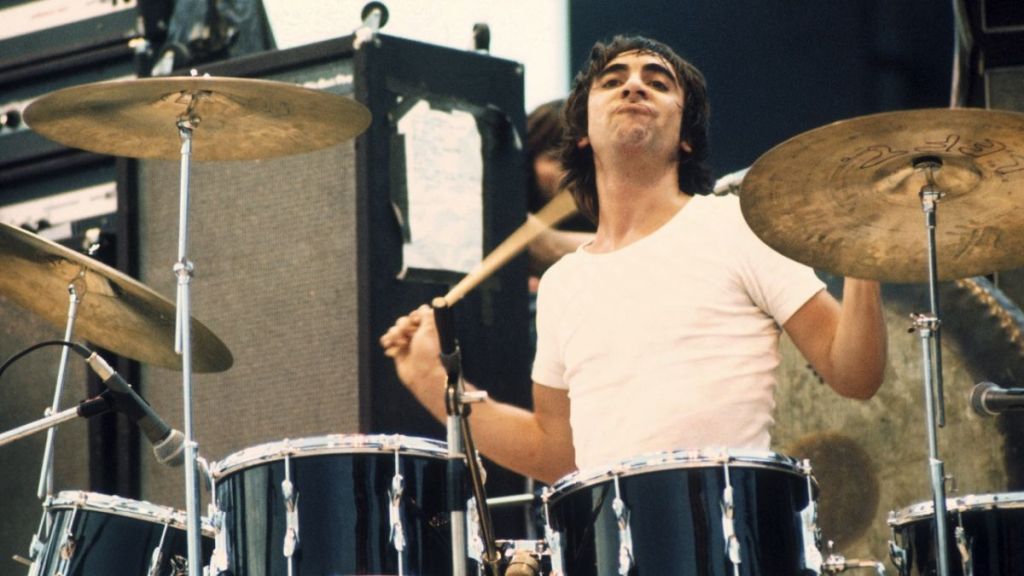
DAVE: I mean, you’ve got the potential, but you’re sloppy. I need a clean roll on the toms but powerful, like Moon.
The toms refer to tom drums a cylindrical drum with no snares, named from the Anglo-Indian and Sinhala language of Sri Lanka, derived from thammattama, from the Tamil word thappu, a type of drum.
Referring to Keith Moon, previously discussed, drummer for The Who, and one of Lane’s drum heroes.
Dave and Lane have come up with a plan to keep their relationship a secret from their bandmates – Dave will put Lane down in public, patronise her, and insult her. Lane is totally into it, as she loves zany schemes and keeping secrets.
LORELAI: [on phone] Oh, no, sir, I’m afraid we don’t offer a complimentary breakfast … Uh, yes, sir, I realize the Ramada does.
Ramada is a large multinational hotel chain, and the first Ramada hotel was opened in Flagstaff, Arizona in 1954. The name is literally Spanish for “branch”, but ramadas (“porches, arbors”) were temporary open-air structures, popular in Arizona at harvest time. The company translates their name as “shady resting place”. It is now owned by Wyndham Hotels and Resorts.
There are two Ramada hotels in Connecticut – one in Windsor Locks, just north of Hartford, and the other in Groton, where Lorelai’s relative once lived. Presumably the customer is considering remaining in Windsor Locks [pictured], which is at the airport. It’s a modest budget-priced two and half star hotel, and in reality they don’t offer a complimentary breakfast – they don’t serve breakfast at all, some days. It’s obviously nowhere near the luxury and charm of the Independence Inn.
[Lorelai walks up to Michel at the front desk] LORELAI: Okay, so you’ll come in early and set up the conference room for the group from Michigan.
Michigan, a state in the Great Lakes region of the upper Midwest in the US. It has a population of over 10 million, and is the largest by area east of the Mississippi River at 97 000 square miles (250 000 square km). Its capital is Lansing, and its largest city is Detroit, among the nation’s most populous and largest metropolitan economies. The name Michigan derives from a Gallicised variant of the Ojibwe word mishigami, meaning “large water” or “large lake”.
EMILY: She was the clomper … She’d be upstairs making the beds and it’d sound like a Munich beer hall rally.
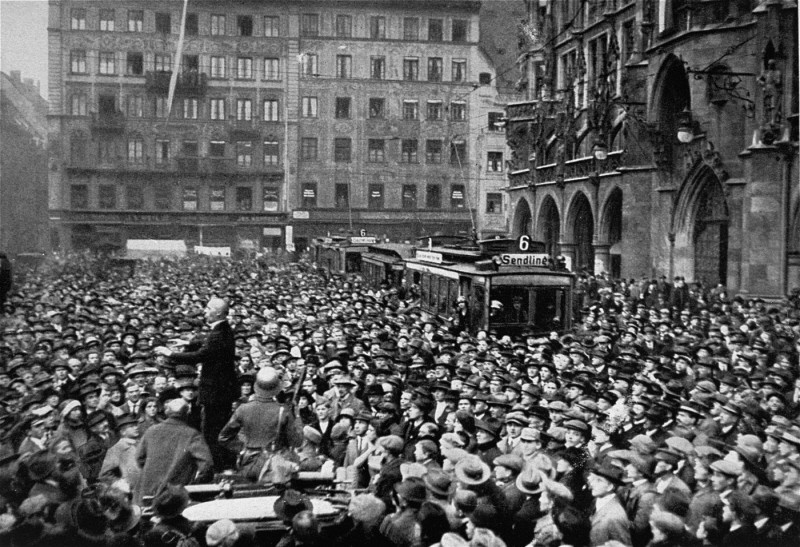
Emily refers to the Beer Hall Putsch, or Munich Putsch, a failed coup d’état by Nazi Party leader Adolf Hitler, and other leaders in the city of Munich in 1923, during the Weimar Republic. Approximately two thousand Nazis marched on the Feldherrnhalle (a monument to honour the Bavarian army), but were confronted by police which resulted in the deaths of 16 Nazi Party members and four police officers.
Hitler was eventually arrested and charged with treason. The putsch (coup) brought Hitler to the attention of the German nation for the first time and generated international headlines. His arrest was followed by a widely publicised trial, which gave him a platform to express his nationalist sentiments to the nation.
Hitler was found guilty of treason and served 9 months in prison, where he wrote Mein Kampf. Once released, Hitler redirected his focus towards obtaining power through legal means rather than by revolution or force, and accordingly changed his tactics, further developing Nazi propaganda.
Emily has combined or conflated this with the Nuremburg rallies, celebratory events coordinated by the Nazi Party. They played a seminal role in propaganda events, conveying a unified Germany under Nazi control.
SOOKIE: Twelve courses, each paired with a specific wine, and for dessert, individual chocolate amaretto mousse cakes in the shape of a G.
Amaretto, sweet Italian liqueur that can be made from almonds, bitter almonds, apricot kernels, or peach stones. It can be drunk neat, added to cocktails or coffee, and is commonly used in cooking, especially desserts. Its name means “a little bitter” in Italian.
LORELAI: What do you mean you don’t know? All you had to say was ‘Welcome to Stars Hollow,’ that’s it.
MICHEL: I know, I thought I did, and then they got angry and threw bread sticks and butter pats.
In the inn, when greeting the Hungarians, Michel says in Hungarian, A te országod tele van csúnya emberekkel. The translation in English is, “Your country is full of ugly people.”
Somehow he confused this with udvözöljük, meaning “welcome”. This doesn’t seem like a simple error or misunderstanding. He must have at least known how to say Stars Hollow!
LORELAI: Is there anything ceremonial about the salads? Do we carve a crouton, then have them taken away?
A crouton is a piece of rebaked bread, often cubed and seasoned. They are often used to add texture and flavor to salads. The word crouton is derived from the French croûton, meaning “little crust”. Croutons are often seen in the shape of small cubes, but they can be of any size and shape, up to a very large slice.
CLAUDE: And you, my dear? [how much French do you speak?]
LORELAI: Even less. Uh, voulez vous couchez avec moi ce soir? That’s about it …
CLAUDE: It’s a pop song, ah, Monique . . . I did not know that.
MONIQUE: “Lady Marmalade”.
“Lady Marmalade”, a 1974 pop song written by Bob Crewe and Kenny Nolan, performed by R&B group Labelle, it went to #1 in the US and Canada. The song has been covered several times, including the 2001 version from the Moulin Rouge! soundtrack by Christina Aguilera, Mya, Pink, and Li’l Kim, which also went to #1.
The song is famous for the repeated refrain of Voulez-vous coucher avec moi?, which translates to: “Do you want to sleep with me?”.
Monique gets Lorelai’s joke and is familiar with the song – the 2001 version went to #12 in France, although earlier cover versions had charted there as well, if not so high.





 The Annotated Gilmore Girls